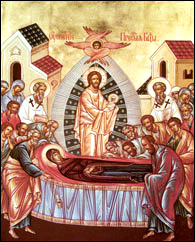
I agree. There is no official teaching of the Catholic Church that said that she had suffer birth pains. I firmly believe she did. Jesus suffer the pains of the cross. He was sinless, both True God and True Man.
To say that Mary didn’t have any pain during child birth would implied that she was greater than Jesus since he suffered pains and Mary didn’t.
Wait a minute? Kinda odd right?


I firmly believe she did suffer birth pains when she delivered Jesus, and when she died also. Pain isn’t a bad thing. Those souls in purgatory surely suffer many pains but in the end, they will be filled with joy because they will be in heaven.
As a human being, Mary must have experienced pain and suffering in some form
or other. But she could not have experienced pain when giving birth to Jesus. This
particular form of physical suffering was a “curse” brought about by Eve’s disobedience
to the will of God. The pain of childbearing was exacted as a penalty of original sin.
(Cf. Gen:3-16) We must not generalise this particular painful experience. The dogma
of the Immaculate Conception of Mary presupposes that Mary felt no pain when giving birth
to Jesus, for by God’s grace she was conceived without original sin and so could not have
inherited this curse of Eve. By the time Jesus was born, our Lord’s mother had already
accepted the will of God, unlike Eve, by pronouncing her humble and pure “Fiat” thereby
undoing Eve’s disobedience. Mary is opposed to Eve and so she cannot share her cursed
fate. The dogma of the Immaculate Conception is an infallible teaching to which we must
give our “sacred assent” or cease being truly Catholic. This dogma presents Mary as
the New Eve, free from original sin. Catholics cannot truly and fully accept this dogma as
true while maintaining the “pious” belief that she felt pain when bearing Jesus.
The authors of the Gospels recognized the suffering Mary did experience on earth. But the
suffering that concerned them was her spiritual or moral suffering. Likewise, the Gospel writers
were concerned with the spiritual or moral suffering of our Lord. The physical form of suffering
that lay on the surface and effected the higher form was of no spiritual significance to them.
There is no need for us to speculate on the physical nature of the pain and suffering our Lord
and Blessed mother may have experienced. The Scriptures direct our attention to the spiritual
quality of their painful experiences and suffering. On the spiritual plane, Mary could not have
suffered the pain of childbearing. The suffering she actually did experience as a human being
was the moral suffering of a mother who loves her son. Our Blessed Mother’s suffering
constitutes her Seven Sorrows.
Mary’s first sorrowful experience occurred when she presented the infant Jesus in the Temple.
Simeon announced to her that her Son would become a symbol of opposition and that her soul
would be pierced on account of him; second, we can imagine the suffering she went through when she had to get up in the middle of the night to flee with her child to a foreign land because his life was in danger; third, for three days she looked for her son in anxiety and sadness before she found him preaching in the Temple; fourth, we cannot even begin to describe the emotional pain she felt when she met her Son carrying his cross; fifth, one could not possibly have hoped to console her as she stood beneath the cross of her Son in anguish; sixth, with a grief-stricken soul she took hold of the lifeless body of her Son after he was taken down from the cross; seventh, she must have cried and sobbed like any mother at the burial of her son.
Although she was conceived free from original sin and remained sinless throughout her life,
Mary suffered like any other mother would out of love and concern for her son. The brief moment
of physical pain during childbearing cannot compare with the spiritual and moral suffering
our Blessed Mother endured in her entire motherhood. Because of a mother’s love for a son,
our Lord could not prevent how she sorrowly felt for him. A mother’s love for her son is good in whatever form it is expressed and under any circumstances. But our Lord could have prevented that she not undergo the disgraceful experience of the curse of Eve, a form of pain that lies immeasurably beneath the dignity of the sorrows she endured because of her love for Jesus.
Pax vobiscum
Good Fella