If you look at some ancient churches in Rome, for example, you’ll find that they’re constructed so that the only possible orientation is versus populum, and indeed, that was the earliest orientation. The ad orientem position gained popularity through Frankish influence (think Charlemagne, the Merovingians, the Carolingian Empire, Charles the Bald, etc) and can be traced to the 8th or 9th c, although I’m not sure if that refers to when Frankish influence influenced Rome, or when the Franks picked up the habit, and Rome was affected at a later date.
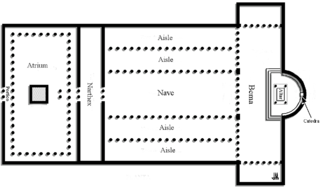
That is because these churches were built with the façade to the east and the apse with the altar to the west. Another factor which prevented the ‘facing the altar’ postion is the presence of the so-called
confessio, a sort of recess or small chamber sunk below floor level immediately in front of the altar area which enabled people to come close to the tomb of a saint buried beneath the altar. These churches (St. Peter’s
is a prime example) were literally built over the tombs of the martyrs, because the attitude of the time was against disturbing the martyr’s resting place. In other words, the church was brought to the martyr (no matter whatever obstacles may be encountered), not the martyr to the church.
Even then,
there is the theory that during the early centuries, the congregation stood (no pews back then) in the side aisles of the church and not in the central nave, so that they be would be face the altar from the sides, at least up until the Canon, when they would face east along with the priest towards the church doors. (There’s nothing to see in the sanctuary by then anyways, since
the altar was veiled by curtains that hung from the ciborium.)
Msgr. Klaus Gamber has pointed out that although in these early west-facing Roman basilicas the people stood in the side naves and faced the centrally located altar for the first portion of the service, nevertheless at the approach of the consecration they all turned to face east towards the open church doors, the same direction the priest faced throughout the Eucharistic liturgy. Because the sanctuary with its veiled altar occupied the portion of the church west of the main entrance the people could face east, the direction of the imminent eschaton of Christ, only by turning.
As we have noted, churches came in time to be built with their sanctuaries no longer towards their west end but instead towards their east end so that now the people no longer needed to turn but could face east throughout the Mass. (A similar switch in orientation took place in the Jewish synagogue about the same time and still may be seen in today’s synagogue.) Quite obviously, the importance of the people’s facing east in the Christian church was that this posture signified they were “the priesthood of the faithful,” who in this way showed that they joined in the sacrifice offered by the ministerial priest in his and their collective name.
BTW, in the first
Ordo Romanus, we have a curious rubric:
- Schola vero, finita antiphona, imponit Kyrie eleison. Prior vero scholae custodit ad pontificem ut ei adnuat si vult mutare numerum litaniae, et inclinat se pontifici. Quando vero finierint, dirigens se pontifex contra populum, incipit: Gloria in excelsis Deo, [si tempus fuerit,] et statim regyrat se ad orientem usque dum finiatur. Post hoc dirigens se iterum ad populum dicens: Pax vobis; et regyrans se ad orientem dicit: Oremus, et sequitur oratio. Post finitam sedet; similiter episcopi vel presbyteri sedent.
- Now, after the anthem is finished, the choir begins, Lord, have mercy. But the precentor keeps his eye on the pontiff, so that the latter may sign to him if he wishes to change the number of the Kyries, and bows to him. When they have finished, the pontiff turns himself round towards the people, and begins, Glory be to God on high, [if it be the season for it,] and at once turns back again to the east until it be finished. Then, after turning again to the people, he says, Peace to you, and once more turning to the east, says, Let us pray, and the collect follows. At the end of it he sits, and the bishops and presbyters sit in like manner.
The first
Ordo Romanus (one of
many) is one of the most ancient surviving ceremonial of the Roman liturgy. The opinion today is that the early half of the text represents in substance the Roman stational Mass in the time of Gregory the Great, with adjustments and additions dating to the end of the 7th century or later. This
ordo seems to have served as a prototype for many of the later ‘Roman’
ordines, which are really of Gallican or Frankish composition.
So in conclusion: St. Gregory the Great would have said Mass in a Roman church facing the church doors, but not with the congregation in front of him - since they probably would have been off to the sides.


 Since he actually lived about 800-900 years before those paintings were painted, of course, it doesn’t count for anything (Renaissance and medieval artists were never the greatest at historical accuracy), but it’s still amusing that he happened to bring up that specific Pope for his argument, since he’s so well-represented in later art.