C
Crescentinus
Guest
Random, but do they have liturgical spoons?


Very interesting. :Yes, Orthodox and many Eastern Catholics give Holy Communion by intinction with a spoon.
I guess you could call that a liturgical spoon.
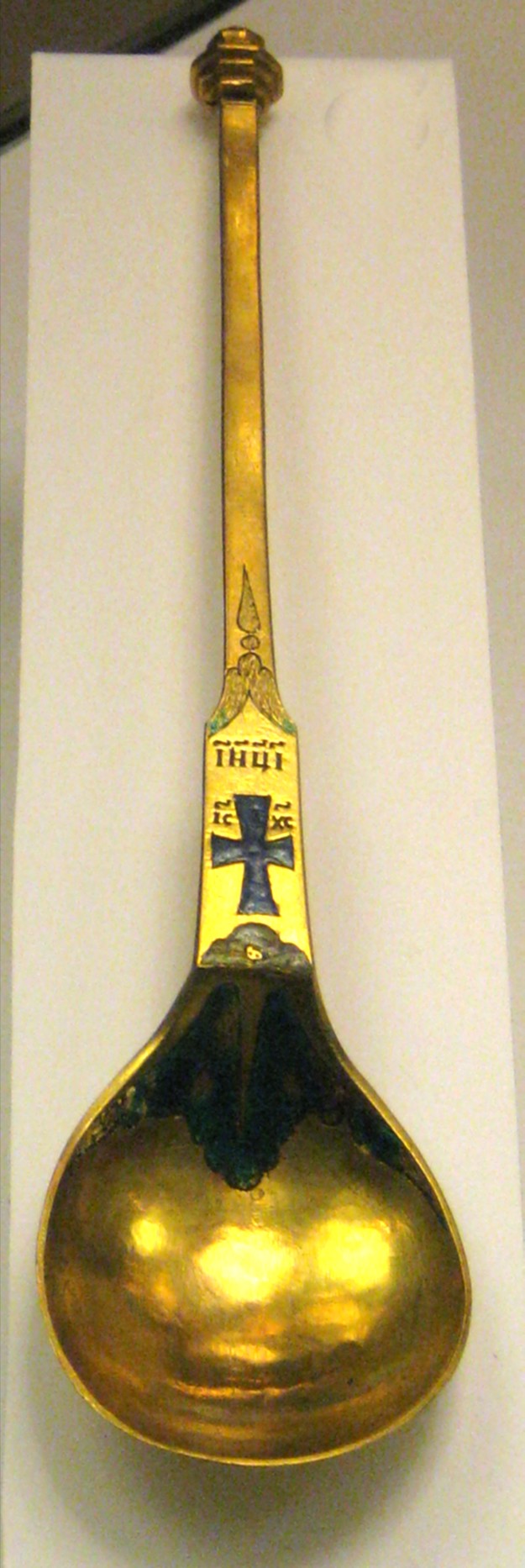
Wait, so the Wikipedia pic is exaggerated in size!? /stunnedWhen I attended a Ukrainian church, we received from the spoon, but it was no bigger than a teaspoon.
However, not all Eastern Catholic Churches use a spoon for the reception of Holy Communion. For example, the Melkites deliver the Eucharist by intinction.
Haha no, no. I just don’t think that picture puts it into perspective.Wait, so the Wikipedia pic is exaggerated in size!? /stunned
I thought that they had super-sized liturgical spoons… o:

That is one tiny spoon. o:Haha no, no. I just don’t think that picture puts it into perspective.
This is a picture of a Greek-Orthodox Church liturgical spoon. The pic puts it in perspective
transfiguration.org/wp-content/uploads/2009/09/Father-Jordan-03.jpg
Cheers!
Real quick, is the Spear used after the Consecration?Spoon and spear together: easternchristiansupply.biz/mm/products/4/40/406/40677/extras/40677.jpeg
http://www.stgeorgegreenville.org/Images/Prosfora-IC XC NI KA.jpgReal quick, is the Spear used after the Consecration?
Thanks, that makes sense.http://www.stgeorgegreenville.org/Images/Prosfora-IC XC NI KA.jpg
After the consecration, the Body of Christ is broken into four pieces and sits on the diskos (paton) like this:
--------[IC]-------
[NI]----------[KA]
-------[XC]-------
IC goes into the chalice. XC is for the celebrant and those ministering with him. NI and KA are put into the Chalice for the laymen to partake. Some priests (as I’ve witnessed) will use the spear to divide the XC into a few pieces so that all the clergy may partake.
Most Eastern Catholics who use the Byzantine liturgy use pre-cut pieces and do not follow the traditional form as noted above. St Elias UGCC in the Toronto area is a notable exception.http://www.stgeorgegreenville.org/Images/Prosfora-IC XC NI KA.jpg
After the consecration, the Body of Christ is broken into four pieces and sits on the diskos (paton) like this:
--------[IC]-------
[NI]----------[KA]
-------[XC]-------
IC goes into the chalice. XC is for the celebrant and those ministering with him. NI and KA are put into the Chalice for the laymen to partake. Some priests (as I’ve witnessed) will use the spear to divide the XC into a few pieces so that all the clergy may partake.
Go St. Elias!Most Eastern Catholics who use the Byzantine liturgy use pre-cut pieces and do not follow the traditional form as noted above. St Elias UGCC in the Toronto area is a notable exception.

Yes. The Coptic, Ethiopian, and Assyrian traditions use the spoon to give the Blood of Christ, the Byzantine traditions to give the Body and Blood of Christ sops. Some Melkites use the spoon in some locations (they changed from the Syrian tradition to the Byzantine). The Syrian tradition uses intinction, delivered by spoon, and the clergy uses the spoon for the Blood of Christ. The Armenians do not use the spoon.Random, but do they have liturgical spoons?
We use prosphoras but it is a combination of the pre-cut and the prosphora. I bake them and the priest uses one per Sunday Liturgy.Most Eastern Catholics who use the Byzantine liturgy use pre-cut pieces and do not follow the traditional form as noted above. St Elias UGCC in the Toronto area is a notable exception.
How about the Maronites?Yes. The Coptic, Ethiopian, and Assyrian traditions use the spoon to give the Blood of Christ, the Byzantine traditions to give the Body and Blood of Christ sops. Some Melkites use the spoon in some locations (they changed from the Syrian tradition to the Byzantine). The Syrian tradition uses intinction, delivered by spoon, and the clergy uses the spoon for the Blood of Christ. The Armenians do not use the spoon.
Maronites use unleavened bread, a Eucharist host, but give by intinction: the priest dips the Sacred Body into the Sacred Blood and places on the tongue. I believe they still have a spoon on the table however.How about the Maronites?