Does some clerical fashions become outdated?

  • Thread starter Thread starter redrosetea
  • Start date Start date
Status
Not open for further replies.
R

redrosetea

Guest
I never see priest wear cassocks now. i always thought they were so nice looking. I haven’t seem them worn in years

Do any of you have a priest that still wears a soutain?
 
I never see priest wear cassocks now. i always thought they were so nice looking. I haven’t seem them worn in years

Do any of you have a priest that still wears a soutain?
They are still worn – but they are not always the most practical garments to wear…
 
Yes, but he’s a member of a Traditional Society.

Why not practical? I’ve seen Priests ice-skating in cassocks! 😉
 
I never see priest wear cassocks now. i always thought they were so nice looking. I haven’t seem them worn in years

Do any of you have a priest that still wears a soutain?
I don’t know what a soutain is, but one of the priests at my parish wears a cassock a lot.
 
I don’t know what a soutain is, but one of the priests at my parish wears a cassock a lot.
A soutane is a Cassock with sleeves cut a particular way. There are a few other minor differences, but they’re virtually the same.
 
Tradition and clerical wear never gets outdated.

The simple fact is that most priests have become secularized. Modernism has been inside the Church for decades. Many priests did not recieve proper formation in the seminary.

Priests have an identity crisis since their loss of esteem and respect following the cultural revolution and abuses in luturgy. Many do not understand their roles as sacraficing priests and that they are separate from any other human being on the planet.
 
I was told by an FSSP that a cassock is a sacramental (unlike a black suit) and wearing one is similar carrying rosary. It seems with all the attacks our priests suffer nowadays they would want all the protection they can get.
 
Thats very interesting David

Is a cassock sort of like a habit?
 
Thats very interesting David

Is a cassock sort of like a habit?
I don;t know the status of a habit. he also told me that if the priest is wearing an un-blessed scapular and puts on his cassock, the scapular does not need to be blessed.

I look at the cassock as the fancy class-a uniforms that marines wear, which commands some respect, whereas the “suit” is civillian clothes. Our priests need to start acting like they are something special and dress it. Otherwise people will treat them like an ordinary person in a suit.
 
I like to see the priest wear them because it sets them apart immediately

You know at once they are Catholic
 
They definitely change over time. The familiar version of Roman collar with the little white square is relatively recent. Compare it with the collar of, say St. Jean Vianney or that of St. Vincent de Paul.

I’m not sure whether that is necessarily a preferable thing or not, but it is what has happened over history.
 
I have to agree that the Cassock is a definate catholic vestment that makes our clergy unique. Especially that here in america, various christian groups have ministers that wear the “roman collar” and black suit. Same way with the Biretta for the parish priest. It makes them stand out as a catholic.
 
Check out websites for the Institute of Christ the King Sovereign Priest. I am sorry that I do not know how to put in those links like everyone does. My son is in seminary there (in Italy) and he has worn a cassock for the past three years and will continue to do so. It is not just for Mass, but for daily dress. It is made after very old styles of cassocks from the past and the thing that I like is that is has 33 buttons down the front to signify Christ’s age. There is more about it, but I don’t remember it all.
 
In my relatively limited experience, cassocks are actually coming back into style. At the OF parish I attend, the priests generally wear the black suit, but I do see them in cassocks quite a bit. I find it interesting because the priests at this parish are all relatively young. (I assume this is on purpose because the parish is associated with a college campus.)

I do get the feeling, though, that, at least at this parish, the use of the cassock is a bit of a statement, much like the use of the Bendictine altar arrangement, regular use of Latin for parts of the mass, etc. If I’m right about this and the apparent current trend for new priests to be more “orthodox” continues, the wearing of cassocks might become much more widespread than it is now. Just my thought, though.
 
Is a cassock sort of like a habit?
No, a cassock is not like a habit. A habit may only be worn by those who live the Consecrated Life, that is religious.

If a priest is ALSO a religious he may wear the habit of his community. The habit is a sacred gard that is consecrated at the time that the religious is invested. In most religious communities the members receive the habit at the beginning of the novitiate, but it may also be postponed to the end of the novitiate when the religiuos makes vows.

Secular priests do not make vows. They are seculars. The idea that a priest is not a secular man is erroneous and against canon law. A priest is a secular man.

Only those priests who are ALSO members of religoius orders are not secular men. Religioius men and women are consecrated to God by vows of poverty, obedience and chastity.

These vows are not part of the Sacrament of Holy Orders. Therefore a priest who is not a member of a religious community does not make these vows nor can he wear a habit.

The cassock was originally created for the Society of Jesus during the 1500s. St. Ignatius wanted to found a society of priests and brothers to counteract heressy. But he did not want them to be friars or monks. Friars and monks wear habits, as do nuns and many sisters, because they are all Consecrated Religious.

St. Ignatius wanted a group of consecrated religious who looked like secular men. He never gave his priests a habit, even though they took vows. He gave them a long black coat that went over their clothes with a white collar as a sign of celibacy.

Diocesan or secular priests did not wear such distinctive garb. They adopted it from the Jesuits.

It is also not true that priests do not wear a cassock because of the post Vatican II Church.

In many countries they were banned either by the State or by the Church or both.

At the Council of Baltimore the American clergy was advised to adopt the clerical garb of the Anglican clergy by Archbishop Carrol, the first bishop of the United States. At the time the war was just over and there were many anti-Catholic sentiments as many Irish immigrants had arrived in NY and Baltimore. To protect the priests from harm, the Archibishop told them to wear the black suit and collar of the Anglicans when on the streets.

Years later, when the danger was no longer present, many American priests returned to wearing the cassock in public.

In Mexico it is still banned off Church property. The Constitution prohibits all forms of religious garb in public places. To avoid conflicts and arrests, priests and religious change into secular clothes when leaving their houses. This has been the law for more than 100 years.

This is also the case in most communist countries. Poland was one of the few communist countries where priests wore cassocks in public.

Most European priests do not wear a suit with a roman collar as this is more of an Anglican custom in Europe. That’s why we often see pictures of Joseph Ratzinger in a shirt and tie during his younger days as a professor in Germany. That was the expected norm of dress for German priests.

In spain the custom was a black crew neck shirt under a jacket or a cassock or habit. That had been the custom since the Spanish Civil War. Again, this was to protect priests.

After the French Revolution priests and religioius in France adopted secular garb. That is why many sisters who came to the USA from France dressed as widows. In France they passed without detection. The clergy in France covered ther cassocks or habits with cloaks. Later they switched to a suit with a tie. It wasn’t until after World War II that the French clergy went back to wearing a cassock or habit in public. Under the new Constitution they were guarranteed freedom of religion and protection from anti-clericalism.

Interestingly enough, the only Nation where the clergy or religious never had to hide their identity was in Israel. By the 1949 when Israel was founded the Franciscan Friars of Jerusalem had been there for more than 700 years along with the Orthodox clergy of Jerusalem. Their presence was not seen as a threat by either Jews or Muslims.

Also, you will find that Franciscan bishops will wear the Franciscan habit instead of the Cassock. The reason for this is because even though they are bishops or cardinals, they are still friars. The are allowed to choose what to wear.

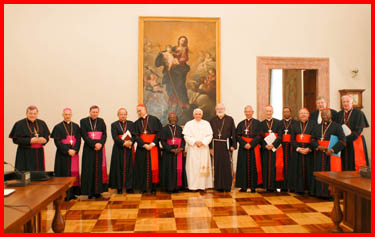
In the pic below, to the left of the Pope you will see a Capuchin-Franciscan Cardinal wearing a Brother’s habit, instead of a cassock. This has nothing to do with modernism. It has to do with fidelity to the individual’s religious order and his vocation to be a Brother and a Priest.
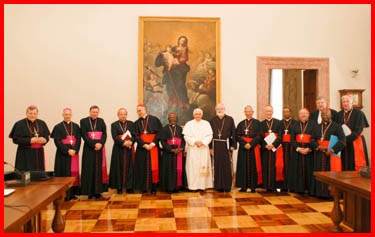


cardinalseansblog.org/?m=200706

JR 🙂
 
I like to see the priest wear them because it sets them apart immediately

You know at once they are Catholic
This true to a certain extent. If you go to a parish that is staffed by a religious order, you won’t be able to tell who is ordained and who is a lay brother, because they all wear the same habit.

In Capuchin-Franciscan parishes everyone is either Brother (Br.) or Friar (Fr.).

Our parish has seven friars. Only three are priests. They all wear the same habit or the roman collar. They all have Fr. in front of their name. You only know which is a priest if you ask for a sacrament. Then you’re pointed to the right person.

The parishiones of course know who’s who. An outsider would not.

In the UK the Anglican clergy also wear cassocks. And Anglican religious wear habits. Though from what I hear, there are few religious orders left in the Anglican communion. The Franciscans and the Benedictines I believe are the two largest groups left.

JR 🙂
 
I dont know if they become outdated or not. Personally I’m a traditional catholic priest in the UK and I always wear full cassock, with cincture, shoulder cape, zuchetto and biretta.

As far as I’m concerned, I am proud to be a Priest and just like other vocations, it is my uniform and am proud to wear it. If other priests, ministers or vicars snear at it, it is not my problem.

In Christo

Emilio
 
Status
Not open for further replies.
Back
Top