Doesn’t the way Jesus was crucified contradict how the Romans actually crucified people?

  • Thread starter Thread starter lemerjoe
  • Start date Start date
Status
Not open for further replies.
Just a little aside. I know of only five Jesus films which choose to follow the possible way(s) Yehohanan, the man from Givat ha-Mivtar, was crucified.

(Please Note: This uploaded content is no longer available.)
The Last Temptation of Christ (1988)

http://s3.amazonaws.com/auteurs_pro...ontreal/w448/jesus-of-montreal.jpg?1341486359
Jesus of Montreal (1989)

http://img41.imageshack.us/img41/7154/mv5bmty0mde2ndu1nf5bml5.jpg
The Miracle Maker (2000)

(Please Note: This uploaded content is no longer available.)
The Visual Bible: The Gospel of John (2003)

http://img109.imageshack.us/img109/9801/pasjas.jpg
The Passion (2008)

Both The Last Temptation and Jesus of Montreal follow the initial reconstruction of Yehohanan’s posture by Nicu Haas (one nail through both ankles), which allows for self-censorship, given how both portrayals choose to show Jesus naked on the cross. The Miracle Maker follows both this (for Jesus) and the newer reconstruction by Eliezer Sekeles and Joe Zias (for the thief crucified on Jesus’ left - our right - as well as for a brief hallucination by Judas). The Gospel of John uses Sekeles and Zias’ reconstruction exclusively. The Passion seems to follow again Haas’ version.

Most other films meanwhile often just copy ‘classical’ Western portrayals, down to the feet being pierced by one nail. Some more famous recent examples are:

http://img7.imageshack.us/img7/7820/jesuq.jpg
Jesus of Nazareth (1979)

http://www.teensay.com/resources/filmslists/-3zpa.jpg
The Passion of the Christ (2004)

http://www.empowernetwork.com/donaldalexander/files/2013/04/TheBible-Crucifixion-630-jpg_225818.jpg
The Bible (2013)
 
How did we get from four nails to three, anyway?

The three-nails convention is first attested in the West from the 11th century, although it would only become dominant in the 13th century and afterwards. We don’t know exactly why three nails became favored, although the symbolism of the number three may have something to do with it. Another factor may also be the artistic effect afforded by showing the legs crossed with one foot over the other: it is much more dramatic to show the legs crossed if the head is bowed and the body is slumping than to show them side-by-side. It is perhaps no coincidence that the convention appeared as soon as Western artists began to show a Jesus who is visibly suffering or dead up on the cross.

In fact, whether Jesus was crucified with three nails or four became a minor controversy in the Middle Ages, because it just so happened that the Cathars were one of the first to use the artistic convention. The Cathars were purported to have made a crucifix composed only of the vertical post, the inscription, and the footrest without the horizontal beam, while showing Jesus crucified with three nails, one of which went on both feet. A historian from León named Lucas, later bishop of Tuy in France (died 1249) reacted in horror to what he considered to be “ill-shapen” images of the crucified Jesus “with one foot laid over the other, so that both are pierced by a single nail, thus striving to annul or render doubtful men’s faith in the Holy Cross and the traditions of the sainted Fathers.” In answer, Lucas retorted that a proper cross must take the shape of overlapping arms and represent the four regions of the earth. He had also invoked the testimony of Pope Innocent III (reigned 1198-1216), who had also declared that four nails were used in the crucifixion, and the stigmata of St. Francis of Assisi (1181/2-1226), which had what looked like fleshy nails driven into each of his hands and feet.

In addition, St. Bridget of Sweden (1303-1373) also saw visions (Revelations 1.10; 4.70; 7.15):

"My Son was standing there, naked as he had been born, when someone came running up and offered him a veil with which he joyfully covered his shame. Then his cruel executioners seized him and stretched him out on the cross, nailing first his right hand to the crossbeam that had a hole in it for the nail. They pierced his hand at the point where the bone was more solid. With a rope they pulled his other hand and attached it to the crossbeam in similar fashion. Then they crucified his right foot with the left on top of it using two nails so that all his sinews and veins became overstrained and burst.

===

Once he arrived at the place for crucifixion, a hammer and four sharp nails were ready for him there. He took off his clothes when ordered but covered his private parts with a small cloth. He proceeded to tie it on as though it gave him some consolation to do so. The cross was planted firmly, and the crossbeam was so placed that the juncture was at the center of the shoulder blades. The cross did not have any kind of headrest. The sign with his sentence on it was attached to each arm of the cross sticking out above the head.

On being ordered, he lay down with his back to the cross and, when he was asked to do so, first stretched out his right hand. Then, since his left hand could not read the other corner of the cross, it had to be stretched out at full length. His feet were similarly stretched out to reach the slots for the nails and placed crosswise, and, as if they had been loosened from the shinbones, were fastened to the wood of the cross by two nails driven through solid bone, as had been done with his hands.

===

Then, when the cross had been so solidly fastened there, at once wooden planks were fitted around the trunk of the cross to form steps up to the place where his feet were to be crucified, in order that both he and his crucifiers might be able to ascend by those plank steps and stand atop the planks in a way more convenient for crucifying him. After this, they then ascended by those steps, leading him with the greatest of mockery and scolding. He ascended gladly, like a meek lamb led to the slaughter. When he was finally on top of those planks, he at once, willingly and without coercion, extended his arm and opened his right hand and placed it on the cross. Those savage torturers monstrously crucified it, piercing it with a nail through that part where the bone was more solid. And then, with a rope, they pulled violently on his left hand and fastened it to the cross in the same manner. Finally, they extended his body on the cross beyond all measure; and placing one of his shins on top of the other, they fastened to the cross his feet, thus joined, with two nails. And they violently extended those glorious limbs so far on the cross that nearly all of his veins and sinews were bursting.

St. Bridget envisions Jesus being crucified with His legs crossed, but with His feet being nailed separately. She also has the cross being erected first, with Jesus climbing up to it to be nailed. This accords with a certain depiction (also attested in Byzantine art) showing the cross being raised first, instead of the version familiar to us, where Jesus is nailed first before the cross is raised and set up.


http://img11.imageshack.us/img11/3449/ferrarachiesadisantonio.jpg


http://upload.wikimedia.org/wikipedia/commons/thumb/4/4c/Fra_Angelico_-Nailing_of_Christ_to_the_Cross%28Cell_36%29_-WGA00550.jpg/386px-Fra_Angelico-Nailing_of_Christ_to_the_Cross%28Cell_36%29_-_WGA00550.jpg
 
One of the best scientific books on the Crucifixion is indeed the book “The Crucifixion of Jesus: A Forensic Inquiry” by Frederick T. Zugibe, M.D., Ph.D.

Besides the issue of the wrists (we established that the nails did go through the hands, as the stigmata - visible and invisible - of many saints also prove), in general the Romans broke the rules quite a bit…nobody was scourged before crucifixion, and certainly not as many times as the Holy Shround shows (and Sacred Scripture describes). And nobody was ever - as far as we know - crowned with thorns. So it would not be s
The scourging was implemented by Pontius Pilate in order to placate the crowd. Pilate, according to history, was actually summoned to Rome THREE times by Tiberius cause of the number of crucifixions he was performing. Meaning, believe it or not, he performing too many and Rome did not want it. It was causing problems.

Pilate was trying to avoid crucifixion, so he thought the scourging to satisfy the crowds blood lust. It was not going be a part of crucifixion. This is actually spelled out in the gospels as well.

John 18

38 “What is truth?” retorted Pilate. With this he went out again to the Jews gathered there and said, “I find no basis for a charge against him. 39 But it is your custom for me to release to you one prisoner at the time of the Passover. Do you want me to release ‘the king of the Jews’?”

40 They shouted back, “No, not him! Give us Barabbas!” Now Barabbas had taken part in an uprising.

John 19

19 Then Pilate took Jesus and had him flogged. 2 The soldiers twisted together a crown of thorns and put it on his head. They clothed him in a purple robe 3 and went up to him again and again, saying, “Hail, king of the Jews!” And they slapped him in the face.

4 Once more Pilate came out and said to the Jews gathered there, “Look, I am bringing him out to you to let you know that I find no basis for a charge against him.” 5 When Jesus came out wearing the crown of thorns and the purple robe, Pilate said to them, “Here is the man!”

6 As soon as the chief priests and their officials saw him, they shouted, “Crucify! Crucify!”

But Pilate answered, “You take him and crucify him. As for me, I find no basis for a charge against him.”

7 The Jewish leaders insisted, “We have a law, and according to that law he must die, because he claimed to be the Son of God.”

8 When Pilate heard this, he was even more afraid, 9 and he went back inside the palace. “Where do you come from?” he asked Jesus, but Jesus gave him no answer. 10 “Do you refuse to speak to me?” Pilate said. “Don’t you realize I have power either to free you or to crucify you?”

So, again. The scourging was done in order to placate the crowd, and he hoped it would satisfy the crowd. He was trying to avoid crucifixion. He was sentenced to be crucified AFTER he was flogged.
 
In context, Lucas was attacking what he saw as deception on the part of the Cathars. He purported that they were misleading the common people through subtle means, by “[painting] mostly deformed images of the saints, to the end that the aspect may transform the devotion of the plain Christian people into disgust.” He even used a (fictional) Cathar as a sock-puppet for this supposed plot: “‘We wish to change the practice of the Church, so that we may be able to excite the devotion of the people by the greater intensity of the passion of Christ and to prevent tedium by replacing the customs of long standing by something new. … It suffices for the salvation to believe that Christ has been crucified and to believe it immaterial whether … he was pierced by four or three nails.’ … That and suchlike they say so that it seems also rational.” According to Lucas’ Cathar character, all this was supposedly part of some plot to change the Church and to make people no longer concerned about the exact number of nails Christ was crucified with (something which our author disagrees with).

However despite Lucas’ complaints against it, and despite Francis and Bridget, the three-nails convention eventually won out in art. The four-nails version lasted a bit longer in Italy, but eventually also gave way to the three-nails one. What was formerly condemned by some as an heretical innovation became the accepted norm (we can also see this in how some people complained of depictions of the crucified Christ as clearly suffering and dying instead of the living, triumphant Savior that had up to then had been the standard iconography). It became established enough that Bocaccio could invoke the differences in portrayal as a defense of artistic license at the end of The Decameron:

Some of you may say that in writing these tales I have taken too much license, by making ladies sometimes say and often listen to matters which are not proper to be said or heard by virtuous ladies. This I deny, for there is nothing so unchaste but may be said chastely if modest words are used; and this I think f have done.

But suppose it to be true – and I shall not strive with you, for you are certain to win – I reply that I have many arguments ready. First, if there is any license in some of them, the nature of the stories demanded it; and if any understanding person looks at them with a reasonable eye he will see that they could not be related otherwise, unless I had altered them entirely. And if there are a few words rather freer than suits the prudes, who weigh words more than deeds and take more pains to appear than to be good, I say that I should no more be reproved for having written them than other men and women are reproved for daily saying “hole,” “peg,” “mortar,” “pestle,” “sausage,” “Bologna sausage,” and the like things. My pen should be allowed no less power than is permitted the painter’s brush; the painters are not censured for – allowing Saint Michael to slay the serpent with a sword or lance and Saint George to kill the dragon as he pleases. They make Christ male and Eve female, **and they fasten sometimes with one nail, sometimes with two, the feet of Him who died for the human race on the Cross. **

It did not mean that the four-nails depiction died out completely in the West. While the three-nails convention did become the standard, a few artists could still from time to time show four nails; sometimes even the same artist could variously show three or four nails depending on the artwork. Take for example, Albrecht Dürer (this and this), Hans Burgkmair (this and this), or Lucas Cranach the Elder (this and this).
 
Now after the Council of Trent there was a sort of movement to reintroduce the four-nails depiction, because of the council’s emphasis on reviving and maintaining the traditions of the early Church, stressing the importance to what they perceived as the veracity of Scripture and other canonical texts. In order to fill the gaps left by those accounts, theologians, antiquarians, and artists began to investigate the history of the early Church. Catholic Counter-Reformation painters were now compelled to represent images of Christ and the saints in strict accordance with textual and pictorial evidence that demonstrated the historical “truth” of the events portrayed.

In Spain (Seville in particular), this became a popular fad after the painter (and official censor for the Spanish Inquisition) Francisco Pacheco (1564-1644) took up the challenge. Along with his poet friend Francisco de Rioja (1583-1689), Pacheco researched just how ‘exactly’ Jesus was crucified. After a study of ancient texts and images, they arrived at the conclusion that Christ was crucified with four nails rather than the three shown in popular art. Pacheco then began showing a Jesus pierced with four nails in all his artworks (“conforming in everything to what is said by the ancient writers” according to Rioja) and devoted a whole chapter on the subject in his treatise Arte de la pintura (“The art of painting,” published posthumously in 1649), wherein he cites authors ranging from Gregory of Tours to Innocent III to Bridget of Sweden in support of his idea. As a consequence, the four-nails convention became dogma for other Sevillian painters of his time. By the time of Murillo (1617-1682), the fad had ended, and Sevillian artists reverted to the three-nails convention.

(Please Note: This uploaded content is no longer available.)
Christ of Clemency by Juan Martínez Montañés (1603-6). Note how he follows the position of Christ’s feet in the visions of St. Bridget. Montañés often sent his sculptures to Pacheco’s studio to be painted.


Christ on the Cross by Francisco Pacheco (1614)

http://upload.wikimedia.org/wikipedia/commons/thumb/5/5b/Francisco_de_Zurbarán_010.jpg/336px-Francisco_de_Zurbarán_010.jpg
Christ Crucified by Francisco de Zurbarán (1627)


Christ Crucified, by Diego Velázquez (1632). Velázquez became Pacheco’s apprentice when he was twelve and remained with him five years.


Saint Luke as a Painter before Christ on the Cross by Francisco de Zurbarán (1660). Here he, like Montañés, follows the description of how Christ’s feet were nailed in the vision of St. Bridget.
 
Incidentally, it just so happened that it was around that time that Pacheco was voicing his opinions in Spain that a Flemish humanist scholar named Justus Lipsius (1547-1606) published his three-volume work on crucifixion, De Cruce (1593-4). Lipsius, despite his comprehensive research, refrained from making any definitive statement about Jesus’ crucifixion: his work was more of a historical-archaeological undertaking rather than a doctrinal treatise.* In response to Lipsius, a German Lutheran theologian named Georg Calixtus (1586-1656) published a work known as De vera forma crucis (“On the true form of the Cross”), which eventually also came to be bound along with Lipsius’ third volume as an appendix. Calixtus built upon Lipsius’ work to give an answer to the question the latter refrained from directly answering: just how Jesus was crucified. Calixtus pointed out that Lipsius overlooked the horn-like peg upon which the victim rests mentioned by the ancient writers (which he calls the sustentaculum); accordingly he showed Jesus crucified while resting on the device, being affixed by four nails.

http://img29.imageshack.us/img29/5705/sedile.jpg

http://img541.imageshack.us/img541/6083/christsedile.jpg
  • Take note: sometimes the Jehovah’s Witnesses like to use an engraving from Lipsius showing a man on a stake and claiming that it shows how Jesus was impaled, which is a blatant misuse of the work.
It is often said that Lipsius in some way influenced Peter Paul Rubens (1577-1640), another painter from the period who preferred painting a Christ crucified with four nails. So yes, despite these revivals, the three nails depiction became pretty much the ‘standard’ portrayal of the crucified Christ in the West, down to the present day. Incidentally, the visions of the Venerable Maria of Agreda (1602-1665) and Blessed Anne Catherine Emmerich (1774-1824), both of which served as the basis for Mel Gibson’s The Passion of the Christ, assert contra St. Bridget’s vision that Jesus’ feet were pierced with one nail.

Presently one of the executioners seized the hand of Jesus our Savior and placed it upon the auger-hole while another hammered a large and rough nail through the palm. The veins and sinews were torn, and the bones of the sacred hand, which made the heavens and all that exists, were forced apart. When they stretched out the other hand, they found that it did not reach up to the auger-hole; for the sinews of the other arm had been shortened and the executioners had maliciously set the holes too far apart, as I have mentioned above. In order to overcome the difficulty, they took the chain with which the Savior had been bound in the garden, and looping one end through a ring around his wrist, they, with unheard of cruelty, pulled the hand over the hole and fastened it with another nail. Thereupon they seized his feet, and placing them one above the other, they tied the same chain around both and stretched them with barbarous ferocity down to the third hole. Then they drove through both feet a large nail into the Cross.
  • Maria de Agreda, The Mystical City of God
The executioners had fastened a piece of wood at the lower part of the cross under where the feet of Jesus would be nailed, that thus the weight of his body might not rest upon the wounds of his hands, as also to prevent the bones of his feet from being broken when nailed to the cross. A hole had been pierced in this wood to receive the nail when driven through his feet, and there was likewise a little hollow place for his heels. These precautions were taken lest his wounds should be torn open by the weight of his body, and death ensue before he had suffered all the tortures which they hoped to see him endure. The whole body of our Lord had been dragged upward, and contracted by the violent manner with which the executioners had stretched out his arms, and his knees were bent up; they therefore flattened and tied them down tightly with cords; but soon perceiving that his feet did not reach the bit of wood which was placed for them to rest upon, they became infuriated. Some of their number proposed making fresh holes for the nails which pierced his hands, as there would be considerable difficulty in removing the bit of wood, but the others would do nothing of the sort, and continued to vociferate, ‘He will not stretch himself out, but we will help him;’ they accompanied these words with the most fearful oaths and imprecations, and having fastened a rope to his right leg, dragged it violently until it reached the wood, and then tied it down as tightly as possible. The agony which Jesus suffered from this violent tension was indescribable; the words ‘My God, my God,’ escaped his lips, and the executioners increased his pain by tying his chest and arms to the cross, lest the hands should be torn from the nails. They then fastened his left foot on to his right foot, having first bored a hole through them with a species of piercer, because they could not be placed in such a position as to be nailed together at once. Next they took a very long nail and drove it completely through both feet into the cross below, which operation was more than usually painful, on account of his body being so unnaturally stretched out; I counted at least six and thirty blows of the hammer.
  • Emmerich, Dolorous Passion of our Lord Jesus Christ
 
The scourging was implemented by Pontius Pilate in order to placate the crowd. Pilate, according to history, was actually summoned to Rome THREE times by Tiberius cause of the number of crucifixions he was performing. Meaning, believe it or not, he performing too many and Rome did not want it. It was causing problems.
No. We only have one record of Pilate being sent to Rome in Josephus, and that is clearly when he was fired from his job as prefect. He was not so much reprimanded for his crucifixions as he was for his heavy-handed treatment of a Samaritan fanatic:

But the nation of the Samaritans did not escape without tumults. The man who excited them to it was one who thought lying a thing of little consequence, and who contrived every thing so that the multitude might be pleased; so he bid them to get together upon Mount Gerizim, which is by them looked upon as the most holy of all mountains, and assured them, that when they were come thither, he would show them those sacred vessels which were laid under that place, because Moses put them there.

So they came thither armed, and thought the discourse of the man probable; and as they abode at a certain village, which was called Tirathana, they got the rest together to them, and desired to go up the mountain in a great multitude together; but Pilate prevented their going up, by seizing upon file roads with a great band of horsemen and foot-men, who fell upon those that were gotten together in the village; and when it came to an action, some of them they slew, and others of them they put to flight, and took a great many alive, the principal of which, and also the most potent of those that fled away, Pilate ordered to be slain.

But when this tumult was appeased, the Samaritan senate sent an embassy to Vitellius, a man that had been consul, and who was now president of Syria, and accused Pilate of the murder of those that were killed; for that they did not go to Tirathaba in order to revolt from the Romans, but to escape the violence of Pilate. So Vitellius sent Marcellus, a friend of his, to take care of the affairs of Judea, and ordered Pilate to go to Rome, to answer before the emperor to the accusations of the Jews.

So Pilate, when he had tarried ten years in Judea, made haste to Rome, and this in obedience to the orders of Vitellius, which he durst not contradict; but before he could get to Rome Tiberius was dead.
  • Josephus, Antiquities 18.85-89
So, again. The scourging was done in order to placate the crowd, and he hoped it would satisfy the crowd. He was trying to avoid crucifixion. He was sentenced to be crucified AFTER he was flogged.
You have to remember that there is a difference between the Synoptics and John at this point. In Matthew and Mark the scourging (and its accompanying mockery) takes place after the condemnation of Jesus and immediately before His carrying of the cross (Mark 15:17-20; Matthew 27:28-31), while in John the events play out as you mention. Luke’s Pilate threatens to punish Jesus first (by scourging?) and then let Him go (23:22), but we are never explicitly shown him carrying it out. The detail about the crowning with thorns is also absent from Luke: the mockery of Jesus by Herod’s men seems to be a substitute for it.

Either John was reporting the same event as the synoptics but had ‘tweaked’ it in his own way to drive home a theological point, or John was writing of a lighter, remedial scourging, different from the one described by Matthew or Mark - in which case this light beating was more to satisfy the demand for punishment and possibly prompt the victim to confess than a prelude to execution.

Here is another Jesus, one who lived thirty years after our Jesus was crucified:

But, what is still more terrible, there was one Jesus, the son of Ananus, a plebeian and a husbandman, who, four years before the war began, and at a time when the city was in very great peace and prosperity, came to that feast whereon it is our custom for every one to make tabernacles to God in the temple, began on a sudden to cry aloud, “A voice from the east, a voice from the west, a voice from the four winds, a voice against Jerusalem and the holy house, a voice against the bridegrooms and the brides, and a voice against this whole people!” This was his cry, as he went about by day and by night, in all the lanes of the city. However, certain of the most eminent among the populace had great indignation at this dire cry of his, and took up the man, and gave him a great number of severe stripes; yet did not he either say any thing for himself, or any thing peculiar to those that chastised him, but still went on with the same words which he cried before. Hereupon our rulers, supposing, as the case proved to be, that this was a sort of divine fury in the man, brought him to the Roman procurator, where he was whipped till his bones were laid bare; yet he did not make any supplication for himself, nor shed any tears, but turning his voice to the most lamentable tone possible, at every stroke of the whip his answer was, “Woe, woe to Jerusalem!” And when Albinus [for he was then our procurator] asked him, Who he was? and whence he came? and why he uttered such words? he made no manner of reply to what he said, but still did not leave off his melancholy ditty, till Albinus took him to be a madman, and dismissed him.
 
What do we know about Jesus’ crucifixion?

And they are leading him out that they may crucify him; and they force a passerby – a certain Simon, a Cyrenaean coming from the country, the father of Alexander and Rufus – to bear his cross, and they bring him to the place Golgotha (which is, being translated, ‘Skull Place’), and they were giving him myrrhed wine, but he did not take it. (Mark 15:20b-23)

Now as they came out, they came upon a Cyrenaean man named Simon; this one they forced to bear his cross, and having come to a place called Golgotha (which is called ‘Skull Place’), they gave him to drink wine mixed with gall, and having tasted it, he would not drink it. (Matthew 27:32-34)

And as they led him away, having seized Simon, a certain Cyrenaean, coming from the country, they put the cross on him to bear it behind Jesus. (Luke 23:26)

Then [Pilate] handed [Jesus] over to them to be crucified. So they took Jesus, and he went out, carrying the cross by himself, to the place called ‘Skull Place’, which in Hebrew is called Golgotha. (John 19:16-17)

http://img203.imageshack.us/img203/2073/vlcsnap2013040813h12m38.png

Crucifixion victims are usually spoken of as carrying their own crosses:

Palaestrio: Well, Sceledrus?
Sceledrus: I’m at this job. I so have ears; say what you want.
Pal.: (noting his position) You’ll soon have to trudge out beyond the gate in that attitude, I take it - arms outspread, with your gibbet patibulum] on your shoulders.
Scel.: (still eyeing the door) So? What for?
  • Plautus, Miles Gloriosus (“The Braggart Warrior”) 358-360 (Act 2, 4)
Grumio: Oh, I bet the hangmen will hang you looking like a human sieve, the way they’ll prod you full of holes as they run you down the streets with your arms on a cross bar (patibulatum), once the old man gets back!
  • Plautus, Mostellaria (“The Haunted House”) 56-57
Chrysalus: When he shall have found out that he has made his journey thither to no purpose, and that we have misspent his gold, what will become of me after that? I’ faith, I think upon his arrival he’ll be changing my name, and at once be making me Crucisalus (cross-bearer) instead of Chrysalus (gold-bearer).
  • Plautus, Bacchides 362
Bearing my gibbet I shall be carried through the city; afterwards I shall be nailed to the cross.
  • Plautus, Carbonaria, fragment 2
Whoever will want to exact punishment on a male or female slave at private expense, as he [the owner] who wants the [punishment] to be inflicted, he [the contractor] exacts the punishment in in this manner: if he wants [him] to bring the patibulum to the cross, the contractor will have to provide wooden posts, chains and cords for the floggers and the floggers themselves. And anyone who will want to exact punishment will have to give four sesterces for each of the workers who bring the patibulum and for the floggers and also for the executioner.
  • Leges libitinariae (De publico libitinae), 8-9
 
And whereas every criminal who goes to execution must carry his own cross on his back, vice frames out of itself each instrument of its own punishment, cunning artisan that it is of a life of wretchedness containing with infamy a host of terrors, regrets, cruel passions, and never-ending anxieties.
  • Plutarch, Moralia 554
If a wrongdoer dreams that he is carrying one of the demons of the lower world, Pluto himself or Cerberus or some other one of those in Hades, it signifies that he will carry a cross. For the cross is like death and the man who is nailed to it carries it beforehand.
For a righteous man, it signifies that he will carry a wild animal and, if he feels oppressed by his burden, that he will be bitten and will die. If this is not the case, he will notice it, will cast it down, and will not perish. …
  • Artemidorus of Ephesus, Oneirocritica 2.56
At daybreak the estate manager went and informed his master of what had happened. Mithridates neither saw the prisoners nor listened to any defense but immediately ordered the sixteen cellmates to be crucified. They were brought forth bound together by their feet and necks, each of them bearing his own cross. The men in charge of the punishment added this gloomy spectacle to the strictly necessary penalty as an example to frighten other slaves. As he was led away with the others, Chaireas said nothing, but Polycharmos, when he picked up his cross, said, “Callirhoe, it’s your fault we’re going through this. You’re responsible for all our troubles.”
  • Chariton of Aphrodisias, Chaereas and Callirhoe 4.2.7
All these sources attest to the fact that the criminal who had received judgment by crucifixion could be forced to go to the place of execution as in a kind of public procession, usually while being forced to carry the patibulum (the horizontal crossbeam), all the while as soldiers, officials, or in the case of private crucifixions, the slave-owner or the assistants in charge, harm and torture the criminal both before and during the journey. (The Leges libitinariae is a bit ambiguous as to whether it is the slave or the workers who will carry the patibulum - operis singulis quae patibulum ferunt “each of the workers who bring the patibulum” - but this may refer to those who provide the equipment. It could be that the slave does carry the patibulum while the workers drive him or her on.) We can see that the gospels accord with this basic detail.

As for Simon of Cyrene, a number of modern scholars agree with the traditional harmonization: that Jesus was originally supposed to carry His own gibbet, but when it became clear that He could not do it for long, because He was somehow already quite weak, they had to draft a random stranger to bear it for Him. John’s omission of Simon is most likely due to his emphasis on Jesus being in complete control of His own fate (something seen in the Johannine passion account as a whole). Granted, we have no record in other ancient text attesting to vicarious cross-bearing, but the way the gospels tell the incident suggests that no additional explanation or information is needed.

All four gospels agree that Jesus was crucified on an area known as ‘(Place of a) Skull’ or Golgotha (Aramaic gûlgaltâ). John would later note that “the place where Jesus was crucified was near the city,” and Matthew and Mark both speak of passersby taunting Jesus. This might suggest that Jesus was crucified near or by the roadside, which accords with Pseudo-Quintilian said (Declamationes Minores 274):

When we crucify criminals the most frequented roads are chosen, where the greatest number of people can look and be seized by this fear. For every punishment has less to do with the offence than with the example.

Crucifixion was a deterrent designed to punish troublemakers and keep potential troublemakers in line and so was often held in public areas. One could also execute robbers in the spot where they have committed their crime (cf. **Digest 48.19.28.15 “That the sight may deter others from such crimes and be a comfort to the relatives and neighbors of those whom they have killed, the penalty is to be exacted in the place where the robbers did their murders.”)

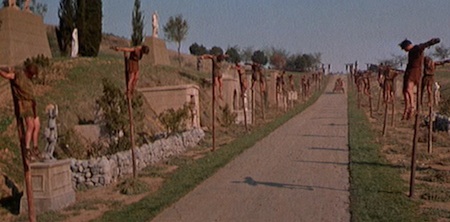
Note that after Spartacus’ revolt, the surviving slaves who participated (Spartacus was not one of them; he probably died during the battle - at least his body was never found) were rounded up and crucified - all 6,000 of them - lining the Appian Way from Rome to Capua.

 
Now it was the third hour, and they crucified him, and the superscription of his charge was superscribed: “The king of the Judaeans.” (Mark 15:25-26)

And over his head they put the charge against him written: “This is Jesus, the king of the Judaeans.” (Matthew 27:37)

Now there was also a superscription over him, “This is the king of the Judaeans.” (Luke 23:38)

Now Pilate also wrote a title and put it on the cross, and it was written, “Jesus the Nazorean, the king of the Judaeans.” Then many of the Judaeans read this title, because the place where Jesus was crucified was near the city, and it was written in Hebrew, in Roman, in Greek. So the chief priests of the Judaeans said to Pilate, “Do not write, ‘The king of the Judaeans,’ but that, ‘This man said, I am king of the Judaeans.’” Pilate answered, “What I have written I have written.” (John 19:19-23)

A resume of the crime(s) that a person had perpetrated, written on a sort of tablet, was sometimes either hung around the neck of a condemned person or paraded on a sign before him as he was marched or dragged to the site of execution.

And inasmuch as some of the jurymen voted to acquit even these conspirators, the emperor [Augustus] made a law that in trials at which the defendant was not present the vote should not be taken secretly and the defendant should be convicted only by a unanimous vote. Now that he took these measures, not in anger, but as really conducive to the public good, he gave very strong proof; at any rate, when [Fannius] Caepio’s father freed one of the two slaves who had accompanied his son in his flight because this slave had wished to defend his young master when he met with death, but in the case of the second slave, who had deserted his son, led him through the midst of the Forum with an inscription making known the reason why he was to be put to death, and afterwards crucified him, the emperor was not vexed.
  • Dio Cassius, 54.3.7
At a public banquet in Rome [Caligula] immediately handed a slave over to the executioners for stealing a strip of silver from the couches, with orders that his hands be cut off and hung from his neck upon his breast, and that he then be led about among the guests, preceded by a placard giving the reason for his punishment.

A householder who said that a Thracian gladiator was a match for the murmillo, but not for the giver of the games, [Domitian] caused to be dragged from his seat and thrown into the arena to dogs, with this placard: "A favourer of the Thracians who spoke impiously."
  • Suetonius, Caligula 32; Domitian 10
But Attalus was called for loudly by the people, because he was a person of distinction. He entered the contest readily on account of a good conscience and his genuine practice in Christian discipline, and as he had always been a witness for the truth among us. He was led around the amphitheater, a tablet being carried before him on which was written in the Roman language ‘This is Attalus the Christian,’ and the people were filled with indignation against him. But when the governor learned that he was a Roman, he commanded him to be taken back with the rest of those who were in prison concerning whom he had written to Caesar, and whose answer he was awaiting.
  • Eusebius, Church History 5.1.43-44
In all the above passages, only one directly deals with a crucifixion. So it would seem that this was an occasional practice of variable application. Also, all of the above passages only speak of the placard in the context of the parading of the victim; the posting of the accusation on the cross is not-well attested, either because those describing crucifixion had already mentioned its being carried or because the practice was not standard. In fact, some think that the reason why this detail was remembered is precisely because it was unique.

‘King of the Judaeans’ (or traditionally, ‘king of the Jews’) is not a religious term, but a political one (cf. Josephus, Antiquities 14.36; 15.373; 16.311, all in reference to Herod the Great; Jewish War 6.104, of the Judahite king Jeconiah/Coniah/Jehoiachin; 7.171, “Alexander [Jannaeus], the king of the Jews;” Plutarch, Pompey 45.5 “Aristobulus, king of the Jews”). While there were a few people who doubted the historicity of the inscription, the early Christians generally hesitated to explicitly grant the title ‘king’ for Jesus for political reasons, so the title is not confessional and thus, is unlikely to have been fabricated. The title is not so much a formal statement of charges as it was an expression of Roman ridicule for a supposed insurrectionist who was made out to be king.
 
And they crucify him and were dividing up his clothes, throwing the lot upon them, who may take what. (Mark 15:24)

And having crucified him, they divided up his clothes among them, throwing the lot. And sitting down, they were keeping watch over him there. (Matthew 27:35-36)

And when they came to the place called ‘Skull’, there they crucified him, and the criminals, one on the right and one on the left. [And Jesus said, “Father, forgive them, for they do not know what they are doing.”] And dividing up his clothes, they threw the lot. (Luke 23:33-34)

When the soldiers had crucified Jesus, they took his clothes and made four parts, to each soldier a part; also the tunic. But the tunic was seamless, woven from the top throughout, so they said to one another, “Let us not tear it, but throw the lot for it to see whose it shall be,” that the Scripture might be fulfilled: “They divided up my clothes among them, and for my clothing they threw the lot.” So the soldiers did these things. (John 19:23-24)

From these texts we can infer that Jesus was naked on the cross (cf. Artemidorus, Oneirocritica 2.53):

Being crucified [in a dream] is auspicious for all seafarers. For the cross, like a ship, is made of wood and nails, and the ship’s mast resembles a cross. It is also auspicious for a poor man. For a crucified man is raised high and his substance is sufficient to keep many birds. But it means the betrayal of secrets. For a crucified man can be seen by all. On the other hand, it signifies harm for rich men, since the crucified are stripped naked and lose their flesh.

We are not told how Jesus was crucified. The only explicit indication in the gospels of Jesus being nailed onto His cross comes from Thomas’ statement in John 20:25: “Unless I see in his hands the mark of the nails, and place my finger into the mark of the nails…” Even then, it only speaks of nails being driven into Jesus’ hands, with no indication of the feet. The 2nd-century Gospel of Peter is equally silent about the feet (“Then they drew the nails out of the hands of the Lord and placed him upon the earth…”), and two out of the three earliest images of crucifixion (look at post number 6 of this thread) are ambiguous about the matter; the Pereire gemstone, by contrast, shows the crucified figure’s legs as unbound to the cross, but spread out, dangling loosely. (But then again, the figure himself seems to be merely tried at the wrists with rope than nailed.)

http://img202.imageshack.us/img202/3784/crucifixionh.jpg

On the other hand, the ankle bone of Yehohanan (the crucified man from Givat ha-Mivtar) shows us that the nailing of the feet or ankles, even if not ‘common’ procedure, is at least an attested practice. Also, the Christian interpretation of Psalm 22:16 (“they pierced my hands and my feet”) seems to encourage the idea (so Justin Martyr, Dialogue with Trypho 97: “for when they crucified Him, driving in the nails, they pierced His hands and feet”).


Luke 24:40 (“He showed them his hands and his feet”) can also be taken as evidence that there was something about/at Jesus’ feet which could convince the disciples, but on the other hand, there is also a possibility that it need not necessarily mean a nail wound. For instance, the mid 2nd-century Epistula Apostolorum interprets the command in the light of the popular belief that ghosts levitate: “That you may know that it is I, put your finger, Peter, in the nailprints of my hands, and you, Thomas, put your finger in the spear-wounds of my side; but you, Andrew, look at my feet and see if they do not touch the ground. For it is written in the prophet: ‘The foot of a ghost or a demon does not join to the ground’.”
 
Status
Not open for further replies.
Back
Top