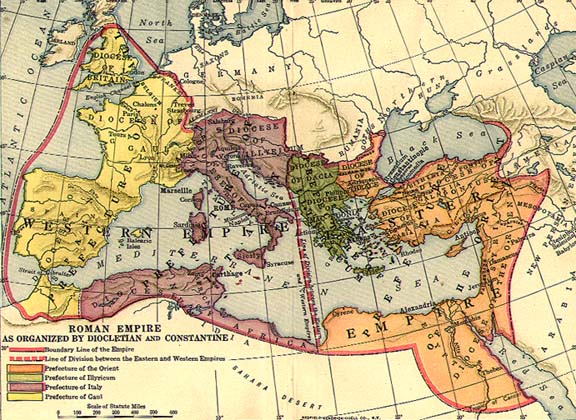
Geography definitely did have something to do with the designation originally, although with Christianity now having a worldwide exposure and many places where the populations are mixed, it just seems to be a misnomer now.
Originally (as stated previously), the Roman empire had been divided into eastern and western “halves” for organizational purposes. It really was not a true half-split in any sense.
I believe the western portion was slightly larger in land mass, but much smaller in population. Also the western half had a less developed economy, being largely frontier land open for colonization. The road network was extensive in the west, but not really as comprehensive because the cities were so far apart and the woods (over much of western Europe) were thick virgin forest.
Rome was close to the center of the combined empire, but what really mattered was where the emperor called home and for each one that could be different. This situation lasted over a long succession of emperors. After the formal division there was one Roman Senate (for both halves) and that remained in the city of Rome.
With Diocletian’s new system there were four emperors and each set up housekeeping in a different city. Constantine eventually gained control of the entire government through a series of civil wars and moved the Roman Senate to his new capital further east.
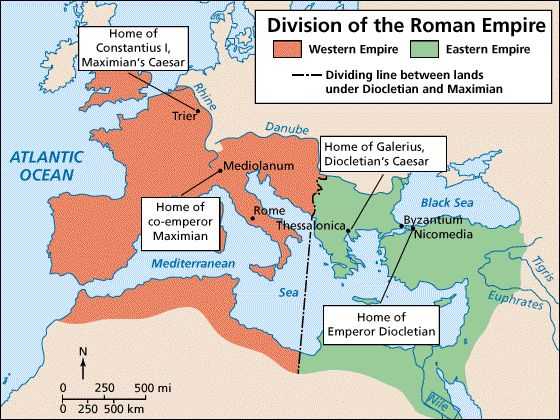

Basically, the Apostles worked in the eastern half for the most part, with Rome being about as far west as any went. There was also activity across the border further east and south. From the perspective of a churchman in the city of Rome, everything was ‘east’. But ‘eastern’ and oriental’ are not good descriptions of the non-Roman churches. It is a catch-all phrase which lumps everyone together based upon nothing more than historical chance, or coincidence.