Eastern Christianity Saints & Feasts

  • Thread starter Thread starter Edwin1961
  • Start date Start date
Status
Not open for further replies.
Thank you for the information about St Helena and the True Cross of Christ. I have a devotion to her and took her for my confirmation saint.
 
**September 15
Post-Festive Day of the Exaltation of the Holy Cross

The Holy Martyr Nicetas**
Nicetas was a Goth by birth, and a disciple of Bishop Theophilus of the Goths, who took part in the First Ecumenical Council. When Athenarik, Prince of the Goths, began to persecute the Christians, St Nicetas stood before the prince and denounced him for his paganism and inhumanity. Tormented by terrible tortures, Nicetas the more strongly confessed his faith in Christ, and prayed to God with thanksgiving. His mind was unceasingly lifted up to God and immersed in Him, and in his hand beneath his robe he held an icon of the holy Mother of God with the pre-eternal Christ Child standing and holding the Cross in His hands. St Nicetas carried this icon because the holy Mother of God had appeared to him and comforted him. Finally, the torturer threw Christ’s martyr into the flames, in which St Nicetas breathed his last; but his body remained untouched by the fire. His friend Marianus took his body from the land of the Goths (Wallachia and Bessarabia) to Cilicia, to the town of Mopsuestia, where he built a church dedicated to St Nicetas and placed the wonderworking relics of the martyr in it. Nicetas suffered and was glorified in 372.

Our Holy Father Philotheus
He was from the village of Myrmix or Mravin in Asia Minor. His mother had the same name the other way round - Theophila. He was a priest, and a wonderworker even during his lifetime. On one occasion, he turned water into wine, and on another multiplied bread. He entered into rest in the Lord in the tenth century, and myrrh was found to flow from his relics.

The Holy Martyr Porphyrius
An actor, he first mocked at Christians before Julian the Apostate. On one occasion, when he was mimicking the Christian mystery of Baptism, he was dipped into the water, pronouncing the words: ‘In the name of the Father, and of the Son, and of the Holy Spirit.’ When he emerged from the water, he cried out: ‘Now I am a Christian!’ Everyone thought that this was in jest, as always, but he held firm to it, stopped mocking Christians and finally suffered for Christ. He was beheaded in 361, and entered into the Kingdom of Christ.

The Holy Martyrs Theodotus, Asclepidote and Maximus
Nobles of Trachis, they suffered for Christ near Philipopolis in the village of Saltis, some time between 305 and 311, and entered into the Kingdom of heaven.

Today’s Readings
Galatians 4:8-21
Mark 6:45-53
 
**September 16
Post-Festive Day of the Exaltation of the Holy Cross
Saturday after the Exaltation of the Holy Cross

The Holy and Great Martyr Euphemia**
Born in Chalcedon, her father was the senator Philophronus and her mother’s name was Theodorisia, both devout Christians. Euphemia was a girl beautiful in both body and soul. When the Proconsul, Priscus, celebrated a festival of sacrifice to Ares in Chalcedon, forty-nine Christians absented themselves from the festivities and hid themselves. But they were discovered and brought before Priscus, holy Euphemia being among them. When the furious Priscus asked them why they had not carried out the imperial command, they replied: ‘Both the Emperor’s commands and yours must be obeyed if they are not contrary to the God of heaven. If they are, they must not only not be obeyed; they must be resisted.’ Then Priscus put them to various tortures for nineteen days, from day to day. On the twelfth day, he held Euphemia apart from the others and began to flatter her beauty, hoping to bring her thus to idolatry. When all his flattery proved fruitless, he ordered that she be tortured. First, she was put on a wheel, but an angel of God appeared and broke it. Then he had her thrown into a fiery furnace, but she was preserved by God’s power. Seeing this, two soldiers, Victor and Sosthenes, came to faith in Christ, for which they were thrown to the wild beasts and thus finished their earthly course with glory. After that, Euphemia was thrown into a pit filled with water and all kinds of poisonous reptiles, but she made the sign of the Cross over the water as she went into the pit, and remained unharmed. She was finally thrown to the wild beasts and, with a prayer of thanksgiving, gave her soul into God’s hands. Her parents buried her body. She suffered in the year 303, and entered into eternal joy. (St Euphemia is also commemorated on July 11th).

Our Holy Father Dorotheus
An Egyptian hermit of the fourth century, he lived in asceticism for sixty years in a cell in the Thebaid. He was distinguished by a rare love of labour and by wonderworking power. By day he built cells for the new monks and by night plaited mats, never interrupting his prayer and psalmody.

St Cyprian, Metropolitan of Kiev
Born in Trnovo and given a Serbian upbringing on the Holy Mountain, he devoted himself especially to the translation and writing of books. His patron was Patriarch Philotheos of Constantinople, who came to know him on the Holy Mountain, took him into his service and then sent him to Kiev as Metropolitan. He lived through all this with greatness of soul and, by his fruitful labours, brought much benefit to the Russian Church, spending almost thirty years as Metropolitan. At the time of his death, he wrote a Farewell which was read at his graveside. He entered into rest on September 16th, 1406, and his wonderworking relics are preserved in the Church of the Dormition in Moscow.

The Holy Martyr Ludmilla
The grandmother of the Czech King Vatslav (Wenceslas) and wife of the Czech Prince Borivoy, she was very zealous for the Christian faith and was greatly instrumental in freeing the Church from paganism. Her daughter-in-law hated her, and sent men to kill the aged Ludmilla in Techino in 927. Vatslav buried her in the Church of St George in Prague, and many miracles were wrought over her relics. Holy Vatslav, a great zealot for the Orthodox faith, was murdered by his brother Boleslav.

Today’s Readings
1 Corinthians 1:26-29
John 8:21-30
 
**September 17
FIFTEENTH SUNDAY AFTER PENTECOST
Post-Festive Day of the Exaltation of the Holy Cross
Sunday after the Exaltation of the Holy Cross

The Holy Martyrs Vera, Nada and Lubov (Faith, Hope and Love), and their mother Sophia**
They lived and suffered in Rome in the time of the Emperor Hadrian. The wise Sophia (as her name - Sophia - wisdom, indicates) was left a widow and, as a Christian, steeped herself and her daughters in the Christian faith. At the time that Hadrian’s persecuting hand stretched out over the virtuous house of Sophia, Vera was twelve, Nada ten and Lubov nine. The four of them were brought before the Emperor, with their arms entwined ‘like a woven wreath’, humbly but firmly confessing their faith in Christ the Lord and refusing to offer sacrifice to the goddess Artemis. At the moment of their passion, the mother urged her valiant daughters to endure to the end: ‘Your heavenly Lover, Jesus Christ, is eternal health, inexpressible beauty and life eternal. When your bodies are slain by torture, He will clothe you in incorruption and the wounds on your bodies will shine in heaven like the stars.’ The torturers inflicted harsh torture on Vera, Nada and Lubov one by one. They beat them, stabbed them and threw them into fire and boiling pitch, and finally beheaded them one after the other. Sophia took the dead bodies of her daughters out of the town and buried them, and stayed by their grave in prayer for three days and nights, then gave her soul to God, hastening to the heavenly company where the blessed souls of her daughters awaited her.

The Holy Martyr Agathocleia
She was a servant of one Nicolas and his wife Paulina, who were at first Christians but forsook Christianity and turned again to idol-worship. Holy Agathocleia refused to follow the example of her masters, and for this was harshly tortured both by them and by the judge. Finally, her mistress killed her by pouring burning coals on her neck, but God glorified His handmaid in His heavenly kingdom.

The 156 Holy Martyrs of Egypt
They were all Egyptians, and suffered for Christ the Lord in 310, some by the sword and some by fire. Among them were two old bishops, Peleus and Nilus, a priest, Zeno, and two renowned men, Patermuthius and Elias. With them also suffered Bishop Silvanus and an eminent, blind old man, John, who knew the Scriptures by heart and recited them to gatherings of Christians. They were all crowned with wreaths and entered into the eternal Kingdom of Christ.

The Holy Martyr Theodota
She endured eight years of harsh torture on the part of the governor, Simplicius, who finally went out of his mind. She was beheaded with the sword in the time of the Emperor Alexander Severus, in about 230.

Today’s Readings:
Galatians 2:16-20
Mark 8:34-38 Mark 9:1
 
**September 18
Post-Festive Day of the Exaltation of the Holy Cross

St Eumenius, Bishop of Gortyna in Crete**
He gave himself to Christ with his whole heart from his youth, freeing himself of two heavy burdens: the burden of riches and the burden of the flesh. He freed himself from the first by giving away all his goods to the poor and needy, and from the latter by strict fasting. He thus healed himself and was able to heal others. Passionless and filled with the grace of the Holy Spirit, Eumenius shone with a radiance that could not be hidden, as it is written: ‘A city set on a hill cannot be hid’ (Matt. 5:14), and so holy Eumenius could not be hidden from the world. Seeing him, the people chose him as their bishop in Gortyna. As a bishop, he governed Christ’s flock as a good shepherd. He was a father to the poor, riches to the needy, consolation to the sad, healing to the sick and a marvellous wonderworker. He worked many miracles by his prayers: he killed a poisonous snake, drove out demons, healed many of the sick, and did this not only in his home city but in Rome and in the Thebaid. In the Thebaid, he brought rain from God in a time of drought, and there finally finished his earthly course and entered into the eternal presence of his Lord. He lived and worked in the seventh century.

The Holy Martyr Ariadne
In the town of Promisea in Phrygia in the time of the Emperor Hadrian (117-138), there lived a pagan patrician, Tertullus. The maiden Ariadne was a slave of his, and a Christian. On his son’s birthday, Tertullus ordered a great sacrifice to the idols, in which Ariadne did not take part, staying at home and praying to the true God. Her owner was furious with her for this, and put pressure on her to deny Christ and worship idols. When Ariadne refused to do this, he had her whipped and tortured in other ways, then threw her into prison. He soon released her from prison and drove her from the house, but quickly changed his mind and sent servants to bring her back. Ariadne was already a long way from the town. When she saw her persecutors, she prayed to God beside a great rock, and the rock opened and hid her. The servants were nonplussed at this, quarrelled among themselves and came to blows, and so perished at one another’s hands.

Today’s Readings:
Galatians 4:28-31 Galatians 5:1-10
Luke 3:19-22
 
**September 19
Post-Festive Day of the Exaltation of the Holy Cross

The Holy Martyrs Trophimus, Sabbatius and Dorymedon.**
In the time of the Emperor Probus, in the third century, when Atticus was governing Antioch, two Christians, Trophimus and Sabbatius, both eminent and honoured men, came to that city. Just at that time, there was a pagan festival and offerings to the idol of Apollo in Daphne near Antioch. Atticus made a special effort to ensure that all the citizens took part in the festivities. When someone saw Trophimus and Sabbatius, and told Atticus that these two old men were not taking part, Atticus summoned them for trial, and, when they refused to deny Christ, put them to torture one by one. After beating and torturing Trophimus, he sent him to Phrygia to Dionysius, a yet harsher torturer of Christians, himself taking Sabbatius from prison and trying him. When the torturer asked Sabbatius who he was and what was his rank, he replied: ‘My rank and dignity, my homeland, my glory and my riches are Christ the Son of God. who is alive for ever and by whose providence the whole universe is held in being.’ He was therefore beaten and flogged with iron flails until his bones showed through his flesh, and he died under these tortures. The torturer put Trophimus to harsh torture, and held him in prison to inflict yet greater torture on him. Then a certain senator, Dorymedon, a secret Christian, came to the prison and ministered to Trophimus. When the torturer discovered this, he put them both to torture and finally threw them to the wild beasts. But the animals would not touch them. Holy Dorymedon even shouted into the ear of a she-bear to eat him up, but the bear only became even more docile. The torturer ordered, in consequence of this, that Ss Trophimus and Dorymedon be beheaded. The souls of these holy martyrs now reign in heaven.

The Holy Martyr Zossima the Hermit
A Sicilian prince, Dometian, went hunting in the mountains with his servants. In the hills, he saw an old man surrounded by wild beasts that were as tame as lambs. Asked who he was, the old man replied that his name was Zossima, and that he was a Christian and had lived a long time with the beasts, who were better than the persecutors of Christians in the city. This outraged Dometian, who was himself a harsh torturer of Christians, and he bound Zossima and sent him ahead to Nazareth, to torture him there and thus intimidate those who believed in Christ. When he had wounded him all over and left him bloodied with blows, he tied a rock round his neck and hanged him from a tree. Then the prince mocked at him: ‘Command a wild beast to come, and we’ll all believe!’ The holy martyr prayed to God, and an enormous lion appeared. Coming up to Zossima, it took the weight of the rock with its head, to ease the martyr. With great fear, the prince freed Zossima, who soon after that gave his soul into the hands of his Lord.

Today’s Readings:
Galatians 5:11-21
Luke 3:23-38 Luke 4:1
 
**September 20
Post-Festive Day of the Exaltation of the Holy Cross

The Holy and Great Martyr Eustace**
He was a great Roman military leader in the time of the Emperors Titus and Trajan. Although a pagan, Placidus (for that was his pagan name) was a righteous and merciful man, like the centurion Cornelius, who was baptised by the Apostle Peter (Acts 10). Going hunting one day, he found a stag. By the providence of God, a shining Cross appeared among the stag’s antlers and the voice of God came to Placidus, telling him to go to a Christian priest and be baptised. Placidus was baptised, along with his wife and two sons. At his baptism, he received the name Eustace, his wife the name Theopiste and their sons the names Agapius and Theopistus. After his baptism, Eustace went back to the very place where the revelation through the stag had occurred, and thanked God on his knees that he had brought him to the truth. At that, the voice of God came to him again, foretelling suffering for His name and strengthening him. Then Eustace secretly left Rome with his family, with the intention of hiding among simple people and serving God in an unknown and humble way. Arriving in Egypt, he was immediately beset by trials. Some wicked barbarian carried off his wife, and his two sons were seized by wild beasts. But the barbarian quickly came to a bad end, and a herdsman saved the boys from the wild beasts. Eustace settled in the Egyptian village of Vadisis, and there lived as a village hireling for fifteen years. After this, the barbarians descended on the Roman Empire, and the Emperor Trajan was sorry that his brave commander Placidus, who had been victorious wherever he had fought, was not with him. The Emperor sent two of his officers to seek the great general throughout the Empire. By God’s providence, these officers, who had been friends of Eustace, came to this village of Vadisis, found him and took him to the Emperor. Eustace gathered the army together and defeated the barbarians. On the way back to Rome, Eustace went and found his wife and sons. When he arrived in Rome, the Emperor Trajan had died and the Emperor Hadrian was on the throne. When Hadrian summoned Eustace to offer sacrifice to idols, Eustace told him that he was a Christian. The Emperor put him to torture, together with his wife and sons. When the wild beasts did them no harm, he threw them into a white-hot metal ox. On the third day, they took out their bodies, dead but untouched by the fire. Thus this glorious general gave to Caesar that which is Caesar’s, and to God that which is God’s, and entered into the eternal Kingdom of Christ our God.

The Holy Prince Michael and his Counsellor Theodore
Prince Michael of Chernigov went to the Tartar horde with his counsellor, Theodore, at the invitation of their ruler, Bati. When they refused to follow the Tartar custom of passing through fire and worshipping idols on being received by Bati, they were beheaded, in 1244. Their relics, the witnesses of their death by martyrdom for the sake of Christ, are preserved in the Church of the Archangel in Moscow.

Our Holy Father, the Martyr Hilarion
A monk of the Holy Mountain, he suffered voluntarily for the Christian faith at the hands of the Turks in Constantinople on September 20th, 1804. His wonderworking relics are preserved in the Church of the Transfiguration on the island of Proti.

Today’s Readings:
Galatians 6:2-10
Luke 4:1-15
 
**September 21
Leave-taking of the Exaltation of the Holy Cross

The Holy Apostle Codratus.**
One of the Seventy, he was a disciple of the Great Apostles. He preached the Gospel in Athens, and was at first bishop in Athens after St Publius, and then in the city of Magnesia. He was very learned in the secular disciplines and rich with the grace of the Holy Spirit. His biographer says of him: ‘He was as a morning star among clouds’, the clouds being the darkness of Hellenic paganism, lacking the light of devotion, and the holy Apostle Codratus shone to them - the Hellenes - as a great light, illumining the darkness, casting down the foul sacrifices and destroying demonic temples by his prayers. But darkness always hates the light, and the pagans hated holy Codratus. They first stoned him, as the Jews had earlier stoned St Stephen, and then imprisoned him, leaving him without bread until his holy soul left his body and entered into the Kingdom of Christ his God. St Codratus wrote a defence of Christianity and gave it to the Emperor Hadrian. This defence acted so strongly upon the pagan Emperor that he decreed that Christians should not be persecuted without especial cause. Holy Codratus suffered in about 130. He was buried in Magnesia, the place of his passion.

The Hieromartyr Hypatius, Bishop of Ephesus, and Andrew the Priest
Two childhood friends, born in Lycia. they both gave themselves with their whole souls to the service of God when they grew up, Hypatius as a strict monk and ascetic, and Andrew as a priest among the people and a preacher of the Word of God. For his great virtues, Hypatius was made Bishop of Ephesus, and Andrew was made priest in the same city. They both suffered in the time of the iconoclast Emperor Leo the Isaurian. After terrible tortures for Orthodoxy, they were beheaded in 730, and both went from this transitory world to eternal life.

Today’s Readings:
Ephesians 1:1-9
Luke 4:16-22
 
**September 22

The Hieromartyr Phocas, Bishop of Sinope.**
He exercised himself from his youth in all the Christian virtues. As bishop in his birthplace, the town of Sinope on the shore of the Black Sea, he strengthened the devout in their faith by his divine example and words, and brought many idol-worshippers to the true Faith. The stony-hearted pagans were filled with wrath against holy Phocas, and the Lord foreshowed to him in a vision his death by martyrdom. Phocas saw a shining dove fly down from heaven, carrying in its beak a beautiful wreath of flowers which it laid on his head, and a voice came from the dove: ‘My cup is full, and it is for thee to drink it!’ From this vision, the man of God learned that he must very soon suffer for Christ. He was not afraid, but, with thanksgiving to God, prepared himself for torture. Soon after this, the Governor, Africanus, took Phocas for interrogation and inflicted harsh tortures upon him: his whole body was beaten black and blue and torn with wounds, and, after imprisonment, he was thrown into boiling water, in which this courageous soldier of Christ finished his earthly course and entered into the joy of his Lord. He suffered in the time of the Emperor Trajan (98-117).

The Holy Prophet Jonah.
He lived more than eight hundred years before Christ. It is said that he was the widow’s son of Zarephath in Sidon, whom the Prophet Elias raised from the dead. By his three-day sojourn in the belly of the whale, St Jonah foreshadowed the three-day sojourn of Christ in the tomb, and, by his deliverance from the whale’s belly, the Lord’s Resurrection from the dead. Everything else about this wonderful prophet is there to be read in the Book of Jonah.

The Holy Martyr Phocas the Gardener.
A compatriot of the hieromartyr Phocas, he had a garden in Sinope, near the Black Sea, which he cultivated himself. He refreshed all the passersby with the fruits of his garden, not neglecting to entertain their ears with the Word of God. But the governor, who was a persecutor of Christians, heard of him and sent soldiers to kill him. Phocas welcomed the soldiers so warmly that they held back from killing him, but, at his beseeching, carried out their orders and beheaded him. In that place, a church dedicated to him was soon built over his relics. St Phocas is especially venerated by seamen, and is invoked for aid by all who travel by sea. He suffered in 320.

Our Holy Father Cosmas of Zographou.
He was of a noble Bulgarian family. When his parents wanted him to marry, he fled to the Holy Mountain. He was a solitary and a wonderworker, living in asceticism in a cave near the monastery of Zographou, and was the greatest ascetic and wonderworker of that monastery. The Mother of God appeared to him several times. The cell in which Cosmas lived in silent asceticism and wrestled with demons remains to this day to the north-west of the monastery. Being gifted with discernment, he could see in the spirit, and described happenings in far-off times and places. He died in old age, on September 22nd, 1323, and, after a life of much toil, entered into the joy of his Lord.

Today’s Readings
Ephesians 1:7-17
Luke 4:22-30
 
**September 23
The Conception of the Holy Prophet, Forerunner and Baptist John

The Conception of St John the Baptist**
On this day are celebrated God’s mercy, His wondrous act and His wisdom: His mercy towards the devout and righteous parents of St John, the aged Zacharias and Elisabeth, who had all their lives begged a child of God; the wonder of the conception of John in Elisabeth’s more-than-aged womb; and the wisdom of the dispensation of man’s salvation. For John, God had a specially great plan: that he should be a prophet and the forerunner of Christ the Lord, the Saviour of the world. Through His angels, God revealed the birth of Isaac to the childless Sarah, and of Samson to the childless Manoah and his wife, and of John the Baptist to the childless Zacharias and Elisabeth. Through His angels, God revealed the birth of those for whom He had a special plan. How could children be born of aged parents? If someone is curious to find out, let him not ask men, for men do not know, nor does natural law (it being beyond natural law), but let him turn his gaze to the power of almighty God, who made the whole world from nothing and who, for the creation of Adam, the first man, used no parents, either young or old. Instead of being curious, let us thank God that He often reveals to us His power and mercy and wisdom beyond the natural law, by which we would otherwise be fettered and, without these special wonders of God, would fall into despair and forgetfulness of Him.

The Holy Martyr Iraida
She is sometimes called Ra?s or Raida. A maiden from an Egyptian town called Batan, she was therefore probably an Egyptian. Iraida went out one day to draw water from a well near the sea, and saw a ship laden with bound Christians: priests, deacons, monks, women and maidens. Enquiring, she learned that pagan torturers were taking all this crowd to torture and death for the name of Christ the Lord. In the heart of the young Iraida, the desire flared up to suffer for the Lord. She left her pots by the well, went onto the ship and confessed that she was a Christian. She was immediately bound and taken with the others t the Egyptian town of Antinopolis. After divers tortures, Iraida was the first to be beheaded, followed by the others. She suffered with honour and was glorified at the beginning of the fourth century.

The Holy New Martyr Nicolas Pantopoles (The Grocer)
He suffered for the Christian faith as a young man at the hands of the Turks in Constantinople in 1672; his father, a grocer, having moved there from Thessaly. He took the name of his father’s trade (in Greek, pantopoles). After great pressure to become a Turk, and torture because he refused, he was beheaded and entered into the Kingdom of God. His relics are preserved in the monastery of Xeropotamou on the Holy Mountain.

The Holy New Martyr John
Born in a place called Konitsa in Albania, he was a Moslem of Moslem parents. Later, seeing the wonderful power of the Christian faith in various places and events, he was baptised. He was arrested for this and brought before the Turkish judge. Tortured for the Christian faith in Aetolia and beheaded in 1814, he cried out at the time of his death: ‘Remember me, O Lord, in Thy Kingdom!’

Today’s Readings:
Galatians 4:22-31
Luke 1:5-25
 
**September 24
SIXTEENTH SUNDAY AFTER PENTECOST

The Holy Protomartyr Thecia, Equal to the Apostles**
Thecla was born in Iconium of eminent pagan parents. She was betrothed at the age of eighteen to a young man, at the time that the Apostle Paul came to Iconium with Bamabas to preach the Gospel. Listening to Paul for three days and nights, Thecla turned utterly to the Christian faith and vowed to live in virginity. Her mother, seeing that she shunned her betrothed and thought no more of marriage, first talked to her and then beat her and starved her. Finally, she gave her over to the judges and demanded, wicked mother that she was, that 'Mecla be burned. The judge threw her into the flames, but God preserved her unharmed. Thecla then became a follower of the Apostle Paul, and went with him to Antioch. Attracted by Thecla’s beauty, an elder of the city attempted to take her by force, but Thecla tore herself out of his grasp. The elder denounced her to the governor as a Christian who was averse to marriage. The governor condemned her to death and threw her to the wild beasts, but the animals would not touch the body of this holy virgin. Amazed at this, the governor asked: ‘Who are you, and what is the power that you have in you, that nothing can do you harm?’ Thecia replied: ‘I am a servant of the living God.’ Then the governor let her go free, and she began to preach the Gospel and succeeded in bringing many to the true Faith, among whom was an eminent and honoured widow, Tryphena. After this, St Thecla, with the blessing of the Apostle Paul, withdrew to a solitary place near Seleucia. She lived a long time there in asceticism, healing the sick with miraculous power and in this way bringing many to Christianity. The doctors in Seleucia were jealous of her and sent some young men to assault her, hoping that, in losing her virginity, she would lose also her miraculous power. Thecla fled from these insolent young men and, when she saw that they would catch her, prayed to God for help in front of a rock, and the rock opened and hid the holy maiden and bride of Christ. This rock was her hiding place and her tomb . St Chrysostom says of this wonderful Christian heroine and saint: ‘I seem to see this blessed virgin going to Christ with virginity in one hand and martyrdom in the other.’

St Stephen, King of Serbia, the First-Crowned (Simon the Monk)
Crowned king at Zica, his foundation, by his brother and spiritual father, St Sava, he was a devout Christian and a wise and peaceloving ruler. Stephen, together with St Sava, raised Orthodoxy to great heights among his people. At his desire, St Sava made him a monk at the time of his death, giving him the name Simon. He entered into rest in the Lord on September 24th, 1224, and his relics are preserved at Studenica.

Today’s Readings:
2 Corinthians 6:1-10
Luke 5:1-11
 
September 25
The Venerable Euphrosyne

Euphrosyne was the daughter of Paphnutius, a wealthy and distinguished man of Alexandria. Her childless parents had besought God with prayer for the birth of a child, and they were given her. Her devout parents raised their daughter in the Christian Faith. Not wanting to enter into marriage, the young Euphrosyne hid from her father, changed into men’s clothing, and presented herself to the abbot of a monastery as a eunuch of Emperor Theodosius, giving the name Smaragdus. The abbot received her, and turned her over to the spiritual father Agapitus for guidance. By her fasting and prayerful asceticism, Smaragdus quickly surpassed all the monks in that monastery. When she had completed thirty-eight years of strict asceticism, her father Paphnutius visited that monastery, and the abbot directed him to Smaragdus for prayer and counsel. Smaragdus recognized Paphnutius, but Paphnutius did not recognize Smaragdus. When the father confessed his grief for his lost daughter, Smaragdus told him not to lose hope, for he would see his daughter again in this life, and besought him to come again within three days. When Paphnutius came again, Smaragdus was on her deathbed. The dying one said to Paphnutius: ``I am Euphrosyne, your daughter; you are my father!’’ For a long time, the father was unable to come to himself due to his severe shock. Then, the Blessed Euphrosyne breathed her last, and her father wept over her. After burying her, Paphnutius himself entered the monastery, and settled in the cell of his holy, reposed daughter. After ten years of asceticism, Paphnutius also entered into rest in the Lord.

The Venerable Sergius of Radonezh
Sergius was a great ascetic and light of the Russian Church. He was born in 1313, in Rostov, of devout parents, Cyril and Maria. After his parents’ deaths, Bartholomew-for that was his baptismal name-became a monk, and founded the Monastery of the Holy Trinity in the forests of Radonezh. As a quiet and gentle servant of God, he knew only labor and prayer. Because of the purity of his heart he was made worthy of the gift of miracle-working, even resurrecting the dead in the name of Christ. The Holy Theotokos appeared to him many times. Princes and bishops came to him for advice. He blessed Prince Dimitri Donskoy, and foretold his victory in the battle for the liberation of Russia from the Tartars. He saw into the hearts of men as well as future events. His monastery was full of monks, even during his lifetime and, century after century, has been one of the most important centers of spiritual life and God’s miracles. St. Sergius entered into rest in the year 1392. Following his repose, he appeared many times to various people.

(Continued)
 
September 25Continued

Today’s Readings:
Galatians 4:28-5:10

28: Now we, brethren, like Isaac, are children of promise.
29: But as at that time he who was born according to the flesh persecuted him who was born according to the Spirit, so it is now.
30: But what does the scripture say? “Cast out the slave and her son; for the son of the slave shall not inherit with the son of the free woman.”
31: So, brethren, we are not children of the slave but of the free woman.
1: For freedom Christ has set us free; stand fast therefore, and do not submit again to a yoke of slavery.
2: Now I, Paul, say to you that if you receive circumcision, Christ will be of no advantage to you.
3: I testify again to every man who receives circumcision that he is bound to keep the whole law.
4: You are severed from Christ, you who would be justified by the law; you have fallen away from grace.
5: For through the Spirit, by faith, we wait for the hope of righteousness.
6: For in Christ Jesus neither circumcision nor uncircumcision is of any avail, but faith working through love.
7: You were running well; who hindered you from obeying the truth?
8: This persuasion is not from him who calls you.
9: A little leaven leavens the whole lump.
10: I have confidence in the Lord that you will take no other view than mine; and he who is troubling you will bear his judgment, whoever he is.

Luke 4:37-44
37: And reports of him went out into every place in the surrounding region.
38: And he arose and left the synagogue, and entered Simon’s house. Now Simon’s mother-in-law was ill with a high fever, and they besought him for her.
39: And he stood over her and rebuked the fever, and it left her; and immediately she rose and served them.
40: Now when the sun was setting, all those who had any that were sick with various diseases brought them to him; and he laid his hands on every one of them and healed them.
41: And demons also came out of many, crying, “You are the Son of God!” But he rebuked them, and would not allow them to speak, because they knew that he was the Christ.
42: And when it was day he departed and went into a lonely place. And the people sought him and came to him, and would have kept him from leaving them;
43: but he said to them, “I must preach the good news of the kingdom of God to the other cities also; for I was sent for this purpose.”
44: And he was preaching in the synagogues of Judea.
 
September 26
St John the Theologian, Apostle and Evangelist

John was the son of Zebedee the fisherman and Salome the daughter of Joseph, the betrothed of the holy Mother of God. Called by the Lord Jesus, John immediately left his father and the fishing nets and followed Christ with his brother James. From that time, he was not parted from his Lord until the end. With Peter and James, he was present at the raising of Jairus’s daughter and at the Lord’s Transfiguration, and laid his head on Jesus’ breast at the Last Supper. When ail the others had forsaken the crucified Lord, John staved beneath the Cross with the holy Mother of God. In obedience to the Lord’s wish, he was as a son to the holy Virgin Mary, caring for her and serving her, looking after her right up to her falling-asleep. After her Dormition, John went off with his disciple Prochorus to preach the Gospel in Asia Minor, and mainly lived and worked in Ephesus. By his inspired preaching and miracles, he brought many to Christianity and undermined the foundations of paganism. The vexed pagans bound him and sent him to Rome to the Emperor Domitian. He was tortured and flogged before the Emperor, but, when he was unharmed either by the strong poison that he was given to drink or the boiling oil into which he was put, the Emperor was afraid and, thinking he was immortal, sent him into exile on the island of Patmos. On this island, St John brought many to Christianity by his words and miracles, and strengthened the Church of God. He wrote his Gospel and the Revelation there. In the time of the Emperor Nerva, who gave liberty to all the captives, John returned to Ephesus, where he lived for some time, confirming the work that he had earlier begun. He was over a hundred years old when he went to the Lord. When his disciples later opened his grave, they found that his body was not there. Every year, on May 8th, a fine, fragrant dust, endowed with healing power rose from his grave. After a long and fruitful life of labour upon earth, this beloved disciple of Christ and pillar of the Church entered into the joy of his Lord, to peace and eternal rejoicing.

Our Holy Father Nilus of Calabria
A great ascetic among the Greeks of Calabria, the founder of several monasteries, a wonderworker and defender of the purity of Orthodoxy, he undertook long journeys simply in order to save another man trouble. He had a burning love for his neighbour, and entered into rest in 1005, leaving many disciples of real worth. The best-known among these is St Bartholomew, the writer of several Canons, who died in 1044.

Today’s Readings:
1 John 4:12-19
John 19:25-27 John 21:24-25
 
** September 27

The Holy Martyr Callistratus**
Born in Carthage, he was a Christian from his birth, as his father and grandfather were. One of his forbears, Neochorus, served as a soldier in Jerusalem under Pontius Pilate at the time of the Passion of our Lord and Saviour Jesus Christ. Seeing the many miracles that were wrought at the time of Christ’s death, Neochorus came to believe in Him, and was taught the Faith and baptised by the apostles. Returning home, Neochorus took his Christian faith to his own people, like a precious pearl. So, in time, St Callistratus was born, baptised and brought up a Christian. When he went into the army, there was no other Christian in his regiment. One of his companions, seeing holy Callistratus get up at night and pray to God, reported him to the commander, Persentinus, as a Christian - and Persentinus was a harsh torturer of Christians. When he was convinced that Callistratus was indeed a Christian, the commander ordered him to offer sacrifice to idols, which Callistratus immediately refused to do. Then Callistratus was harshly beaten and thrown into the sea, but God’s power preserved him, and he emerged from the sea unharmed. Seeing Callistratus’s endurance and his miracles, forty-nine soldiers came to believe in Christ the Lord, and they were beaten and thrown into prison along with him. In prison, St Callistratus instructed his companions in the Faith and encouraged them. They showed great courage in suffering, and the Lord showed great power through them. The wicked torturer sent soldiers to the prison at night, and they slew Callistratus and the other forty-nine. They suffered for the truth in 304, and a church was later built over their relics.

The Holy Apostles Mark, Aristarchos and Zenas
They were of the Seventy. St Mark was also called John. The apostles gathered together for prayer at the house of his mother, Mary, in Jerusalem (Acts 12:12). He preached the Gospel with the Apostles Paul and Barnabas, and was after that bishop in Byblos. St Aristarclius, a companion of the Apostle Paul on his travels (Acts 16:29), was Bishop in Syrian Apamea. St Zenas, spoken of as a lawyer by the Apostle Paul (Titus 3:13), was bishop in Palestinian Lydda. They shone like stars in the darkness of paganism and brought many to the Christian faith, and now they shine like stars in the Kingdom of Christ their Beloved.

Today’s Readings:Ephesians 3:8-21
Luke 5:33-39
 
**September 28

Our Holy Father Chariton the Confessor**
Chariton was an eminent and devout citizen of the city of Iconium. Imbued with the spirit of his compatriot, St Thecla, Chariton openly confessed the name of Christ. When a harsh persecution of Christians broke out under the Emperor Aurelian, Chariton was immediately brought to trial before the governor. The judge ordered him to worship false gods, to which Chariton replied: ‘All your gods are furies, which were aforetime through pride cast out from heaven into the nethermost hell.’ Chariton openly showed his faith in the one, living God, the Creator of all, and in the Lord Jesus Christ, the Saviour of mankind. Then the governor ordered that Chariton be so beaten and tortured that his whole body became covered with wounds until it was like one great wound. After the evil death of Aurelian, whose evil-doing caught up with him in the end, Chariton was released from torture and imprisonment. He travelled to Jerusalem, but on the way was seized by robbers from whom he was freed by God’s providence. He did not return to Iconium, but withdrew to the wilderness of Pharan, where he founded a community and gathered a group of monks together. Having given a rule to this community and desiring to escape the praise of men, he withdrew to another desert near Jericho where, in time, he founded another community, called after him. He finally founded another community, Souka, called in Greek the Old Lavra. He died at a great age and entered into the glory of his Lord on September 28th, 350, and his relics are preserved in his first monastery. The practice of tonsuring monks is attributed to St Chariton.

The Holy Martyr Vatslav (Wenceslas), King of the Czechs (Bohemians)
The grandson of St Ludmilia, he lived as king in spiritual striving in the Faith like the great ascetics, and strengthened the Orthodox faith among his people. He took care when sitting in judgement that no innocent man should suffer. In his zeal for the Christian faith and his love for his neighbour, holy Vatslav bought pagan children who had been sold as slaves and immediately baptised them, bringing them up as Christians. He translated St John’s Gospel into Czech and brought the relics of St Vitus and his grandmother, Ludmilia, to Prague. His brother Boleslav invited him to stay and killed him at his court. Immediately after this, Boleslav began to make German priests and to have the Liturgy celebrated in Latin. Holy Vatslav suffered in 919. His relics are reserved in Prague.

The Holy Prophet Baruch
A disciple and faithful friend of the holy prophet Jeremiah, he foretold the return of the Jews from slavery in Babylon and the coming of the Son of God on earth. It is held that he was killed by the Jews in Egypt, as was the Prophet Jeremiah, in the seventh century before Christ.

The Holy Martyr Mark the Shepherd
In the time of Diocletian, Magnus, governor of Antioch, went hunting with his soldiers. Chasing a wild beast, the soldiers saw that it fled to the shepherd, Mark, who was keeping his flocks just there. The beast stood fawning around Mark, the man of God. Seeing this, thirty of the soldiers, being instructed in the Faith by Mark, came to belief in Christ and were immediately beheaded. The governor bound Mark, took him to the town, summoned three brothers, Alexander, Alphaeus and Zossima, and ordered them to make instruments of torture to use on Mark, but the three of them, having talked with St Mark, embraced the Christian faith and refused the governor’s command. The governor condemned them to death, and ordered that molten lead be poured into their mouths. After this, holy Mark was beheaded and his body placed in the temple of Artemis, which temple was then destroyed by God’s power.

Today’s Readings:
2 Corinthians 4:6-15
Luke 6:17-23

 
September 29
The Venerable Cyriacus the Recluse

Cyriacus was born in Corinth, to John and Eudoxia. His father John was a presbyter and Peter, Bishop of Corinth, was his kinsman. In his early youth, the bishop ordained Cyriacus a reader in the cathedral church. Reading the Holy Scripture, the young Cyriacus marveled at God’s providence: how God glorified all His true servants and how He arranged the salvation of the human race. At age eighteen, Cyriacus’s desire for the spiritual life led him to Jerusalem. There, he entered the monastery of a godly man Eustorgius, who gave him his first instruction in the monastic life. After that, he went to St. Euthymius, who foresaw that he would be a great spiritual father. He clothed him in the schema and sent him to St. Gerasimus at the Jordan, where Cyriacus spent nine years. Following the death of Gerasimus, he returned to the Monastery of St. Euthymius, where he remained in stillness for ten years. Then, fleeing the praise of men, he moved from place to place. He finally lived a life of asceticism in the community of St. Chariton, where he ended his earthly sojourn of 109 years. A celebrated ascetic and miracle-worker, St. Cyriacus was massive and strong in body, and remained such in deep old age, despite strict fasts and vigils. In the wilderness, he sometimes ate only raw greens for years. He was very zealous for the Orthodox Faith, denouncing all heresies, especially that of Origen. He said of himself that, since he became a monk, the sun had neither seen him eat nor become angry with anyone. According to the Rule of St. Chariton, the monks ate only once a day, after the setting of the sun. Cyriacus was a great light, a pillar of Orthodoxy, the adornment of monks, a mighty healer of the sick, and a gentle comforter of the sorrowful. Having lived long for the benefit of many, he took up his habitation in the eternal joy of his Lord in the year 557.

The Holy Martyrs Dada and Gabdelas
Dada was a great Persian nobleman and a kinsman of King Sapor, and Gabdelas was Sapor’s son. When St. Dada openly confessed his faith in Christ, King Sapor ordered that he be cruelly tortured. During these tortures, Dada worked great miracles in the name of Christ, and these so strongly influenced Gabdelas that he also believed in Christ. The pagan King did not even spare his own son, but subjected him also to harsh tortures. Both Dada and Gabdelas glorified God with their patient endurance and many miracles, and gave up their souls to God under torture. They suffered in the fourth century. Gabdelas’s sister Casdoa, and Gargal the chief pagan priest, suffered with them-for they, too, had come to believe in Christ.

Saint Theophanes the Merciful
Theophanes was a wealthy citizen from Gaza. He was so merciful that, in distributing his possessions to the poor, he impoverished himself. Toward the end of his life, he was afflicted with dropsy and died from that illness. Thereafter a healing myrrh flowed from his body, by which the sick were healed.

Saint Mary of Palestine
At first, Mary was a reader of the Psalter in the Church of the Resurrection in Jerusalem. Because she was of beautiful countenance, many who gazaed upon her were tempted by lustful thoughts. So that she would no longer be a cause of temptation for men, Mary withdrew into the wilderness of Souka with a basket of beans and an earthenware jug of water. St. Mary lived in the wilderness for eighteen years. By God’s power, neither the beans nor the water ran out. The disciples of St. Cyriacus found her during her lifetime, and later buried her.

Today’s Readings:
Ephesians 4:17-25
Luke 6:17-23
 
September 30
St Gregory the Enlightener, Bishop of Armenia

Gregory was of a noble family, kin to the imperial house of Persia (to King Artaban) and Armenia (King Khosrov). When these two houses made war between themselves, Gregory withdrew to Caesarea in Cappadocia, where he first came into contact with the Christian faith, received baptism and married. He had two sons of this marriage, Rostanes and Aristanes, and dedicated them both to the service of the Church. After his wife’s death, he returned to Armenia and entered the service of King Tiridates. Gregory served his king faithfully, and the king loved him, but, when he discovered that Gregory was a Christian, he was greatly enraged and put pressure on him to reject the Christian faith and worship idols. Having no success whatever in this, Tiridates put Gregory to harsh torture and, after cruel torment, threw him into a deep pit filled with every kind of poisonous reptile, meaning thus to kill him. But God, who is all-seeing, preserved Gregory alive in that pit for fourteen whole years. Tiridates continued the persecution of Christians in his kingdom, and attacked a women’s monastery of thirty-seven nuns with their abbess, Gaiane. When he had slain them with terrible tortures, Tiridates went mad and was like a monstrous wild boar. A man appeared to the king’s sister in a dream and told her that her mad brother would not be restored to sanity until Gregory was taken out of the pit. This being done, Gregory healed and baptised Tiridates. Then Gregory, at the king’s desire, became Bishop of Armenia and, with the king’s help and, above all, God’s help, enlightened the whole of Armenia and the surrounding area with the Christian faith. St Gregory finished his life of great toil in old age, in about 335. In his place, his son Aristanes was consecrated bishop, and he continued his father’s work. Aristanes was one of the 318 fathers at the First Ecumenical Council.

The Holy Martyrs Gaiane, Rhipsimia and 35 other nuns
They were all slain by Tiridates for their faith in Christ. Holy Rhipsimia was of rare beauty, and the Emperor Diocletian therefore wanted her-for his wife. This-was the cause of the suffering of all thirty-seven of them. Rhipsimia refused to go to the Emperor, because she was already consecrated to Christ her bridegroom. Then Tiridates began to urge her to go with him, for the king was as though intoxicated by her beauty, but Rhipsimia resisted the pagan king with all her strength, ‘and he who was victorious over the princes of the Goths and routed the Persians could not overcome one virgin of Christ’. The furious king put her to harsh torture (her tongue was cut out, her stomach cut open and her entrails spilled out), during which Rhipsimia gave her soul into God’s hands. After that, the other nuns were seized and beheaded with the sword. The famous monastery of Echmiazdin, near Erivan. was built over their relics, and became the chief spiritual centre of Armenia for many centuries.

St Michael, First Metropolitan of Kiev
He was sent by the Patriarch of Constantinople to Russia at the request of the great Prince Vladimir, to baptise the pagan people and to establish and organise the Church. St Michael baptised the people in Kiev. Novgorod, Rostov and many other towns and villages, set the Church in order, establishing the episcopate and priesthood, laid the foundations of the monastery of St Michael in Kiev, and sent missionaries to the Bulgars and Tartars, bringing many of them to Christ. This saint accomplished all this and much else in a mere four years. He entered peacefully into rest in 992, and his relics are preserved in the Monastery of the Caves.

Today’s Readings:
1 Corinthians 14:20-25
Luke 5:17-26
 
October 1
SEVENTEENTH SUNDAY AFTER PENTECOST
THE PROTECTION OF OUR MOST BLESSED LADY, THE THEOTOKOS
AND EVER-VIRGIN MARY

The Protecting Veil of the Most Holy Mother of God

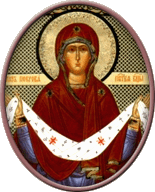
The Church has always glorified the most holy Mother of God as the Protectress and Defender of the Christian people, entreating, by her intercession, God’s loving-kindness towards us sinners. The Mother of God’s aid has been clearly shown times without number, both to individuals and to peoples, both in peace and in war, both in monastic deserts and in crowded cities. The event that the Church commemorates and celebrates today proves this constant protection of the Christian people by the Mother of God. On October 1st, 911, in the time of the Emperor Leo the Wise (or the Philosopher), there was an all-night vigil at the Blachemae church of the Mother of God in Constantinople. The church was crowded. St Andrew the Fool for Christ was standing at the back of the church with his disciple Epiphanius. At four o’clock in the morning, the most holy Mother of God appeared above the people with a veil spread over her outstretched hands, as though to protect them with this covering. She was clad in gold-encrusted purple and shone with an unspeakable radiance, surrounded by apostles, saints, martyrs and virgins. Seeing this vision, St Andrew gestured towards it and asked Epiphanius: ‘Do you see how the Queen and Lady of all is praying for the whole world?’ Epiphanius replied: ‘Yes, Father; I see it and stand in dread.’ As a result, this commemoration was instituted to remind us both of this event and of the Mother of God’s constant protection whenever we prayerfully seek that protection, that shelter, in distress.

The Holy Apostle Ananias
One of the Seventy, he was bishop in Damascus. In response to a vision from God, he baptised Saul, the future Apostle Paul (Acts 9), and courageously preached the Gospel in the face of all persecution, for which he was stoned to death in the city of Eleutheropolis. His holy relics were taken to Damascus, and later to Constantinople.

Our Holy Father Romanus the Melodist
Born in the Syrian town of Emesa, he served as a verger first in Beirut and then in Constantinople at the cathedral, in the time of Patriarch Euphemius (490-96). Illiterate and with no musical training, he was despised by certain educated clergy. St Romanus prayed weeping to the Mother of God, and she appeared to him in a dream, held a piece of paper out to him and told him to swallow it. The following day was Christmas Day, and Romanus went up to the ambo and, with an angelic voice, sang: 'Today the Virgin which has come down to us as the Kontakion of the Feast. All marvelled at the words of the hymn and at the singer’s voice. Receiving thus the gift of song from the Mother of God, Romanus composed more than a thousand kontakia. He died as a deacon of the Great Church in Constantinople in 530, and went to join the angelic choir.

today’s Readings:
Hebrews 9:1-7
Luke 10:38-42Luke 11:27-28
 
October 2
Andrew the Fool for Christ

By birth a Slav, he was bought as a slave by Theognostus, a rich man in Constantinople, in the time of the Emperor Leo the Wise, son of the Emperor Basil the Macedonian. Andrew was a handsome young man, both in body and soul. Theognostus took a fancy to him and allowed him to learn to read and write. Andrew prayed fervently to God and attended church services with great devotion, and, in obedience to a heavenly revelation, resolved on the ascesis of folly for Christ’s sake. Once, when he went to the well for water, he cast off his clothes and cut them to pieces, feigning madness. Saddened by this, his owner Theognostus put him in chains and took him to the church of St Anastasia the Deliverer from Bonds, that prayers be read for him. But, as Andrew did not recover as far as his owner could see, he was freed as being sick in mind. Holy Andrew feigned madness all day and spent the nights in prayer. He lived without a roof over his head, spending the nights in the open and going about half-naked in a single, tattered garment and eating a little bread when kindly people shared theirs with him. Whatever he received, he gave away to beggars, and when he gave it to them he would mock them to avoid their thanks, for holy Andrew looked only for the reward from God. Therefore great grace from God abode in him, and he was able to discern men’s secrets, see angels and demons, drive demons from men and turn men from sin. He had a most wonderful vision of Paradise and the exalted powers of heaven; he saw the Lord Christ on His throne of glory; he, with his disciple Epiphanius, saw the most holy Mother of God in the Blachemae church, sheltering the Christian people with her veil (see Oct. 1st); he heard in heaven unspeakable words, which he dared not recount to men. After unprecedentedly harsh asceticism, he entered into rest and the eternal glory of his Lord in 911.

(OP Note: When I returned back to the church, I asked my pastor who would you recommend to be my patron Saint to pray to? My Pastor replied: “St. Andrew, the Fool for Christ.” I asked, “Why him?” My pastor answered, “You don’t question the Holy Spirit>”)

The Hieromartyr Cyprian and the Virgin Justina
Cyprian moved from Carthage to Antioch, where Justina lived with her parents, Edesius and Cleodonia. Edesius was an idolatrous priest and his whole household was pagan, but when Justina, going round the Christian churches, came to know the true Faith, she brought both her father and mother to Christ the Lord and all three were baptised by the bishop, Optatus. Cyprian was a magician, and had links with unclean spirits and powers of divination. A dissolute youth Aglaidas, a pagan, tried to lead Justina astray, being enraptured by her beauty, and, when the holy maiden firmly rejected him, sought Cyprian’s help. Cyprian invoked evil spirits, one after the other, on Justina, to set alight in her the passion of impurity towards Aglaidas, but they were totally unsuccessful in this, for St Justina, with the sign of the Cross and prayer to God, drove out the evil spirits. Then Cyprian came to know the power of the Cross, and was himself baptised, in time becoming priest and bishop. The wicked pagans seized both him and Justina, and they were sent for trial to Damascus, and then tortured and beheaded in Nicomedia at the end of the third century.

The Holy Martyrs David and Constantine
Christian princes of Argueti, they were condemned to death for Christ in Imereti by Caliph Emil-el-Mumenim and drowned in a river in 730. At the time of their death, they prayed to God that He would forgive the sins of all who invoked them in prayer for help. After their prayer was finished, a thunderbolt fell and a voice came from heaven, saying that their prayer was heard. Their relics are preserved in Georgia, in the monastery of Modzameta.

Today’s Readings
Ephesians 4:25-32
Luke 6:25-32
 
Status
Not open for further replies.
Back
Top