Embalming - soul leaving the body

Status
Not open for further replies.
40.png
BlueMaxx:
When the body has achieved “room temperature” you can safely assume the soul has left the building…
I have to wonder if that guy in Mississippi had “achieved room temperature”.
In our state, once I the medic confirms death the coroner is called…the coroner confirms death by a method I will not go into here…but believe me, if you were alive and they did it someone would know.

So I would say the coroner did his job incorrectly.

Also, very few places I know of around here go from dying to dead to the embalming table very quickly…some set in the morgue or in the hospital morgue awhile.
 
Last edited:
I know green burials require green burial-specific sites… you can’t just go into any cemetery and ask for a green burial, because people are nervous about what gets into the local groundwater.

But being buried in a regular cemetery doesn’t require mandatory embalming. All embalming does is offset decay by a week or two, so that you look nice for the funeral, underneath all your makeup.

But a couple of days in the morgue fridge is okay as well… then you have your funeral in your coffin, perhaps with your nice makeup on to make them feel better, and then you get sealed up and buried, and it’s all the same, because you have a nice headstone to visit. Except you haven’t paid someone $200-$700-whatever to empty out your liquids and fill you up with formaldehyde and methanol and stuff.
 
Here’s an interesting sidebar topic on this subject.

I timestamped the video to play about ten seconds before the moment the soul was said to leave the body.


It’s possible it was faked, but it would seem pretty creepy if someone had faked it.
 
Last edited:
I was asking if it was church teaching. So far, no sources from the Church have been provided, just “hearsay.”
The Church only teaches that death occurs when the soul leaves the body. As far as I am aware, the Church doesn’t specify exactly when this happens.

This is very problematical, then, for purposes of harvesting organs for transplant from a decedent whose heart has stopped beating and for whom brain activity and respiration have ceased.
 
I know green burials require green burial-specific sites… you can’t just go into any cemetery and ask for a green burial, because people are nervous about what gets into the local groundwater.

But being buried in a regular cemetery doesn’t require mandatory embalming. All embalming does is offset decay by a week or two, so that you look nice for the funeral, underneath all your makeup.

But a couple of days in the morgue fridge is okay as well… then you have your funeral in your coffin, perhaps with your nice makeup on to make them feel better, and then you get sealed up and buried, and it’s all the same, because you have a nice headstone to visit. Except you haven’t paid someone $200-$700-whatever to empty out your liquids and fill you up with formaldehyde and methanol and stuff.
If I do go for green burial, I have a place in mind. As it stands now, though, our entire family has prepaid arrangements. I would have to find some way for those arrangements to be transferred to the green burial site, and I’m not sure that’s possible. Again, aside from environmental considerations (and those would be minimal as these are mausoleum crypts), it really doesn’t matter to me. It’s just a preference.
 
This is very problematical, then, for purposes of harvesting organs for transplant from a decedent whose heart has stopped beating and for whom brain activity and respiration have ceased.
No, it isn’t. The Church has already addressed this quite fully.

Real Talk from the National Catholic BIoethics Center:
https://www.ncbcenter.org/files/1414/4916/3460/NCBCsummFAQ_BrainDeath.pdf

I have only posted an excerpt here but feel free to go to the link and read the whole thing as it addresses organ donation specifically.
Question 1. To what does the expression “brain death” refer?

Reply: “Brain death” refers to the medical judgment that a person is dead, determined by neurological criteria. Properly diagnosed, brain death means the complete cessation of all organized neurological activity throughout the entire brain, including the cerebrum, cerebellum, and brain stem. When all brain activity has ceased, the body irrevocably ceases to function as a unified whole. The appropriate phraseology here is “the determination of death using neurological criteria.”

Question 2. Why does the Church accept this definition of death?

Reply: This is not a new definition of death but rather of the use of new signs to determine that death has occurred. The Christian understanding has always been that death is the separation of the soul from the body. The Catholic Church looks to the medical community to determine the biological signs that indicate with moral certainty that this event has already occurred. In recent years, medical research has indicated that the irreversible loss of brain function provides a firm indicator that death has already occurred.

Question 3. What does Catholic theology say about this definition of death?

Reply: Neurological criteria are compatible with Catholic teaching that a human being is a substantial union of body and rational soul. The complete and irreversible loss of all brain function may be taken as a reasonable indicator that the rational soul is no longer present.

Question 4. Does the use of brain-death criteria cause the death of the patient?

Reply: The use of brain-death criteria does not cause the death of the patient, but only assesses and confirms the signs that indicate whether that death has already occurred. This is analogous to the way that cessation of heartbeat and respiration have traditionally been used to carry out that assessment.

 
Last edited:
Again, as I just edited my post to add, please go to the website and read about organ harvesting specifically if you still have questions.

You are of course free to choose to not donate organs if you are nervous about it. They don’t just go in there and rip them out of you if you have said no, you aren’t donating yours.
 
According to Jewish law, embalming is not permitted, only washing the body of the deceased. Now I wonder whether this rule has anything to do with the soul leaving the body? Interesting.
 
Again, as I just edited my post to add, please go to the website and read about organ harvesting specifically if you still have questions.

You are of course free to choose to not donate organs if you are nervous about it. They don’t just go in there and rip them out of you if you have said no, you aren’t donating yours.
I will read it, thanks. I have long wondered “even if all physical signs indicate death, that does not necessarily mean the soul has left the body, so wouldn’t organ harvesting run the risk of being murder?”. But on the other hand, once physical death has taken place, obviously you’re not coming back, and even if you do remove organs, does that then “force” the soul out of the body? Or can the soul remain for a time even after that?
 
Last edited:
That’s not the issue, but rather, how certainly is the individual dead?

At one time, a lack of breathing was sufficient to diagnose death, hence the instances of people “coming back.” 2000s medicine can easily restart someone’s breathing.

Lack of heartbeat, cold skin, etc. have also failed as diagnostics of death.

In a hospital with electronic terminals on the head, this isn’t as much a problem because the failure of the brain can be documented. But when someone dies outside this setting, the question remains. It has been a question for centuries.

Short of reinstating the traditional “wake” (which was less a funeral viewing, as we know it, than assuring the body was not going to WAKE up!), there’s not much to do. It’s not necessary, however, to wait for smell to set in. Settling of the blood would establish the heart was stopped.

ICXC NIKA
 
In my husband’s town in rural Mexico they do not embalm. A person is declared dead and checked by a doctor to confirm it. Then they get the carpenter to measure the body and build the casket. If possible they will have the priest come, but there is only one priest for a very large area that covers several towns. The priest might not be able to say a funeral Mass until a later date. Regardless of when the Mass is, the body is buried within 24 hours. Veracruz is pretty hot so they don’t keep dead bodies around for days to be sure they are dead. There is no funeral home in the rural mountain towns so the bodies stay in their homes until the carpenter brings the casket and they are carried to either the church or the cemetery. There’s no refrigerated morgue or anything like that so burials happen quite quickly out of necessity. This is hard on many people because if they don’t live in the same town or a close by town, there is no way to be at the burial of your loved one. We missed both of my in laws funerals and burials because of that.

It’s interesting how even death is affected by culture, necessity, religious beliefs and also availability of modern services.

I wouldn’t worry too much about when the soul actually physically separates from the body. That is God’s concern, not our own. It would not be considered murder if we somehow mistakenly embalmed or buried someone “not quite dead yet” I don’t think. Burying the dead is one of the corporal works of mercy and what we are called to do. God would not play tricks on us like that. We wouldn’t be called to do something and then condemned for doing it.
 
I do know that in certain places (such as Poland, where by the way they typically do not embalm), the presumed deceased were placed in a special room, where they lay for a period of days, again, to be absolutely sure they were dead. I do not know if they do this anymore, but they once did. When putrefaction sets in, then you can know with certainty that the person is dead and that, indeed, the soul has left the body. But I realize it is more difficult to embalm at that point.
It was not just Poland but in much of Europe at one point. This was before funeral homes were invented. Today the bodies of the deceased are kept in funeral homes for some days while awaiting their funeral, and to allow family and friends to come and pay their respects. But the concept is the same.
 
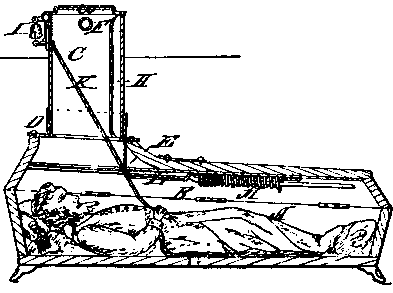
In 1905, the English reformer William Tebb collected accounts of premature burial. He found 219 cases of near live burial, 149 actual live burials, 10 cases of live dissection and 2 cases of awakening while being embalmed.

 
Again, as I just edited my post to add, please go to the website and read about organ harvesting specifically if you still have questions.

You are of course free to choose to not donate organs if you are nervous about it. They don’t just go in there and rip them out of you if you have said no, you aren’t donating yours.
I did read this, and it is very good. I would have no problem with my corpse being “kept alive” to ensure the transplantation of needed organs. I would say “take what you need, I’m not going to need them anymore”.
 
Status
Not open for further replies.
Back
Top