February 14: Study and Meditations on the Scripture Readings for This Sunday's Mass

  • Thread starter Thread starter Fidelis
  • Start date Start date
Status
Not open for further replies.
F

Fidelis

Guest
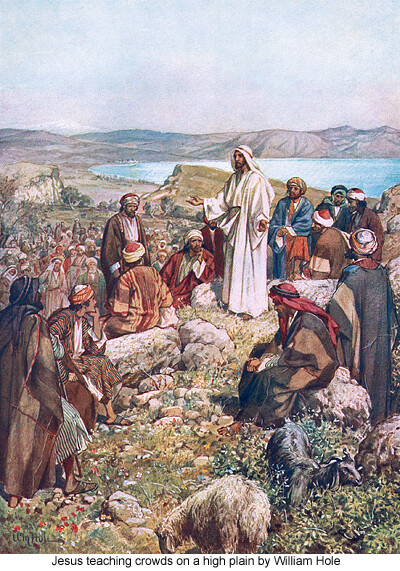
To help you prepare for this coming Sunday, here are the readings and reflections for this coming Sunday’s Scripture readings. This Sunday in the Gospel Reading, we hear Jesus’ “Sermon on the Plain.”

Here are the Scripture readings from the U.S. Catholic bishops website.

My own weekly study (along with Don Schwager’s meditation) can be found here under "Current Study.

Reflections on the Sunday Scriptures to share with the younger ones in your family by Emily and Jeff Cavins can be found at Family Night .

Here also are links to audio reflections on the Gospel reading by Dr. Scott Hahn and Fr. Robert Barron.

The Navarre Bible Commentary for each reading can be viewed here. (Usually available by Friday)

Further study resources for the Readings can be found here and here.

Here are trio of recorded weekly Bible studies, each about an hour long:
– St. Martha Catholic Church Adult Faith Formation
– Franciscan Sisters of the Sorrowful Mother(Usually available by Thursday night)
– Sunday Gospel Scripture Study

Discussion and charitable comments are always welcome. Have a blessed and holy Lord’s day!

 
Two Sunday’s ago at Mass, we heard about the call of the reluctant prophet Jeremiah.This week (after hearing about Isaiah’s call last week), we again look at Jeremiah, this time from chapter 17. If you missed that week or need to refresh your memory, here is the background on Jeremiah from that previous thread (found here.):
Jeremiah, one of the greatest prophets of Old Testament times, lived in a turbulent and eventually fatal period of Jewish history (600-550 circa). The people (and most of their kings) had for years neglected the things of God. They admired the pagan nations and too often the pagan gods. God let the pagan nations punish them. Jeremiah is the second of the four great prophets of Israel; a contemporary of Zephaniah, Nahum, and Habakkuk. He was born in the last part of the reign of Manasseh, about 645 years before the birth of Jesus and almost a century after Isaiah.
Called by God to be a prophet at the age of 19, he remained unmarried and celibate by order of Yahweh (Jeremiah 16:2). For more than 40 years, up to his death, he remained faithful to his vocation and prophesied until after the fall of Jerusalem in 587/586 B.C. In the 52 chapters of this book, oracles alternate with passages of history which confirm and illustrate the prophecies.
The book as we have it does not follow a chronological or other order because it is, as Saint Jerome described, more a collection of writings than a book in the proper sense. These writings consist of a series of warnings and threats of divine retribution for the unfaithfulness of the chosen people and also for the behavior of the neighboring peoples.
Here is some background on this Sunday’s reading from Jeremiah from this week’s Catholic Matters:
The Prophet Jeremiah has been foretelling dire consequences for the people of Judah because of their sins. They will lose their land and their kingdom, they will be exiled in a pagan country, because they insulted and ignored the God who had been so good to them down through the ages. They trusted in human allies when they should have trusted in God. He goes on now to stress in poetic form the real basis of true religion: God is man’s sole refuge.
Here is this weeks First Reading, as we will hear it at this Sunday’s Mass:
Reading I
Jeremiah 17:5-8
Thus says the LORD:
Cursed is the one who trusts in human beings,
who seeks his strength in flesh,
whose heart turns away from the LORD.
He is like a barren bush in the desert
that enjoys no change of season,
but stands in a lava waste,
a salt and empty earth.
Blessed is the one who trusts in the LORD,
whose hope is the LORD.
He is like a tree planted beside the waters
that stretches out its roots to the stream:
it fears not the heat when it comes;
its leaves stay green;
in the year of drought it shows no distress,
but still bears fruit.
 
There is a common feature in all of this Sunday Readings: they all present a contrast between one kind of man – one who is faithful to God, and another kind of man – one that is not faithful to God, but rather depends on someone or something else. (This is true even of the Second Reading from Paul’s first letter to the Corinthians, even though it is a little harder to see – can you pick it out?)

The Responsorial Psalm also falls into this category and is especially reflective of the First Reading from Jeremiah:
Responsorial Psalm
Ps 1:1-2, 3, 4 and 6
Blessed are they who hope in the Lord.
Blessed the man who follows not
the counsel of the wicked,
nor walks in the way of sinners,
nor sits in the company of the insolent,
but delights in the law of the LORD
and meditates on his law day and night.
Blessed are they who hope in the Lord.
He is like a tree
planted near running water,
that yields its fruit in due season,
and whose leaves never fade.
Whatever he does, prospers.
Blessed are they who hope in the Lord.
Not so the wicked, not so;
they are like chaff which the wind drives away.
For the LORD watches over the way of the just,
but the way of the wicked vanishes.
Blessed are they who hope in the Lord.
 
Just to provide a further bit of context, let’s look at the verses preceding this weeks passage. As mentioned above, Jeremiah is decrying the idolatry of the people of Judah in which they were imitating the nations around them.
Jeremiah 17:1-4
The sin of Judah is written with an iron stylus, Engraved with a diamond point upon the tablets of their hearts.(And the horns of their altars, when their sons remember their altars and their sacred poles, beside the green trees, on the high hills,the peaks in the highland.) Your wealth and all your treasures I will give as spoil. In recompense for all your sins throughout your borders, You will relinquish your hold on your heritage which I have given you. I will enslave you to your enemies in a land that you know not: For a fire has been kindled by my wrath that will burn forever.
Using Catholic Matters (one of this week’s study aids found in the first post) as a template, here are some thoughts on this reading with my comments (if any) in green, and the Navarre Bible Commentary notes in blue.

17:1-13. This passage includes a number of short oracles in the style of wisdom writing, graphically expressing themes that were constant in Jeremiah’s preaching. Judah’s sin of idolatry was quite obvious: anyone travelling the country could see people frequenting the places where Canaanite gods were worshipped; they were everywhere one went (vv. 1-3a). That is why the Lord will abandon the Israelites, who will be uprooted from their land and enslaved (vv. 3b-4).

Thus says the Lord: He introduces his teaching with the solemn prophetic introduction, he is speaking not from himself but as God’s mouthpiece.

[5] cursed is the man: He is stating a fact, not wishing evil on his hearers.

Those that disobey the clear commands of God and the warnings of his prophets have no need to have curses directed at them: they curse themselves by putting themselves in opposition to God.

In chapters 27-30 of Deuteronomy, Moses lays down a long list of curses (and a few blessings) on the people who are about to end the promised land based on how well they obey the precepts of the Lord. The instruction ends with these words:
The LORD, your God, will circumcise your hearts and the hearts of your descendants, that you may love the LORD, your God, with all your heart and all your soul, and so may live. But all those curses the LORD, your God, will assign to your enemies and the foes who persecuted you. You, however, must again heed the LORD’S voice and carry out all his commandments which I now enjoin on you.

Then the LORD, your God, will increase in more than goodly measure the returns from all your labors, the fruit of your womb, the offspring of your livestock, and the produce of your soil; for the LORD, your God, will again take delight in your prosperity, even as he took delight in your fathers’, if only you heed the voice of the LORD, your God, and keep his commandments and statutes that are written in this book of the law, when you return to the LORD, your God, with all your heart and all your soul.

"For this command which I enjoin on you today is not too mysterious and remote for you.
It is not up in the sky, that you should say, ‘Who will go up in the sky to get it for us and tell us of it, that we may carry it out?’ Nor is it across the sea, that you should say, ‘Who will cross the sea to get it for us and tell us of it, that we may carry it out?’ No, it is something very near to you, already in your mouths and in your hearts; you have only to carry it out.
"Here, then, I have today set before you life and prosperity, death and doom. If you obey the commandments of the LORD, your God, which I enjoin on you today, loving him, and walking in his ways, and keeping his commandments, statutes and decrees, you will live and grow numerous, and the LORD, your God, will bless you in the land you are entering to occupy. If, however, you turn away your hearts and will not listen, but are led astray and adore and serve other gods, I tell you now that you will certainly perish; you will not have a long life on the land which you are crossing the Jordan to enter and occupy.
I call heaven and earth today to witness against you: I have set before you life and death, the blessing and the curse. Choose life, then, that you and your descendants may live, by loving the LORD, your God, heeding his voice, and holding fast to him. For that will mean life for you, a long life for you to live on the land which the LORD swore he would give to your fathers Abraham, Isaac and Jacob." (Deut. 30:11-20
)

Continued on next post…
 
…Continued from previous post.

who trusts in man: That is one who puts his whole trust in man and in human power, to the exclusion of God, as the following words “whose heart turns away from the Lord” show.

[6] like a shrub in the desert: Because it has neither soil nor moisture it will never produce flower or fruit. It will be as fruitless in the summer as in the winter.

I happen to live in the Sonoran desert and I can attest to the aridity of the land if there is no rainful. When it does rain here, the desert is actually very lush and green, and in its own way a beautiful and refreshing place to be. However, without rain, things very quickly bcome dry. Some varieties of bushes are particularly pathetic: spindly, brown and unattractive. But even these least of all plants grow green and flower if they have enough water. The difference is the amount of water they get on a consistent basis. So too we, if we place our trust in the things of this world that offer no nourishment rather than God who wants us to abide in him like the branches abide in the vine (John 15), we will likewise be barely living, bearing neither flower or good and abundant fruit.

parched places…uninhabited salt land: Where nothing can grow or prosper because of the unproductive poisonous soil.

Some lands are naturally salt wastes (such as areas of Nevada) where nothing grows. Some, however, are made so purposely. When the Romans (and other conquering armies) wanted to make sure a particulary rebellious nation was not re-occupied, they would salt the fields so that the people could not grow prosperous and strong there again.

[7] **Blessed is the man: **In contrast he who trusts and hopes in the Lord will prosper, like a tree planted by water: Where the soil is fertile and there is plenty of moisture, there a tree will grow and produce fruit.

The word “blessed” means more than “happy” as it is sometimes translated. To be blessed is a form of beatitude, that is, to have more or less a share in God’s life and to be in his presence to the extent we conform ourselves to his own goodness. We do this primarily by detaching ourselves from what is not pleasing to him, and by conforming ourselves to what is pleasing to him.
For when you were slaves of sin, you were free from righteousness. But what profit did you get then from the things of which you are now ashamed? For the end of those things is death. But now that you have been freed from sin and have become slaves of God, the benefit that you have leads to sanctification, and its end is eternal life. For the wages of sin is death, but the gift of God is eternal life in Christ Jesus our Lord. (Romans 6:20-23)
[8] **not fear when heat: **The changes of season will not affect it. Even a year of drought will not injure its vitality for it is planted beside the waters.

17:1-13. Using words similar to those of Psalm 1, the prophet describes the misfortune that will befall those who trust in themselves, as against the prosperity of those who trust in God (vv. 5-8). St Thomas Aquinas’ commentary on Psalm 1 fits in nicely with the simile here of the tree planted beside water (v. 8): “We are asked to consider three things in the image of the tree–its being well-rooted, its fruitfulness, and the sustaining of its life. To be well-rooted, the tree must be well-watered, otherwise it will dry up and wither away; thus, we are told that the tree is planted beside running waters, which symbolize the currents of grace. ‘He who believes in me…out of his heart shall flow rivers of living water’ (Jn 7:38). The one whose roots draw on the living waters will bear much fruit in all the good works that he does, and fruitfulness is the second aspect of the image that we are asked to contemplate. ‘But the fruit of the Spirit is love, joy, peace, patience, kindness, goodness, faithfulness’, etc. (Gal 5:22). The tree does not wither away: it is sustained in life. Some trees lose their leaves, but others never lose their leaves; and thus it is with righteous men …]; they will not be forgotten by God even in their tiniest and least significant actions. ‘The righteous will flourish like a green leaf’ (Prov 11:28)” (“Postilla super Psalmos”, 1, 3).

 
Interestingly, Scott Hahn (in his meditation linked in the first post) points out the following:
We’ve already seen today’s dramatic imagery of reversal in Mary’s “Magnificat.” There, too, the rich are cast down while the hungry are filled and the lowly exalted (see Luke 1:45-55 also 16:19-31).
[45] And blessed is she who believed that there would be a fulfillment of what was spoken to her from the Lord." [46] And Mary said,
“My soul magnifies the Lord, [47] and my spirit rejoices in God my Savior, [48] for He has regarded the low estate of His handmaiden. For behold, henceforth all generations will call me blessed; [49] for He who is mighty has done great things for me, and holy is His name. [50] And His mercy is on those who fear Him from generation to generation. [51] He has shown strength with His arm, He has scattered the proud in the imagination of their hearts, [52] He has put down the mighty from their thrones, and exalted those of low degree; [53] He has filled the hungry with good things, and the rich He has sent empty away. [54] He has helped His servant Israel, in remembrance of His mercy, [55] as He spoke to our fathers, to Abraham and to his posterity for ever.”
That’s the upside-down world of the Gospel: in poverty we gain spiritual treasure unimaginable; in suffering and even dying “on account of the Son of Man,” we find everlasting life.
 
The verses following the First Reading, though not part of the reading itself, nonetheless are very interesting and worthy of meditation. They include a further warning based on the reality of mans sinfulness, a proverb about riches, and another warning:
The heart is deceitful above all things, and desperately corrupt; who can understand it? “I the LORD search the mind and try the heart, to give to every man according to his ways, according to the fruit of his doings.”
Like the partridge that gathers a brood which she did not hatch, so is he who gets riches but not by right; in the midst of his days they will leave him, and at his end he will be a fool.
A glorious throne set on high from the beginning is the place of our sanctuary. O LORD, the hope of Israel, all who forsake thee shall be put to shame; those who turn away from thee* shall be written in the earth, for they have forsaken the LORD, the fountain of living water. [Jeremiah 17:9-13]
The Navarre Bible comments as following:
God cannot be deceived; he sees right into a person’s heart, and he will judge each on his merits (vv. 9-11). The hope of Israel is the Lord (vv. 12-13), the fount of water (cf. 2:13; Ps 42:2; Jn 4:10) without which none can live (cf. v. 8). To show that those who forsake God will be judged and condemned, Jeremiah uses an image (they “shall be written in the earth”: v. 13) that is reminiscent of Jesus’ gesture when he “judges” the men who accuse the woman caught in adultery (Jn 8:6). The wind will blow their names away: they will have no place in the book of life.
Jesus also references this passage, applying it to himself, in John 7:37-39:
On the last day of the feast, the great day, Jesus stood up and proclaimed, “If any one thirst, let him come to me and drink. He who believes in me, as the scripture has said, ‘Out of his heart shall flow rivers of living water.’” Now this he said about the Spirit, which those who believed in him were to receive; for as yet the Spirit had not been given, because Jesus was not yet glorified.
 
The Catechism of the Catholic Church (CCC) contains one reference to the passage that comprises our First Reading. It is as follows:
**150 **Faith is first of all a personal adherence of man to God. At the same time, and inseparably, it is a free assent to the whole truth that God has revealed.
As personal adherence to God and assent to his truth, Christian faith differs from our faith in any human person. It is right and just to entrust oneself wholly to God and to believe absolutely what he says. It would be futile and false to place such faith in a creature.
cf. Jer. 17:5-6; Ps 40:5, 146:3-4
 
Finally, here are some questions for personal reflection on this reading:
  1. Upon what is Jeremiah relying (Jeremiah 14:22)? How does this contrast with the gods of the other nations. “their altars and their sacred poles” (17:2; see Exodus 34:12-14?
  2. In contrast to the cursed drought conditions that prevail, what blessed hope does Jeremiah cling to and hold forth for others (verses 5-8)?
  3. What times of spiritual drought have you experienced? What keeps you going during those dry times?
  4. At present, are you feeling more like a “bush in the desert” (verse 6) or a “tree planted beside the waters” (verse 8)? Why?
  5. Why does Jeremiah call the human heart “more torturous than all else” (verse 9)? What is the relationship between mind and action (verse 10)? What is the point of the related parable (verse 11)?
  6. How honest are you with yourself? Could your heart be decieving you about some of your motives at work? At home? In relationships?
(Questions adapted from The Catholic Serendipity Bible for Personal and Small Group Study, New American Bible; Zondervan, 1999)
 
On to the Second Reading.

We are continuing to hear from St. Paul in his First Letter to The Corinthians, chapter 15. From St. Charles Borromeo Bible Study aid provided in the first post, here is a short introduction to the present passage:
Today’s second reading continues the teaching we heard last week on the resurrection of the dead. Last week we heard the Creed of the Church: Christ died for us, He was buried, He rose on the third day.
Christ’s resurrection is the crowning event of salvation history and man’s vistory over sin, Satan, and death. As Adam brought death, Christ brings resurrection from the dead.
The Christian is incorporated into Christ by baptism and shares in His risen life. This final fruit of redemption in Christ will be realized for the Christian at the Lord’s parousia when the dead rise in their glorified bodies.
The Catholic Matters study aid adds the following:
Some of Paul’s converts in Corinth, it seems, doubted that their bodies would rise again from the dead. They were influenced here by Platonic philosophy which looked on the human body as something superimposed on the soul as an instrument for the soul’s purification. This human body then could not, they thought, be worthy of heaven. St. Paul refutes this false idea by reminding them that one of the basic doctrines of the Christian faith which they had accepted was that Christ had risen from the dead. In the preceding verses (15: 1-11) he has proved Christ’s resurrection by listing the witnesses (including himself) who had seen the risen Christ.
Here is the Second Reading as we will hear it in Mass this Sunday (except that, to provide fuller context, I’ve inserted the verses that are omitted from the Reading, highlighted in blue):
Reading II
1 Cor 15:12-20
Brothers and sisters:
If Christ is preached as raised from the dead, how can some among you say there is no resurrection of the dead? If there is no resurrection of the dead, then neither has Christ been raised. And if Christ has not been raised, then empty (too) is our preaching; empty, too, your faith. Then we are also false witnesses to God, because we testified against God that he raised Christ, whom he did not raise if in fact the dead are not raised. For if the dead are not raised, neither has Christ been raised, and if Christ has not been raised, your faith is vain; you are still in your sins. Then those who have fallen asleep in Christ have perished. If for this life only we have hoped in Christ, we are the most pitiable people of all. But now Christ has been raised from the dead, the firstfruits of those who have fallen asleep.
 
Again, using *Catholic Matters *as a template, here are some thoughts on this reading with my comments (if any) in green, and the Navarre Bible Commentary notes in blue.

[12] **Christ . . . preached as raised: **The resurrection of Christ was one of the basic truths of the apostolic preaching. Paul had preached this truth to the Corinthians and they had accepted it.

how can some of you say there is no resurrection of the dead: If Christ who was truly man and who truly died was raised by God from the grave, resurrection of the dead is possible. It is a contradiction to assert the opposite. It has already happened.

In addition to the Platonic influence noted above that may have been confusing the Corinthians, the Jewish Sadducee party (mostly based in Jerusalem) also did not believe in a resurrection of the dead. It’s possible (though not probable given that the Corinthians were mostly Greeks) that there was some strain of this thought among the Jewish believers among them.
It was also possible that doubt about the bodily resurrection was a factor in the occurance of immorality in the Corinthian church (see 1 Corinthians 6:12-20)

[16] if the dead are not raised: St. Paul was a liar (as were the other Apostles) when he said that God raised Christ from the dead. The argument holds because if, as these Corinthians say, there is no resurrection for man, then Christ, who was man, could not be raised. Therefore, Paul’s preaching would be false.

[17] **If Christ was . . . not raised: **Then the Christian faith, as preached by the Apostles, is false, and the faith of the Corinthians is folly.

you are still in your sins: The entire premise of Christianity is that Christ died and was raised for our sins. It is no avail that Christ simply died for our sins; if he was not raised from the dead afterwards, his was simply another death. his resurrection (and the fact that it was witnessed by numerous people that went on to give their lives in attestation to this fact) proves that he was not just a man, but Divine and thus capable of raising all those who put their faith in him. As the Scripture says “He was delivered up for our sins, and rose again for our justification.” (Romans 4:25. See also 2 Corinthians 5:15)

[18] fallen asleep in Christ . . . perished: The Christians who have already died are gone forever, “perished,” if there is no resurrection for them.

“Fallen asleep” was a euphemism for death. (15:20; Mark 5:39; John 11:11; 1 Thessalonians 4:15). It is also used that way in classical Greek literature such as Homer’s Illiad.

[19] **If . . . this life only: **If we have not been promised (and guaranteed by Christ’s death and resurrection) a future life, Christianity is the greatest folly. We are expected to mortify ourselves in this life, and, if there is no future life, we have nothing to get in return.

**12-19. **St Paul very forcefully states that the resurrection of Christ is an essential truth of the Christian faith; without it that faith is vain. For, by rising from the dead Christ completes the work of Redemption. Dying on the cross meant victory over sins; but it was necessary also that he should rise from the dead and thereby conquer death, the outcome of sin (cf. Rom 5:12). “It was necessary that Christ should rise again in order to manifest the justice of God; for it was most appropriate that he who through obedience to God was degraded, and loaded with ignominy, should by him be exalted. …] He rose also to confirm our faith, which is necessary for justification; for the resurrection of Christ from the dead by his own power affords an irrefutable proof that he was the Son of God. Again the resurrection nourishes and sustains our hope. As Christ rose again, we rest on an assured hope that we too shall rise again; the members must necessarily arrive at the condition of their head. …] Finally, the resurrection of our Lord, it should also be taught, was necessary to complete the mystery of our salvation and redemption. By his death Christ liberated us from sin, by his resurrection he restored to us the most important of those privileges which we had forfeited by sin” (“St Pius V Catechism”, I, 6, 12).

In these verses St Paul is really giving indirect arguments in support of Christ’s resurrection, by pointing out what an absurd situation we would be in if Jesus Christ had not risen: our faith would be in vain (vv. 14,17,18), as would our hope (v.19); the Apostles would be false witnesses and their preaching valueless (vv 14-15); and we would still be in our sins (v. 17). Christians, in other words, would be “of all men most to be pitied” (v. 19).

Continued on next post…
 
Continued from previous post.

[20] **But . . . Christ has been raised: **All these suppositions are futile—Christ has risen, therefore resurrection is possible and guaranteed for…
the first fruits of those who have fallen asleep: The offering of the first fruits was a symbol of the dedication of the whole harvest to God [Exodus 23:19; Leviticus 23:10-14]. So Christ’s resurrection is a symbol, a guarantee that all who have died and who will die, will be raised up by God as he was. He was the first fruits, we are the harvest. [Acts 26:23; Romans 11:15-16]

20-28. The Apostle insists on the solidarity that exists between Christ and Christians: as members of one single body, of which Christ is the head, they form as it were one organism (cf. Rom 6:3-11; Gal 3:28). Therefore, once the resurrection of Christ is affirmed, the resurrection of the just necessarily follows. Adam’s disobedience brought death for all; Jesus, the new Adam, has merited that all should rise (cf. Rom 5:12-21). “Again, the resurrection of Christ effects for us the resurrection of our bodies not only because it was the efficient cause of this mystery, but also because we all ought to arise after the example of the Lord. For with regard to the resurrection of the body we have this testimony of the Apostle: ‘As by a man came death, by a man has come also the resurrection of the dead’ (1 Cor 15:21). In all that God did to accomplish the mystery of our redemption he made use of the humanity of Christ as an effective instrument, and hence his resurrection was, as it were, an instrument for the accomplishment of our resurrection” (“St Pius V Catechism”, I, 6, 13).

Although St Paul here is referring only to the resurrection of the just (v. 23), he does speak elsewhere of the resurrection of all mankind (cf. Acts 24:15). The doctrine of the resurrection of the bodies of all at the end of time, when Jesus will come in glory to judge everyone, has always been part of the faith of the Church; “he [Christ] will come at the end of the world, he will judge the living and the dead; and he will reward all, both the lost and the elect, according to their works. And all those will rise with their own bodies which they now have so that they may receive according to their works, whether good or bad; the wicked, a perpetual punishment with the devil; the good, eternal glory with 'Christ” (Fourth Lateran Council, “De Fide Catholica”, chap. 1).

I mentioned in a previous post that, just like the other readings this week, this Second Reading also presents a choice before two kinds of people. Have you figured out what they are?

The two choices are this: Either Christ was raised from the dead, or he was not. If he was not, our faith (and everything that goes with it) is in vain. If Christ has been raised, our hope is in Christ and we should live our lives accordingly. Those skeptics who deny the resurrection and try to dismiss it as a myth, symbol or delusion are attacking the very basis of our Faith.
 
Catechism of the Catholic Church references for the Second Reading include:

Verses …Sections

15:12-14…991
15:12-13…996
15:14…651
15:20-22…655
15:20…632, 991
 
You can look up the Catechism references from the previous post here.

For the Second Reading, here are some “Questions for Application” taken from The Ignatius Study Bible; The First and Second Letters of St. Paul to the Corinthians (Ignatius Press, 2004), and from The Catholic Serendipity Bible for Personal and Small Group Study, New American Bible; Zondervan, 1999) :
  1. What would result from a Christian denial of the resurrection?
  2. What is your own belief about the resurrection from the dead? How firmly do you hold to the Christian belief in your own regard-- especially if you are facing a life-threatening illness or immediate danger of death? When people say, “When you’re dead, you’re dead!”, how do you respond internally? What do you say?
  3. Paul puts the Resurrection in perspective with the Second Coming and the end of time. How does it make you feel that in the end Christ will be victorious? How would your life be different without your hope that you will be resurrected?
 
Finally, a short meditation on the Second Reading from Catholic Matters, one of the study aids found in the first post:
If, as St. Paul says, our hope in Christ were for this life only, our religion, our Christianity, would not only be false, it would be utter folly. Why should a man not have all the pleasures, all the wealth, all the comforts possible, during his few years on this earth, if the grave is all that awaits him? Any man who would strive, to lead a Christian life, knowing that, it ended forever in death, would indeed deserve to be pitied as the Apostle says. And would St. Paul himself, a man of no mean intelligence, wear himself out, suffering hardships, hunger, weariness, and finally martyrdom, for the cause of Christ and Christianity, if there were nothing beyond the grave?
Furthermore, would Christ, the Son of God, have come on earth to live like one of us and suffer a painful and shameful death, if all that he could offer us was to ask us to imitate him by carrying our cross during our few years on this earth, while we waited for the clay of the grave to cover us forever? Or to go a step further: could the all-wise Creator (and his creation proves his infinite wisdom) have put us on earth, giving us a nature which is superior to all the rest of his creation and which can and does aspire to heights far above finite things, only to have all our hopes buried with us forever in the ground? These are the absurd conclusions that follow from the absurd supposition that we will not rise again after death. We know we shall rise, and to an unending life. It is for this eternal life that we were created by God; it is for this heavenly life that we were redeemed by the Son of God; it is for this that we were made members of the Church on our baptismal day; it is for this that we are now striving to live our Christian lives.
The few years that we have on this earth may be short but they are invaluable because our unending future life will depend on how we use them. Millions of Christians have trod this path of life before us. They slipped, perhaps, and fell at times, but, aided by God’s grace in the sacraments, they stood up again and continued to plod along until they closed their eyes in death, only to open them to the dawn of everlasting happiness.
Let us try to imitate these in their very ordinary daily lives. There are a few saints in heaven who led extraordinary lives, but ninety-nine per cent of the citizens of God’s eternal kingdom were and will be ordinary people who lived the ordinary Christian life in this very ordinary human world.
 
We now come to our Gospel Reading, Luke 6:17, 20-26. Before we do, however, here is some background, first from Catholic Matters:
In today’s excerpt from the Gospel we are given St. Luke’s version of the Beatitudes. The word “beatitude” is derived from the latin “beatus” meaning “happy,” “blest,” “fortunate.” The idea occurs frequently in the psalms and the wisdom books of the Old Testament. A man was said to be happy, fortunate, blest, when he did what was pleasing to God. God blessed him. St. Matthew gives us eight (or nine) Beatitudes (5: 2-12)… St. Luke’s version is somewhat different. He lists four Beatitudes and four Woes. The opposite of blest is woeful, and woe is the lot of the wrongdoer. The location of St. Luke’s list is also different from that of Matthew’s: Christ had come down from the mountain, where he had spent the night in prayer; he was surrounded by a “crowd of his disciples” and “a great multitude of people from Judea and Jerusalem, Tyre and Sidon.” However, in both Gospels the essence of Christ’s teaching is the same.
Here also is some background from my own Sunday Scripture Study:
Since last Sunday’s reading (Luke 5:1-11) Jesus has gone about teaching and healing the sick (Luke 5:12—6:11)—actions that have brought him into his first conflicts with the Pharisees. He has also chosen his Apostles (Luke 6:12-16).
Jesus addresses a large crowd in what is known as the Sermon on the Plain. It is similar to the much longer Sermon on the Mount found in Matthew (chapters 5—7); it contains Matthew’s eight beatitudes (or blessings) compressed into four. Modern scholars propose that the Gospel writers are relating different versions of the same speech. However, it is not unreasonable to conclude that Jesus repeated the same teachings several times over the course of his ministry, adapting it to his specific audience, as any good speaker will do.
Jesus seems to be generally directing his instruction to two groups: the poor and the rich. When Jesus speaks of “the poor” in verse 20, he is not primarily speaking of the materially poor, but of those who place all their confidence in God (Luke 11:28; Psalms 1:1-2). Conversely, when he speaks of “the rich,” he is speaking primarily to the unrighteous rich, who love and trust in their riches instead of God.
Along with the blessings pronounced in the Beatitudes, Jesus’ Sermon on the Plain also contains four “woes.” These woes are cries of impending distress, similar to those voiced by Old Testament prophets (see Isaiah 5:8-22; Amos 6:1-7; Habakkuk 2:6-20) as a warning to those who spurn the blessings of God and his Kingdom.
Note: This Sunday’s Gospel is missing two verses (18 and 19) from the original Scripture passage. They are as follows:
[17 A great crowd of his disciples and a large number of the people from all Judea and Jerusalem and the coastal region of Tyre and Sidon]… 18 came to hear him and to be healed of their diseases; and even those who were tormented by unclean spirits were cured. 19 Everyone in the crowd sought to touch him because power came forth from him and healed them all.
 
Here, then, is the Gospel Reading as we will hear it this Sunday at Mass:
Gospel
Luke 6:17, 20-26
Jesus came down with the twelve and stood on a stretch of level ground with a great crowd of his disciples and a large number of the people from all Judea and Jerusalem and the coastal region of Tyre and Sidon. And raising his eyes toward his disciples he said:
“Blessed are you who are poor, for the kingdom of God is yours.
Blessed are you who are now hungry, for you will be satisfied.
Blessed are you who are now weeping, for you will laugh.
Blessed are you when people hate you, and when they exclude and insult you, and denounce your name as evil on account of the Son of Man. Rejoice and leap for joy on that day! Behold, your reward will be great in heaven. For their ancestors treated the prophets in the same way.
But woe to you who are rich, for you have received your consolation.
Woe to you who are filled now, for you will be hungry.
Woe to you who laugh now, for you will grieve and weep.
Woe to you when all speak well of you, for their ancestors treated the false prophets in this way.”
 
Again, using Catholic Matters as a template, here are some thoughts on this reading with my comments (if any) in green, and the *Navarre Bible Commentary *notes in blue.

**20-49. **These thirty verses of St. Luke correspond to some extent to the Sermon on the Mount, an extensive account of which St. Matthew gives us in Chapters 5 to 7 in his Gospel. It is very likely that in the course of His public ministry in different regions and towns of Israel Jesus preached the same things, using different words on different occasions. Under the inspiration of the Holy Spirit each evangelist would have chosen to report those things which he considered most useful for the instruction of his immediate readers–Christians of Jewish origin in the case of Matthew, Gentile converts in the case of Luke. There is no reason why one evangelist should not have selected certain items and another different ones, depending on his readership, or why one should not have laid special stress on some subjects and shortened or omitted accounts of others.

In this present discourse, we might distinguish three parts—the Beatitudes and the curses (6:20-26); love of one’s enemies (6:27-38); and teaching on uprightness of heart (6:39-49).

Some Christians may find it difficult to grasp the need of practicing the moral teaching of the Gospel so radically, in particular Christ’s teaching in the Sermon on the Mount. Jesus is very demanding in what He says, but He is saying it to everyone, and not just to His Apostles or to those disciples who followed Him closely. We are told expressly that “when Jesus finished these sayings, the crowds were astonished at His teaching” (Matthew 7:28). It is quite clear that the Master calls everyone to holiness, making no distinction of state-in-life, race or personal circumstances. This teaching on the universal call to holiness was a central point of the teaching of (St) Monsignor Escriva de Balaguer. The Second Vatican Council expressed the same teaching with the full weight of its authority: everyone is called to Christian holiness; consider, for example, just one reference it makes, in “Lumen Gentium”, 11: “Strengthened by so many and such great means of salvation, all the faithful, whatever their condition or state–though each in his or her own way–are called by the Lord to that perfection of sanctity by which the Father Himself is perfect.”

In the Sermon on the Mount Jesus is not proposing an unattainable ideal, useful though that might be to make us feel humble in the light of our inability to reach it. No. Christian teaching in this regard is quite clear: what Christ commands, He commands in order to have us do what He says. Along with His commandment comes grace to enable us to fulfill it. Therefore, every Christian is capable of practising the moral teaching of Christ and of attaining the full height of his calling–holiness–not by his own efforts alone but by means of the grace which Christ has won for us, and with the abiding help of the means of sanctification which He left to His Church. “If anyone plead human weakness to excuse Himself for not loving God, it should be explained that He who demands our love pours into our hearts by the Holy Spirit the fervor of His love, and this good Spirit our Heavenly Father gives to those that ask Him. With reason, therefore, did St. Augustine pray: `Give Me what Thou command, and command what You please.’ As, then, God is ever ready to help us, especially since the death of Christ our Lord, by which the prince of this world was cast out, there is no reason why anyone should be disheartened by the difficulty of the undertaking. To him who loves, nothing is difficult” (“St. Pius V Catechism”, III, 1, 7).

[17] **a great crowd of his disciples and a great multitude of people from all Judea and Jerusalem and the seacoast of Tyre and Sidon: **This is a very diverse crowd, not only coming from the southern regions of Jewish territory, but from the Gentile (non-Jewish) coastal regions of Tyre and Sidon (modern-day Lebanon). Thus this teaching is for all men. It also points the universal scope of Christ’s future Church (Luke 2:31-32).

20-26. The eight Beatitudes which St. Matthew gives (5:3-12) are summed up in four by St. Luke, but with four opposite curses. We can say, with St. Ambrose, that Matthew’s eight are included in Luke’s four (cf. “Expositio Evangelii Sec. Lucam, in loc.”). In St. Luke they are in some cases stated in a more incisive, more direct form than in the First Gospel, where they are given with more explanation: for example, the first beatitude says simply “Blessed are you poor”, whereas in Matthew we read, “Blessed are the poor in spirit”, which contains a brief explanation of the virtue of poverty.

Continued on next post…
 
Continued from previous post.

[20 **lifted . . . his eyes on his disciples: He addresses the beatitudes to his disciples first of all, but there is no exclusion of those among the crowds who will follow him.

The lifting (or ‘raising’ or looking up’) of the eyes indicates that a teaching or serious discourse is about to take place

blessed are you poor: He is speaking of the poor in reality, the lowly ones who depend on God for help. This applies especially to the disciples, who have left all worldly things in order to follow him. Of itself poverty is not a virtue, poverty for the sake of God is.

Also spoken of (as emphasized in Matthew) are the spiritually poor, defined by inward detachment from the world’s goods. From a spiritual perspective, there is nothing *inherently *good or holy about being poor: even the materially poor can be inordinately attached to the little they have, as even the wealthy can live in a poverty of spirit (see CCC 2444, 2546).

yours . . . kingdom of God: It is already marked out for them. As followers of Christ, they are already in the kingdom’s preparatory stage. The second and perfect stage is guaranteed, provided they persevere.

In other words, the Kingdom is both “now” but “not yet.”

**20. **"The ordinary Christian has to reconcile two aspects of this life that can at first seem contradictory. There is on the one hand “true poverty”, which is obvious and tangible and made up of definite things. This poverty should be an expression of faith in God and a sign that the heart is not satisfied with created things and aspires to the Creator; that it wants to be filled with love of God so as to be able to give this same love to everyone. On the other hand, an ordinary Christian is and wants to be “one more among his fellow men”, sharing their way of life, their joys and happiness; working with them, loving the world and all the good things that exist in it; using all created things to solve the problems of human life and to establish a spiritual and material environment which will foster personal and social development…

“To my way of thinking the best examples of poverty are those mothers and fathers of large and poor families who spend their lives for their children and who with their effort and constancy–often without complaining of their needs–bring up their family, creating a cheerful home in which everyone learns to love, to serve and to work” (St. J. Escriva, “Conversations”, 110f).

[21] blessed are you . . . hunger: The poor who are hungry in this life for Christ’s sake will have their fill in the next.

Again, Matthew emphasizes that this “hunger” (and “thirst”) are also for righteousness.
**blessed . . . that weep now: **The sorrows of this life borne for Christ will be turned into laughter in the next, where, as St. John says: “there will be neither mourning nor crying nor pain any more.” (Revelation 21: 4).

The righteousness also weep over the sin and offenses against God in this world, just like the prophets did, especially Jeremiah who was known as “the weeping prophet.”

[22] when men hate you: Luke enumerates the various grades of opposition that the followers of Christ would meet—hatred, excommunication from the Temple, outrage (reproach), and defamation.

Continued on next post…
 
Continued from previous post…

**on account . . . the Son of Man: **Because they elected to follow Christ. Our Lord alone calls himself by this title “Son of Man.” He does so perhaps in order to stress the reality of his human nature [Ezekiel 30:2] , his equality with us, while at the same time giving a hint at his Messiahship. [Daniel 7:14]

[23] **Rejoice in that day: **When the disciples suffer because of Christ, they should rejoice, because of the reward that their suffering is already earning for them. The prophets before them suffered, too, because they spoke for God.

When the Apostles were arrested, imprisioned, beaten and censored for proclaiming the name of Jesus, rejoiced that they were allowed that privilege! (Acts 5:27-42, especially verse 41).

leap for joy on that day: I think of John the Baptist “leaping” in the womb of his mother Elizabeth in the presence of the Blessed Virgin Mary carrying the unborn Jesus.

**24-26. **Our Lord here condemns four things: avarice and attachment to the things of the world; excessive care of the body, gluttony; empty-headed joy and general self-indulgence; flattery, and disordered desire for human glory–four very common vices which a Christian needs to be on guard against.

[24] **But woe to you . . . rich: **Christ now, according to St. Luke, turns to those who have no interest in the kingdom of God, and whose sole interest in life is in acquiring wealth and enjoying earthly pleasures. These, he says, will have their poverty, their hunger and their weeping in the next life.

**Woe: **a cry of impending distress used by the prophets of Israel (Isaiah 5:8-22; Amos 6:1; Habakkuk 2:6-20)

From: Luke 12:13-21
Parable of the Rich Fool

One of the multitude said to Him (Jesus), “Teacher, bid my brother divide the inheritance with me.” But He said to him, “Man, who made Me a judge or divider over you?” And He said to them, “Take heed, and beware of all covetousness; for man’s life does not consist in the abundance of his possessions.” And He told them a parable, saying, “The land of a rich man brought forth plentifully; and he thought to himself, What shall I do, for I have nowhere to store my crops?' And he said, I will do this: I will store all my grain and my goods. And I will say to my soul, Soul, you have ample goods laid up for many years; take your ease, eat, drink, be merry.’ But God said to him, `Fool! This night your soul is required of you; and the things you have prepared, whose will they be?’ So is he who lays up treasure for himself and is not rich toward God.”

See also 1 Timothy 6:17-19; Hebrews 13:5; James 5:1-6; CCC 2547)

Continued on next post…
 
Status
Not open for further replies.
Back
Top