
February 21st: Study and Meditation On The Scripture Readings for This Coming Sunday's Mass

  • Thread starter Thread starter Fidelis
  • Start date Start date
Status
Not open for further replies.
F

Fidelis

Guest
To help you prepare for this coming Sunday, here are the readings and some reflections for this coming Sunday’s Scripture readings. This Sunday is the 1st Sunday of Lent and in the Gospel Reading, we’ll hear about Jesus’ temptation in the wilderness.

Here are the Scripture readings from the U.S. Catholic bishops website.

My own weekly study (along with Don Schwager’s meditation) can be found here under "Current Study.

"Reflections on the Sunday Scriptures to share with the younger ones in your family by Emily and Jeff Cavins can be found at Family Night .

Here also are links to audio reflections on the Gospel reading by Dr. Scott Hahn and Fr. Robert Barron.

The Navarre Bible Commentary for each reading can be viewed here.

Further study resources for the Readings can be found here and here.

Here are trio of recorded weekly Bible studies, each about an hour long:
– St. Martha Catholic Church Adult Faith Formation

– Franciscan Sisters of the Sorrowful Mother

– Sunday Gospel Scripture Study

(NOTE: Some resources may not be available until Friday)

Discussion and charitable comments are always welcome. Have a blessed and holy Lent!
 
The First Reading is from the Book of Deuteronomy. For background on that book, see this article which appeared in *This Rock *magazine written by Antonio Fuentes, chief editor of the Navarre Bible Commentary.

The *immediate *context for this Sunday’s reading from Deuteronomy is given in this week’s “Catholic Matters” (linked above):
In these verses we have the ritual prescribed by Moses for the feast of the harvest thanksgiving. The people once settled in the Promised Land are to show their gratitude to the good God who brought them out of the slavery of Egypt and gave them this good land to be their home. They are to offer a basket of the first fruits of the trees and of the fields to God as a token of their thanks.
Here is this Sunday’s First Reading, as we will hear it this Sunday:
Reading I
Deuteronomy 26:4-10
Moses spoke to the people, saying: “The priest shall receive the basket from you and shall set it in front of the altar of the LORD, your God. Then you shall declare before the Lord, your God, ‘My father was a wandering Aramean who went down to Egypt with a small household and lived there as an alien. But there he became a nation great, strong, and numerous.
When the Egyptians maltreated and oppressed us, imposing hard labor upon us, we cried to the LORD, the God of our fathers, and he heard our cry and saw our affliction, our toil, and our oppression. He brought us out of Egypt with his strong hand and outstretched arm, with terrifying power, with signs and wonders; and bringing us into this country, he gave us this land flowing with milk and honey.
Therefore, I have now brought you the firstfruits of the products of the soil which you, O LORD, have given me.’ And having set them before the Lord, your God, you shall bow down in his presence.”
 
Using Catholic Matters (one of this week’s study aids found in the first post) as a template, here are some thoughts on this reading with my comments (if any) in green, and the Navarre Bible Commentary notes in blue.

[4] **set it . . . before the altar: **The people are to make their offering to God through the medium of the priests of the temple who were set apart by God for this purpose.

a wandering Aramaean . . . my father: This prescribed formula repeated year after year was to help them remember their history and all they owed to God. Abraham came from Aram in Mesopotamia.

Abraham is also *our *father in faith. In addition, it was Jacob (the descendant of Abraham and the father of the 12 sons that would become the 12 tribes of Israel) that “went down to Egypt” taking his family. His wives, Leah and Rachael, were born and raised in Mesopotamia, the land of the Arameans (Genesis 29–20).

**went down . . . Egypt: **Jacob and his twelve sons. At first they prospered there and increased greatly in numbers, but some generations later, the Egyptians, under a new Pharaoh, became afraid of them and planned to exterminate them.

[7] **heard our voice: **The Israelites had recourse to God in their tribulations. He answered their cry, and sent Moses to liberate them; this part of their history is described in the book of Exodus.

Note the change from “he” to “us.” In the Hebrew (and the modern Jewish) mind the events of salvation history happened to them as much as it happened their ancestors. It is a form of “rememberance,” an entering into the events themselves. Rememberance is a form of gratitude. Catholics do the same thing today in the Eucharist, re-presenting the one sacrifice that Christ offered on Calvary 2000 years ago and offering it with him to God. The difference is that, while the events of the Old Testament are merely ‘types’ or foreshadowings, the Eucharist is not only a symbol, but a symbol that actually is what it represents. So when we ‘remember’ Christ’s sacrifice, we are re-entering that event. Not repeated (Christ is not slain again and again) but re-presented in a non-bloody way.

heard our cry: Here we see how God responds to prayer. When we recognize God has acted in our lives, especially in response to prayer, we should acknowledge and praise him, and remember.

[8] **outstretched arm: **The miracles which preceded the Exodus and accompanied the Chosen People through the desert journey into Canaan proved that the mighty arm of the Lord was with them.

[9] milk and honey: A poetic description of a prosperous country. When compared with their status of slaves in Egypt, and with the barren desert in which they spent forty years, to possess any such land of their own was great prosperity.

Milk comes from cattle, and cattle comes from a land abundant and lush and at peace. Honey is sign that, not only do the people have the basics, but an abundance of nice and luxurious things.

[10] **I bring the first of the fruits: **As a sign of their recognition that everything they had they owed to God.

The celebration of the first fruits of the grain harvest was called Pentecost. It was celebrated 50 days after Passover and was also a celebration of the giving of the Law on Mt. Sinai (see Exodus 12:42-51. See also Acts 2).

worship: In reverent recognition and thanksgiving.

The verse following this reading is as follows:

[11] *and you shall rejoice in all the good which the LORD your God has given to you and to your house, you, and the Levite, and the sojourner who is among you. *

The context is one of joyful celebration and thanksgiving and giving worship to God – just how we should celebrate Mass and the Eucharist.

26:1-11. The Deuteronomic Code, which began by specifying that there should be only one sanctuary (cf. chap. 12), concludes by giving the prayers that were to be said in that sanctuary in connection with the offering of the first fruits.

The offering of the first fruits was an appropriate way for Israel to express gratitude for the great deeds done by God, the “magnalia Dei”, the wonders he worked in liberating the people from bondage and establishing them in the promised land.

The prayer that is said on this occasion (vv. 5-9) is a kind of historical-religious Creed, a very important one, which takes in all the main features of Old Testament faith. It is a summary of the history of Israel, centered on its deliverance from Egypt and settlement in the promised land. These two saving actions form a paradigm: they are the hinges on which this “creed” (vv. 8-9) turns. Other Old Testament passages containing similar “professions of faith” are to be found in Deut 6:20-23; Josh 24:1-13; Neh 9:4ff; Jer 32:16-25 and Ps 136.

Jacob is portrayed as a key figure in the early history of the people of Israel; he personifies the patriarchal era. The reference to him not by name but as a “wandering Aramaean” (v. 5) underlines the contrast between the miserable circumstances of Israel earlier and settlement in the promised land. Jacob could be called an Aramaean because Abraham may have been connected with the. migrations of Aramaean tribes. Moreover, one must bear in mind the long years Jacob spent in north-eastern Mesopotamia, and his Aramaean wives (Gen 29-30). The prayer at the first-fruits offering heightens the contrast between the poverty of the homeless, landless Aramaean and the prosperity of the rich landowner enjoying his freedom in a land flowing with milk and honey.
 
The Catechism of the Catholic Church has no section references for this Sunday’s First Reading, and there are no questions for reflection available. There is, however, a brief mediation on the First Reading from this weeks Catholic Matters:
**APPLICATION: **The Israelites had every reason to be grateful to the good God who had liberated them from the slavery of Egypt and had given them a land of their own, a territory in which they could live their lives free from oppression and free to serve the God who had made them a Chosen People. In return he asked them to remember his goodness to them, and to show their gratitude by offering to him some of the fruits of the land he had given them, year after year.
How much greater is the debt of gratitude we owe to God? He has made us not only his Chosen People but his sons—he has promised us not a strip of earthly territory in which we could be happy for our few earthly years, but the eternal kingdom of heaven. He sent Moses his servant to liberate the Israelites from Egypt—he has sent his divine Son to liberate us from the slavery of Satan and Sin. That Son of God took human nature in order to represent us and suffer in our name, and thus raise us up to become adopted sons of God and heirs of heaven.
Like the Israelites of old we too are called on to remember what God has done for us. Each Mass we attend during the year is a reminder of what Christ has suffered for us, but the season of Lent is especially set aside by the Church as a time when we should remember Christ’s suffering and death on our behalf.
Today, then, the first Sunday in Lent, it is good to remember what our ancestors were, “wandering Aramaeans”—far from the knowledge of the God of love—before Christ came on earth to give its true meaning to human life. If he had not come, we would still be, as are many today who refuse to listen to his voice, wandering through the trackless desert of life not knowing where we came from or whither we are going.
Now, thanks to Christ the Son of God, we know we are children of God. We are made for an eternal life and helped on every step of our way there by the gifts and the aids that Christ left to us in his Church. But let us not forget, we have to play our part. God has done and is still doing his part. Our part is to thank God for all he has done for us, and during this season of Lent we must especially recall to mind all that Christ suffered for us. The only true way to show our gratitude for this is to take on some extra sufferings, some extra penances on ourselves. These need not be extraordinary or excessive—the basket of first fruits was tiny in comparison with all that the land gave each year—but if what we do reminds us of what God has done for us it will be a true sign of our sincere gratitude, it will be acceptable to God.
 
This Sunday’s Second Reading is from St. Paul’s letter to the Romans, chapter 10. Here is some background on the letter as whole which appeared in *This Rock *magazine and was written by Antonio Fuentes, chief editor of the Navarre Bible Commentary.

The larger section of the Letter to the Romans (chapters 9-11) from which our present passage is taken, concerns the nation of Israel and the double mysteries of their rejection of Jesus as the Messiah, and their eventual full incorporation into his Body, the Church.

The *Navarre Bible *comments briefly on this:
Chaps. 9-11. In these chapters–as we indicate in the title given to this section of the letter [in the *Navarre
Bible text]–St Paul deals with “God’s plan for the chosen people.” The Apostle explains that Israel, as a people, in general has failed to accept the Gospel despite the fact that God’s promises of salvation were made to the Jews in the first instance…The apostle also reveals that the Jewish people will be converted (11:25-26). When this will happen is a mystery of faith and of hope, for God keeps his promises, and his rejection of Israel was neither absolute nor permanent. But we do know that first the Gospel must be preached to the whole world, “until the full number of the Gentiles come in [to the Church] and so all Israel will be saved.”

This weeks Catholic Matters further explains:
In chapters 9-11 of his letter to the Romans, St. Paul is discussing the sad fact that Israel (as a whole) rejected Christ as the promised Messiah and the Son of God. They continue to trust in the observance of the Law of Moses to bring them salvation, although that Law is abolished: it was only a means of preparation, a way to keep the knowledge of God alive until the promised one should come. The one and only means now of justification and salvation is faith, active faith, in Christ who is Messiah and God.
As a matter of fact, the verses immediately preceding would be helpful to look at to provide further context:
[10:1] Brothers, my heart’s desire and prayer to God on their behalf is for salvation. [2] I testify with regard to them that they have zeal for God, but it is not discerning. [3] For, in their unawareness of the righteousness that comes from God and their attempt to establish their own (righteousness), they did not submit to the righteousness of God. [4] For Christ is the end of the law for the justification of everyone who has faith. [5] Moses writes about the righteousness that comes from (the) law, “The one who does these things will live by them.” [6] But the righteousness that comes from faith says, “Do not say in your heart, ‘Who will go up into heaven?’ (that is, to bring Christ down) [7] or ‘Who will go down into the abyss?’ (that is, to bring Christ up from the dead).”
So then, with all that as background, here is the text of this Sunday’s Second Reading as we will hear it at Mass:
Reading II
Romans 10:8-13
Brothers and sisters:
What does Scripture say?
The word is near you,
in your mouth and in your heart
—that is, the word of faith that we preach—,
for, if you confess with your mouth that Jesus is Lord
and believe in your heart that God raised him from the dead,
you will be saved.
For one believes with the heart and so is justified,
and one confesses with the mouth and so is saved.
For the Scripture says,
No one who believes in him will be put to shame.
For there is no distinction between Jew and Greek;
the same Lord is Lord of all,
enriching all who call upon him.
For “everyone who calls on the name of the Lord will be saved.”
 
Again using Catholic Matters as a template, here are some thoughts on this reading with my comments (if any) in green, and the Navarre Bible Commentary notes in blue.
** 6-8.** St Paul here quotes and applies some words from Deuteronomy: “This commandment,” Moses tells the people of Israel, “which I command you this day is not too hard for you, neither is it far off. It is not in heaven, that you should say, ‘Who will go up for us to heaven, and bring it to us, that we may hear it and do it? … Who will go over the sea for us, and bring it to us, that we may hear it and do it?’ But the word is very near you; it is in your mouth and in your heart, so that you can do it” (Deut 30:11-14). The law which God handed to Moses, then, clearly revealed his will and made it much easier to fulfill. By the Incarnation, the Word of God became flesh and dwelt among us and showed us the way to God. For the Christian the life and teaching of the Word made flesh are divine precepts and commandments. Through his Incarnation Jesus Christ brought us grace and truth; by rising from the dead he conquered death; and by ascending into heaven and, with the Father, sending the Holy Spirit, he perfected his work of redemption.
[8] **But what does Scripture say: **The actual NAB text, referring back to verse 5, says “But what does it say?”, although the Rheims NT (DRV) does say “But what saith the Scripture?” See post above for the context.

**The word is near you, in your mouth and in your heart: **The word of faith and of salvation is near, that is to say, easily learned and observed by each one. In comparison with the Old Law the new faith is easy.

Quoted from Deuteronomy 30:14. In citing this, In quoting Moses words to the Israelites, Paul is saying of Israel, they have no excuse for obeying the Gospel since it was so clearly presented to them by the Apostles. This goes for us too.

[9] **if you confess with your mouth that Jesus is Lord: ** One must verbalize the basic Christian confession of faith and mean it. Jesus, the historical person who lived, died, and rose from the dead in Palestine, among the Israelites, is God. This is the essence of the Christian faith—the divinity of Christ. It was the central theme of St. Paul’s, and of all the Apostles’ preaching.
9. At least from the third century B.C. we have documentary evidence that, out of respect, the Jews did not utter the name “Yahweh” but generally referred to God instead as “Lord”. The first Christians, by giving Christ the title of “Lord”, were making a profession of faith in the divinity of Jesus.
and believe in your heart…: “To confess or state this with the mouth” is not faith, it must come from inward conviction.

An inward faith (manifesting itself in obedience and works) is also required. We can’t just say the right words and expect to be saved.

**God raised him [Jesus] from the dead: **St. Paul attributes the resurrection of Christ to God the Father.

Continued on next post…
 
Continued from previous post.

[10] confess . . . believe in your heart: To profess that the risen Christ is God and to live according to that faith is the means of salvation available to all men.

and so is justified: Righteousness; made right with God–not just *declared *righteous, but actually made righteous: born again to a new life. I like how the Jeruslaem Bible phrases this: “By believing in the heart you are made righteous; by confessing with your lips you are saved.”

one believes with the heart and so is justified, and one confesses with the mouth and so is saved: Again, faith alone, that is internal assent of the mind, is not sufficient for salvation. The faith must be practised in everyday life.

St. Paul again draws upon a quote which he cited earlier in verse 10:8,from Deuteronomy 30.

**10. **To make the act of faith, human free will must necessarily be involved as St Thomas explains when commenting on this passage: “He very rightly says that man believes with his heart. Because everything else to do with external worship of God, man can do it against his will, but he cannot believe if he does not want to believe. So, the mind of a believer is not obliged to adhere to the truth by rational necessity, as is the case with human knowledge: it is moved by the will” (“Commentary on Rom, ad loc.”)

However, in order to live by faith, in addition to internal assent external profession of faith is required; man is made up of body and soul and therefore he tends by nature to express his inner convictions externally; when the honor of God or the good of one’s neighbor requires it, one even has an obligation to profess one’s faith externally. For example, in the case of persecution we are obliged to profess our faith, even at the risk of life, if, on being interrogated about our beliefs, our silence would lead people to suppose that we did not believe or that we did not hold our faith to be the true faith and our bad example would cause others to fall away from the faith. However, external profession is an obligation not only in extreme situations of that kind. In all situations–be they ordinary or exceptional–God will always help us to confess our faith boldly (cf. Mt 10:32-33; Lk 12:8).

[11] No one who believes in him will be put to shame: A quotation from Isaiah 28:16.

[12] there is no distinction between Jew and Greek: The Old Covenant was between Yahweh and Israel; the New Covenant is between Christ and all men without distinction of race or nationality.

Just as all nations were complicit in sinning, all will have the opportunity to share alike in newness of life through a common faith.

the same Lord is Lord of all: This refers to Christ who is God the Son.

**enriching all who call upon him: **His divine treasure of mercy and goodness is infinite.

**everyone who calls on the name of the Lord will be saved: **Whoever recognizes him as the Son of God and lives according to that knowledge, as the preceding verses stressed, shall be saved, i.e. shall have eternal life.

A quotation from Joel 2:32. In the Old Testament, those who “called on the name of the Lord” were considered piou and sincere Israelites. The first person in history to call on the name of the Lord was Enosh in Genesis 4:26. St. Peter also quoted the prophet Joel here in his first sermon in Acts 2:17-21 where calling on the name of the Lord was connected with baptism.
 
I’m not a huge fan of paraphrases (Scripture versions that are not a direct translation of the original text but, rather, are attempts at summaries in plain language of what the Scripture is saying), but I think in this case the Good News Translation (GNT) may provide some helpful clarification:
[1] My friends, how I wish with all my heart that my own people might be saved! How I pray to God for them! [2] I can assure you that they are deeply devoted to God; but their devotion is not based on true knowledge.[3] They have not known the way in which God puts people right with himself, and instead, they have tried to set up their own way; and so they did not submit themselves to God’s way of putting people right.[4] For Christ has brought the Law to an end, so that everyone who believes is put right with God.
Salvation Is for All
[5] Moses wrote this about being put right with God by obeying the Law:
Whoever obeys the commands of the Law will live.[6] But what the scripture says about being put right with God through faith is this:
You are not to ask yourself, Who will go up into heaven? (that is, to bring Christ down).
[7] Nor are you to ask, Who will go down into the world below? (that is, to bring Christ up from death).**
[8] What it says is this:
God’s message is near you, on your lips and in your heart – that is, the message of faith that we preach.[9] If you confess that Jesus is Lord and believe that God raised him from death, you will be saved.[10] For it is by our faith that we are put right with God; it is by our confession that we are saved.[11] The scripture says,
Whoever believes in him will not be disappointed**.
 
Catechism of the Catholic Church references for the Second Reading include:
**432 **The name “Jesus” signifies that the very name of God is present in the person of his Son, made man for the universal and definitive redemption from sins. It is the divine name that alone brings salvation, and henceforth all can invoke his name, for Jesus united himself to all men through his Incarnation,[23] so that “there is no other name under heaven given among men by which we must be saved.”[24]
23 Cf. Jn 3:18; Acts 2:21; 5:41; 3 Jn 7; Rom 10:6-13.
24 Acts 4:12; cf. 9:14; Jas 2:7.
**14 **Those who belong to Christ through faith and Baptism must confess their baptismal faith before men.[16] First therefore the Catechism expounds revelation, by which God addresses and gives himself to man, and the faith by which man responds to God (Section One). The profession of faith summarizes the gifts that God gives man: as the Author of all that is good; as Redeemer; and as Sanctifier. It develops these in the three chapters on our baptismal faith in the one God: the almighty Father, the Creator; his Son Jesus Christ, our Lord and Savior; and the Holy Spirit, the Sanctifier, in the Holy Church (Section Two).
16 Cf. Mt 10:32; Rom 10:9.
**186 **From the beginning, the apostolic Church expressed and handed on her faith in brief formula normative for all.[1] But already very early on, the Church also wanted to gather the essential elements of her faith into organic and articulated summaries, intended especially for candidates for Baptism:
This synthesis of faith was not made to accord with human opinions, but rather what was of the greatest importance was gathered from all the Scriptures, to present the one teaching of the faith in its entirety. And just as the mustard seed contains a great number of branches in a tiny grain, so too this summary of faith encompassed in a few words the whole knowledge of the true religion contained in the Old and the New Testaments.[2]
1 Cf. Rom 10:9; 1 Cor 15:3-5,etc.
**2 **St. Cyril of Jerusalem, Catech. illum. 5,12: PG 33,521-524.
**449 **By attributing to Jesus the divine title “Lord”, the first confessions of the Church’s faith affirm from the beginning that the power, honor and glory due to God the Father are due also to Jesus, because “he was in the form of God”,[65] and the Father manifested the sovereignty of Jesus by raising him from the dead and exalting him into his glory.[66]
**65 **Cf. Acts 2:34-36; Rom 9:5; Titus 2:13; Rev 5:13; Phil 2:6.
66 Cf. Rom 10:9; 1 Cor 12:3; Phil 2:9-11.
 
Before we move on to the Gospel Reading, I just wanted to share a link to a thread that COPLAND 3 started which contains a link to his audio and other relections on this Sunday’s readings (I haven’t figured out how to find the direct link). You can find the link to the thread here.

Thanks COPLAND 3! 🙂
 
For the Second Reading, here are some “Questions for Application” adapted from The Ignatius Study Bible; The Letter of St. Paul to the Romans (Ignatius Press, 2004), and from The Catholic Serendipity Bible for Personal and Small Group Study, New American Bible; Zondervan, 1999):

10:6-8. In the passage Paul paraphrases from Deut 30:12-14, what does Moses contend regarding the responsibility of Israel? In the spirit of Moses, what does Paul insist on? Why cannot Israel [or we] plead ignorance of the Gospel?

10:9-10. What does verbal --that is, audible and public-- confession of Jesus as Lord do for salvation that mere faith in the heart may not do? Why confess Jesus verbally?

The central affirmation of the early Church was “Jesus is Lord,” everyone else was saying “Caesar is Lord.” Who (or what) are some ‘gods’ that compete for your allegiance to Christ?

How hard is it for you to accept the fact that “the same Lord is Lord of all” (verse 12)? What about those who commit heinous crimes? What about people of other nations? What about your neighbors?
 
And finally, a meditation on the Second Reading taken from Catholic Matters:
**APPLICATION: **We are Christians—we call upon the name of the Lord. We know that it is Christ’s death and resurrection that opened for us the gates of salvation. This is the basis of our Christian faith, and the solid foundation of our Christian hope. But we also know that we must do our part if we are to profit by our Christian faith. The gates of the eternal life are opened for us by the death and resurrection of Christ. But if we are to arrive at these gates, we must walk during life on the road mapped out for us by the Christian law.
The best of us needs to be reminded of this time and time again. The attractions of this world are strong and alluring for us all. If there is one thing in this life of which every thinking man is absolutely certain, it is that he knows he must leave it one day, yet do we not all try to keep that certainty as far from our minds as possible? When a relative or close friend dies we readily admit it had to be because of that accident, that family weakness, that unfortunate disease he caught—but we always assure ourselves we are protected for ages yet against such causes of death.
Granted that we must not let the fact that death is the one certain event that awaits us, make us morbid or miserable, still the wise man will look often into his conscience and see how prepared he is to meet it. The season of Lent is a very appropriate occasion for this inward examination. During these weeks the Church is urging us to get ready for Good Friday and Easter Sunday by striving in some little way to imitate our divine Lord in his sufferings for us, so that we shall rise with him when our appointed time comes.
We shall rise with him to an eternal life only if we die with him in his grace and friendship. We have one, and only one, guarantee of dying in his grace and friendship, and that is that we strive daily to live our Christian faith. We may all have heard this before, some will not hear it next year, their eternal future will depend on how they react to this call this year. “Whoever calls upon the name of the Lord,” not by empty words but by his daily actions “shall be saved.”
 
We come now to the Gospel Reading for this Sunday, Luke 14:1-13. In this Sunday’s reading, Jesus has just come from being baptized by John the Baptist. It was here that the Holy Spirit in the form of a dove descended upon him, and God’s voice from heaven identified him as his beloved Son (Luke 3:21 and following).

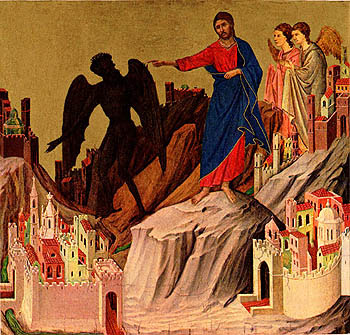
Immediately after this he was led by the Spirit (Mark 1:12 says he was driven) into the desert to be tempted by Satan (this story appears in all of the Gospels except for John). His fasting for 40 days calls to mind many significant Old Testament events that also involved 40 days—Noah in the ark (Genesis 7:12), Moses on Mt. Sinai (Exodus 24:18), and Jonah in Nineveh (Jonah 3:4).

Jesus’ temptation mirrors that of notable Old Testament figures (Adam, Moses, the Israelites in the wilderness) who were also tempted. The difference is that Jesus is successful in resisting, atoning for the failure of those who came before.

Jesus shows that he can empathize with us in that he was subject to temptation just as we are (see Hebrews 2:18; 4:15). He also shows us how to resist the devil.

The Navarre Bible Commentary on the Gospel of Luke introduces the passage in this way:
1-13. Here we see the devil interfere with Jesus’ life for the first time. He does so very brazenly. Our Lord is about to begin His public ministry, so it is a particularly important point in His work of salvation.

“The whole episode is a mystery which man cannot hope to understand–God submitting to temptation, letting the Evil One have his way. But we can meditate upon it, asking our Lord to help us understand the teaching it contains” ([St] J. Escriva, “Christ Is Passing By”, 61).

Christ, true God and true man, made Himself like us in everything except sin (cf. Philippians 2:7; Hebrews 2:7; 4:15) and voluntarily underwent temptation. “How fortunate we are,” exclaims the Cure of Ars, “how lucky to have a God as a model. Are we poor? We have a God who is born in a stable, who lies in a manger. Are we despised? We have a God who led the way, who was crowned with thorns, dressed in a filthy red cloak and treated as a madman. Are we tormented by pain and suffering? Before our eyes we have a God covered with wounds, dying in unimaginable pain. Are we being persecuted? How can we dare complain when we have a God who is being put to death by executioners? Finally, are we being tempted by the demon? We have our lovable Redeemer; He was also tempted by the demon and was twice taken up by that hellish spirit: therefore, no matter what sufferings, pains or temptations we are experiencing, we always have, everywhere, our God leading the way for us and assuring us of victory as long as we genuinely desire it” (“Selected Sermons”, First Sunday of Lent).

Jesus teaches us therefore that no one should regard himself as incorruptible and proof against temptation; He shows us how we should deal with temptation and exhorts us to have confidence in His mercy, since He Himself experienced temptation (cf. Hebrews 2:18).

For further explanation of this passage, see the notes on Matthew 4:3-11.
(Note: The Navarre Bible Commentary on Matthew’s Gospel for this passage is quite extensive. I may include it at the end of this thread if I have time. 🙂 )

The Catholic Matters study aid further notes:
In these verses we have St. Luke’s description of our Lord’s preparation for his public ministry. Matthew and Mark (briefly) relate the same incident. After his baptism by John in the Jordan, he was proclaimed by the Father’s voice from heaven to be his Son and the Messiah, the suffering Servant (cf. Isaiah 40-53). He was then led by the Holy Spirit into the desert, near the Jordan, where he fasted for forty days and was tempted by the devil. This incident in Christ’s life must have been told later by himself to his disciples, as nobody else was present with him at this time. It was cherished by the early Church, as its insertion into all three synoptic Gospels shows. It was regarded as most important because it proves that Christ had real human nature, that he suffered both hunger and humiliation in order to set us an example. He did not need to fast, nor did he need to allow the devil to tempt him, but we need the one and must expect and struggle with the second. Finally, it brings out the other-worldliness of the messianic kingdom that our Lord is about to set up.
 
Here is the text of the Gospel Reading as we will hear it this Sunday at Mass:
Gospel
Luke 4:1-13
Filled with the Holy Spirit, Jesus returned from the Jordan and was led by the Spirit into the desert for forty days, to be tempted by the devil. He ate nothing during those days, and when they were over he was hungry.
The devil said to him, “If you are the Son of God, command this stone to become bread.”
Jesus answered him, “It is written, One does not live on bread alone.”
Then he took him up and showed him all the kingdoms of the world in a single instant.
The devil said to him, “I shall give to you all this power and glory; for it has been handed over to me, and I may give it to whomever I wish. All this will be yours, if you worship me.”
Jesus said to him in reply, “It is written: You shall worship the Lord, your God, and him alone shall you serve.”
Then he led him to Jerusalem, made him stand on the parapet of the temple, and said to him,“If you are the Son of God, throw yourself down from here, for it is written:
He will command his angels concerning you, to guard you,
and:
With their hands they will support you, lest you dash your foot against a stone.”
Jesus said to him in reply, “It also says,
You shall not put the Lord, your God, to the test.”
When the devil had finished every temptation, he departed from him for a time.
 
Again, using Catholic Matters as a template, here are some thoughts on this reading with my comments (if any) in green, and the Navarre Bible Commentary notes in blue.

[1] Filled with the Spirit, Jesus returned from the Jordan: As fully God, of course, Jesus was always filled with the Divine life. As fully man, however, he recieved the Spirit in his humanity when he was baptized (where the Holy Spirit was given to him in the form of a dove) so that the human nature that was necessary to complete his mission would be fully equipped. Like Israel of old who crossed the Red Sea to go into the wilderness and later crossed the Jordan into the Promised Land, Jesus emerges from the water to be tested.

and was led by the Spirit into the desert: Mark says that Jesus was “driven” or “thrust” into the desert (more accurately called a “wilderness”). The exact location is not known, but traditionally it was located just north of Jericho on a low mountain or high hill of about 1600 feet high (Sheed, “To Know Christ Jesus,” Ignatius Press, page 112).

[2] for forty days: Moses before receiving the Old Law from God fasted for forty days on Mount Sinai (Ex. 34: 28). Elijah, the first of the great prophets sent by God to the northern kingdom, fasted for forty days on his journey to Mount Horeb (1 Kgs. 19: 5). So Christ also, the law-giver of the New Covenant and the prophet of God’s mercy and love, fasted for forty days before beginning his mission of redemption.

Also, the flood lasted 40 days, Israel wandered for 40 years in the wilderness, the spies investigated Canaan for 40 days (Num. 14:34), 40 days that Jesus appeared to his disciples after the Resurrection.

he was tempted by the devil: St. Luke describes only the last three temptations: temptation to abuse his divine power for his own benefit, temptation to seek political power in dereliction of his true mission; temptation to abuse the divine power to frighten men into subjection.

**He ate nothing during those days and when they were over he was hungry: **this proves the reality of his human nature. If he had been God, in the appearance of human nature only, he would not feel hunger or any other human passion.

The devil said to him, “If you are the Son of God, command this stone to become bread.”: Both here and in verse 9 Jesus is called “son of God” by Satan, a reference to his baptism (Luke 3:22) and Adam, son of God (Luke 3:38). It seems Satan was not entirely sure of Jesus’ identity (he is only a creature and does not know the mind of God), but he must have intuited something from the events surrounding Jesus’ baptism.

[4] **Jesus answered him, “It is written, ‘One does not live by bread alone.’”: **A quotation from Deuteronomy 6:13. Christ repels each of the temptations with an apt quotation from the Old Testament which forbade those diabolical suggestions.

[5] he took him up and showed him all the kingdoms of the world in a single instant: In a vision, since there is no mountain high enough to do this.

[6] **The devil said to him, “I shall give to you all this power and glory; for it has been handed over to me, and I may give it to whomever I wish. [7] All this will be yours, if you worship me.”: **In a sense, the world is under the control of the devil (John 12:31, 14:30, 16:11; Luke 22:53; Acts 26:18). However, it is actually God who owns and has power over the world. For his own Divine and mysterious purposes, he has given Satan a limited power in this world, but he really only has as much real control as we give or concede to him. Thus, what he says to Jesus is, at most, a truth mixed with a lie.

Continued on next post…
 
Continued from previous post.

[8] Jesus said to him in reply, “It is written: You shall worship the Lord, your God, and him alone shall you serve.”: Deuteronomy 6:13, 10:20; Exodus 23:24.

[9] Then he led him to Jerusalem: A key place, the center of religious and political power where Jesus will journey to and complete his mission as Messiah. However, Jesus was to do so in accordance with God’s plan, not by the shortcuts offered to him by Satan or man’s political means.

**made him stand on the parapet of the temple: **The tallest point of the temple, built on a cliff facing east, over the brook of Kidron and toward the Mount of Olives. A leap from this point would have been very impressive to the inhabitants of Jerusalem. In fact, according to the Jewish historian Josephus, a would-be messiah prior to Jesus named Judas, did throw himself off this pinnacle to his death in a misguided bid to prove his messiah-ship.

**and said to him, “If you are the Son of God, throw yourself down from here, for it is written: He will command his angels concerning you, to guard you: **Satan quotes Psalm 91:11.

With their hands they will support you, lest you dash your foot against a stone.”: This time Satan quotes Psalm 91:12.

Jesus said to him in reply, “It also says, You shall not put the Lord, your God, to the test.”: Jesus counters with a quote from Deuteronomy 6:16.

[13] When the devil had finished every temptation, he departed from him for a time.: The devil failed but he was to try again later. Through his agents he had Christ condemned to the death of the Cross, an illusory victory for him as the Resurrection proved.

During his ministry Jesus will encounter many temptations and the powers of evil who know who he is (Luke 4:41; 8:29) and he vanquishes them all.

**13. **Our Lord’s temptations sum up every kind of temptation man can experience: “Scripture would not have said”, St. Thomas comments, “that once all the temptation ended the devil departed from Him, unless the matter of all sins were included in the three temptations already related. For the causes of temptation are the causes of desires–namely, lust of the flesh, desire for glory, eagerness for power” (“Summa Theologiae”, III, q. 41, a. 4 ad 4).

By conquering every kind of temptation, Jesus shows us how to deal with the snares of the devil. It was as a man that He was tempted and as a man that He resisted: “He did not act as God, bringing His power into play; if He had done so, how could we have availed of His example? Rather, as a man He made use of the resources which He has in common with us” (St. Ambrose, “Expositio Evangelii Sec. Lucam, in loc.”).

He wanted to show us the methods to use to defeat the devil–prayer, fasting, watchfulness, not dialoguing with temptation, having the words of God’s Scripture on our lips and putting our trust in the Lord.

“Until an opportune time”, that is, until it is time for Jesus to undergo His passion. The devil often appears in the course of our Lord’s public life (cf., for example, Mark 12:28), but it will be at the Passion–“this is your hour, and the power of darkness” (Luke 22:53)–that he will be most clearly seen in his role as tempter. Jesus will forewarn His disciples about this and once more assure them of victory (cf. John 12:31; 14:30). Through the passion, death and resurrection of Christ, the devil will be overpowered once and for all. And by virtue of Christ’s victory we are enabled to overcome all temptations.
 
*The Catechism of the Catholic Church *references for this Sunday’s Gospel include:
**538 **The Gospels speak of a time of solitude for Jesus in the desert immediately after his baptism by John. Driven by the Spirit into the desert, Jesus remains there for forty days without eating; he lives among wild beasts, and angels minister to him.[241] At the end of this time Satan tempts him three times, seeking to compromise his filial attitude toward God. Jesus rebuffs these attacks, which recapitulate the temptations of Adam in Paradise and of Israel in the desert, and the devil leaves him “until an opportune time”.[242]
**539 **The evangelists indicate the salvific meaning of this mysterious event: Jesus is the new Adam who remained faithful just where the first Adam had given in to temptation. Jesus fulfills Israel’s vocation perfectly: in contrast to those who had once provoked God during forty years in the desert, Christ reveals himself as God’s Servant, totally obedient to the divine will. In this, Jesus is the devil’s conqueror: he “binds the strong man” to take back his plunder.[243] Jesus’ victory over the tempter in the desert anticipates victory at the Passion, the supreme act of obedience of his filial love for the Father.
540 Jesus’ temptation reveals the way in which the Son of God is Messiah, contrary to the way Satan proposes to him and the way men wish to attribute to him.[244] This is why Christ vanquished the Tempter for us: “For we have not a high priest who is unable to sympathize with our weaknesses, but one who in every respect has been tested as we are, yet without sinning.”[245] By the solemn forty days of Lent the Church unites herself each year to the mystery of Jesus in the desert.
241 Cf. Mk 1:12-13.
242 Lk 4:13.
243 Cf. Ps 95:10; Mk 3:27
244 Cf Mt 16:2 1-23.
245 Heb 4:15.
2096 Adoration is the first act of the virtue of religion. To adore God is to acknowledge him as God, as the Creator and Savior, the Lord and Master of everything that exists, as infinite and merciful Love. “You shall worship the Lord your God, and him only shall you serve,” says Jesus, citing Deuteronomy.[13]
13 Lk 4:8; Cf. Deut 6:13.
**2119 **Tempting God consists in putting his goodness and almighty power to the test by word or deed. Thus Satan tried to induce Jesus to throw himself down from the Temple and, by this gesture, force God to act.[49] Jesus opposed Satan with the word of God: “You shall not put the LORD your God to the test.”[50] The challenge contained in such tempting of God wounds the respect and trust we owe our Creator and Lord. It always harbors doubt about his love, his providence, and his power.[51]
49 Cf. Lk 4:9.
50
Deut 6:16.
51 Cf. 1 Cor 10:9; Ex 17:2-7; Ps 95:9.
 
Here are some questions for personal application on the Gospel Reading from my Scripture study found here:

In the First Reading, on the verge of their entry into the Promised Land, Moses reminds the Israelites of all that God has done for them to bring them to this point. How are they to show their gratitude to God once they have taken possession of the land? How do you show gratitude to the Lord for all the good he has done for you? How do you “give to God what belongs to God” (Matthew 21:22)?

Why were the temptations directed at Jesus immediately after he was affirmed by God at his baptism (Luke 3:22)?

In each temptation, what was its appeal? Its price? How does Jesus resist them? How are the three temptations similar? Different?

What does it mean to you that all the power and glory of the kingdoms of the world have been given to Satan (verses 5-6. See also John 12:31; 14:30; 16:11)?

If the devil had three shots at you, what temptations would he use? What resources does God give to help us resist?

In verse 12, Jesus quotes Deuteronomy 6:16. What does it mean to “tempt the Lord, your God”? How is that different from “taking a step out in faith”? What is your own experience in this regard?
 
The study aid, Catholic Matters, offers this meditation for application of this Sunday’s Gospel Reading:
APPLICATION: Christ’s voluntary self-mortification of forty days’ fast, with its accompanying temptations, was but part of the self-mortification, with its climax on the Cross, which he gladly underwent for our salvation. He did not need to fast in order to keep the inclinations of the body in subjection, he did not need to allow the insult of temptation. He could have said, “begone Satan” at the beginning as easily and as effectively as he said it at the end. But he willingly underwent this humiliation in order to set us an example and to prove to us the infinite love he bears us and the value, the priceless value, he sets on our eternal salvation. He became like us in all things (except sin) in order to make it possible for us to become like him—the beloved of his Father—and co-heirs with him in the kingdom of heaven.
With this example given us by Christ no Christian can or should expect to travel the road to heaven without meeting obstacles and temptations. Our weak human nature is of itself, even without any external tempter, a source of many temptations to us, especially of those three illustrated in the case of Christ. Our body desires all the pleasures and comforts that can be got out of life and resents any curtailment of these desires even on the part of our Creator and Benefactor. Our gifts of intelligence and freewill often tempt most of us to look for power, political or economic, over our fellowman. We want to be better off than others in this world, when our purpose in life is to help ourselves and our fellowmen to the better life. Finally, so fully occupied are many in the mad rush after pleasure and power that they have no time to devote to the one thing that matters, the attainment of eternal life.
Yet, through some foolish logic of our own, we expect God to do for us what we refuse to do for ourselves. We are tempting God by presuming he will save us if we have deliberately chosen the road to perdition.
There are few, if any, amongst us who can honestly say: “I am free from such inclinations or temptations.” The vast majority of us can and should beat our breasts and say with the publican: “O God, be merciful to me a sinner.” And merciful he will be if we turn to him with true humility. He may not remove all our temptations, all our wrong inclinations, but he will give us the grace to overcome them if we sincerely seek his aid
 
A meditation from Don Schwager at Daily Scripture Readings and Meditations:
**Meditation: **What motivated Jesus to spend 40 days and nights of solitude, prayer and fasting in the Judean wilderness? This desert landscape was largely uninhabitable and was full of dangers for anyone who dared to venture in it for long. Danger from scorching heat by day and extreme cold at night, danger from wild animals and scorpions, plus the deprivation of food and the scarcity of water.
For the chosen people of Israel the desert was a place of testing, encounter, and renewal. When the Israelites were freed from slavery in Egypt, they wandered 40 years in the wilderness. This was seen as a time of purification and preparation for entry into the promised land. Moses went to the mountain of the Lord at Sinai and stayed there for 40 days and nights in prayer and fasting (Exodus 24:18). Elijah, after he was fed with bread from heaven, journeyed without any food for 40 days to the mountain of God. (1 Kings 19:8). Jesus journeyed without any food to the wilderness for 40 days to prepare himself for the mission that the Father had sent him to accomplish.
Why did Jesus choose such a barren, lonely place for an intense and long period of sustained prayer and fasting? Matthew, Mark, and Luke tell us in their gospel accounts that Jesus was led by the Holy Spirit into the wilderness. Mark states it most emphatically: “The Spirit immediately drove him out into the wilderness” (Mark 1:12). What compelled Jesus to seek solitude, away from his family and friends, for such a lengthy period? Was it simply a test to prepare him for his mission? Or did Satan want to lure him into a trap? The word tempt in English usually means to entice someone to do what is wrong or forbidden. The scriptural word used here also means test in the sense of proving and purifying someone to see if there are ready for the task at hand. We test flight pilots to see that they are fit to fly under all conditions, including times of adverse turbulence and poor visibility. Likewise God tests his servants to see if they are fit and ready to be used by him. On many occasions God tested Abraham to prove his faith and to strengthen his hope in God’s promises. Abraham obeyed willingly even when God asked him to sacrifice Isaac, the son of promise. When the Israelites were sorely tested in Egypt for more than 400 years, they did not forget God. They kept God’s word and remembered his promise to bring them freedom from their enemies.
Jesus was no exception to this pattern of testing. He went to the desert without food or shelter. Adam and Eve had everything they needed in the Garden of Paradise. But they ate of the forbidden fruit out of disobedience because they trusted in themselves rather than in God. They were cast out of Paradise and driven into the wilderness. Jesus freely enters the wilderness in order to regain Paradise for those who lost it. Jesus refuses food to show his dependence on the bread of heaven, the word of God, that would sustain him not only in his physical hunger, but in his hour of temptation as well. When Satan tempts Jesus to turn stones into bread, Jesus replies with the words of scripture, “Man shall not live by bread alone, but by every word that proceeds from the mouth of God” (quote from Deuteronomy 8:3; see also Matthew 4:4).
Where did Jesus find the strength to survive the desert’s harsh conditions and the tempter’s seduction? He fed on God’s word and found strength in doing his Father’s will. Satan will surely tempt us and he will try his best to get us to choose our will over God’s will. If he can’t make us renounce our faith or sin mortally, he will then try to get us to make choices that will lead us, little by little, away from what God wants for us.
Jesus was tempted like us and he overcame sin not by his own human effort but by the grace and strength which his Father gave to him. He had to renounce his will for the will of his Father. He succeeded because he wanted to please his Father and he trusted that his Father would give him the strength to overcome the obstacles that stood in the way. Luke says that Jesus was “full of the Holy Spirit” (Luke 4:1). When tempted by the devil Jesus did not try to fight his adversary on his own human strength. He relied on the power which the Spirit gave him. Jesus came to overthrow the evil one who held us captive to sin and fear of death (Hebrews 2:14). His obedience to his Father’s will and his willingness to embrace the cross reversed the curse of Adam’s disobedience. His victory over sin and death won for us not only pardon for our sins but adoption as sons and daughters of God.
How can we overcome sin and oppression in our personal lives? The Lord Jesus gives us his Holy Spirit to help us in our weakness (Romans 8:26) and to be our guide and consoler in temptation and testing (1 Corinthians 10:13). The Lord gives grace to the humble who acknowledge their dependence on him (James 4:6) and he helps us to stand against the attacks of our enemy, Satan, who seeks to destroy us (1 Peter 5:8-10; Ephesians 6:10-18). The Lord Jesus is ever ready to pour out his Spirit upon us that we may have the strength and courage we need to resist sin and to reject the lies and deceits of Satan. God wants us to “fight the good fight of the faith” (1 Timothy 6:12) with the power and strength which comes from the Holy Spirit. Do you rely on the Lord for your strength and help?
*“Lord Jesus, your word is life and joy for me. Fill me with your Holy Spirit that I may have the strength and courage to embrace your will in all things and to renounce whatever is contrary to it.” *
 
Status
Not open for further replies.
Back
Top