
First things first, the holy water font

  • Thread starter Thread starter kdkkdt
  • Start date Start date
Status
Not open for further replies.
This thread has already had posted the relevant CDW protocol. That is a document that applies to the entire Church. So, yes, it is true and no, it was not merely a description of what happens in one person’s parish.
It is in error to say that this is a docuument that applies as indicated. It was a letter in answer to a question. It is certainly not universally known or recongized.
I find it troubling that anyone asked the question to start with and that this discussion even continues.
When Jesus didvide the loaves and fishes, I don’t remember him denying anyone food. Now I realize that there is a difference, but a person coming up in the communion line is looking for spirtual noushiment. Both the priest and deacon represent Christ in thier respective roles.
There are positive aspects to the practice. With children it teaches them that they are prepariong for something very special in the future and give anticipation. For a non Cathoclic it sends the message that we are accepting of beliefs, while still indicating our diffences. To the divorce and remarried, it indicates that they are still part of the communitte with the hope that they will some day be in full communion.
I could go on, but I hope you understand what I mean by pastoral. Rejecting people because of were they may be on thier faith journey always have very grave results.
 
I dug up something Archbishop Chaput wrote in 2003. His recommendation is that no one offers any blessing in the Communion line, but they simply invite the person to worship (with a bow), with the phrase “Receive the Lord Jesus in your heart.” I think this may be a reasonable compromise. Here’s the text:
"As members of the community move forward to receive holy Communion during Mass, parents will often bring their small children along. Over the years, it has become a custom in many parishes for these children to receive a blessing. I don’t really know where this practice began, but it’s worth some reflection.
"Usually the children in line will look up expectantly at the person distributing holy Communion. The minister then responds by doing one of several things: He or she may pat the child’s head, or touch the head in a sign of blessing, or mark the child’s forehead with a sign of the cross. As warm and well intentioned as the gesture may be, in the context of the liturgy, the Communion procession really isn’t the time for a blessing of children or adults who are unable to receive Communion.
"There are times in the liturgical year when the laity assist in specific acts of blessing, such as the blessing of throats or the distribution of ashes. These are clearly indicated in the Book of Blessings. But extraordinary ministers of holy Communion do not ordinarily have a commission to bless in the name of the Church, as priests and deacons do. At this point in the liturgy, they have a very specific function: to collaborate with the clergy in the distribution of holy Communion.
"As we’ll explore in a later column, the blessing of the assembly properly occurs at the end of the Mass. As the body of Christ, the assembly is blessed together before we depart to live the fruits of the liturgy.
"What would be appropriate for children to do who accompany their parents in the Communion procession, and adults who do not receive Communion?
"The Communion procession is an opportunity for parents to begin to teach their children about the great gift of the Eucharist. First of all, children could learn to give reverence to the Lord hidden under the forms of bread and wine. Children can already learn from their parents, and others receiving holy Communion, to give honor to the Lord by bowing reverently.
"Parents and catechists should start teaching the mystery of the Eucharist at an early age. Children will soon begin to desire to receive holy Communion. This earnest desire to receive our Lord sacramentally is traditionally called a ‘spiritual communion.’ Regrettably, we don’t talk about spiritual communion as we once did. But Thomas Aquinas, Alphonsus Liguori and many other great saints strongly encouraged spiritual communion as a practice.
"Both children and adults can make a spiritual communion. They may come forward with their arms crossed and bow before the Eucharist. Then the priest, deacon or extraordinary minister could say to them kindly, ‘Receive the Lord Jesus in your heart.’ This is not a blessing, but an invitation to worship, so no gestures are made.
“This spiritual communion would more authentically carry out the spirit of the liturgy. Being faithful to the truths of the sacramental celebration allows all of us, young and old, to enter more deeply into worship.”
 
It is in error to say that this is a docuument that applies as indicated. It was a letter in answer to a question. It is certainly not universally known or recongized.
I find it troubling that anyone asked the question to start with and that this discussion even continues.
When Jesus didvide the loaves and fishes, I don’t remember him denying anyone food. Now I realize that there is a difference, but a person coming up in the communion line is looking for spirtual noushiment. Both the priest and deacon represent Christ in thier respective roles.
There are positive aspects to the practice. With children it teaches them that they are prepariong for something very special in the future and give anticipation. For a non Cathoclic it sends the message that we are accepting of beliefs, while still indicating our diffences. To the divorce and remarried, it indicates that they are still part of the communitte with the hope that they will some day be in full communion.
I could go on, but I hope you understand what I mean by pastoral. Rejecting people because of were they may be on thier faith journey always have very grave results.
The document was an answer to the question of whether there are any guidelines regarding the giving of blessings in the Communion line. The dicastery responsible for such topics responded with a list of (non-binding) guidelines. What you mean by “pastoral” seems to be that these guidelines should be ignored. They are, however, from an official Church statement. When a person asks about this practice, she should be told what the official Church statement says, as well as informed that it is implemented differently in different places.

I find it troubling that you find it troubling that a person would ask the question. That is where she is on her faith journey - beginning to explore Catholicism and having many questions about it. I think it is wonderful that she felt comfortable asking her questions here and I am concerned that your comment will leave her feeling rejected and uncomfortable to ask questions in the future.

I get that this is a meaningful practice for you with a lot of beautiful symbolism, but that is not a good reason to shut down the questions of an inquirer. She should be answered honestly, with official teachings, regardless of your opinion of how pastoral this teaching is.
 
The church I will be attending is a very small one and has just two masses a week in English. I have already inquired about the RCIA through the new friend I mentioned earlier and it turns out her husband teaches the classes, which will hopefully go even further towards making the transition an easier one for me. 🙂
kdkkrt. I always understood that Methodist almost always baptize with aspersion or affusion and that Baptists call other methods of baptism ‘sprinkling’. Total submersion as a mature believer is not Methodist teaching ever at all.

Your baptism as an infant is the only one that counts in the Catholic church, and the submersion was only getting wet (very wet). In RCIA your goal will be confirmation, they will not baptize you.

My gramma was a Nazarene and she took me to her church sometimes. The church of the Nazarene seemed to blend Baptist and Methodist teachings. Is that also true with the Weslyan church?
 
I fear that we have frightened the OP away with our feud about blessings in the Commmunion line.

Please notice that she has not been back at all, and she has OC disorder. I pray we have not scared her away from the church as well!
 
The document was an answer to the question of whether there are any guidelines regarding the giving of blessings in the Communion line. The dicastery responsible for such topics responded with a list of (non-binding) guidelines. What you mean by “pastoral” seems to be that these guidelines should be ignored. They are, however, from an official Church statement. When a person asks about this practice, she should be told what the official Church statement says, as well as informed that it is implemented differently in different places.
 
It may be an official response, but wihout any enforcement.
I prefer to give her the pastoral reponse.
Once she is in RCIA it is a mute point since she will be dismissed for study after the homily.
I’m in RCIA now. They have decided not to dismiss after the homily this year. I don’t know if this is the decision of the church or the Bishop but I like it. Mass is a great time for me and I would hate to miss part of it for most of a year.
 
I’m in RCIA now. They have decided not to dismiss after the homily this year. I don’t know if this is the decision of the church or the Bishop but I like it. Mass is a great time for me and I would hate to miss part of it for most of a year.
The dismissal is part of the RITE, but the decision not to do the breaking open of the word can have a number of reasons. The most common reason is to have a catichist to give instructions. It is often a issue to have someone available every week.
 
My issue with this document is that is cannot be found at any official church site, not the Vatican and not the Catholic bishops. I have only ever been able to find reproductions of it on conservative Catholic sites. Because that I find it primarily suspect.
I do not know of an online source for collected CDW protocols, but they are still official statements. This one in question is reproduced right here on CAF as a sticky in the Liturgy and Sacraments subforum. forums.catholic-questions.org/showthread.php?t=543513 Is CAF too conservative for you?
 
I fear that we have frightened the OP away with our feud about blessings in the Commmunion line.

Please notice that she has not been back at all, and she has OC disorder. I pray we have not scared her away from the church as well!
I am concerned about this too. But perhaps she is merely busy and will return when she has a chance.
 
Didn’t Jesus rebuke the Pharisees because of their strict adherence and interpretation of the law…would Jesus turn that person away from receiving a blessing in their search to draw nearer to him…seriously?..our church also allows those who want to receive a blessing to enter the communion line.
 
Didn’t Jesus rebuke the Pharisees because of their strict adherence and interpretation of the law…would Jesus turn that person away from receiving a blessing in their search to draw nearer to him…seriously?..our church also allows those who want to receive a blessing to enter the communion line.
He rebuked them for hypocrisy but praised them for their strict interpretation the law. Our Lord was not opposed to the Law. In Matthew 23:3 He said of them, “so practice and observe whatever they tell you—but not what they do. For they preach, but do not practice.”
 
I do not know of an online source for collected CDW protocols, but they are still official statements. This one in question is reproduced right here on CAF as a sticky in the Liturgy and Sacraments subforum. forums.catholic-questions.org/showthread.php?t=543513 Is CAF too conservative for you?
Lets see, this is not a copy of the original document, just a retype. There is no name of the original inquirer, and no name of the person who responded, and finally CAF is a private enterprise and not an official church source.
 
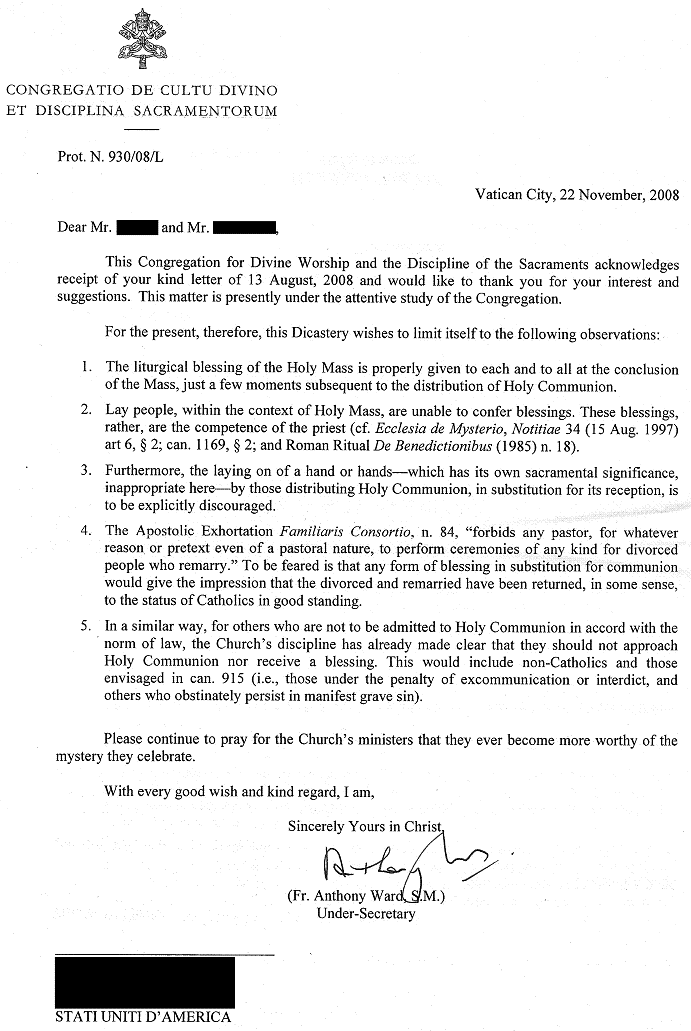
Here’s a physical scan of the document in question. The names and address of the recipients have been censored to respect their privacy:
 
Lets see, this is not a copy of the original document, just a retype. There is no name of the original inquirer, and no name of the person who responded, and finally CAF is a private enterprise and not an official church source.
The original inquirers were CAF members who wrote to the CDW to discover its position when the subject was being discussed here. Their names appear in the post I already linked to. If you follow the link within that, you can see the original thread which prompted their question and a copy of their question which the posted to the forum when they first mailed it. From this thread there is a link to another which shows the CDW response, including a gif of the actual letter on CDW letterhead. All the information you ask about is available right here on CDF if one starts from the link I gave.

That this letter is exactly what it purports to be cannot reasonably be questioned. This is one of the best attested documents I have ever seen.

We probably still have a few members here who remember the original discussion and could act as witnesses.
 
Here’s a physical scan of the document in question. The names and address of the recipients have been censored to respect their privacy:
http://wdtprs.com/images2/13_02_24_CDWDS_Response_Blessings_lr.gif
If the document is in fact is real a couple of items. .
I question that since most official letters would in some way restate the question from the original letter, not just refer to the date of the letter.
Further:
It says the “issue is under study” which means no official statements or instructions as of the date of the letter had been issue. I would say they still have not been.

Second the items listed are “observations” which are a basis for making a decision which in fact has not been made.

This document is an opinion in making the case for not doing blessings. As stated before it has no direct statement of “the practice of …” None of the typical notations or explanations that an official document would have if it is to is to be put into practice would normally contain.

So to say this is a final definitive official document on the issue in the least is misleading.
 
So to say this is a final definitive official document on the issue in the least is misleading.
I am not aware of anyone in this thread who has said that this is a final definitive official document. It is quite clear from the text of the document itself that it is not. I think the EWTN article linked from that first CAF thread I gave you ewtn.com/library/Liturgy/zlitur263.htm gives a good explanation of how to understand the document:
Although the letter as such is not legally binding, some of its points, such as No. 2 on the prohibition of lay ministers giving liturgical blessings, are merely restatements of existing law and as such are already obligatory.

Nor did the letter deal with all possible circumstances, such as the case of small children mentioned by our reader. Because of this, some dioceses have taken a prudent wait-and-see attitude regarding these blessings. For example, the liturgy office of the Archdiocese of Atlanta, while reiterating that “the Archdiocese has no policy prohibiting the use of blessings at the time of Holy Communion,” prudently suggested to pastors that it “may be appropriate to avoid promoting the practice until a more definitive judgment regarding its value in the liturgical celebration can be obtained.”
 
I’d ask the good deacon how it is he would find suspicious a document from the CDW discouraging the blessing practice, but not find suspicious the origin of the recent novelty of coming forward for blessings. Is it not suspicious that this practice did not originate from any official Church teaching or guidance? Why so much trust and faith in modern novelties with specious origins, and so much skepticism and distrust for credible accounts of Rome highly discouraging them?
 
:
Originally Posted by FAB
If they follow the RITE properly, they are dismissed on Sundays
I have yet to encounter a parish that does it this way. Of the six or so parishes that I have been involved in (and some of those teaching RCIA) it was taught during the week. I agree it is supposed to be done this way, but I have yet to see it.
Boulder, are you perhaps confusing dismissal with the (weekly) catechetical sessions?
 
It is in error to say that this is a docuument that applies as indicated. It was a letter in answer to a question. It is certainly not universally known or recongized.
I find it troubling that anyone asked the question to start with and that this discussion even continues.
When Jesus didvide the loaves and fishes, I don’t remember him denying anyone food. Now I realize that there is a difference, but a person coming up in the communion line is looking for spirtual noushiment. Both the priest and deacon represent Christ in thier respective roles.
There are positive aspects to the practice. With children it teaches them that they are prepariong for something very special in the future and give anticipation. For a non Cathoclic it sends the message that we are accepting of beliefs, while still indicating our diffences. To the divorce and remarried, it indicates that they are still part of the communitte with the hope that they will some day be in full communion.
I could go on, but I hope you understand what I mean by pastoral. Rejecting people because of were they may be on thier faith journey always have very grave results.
Amen.
 
Status
Not open for further replies.
Back
Top