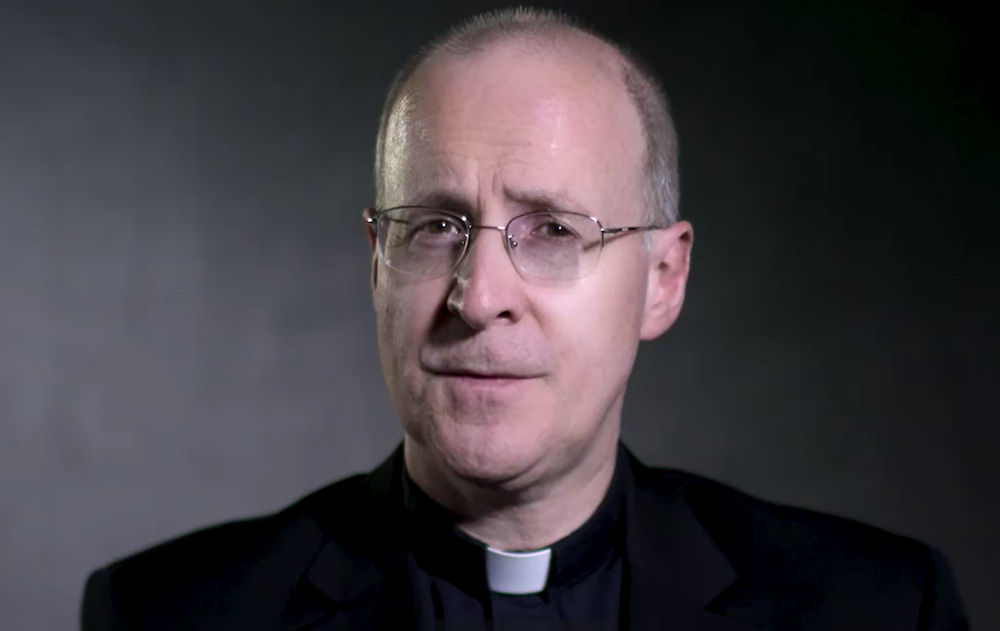
Fr. James Martin: ‘People take the Bible…out of context’ on homosexuality

  • Thread starter Thread starter KMG
  • Start date Start date
Status
Not open for further replies.
Thank you for explaining what I was trying to convey in a much more concise and elegant way.

 
You’re completely missing the point if you’re just reducing this to Jesus changing His mind while ignoring the implications on Christ’s perfection. The Christology being suggested in tis novel interpretation is an erroneous one. Nothing convoluted about what St. John Chrysostom, or even what the writers of Scripture have put forward. I’d love to see someone provide writings that support this interpretation of Christ’s prejudicial attitude that come from prior to the 20th century. Again… arrogance: to think that only in the 20th and 21st centuries we’ve come to understand what these two Gospel accounts actually show us.

But I wouldn’t call Fr. Martin brave. He’s not in the “line of fire” from traditionalists, however you define that. Regular joe Catholics are done putting up with his heterodox ideas. Cardinal Wilfrid Napier said as much. And I’m not sure what reforms you’re talking about: the ones actually called for by the Second Vatican Council, or the ones not called for by the Council, but happened anyways in the 1970’s. I’m thankful for the former, not the latter. Furthermore, if Fr. Martin’s “Nouvelle Théologie” is made manifest in his Georgetown talk, he can keep it. The Church doesn’t need any new theology. It needs the “old theology”. Jesus is the same yesterday, today and tomorrow. He doesn’t change, and the Church doesn’t either in her teachings of faith and morals. Fr. John F. Harvey, O.S.F.S, Fr. Paul Check, and Servant of God Cardinal Terrence Cooke have already shown, and continue to show, those who experience same-sex attraction that Christ loves them. Fr. Martin rejects their approach. The other three men can truly be called brave for their efforts in bringing souls back into communion with Christ. They can be called brave because they do not affirm the sinful proclivities of their brothers and sisters as something that should be “reverenced”.
 
First off, I never said anything about Christ having a “prejudicial attitude”. You got that idea from that other person posting on this subject who I didn’t respond to, because the comments weren’t worth acknowledging. I see no point in engaging someone who deliberately misrepresents what I am saying.

Second, it is possible to highlight part of a story without reducing it to just that meaning. I used the exchange between Jesus and Mary at the wedding in Cana - where Jesus hesitates and Mary presses on in full confidence, to illustrate the point that Jesus does listen to women and is influenced by them. Of course that is not the entire meaning of the story - John packs layers of metaphor & symbolism into every line he writes. So while it’s not everything, it is ONE thing among many.

Third, I make a distinction between the divine pre-existent Word, the Incarnate Jesus, and the exulted, resurrected Christ, because that is what Christianity is all about. Prior to the Incarnation, the Word was in the very nature of God - a status he let go of in order to become human. While he was human, Jesus did not cling to his divine attributes (Philippians 2:6-11). He “grew in wisdom” and was at times “open to seeing things in a new way” - as is plainly recorded in scripture. Only after the Resurrection/Ascension did Jesus returned to his exalted state at the right hand of the Father, but now in a glorified human body.

So to say, “Jesus is the same yesterday, today and tomorrow. He doesn’t change, and the Church doesn’t either in her teachings of faith and morals” is not quite true.

Finally, the “Nouvelle Théologie” was a theological reform movement that gave rise to the greatest Catholic theologians of the 20th century. It sought to return to the sources (Ressourcement) in order to understand the original meaning of a doctrine. This means reading someone like Chrysostom with an understanding of the original historical & cultural context, the purpose of the author, and audience to which it is addressed - all of which shape the composition and meaning of a text. No more reading a 5th century document through the lens of the 16th century.
“The theologians usually associated with Nouvelle Théologie are Henri de Lubac, Pierre Teilhard de Chardin, Hans Urs von Balthasar, Yves Congar, Karl Rahner, Hans Küng, Edward Schillebeeckx, Marie-Dominique Chenu, Louis Bouyer, Jean Daniélou, Jean Mouroux and Joseph Ratzinger (later Pope Benedict XVI).” - Wikipedia
Before disparaging it, you should learn more about it. Many of these men endured the same kind of abuse Fr. Martin is now experiencing - and some still do (e.g., Hans Küng). I see the debate as part of the process of delving into the true meaning of a doctrine and I am happy to see it play out, but I would like the traditionalists to quite with the personal attacks against Father Martin.
 
Last edited:
I’m not sure if you’re quite understanding Phil 2:6-11, as your comments are a bit strange without more exposition. “While he was human…” Well, while He was human, he was also God. And Jesus didn’t “return” to an exalted state after the Resurrection (He already was exalted being the Word of God); His glorified body shows us exactly what we will attain after the Resurrection. He was God through it all and he was human through it all, but after the Resurrection he wasn’t a human like we are now, but a human like we will be after the resurrection of the dead. If you want to talk more about Christology, make another thread like I suggested. This thread is for discussing Fr. Martin and his views on homosexuality.

And I understand what the “Nouvelle Théologie” is, but I was using the words in their actual meaning, “new theology”. And I use that because there are clearly two different camps and distinctions in the 1960’s Nouvelle Théologie movement. Rahner and Ratzinger couldn’t be anymore different. I’m taking Fr. Martin’s views for what they are: something new and something that is not in line with prior Church teaching. I am not disparaging the “Nouvelle Théologie”. Again, you appear to think there is a debate still to be had on the morality of sexual acts between members of the same sex, nad if their partnerships should be “reverenced” as he suggests, or that they should be blessed in some way as others have suggested. I do not. If by “debate” you mean something else, then please spell out what you think needs to be debated. Pastoral practice can definitely be debated, but Fr. Martin has gone far beyond that, especially with how he takes Scripture out of context in Leviticus, and even in St. Paul’s letters. I am not happy to see people being led into confusion when the Church has already spoke through its Magisterium on the issue.

Also, I agree that the personal attacks on Fr. Martin need to stop as well. There’s a lot of nasty vitriol going his way which is not consonant with how Catholics should act. Above all, he is a priest of Jesus Christ, and no matter what he does, he does deserve respect in light of that.
 
Last edited:
“Also, I agree that the personal attacks on Fr. Martin need to stop as well. There’s a lot of nasty vitriol going his way which is not consonant with how Catholics should act. Above all, he is a priest of Jesus Christ, and no matter what he does, he does deserve respect in light of that.”

I respect that Fr. Martin, through Holy Orders has received an indelible mark on his Soul as a Priest of Jesus Christ. I only wish he would live up to this calling and stop spreading heretical views which can lead souls to hell.

 
“Also, I agree that the personal attacks on Fr. Martin need to stop as well. There’s a lot of nasty vitriol going his way which is not consonant with how Catholics should act. Above all, he is a priest of Jesus Christ, and no matter what he does, he does deserve respect in light of that.”

I respect that Fr. Martin, through Holy Orders has received an indelible mark on his Soul as a Priest of Jesus Christ. I only wish he would live up to this calling and stop spreading heretical views which can lead souls to hell.
None of us are qualified to judge whether Father Martin is spreading heretical views. All I know is that his superiors approved the publication of his book & have not asked him to be silent.

However, we can express our hopes & concerns with gentleness and reverence.

 
I prefer this one:
“[6] I wonder that you are so soon removed from him that called you into the grace of Christ, unto another gospel. [7] Which is not another, only there are some that trouble you, and would pervert the gospel of Christ. [8] But though we, or an angel from heaven, preach a gospel to you besides that which we have preached to you, let him be anathema. [9] As we said before, so now I say again: If any one preach to you a gospel, besides that which you have received, let him be anathema. [10] For do I now persuade men, or God? Or do I seek to please men? If I yet pleased men, I should not be the servant of Christ.” St. Paul to the Galations, Ch. 1 Douay-Rheims Catholic Bible Online, Search Study Verses.
 
I prefer this one:
“[6] I wonder that you are so soon removed from him that called you into the grace of Christ, unto another gospel. [7] Which is not another, only there are some that trouble you, and would pervert the gospel of Christ. [8] But though we, or an angel from heaven, preach a gospel to you besides that which we have preached to you, let him be anathema. [9] As we said before, so now I say again: If any one preach to you a gospel, besides that which you have received, let him be anathema. [10] For do I now persuade men, or God? Or do I seek to please men? If I yet pleased men, I should not be the servant of Christ.” St. Paul to the Galations, Ch. 1 Douay-Rheims Catholic Bible Online, Search Study Verses.
Really? Because that verse is very popular among Calvinists who use it to attack Rome. They say the entire sacramental system & grace/works doctrine of salvation preached by Rome is no different than what the Judaizers tried to add to the Gospel in Galatia.

In other words - it’s a verse that is easy to abuse.
 
I guess you could make that argument. But I take it from the Catholic interpretation and the clear interpretation is a warning of those who would soon follow the Apostles and corrupt their teaching, as we know happened.
Nice dodge though.
You might find Fr. Longenecker’s take of Fr. Matin interesting:


And

 
I guess you could make that argument. But I take it from the Catholic interpretation and the clear interpretation is a warning of those who would soon follow the Apostles and corrupt their teaching, as we know happened.
Nice dodge though.
You might find Fr. Longenecker’s take of Fr. Matin interesting:
Correcting Fr. James Martin | Fr. Dwight Longenecker

And

Correcting Fr Martin… Again | Fr. Dwight Longenecker
That is exactly what the Calvinists say - except they see the corruption as the Roman Catholic Church.

You are both wrong. The issue is strictly that of the sufficiency of baptism as a sacrament of initiation into the New Covenant of Christ. Paul says it is, the Judaizers say it isn’t (i.e., they believe circumcision is also required). The matter isn’t settled until the Council of Jerusalem (see Acts 15).

Taking scripture out of context really does wreck all sorts of havoc. In the 16th century it resulted in the Reformation.

I read Fr. Longenecker’s article up to the point where he starts to conflate sexual sin with other types of sin (e.g., abortion). That is a strawman that does not represent Fr. Martin’s position - so I stopped reading. Plus, one priest’s opinion against another priest’s opinion is basically a stalemate.

I’m going to stick to what the Bishops say, and since they have not yet formulated a consistent response, I’m going to wait for THEM to figure it out.
 
Last edited:
40.png
Luke:
I read Fr. Longenecker’s article up to the point where he starts to conflate sexual sin with other types of sin (e.g., abortion). That is a strawman that does not represent Fr. Martin’s position - so I stopped reading.
It’s an analogy. Not every analogy is perfect, but this one Fr. Longenecker made was fairly effective. You didn’t even get halfway through the article. It would be really good for you to read the rest of his response to Fr. Martin because he does make sound (and good) points. I hope you will at least read this portion since I’ve posted it here in this thread, emphases mine:
…when they marry they are making a formal, public statement that is binding for life because that is what marriage is. It is a formal, public, lifelong commitment. … they are saying, “We know what we are doing. We know it is wrong. We are making this formal and public, and we intend to stay in this sinful condition for the rest of our lives.”


Connected with this formal, public and irreformable action is the fact that an illicit marriage (whether it is between two people of the same sex or two people who are already married) is a violation not only of the marriage rules of the Catholic Church, but of the very sacrament of marriage itself. A Catholic would not take the sacred host, throw it on the floor and urinate on it, but when they marry illicitly they are blaspheming a sacrament of the Church. Shall we turn a blind eye and treat this lightly?
He also makes a very good point pertaining to the overall discussion in this very thread in the second article linked to above:
I am happy to be corrected if I have got it wrong, but given Fr Martin’s tireless advocacy for the LGBTQ agenda we must assume he is implying that LGBTQ people can be Jesus’ friends but don’t have to worry about changing their ways.

I would like to move this analysis away from the LGBTQ issue and ask whether the idea that a person can be Jesus’ friend without having to turn away from his sin should be applied to every other category of sin.

Can those who pollute the climate be Jesus’ friend and still churn out their pollution? Can those who want to ship illegal immigrants be Jesus’ friend and still load up the planes and busses to deport people? Is it okay for racists, bigots and haters to go on hating and still be Jesus’ friends? Can Vatican judges keep looking at pederastic porn and still be Jesus’ friend?

The fact is, all of us need to turn away from our sin if we wish to follow Christ.
It’s not a stalemate between Frs. Martin and Longenecker at all. Let’s analyze what they’ve said now and in the past and see who conforms to the Magisterium and the commandments given to us by God.
40.png
Luke:
I’m going to stick to what the Bishops say, and since they have not yet formulated a consistent response, I’m going to wait for THEM to figure it out.
Help me to understand what you’re talking about here, because I’m honestly not sure. The Bishops have not yet formulated a consistent response regarding what? You said you’re waiting for them to figure it out. What exactly is “it”?
 
Last edited:
Help me to understand what you’re talking about here, because I’m honestly not sure. The Bishops have not yet formulated a consistent response regarding what? You said you’re waiting for them to figure it out. What exactly is “it”?
The Bishops are not silencing Fr. Martin or declaring him a heretic. Rather, they are engaging the issues Father Martin raises in his book and are in the process of figuring out how to build a bridge between the Catholic Church and the LGBTQ community. Out of respect for their teaching authority, we all need to back off and wait for them to tell us where we go from here. The ball is in their court.

As Bishop McElroy states so well…
Using a methodology that is fully consonant with Catholic teaching, employing Scripture, the rich pastoral heritage of the church and an unadulterated realism that makes clear both the difficulty and the imperative for establishing deeper dialogue, Father Martin opens a door for proclaiming that Jesus Christ and his church seek to embrace fully and immediately men and women in the L.G.B.T. community.

But alongside [the] legitimate and substantive criticism of Father Martin’s book, there has arisen both in Catholic journals and on social media a campaign to vilify Father Martin, to distort his work, to label him heterodox, to assassinate his personal character and to annihilate both the ideas and the dialogue that he has initiated.

The concerted attack on Father Martin’s work has been driven by three impulses: homophobia, a distortion of fundamental Catholic moral theology and a veiled attack on Pope Francis and his campaign against judgmentalism in the church.
 
Last edited:
Status
Not open for further replies.
Back
Top