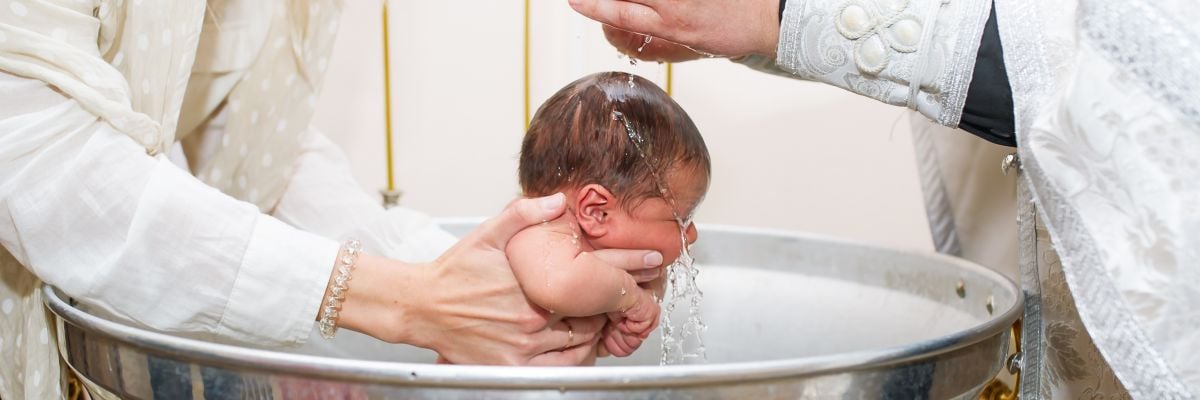
Free will of the infant in infant baptism

  • Thread starter Thread starter DoubtingKT
  • Start date Start date
Status
Not open for further replies.
My understanding of baptism, no doubt is a gift of grace from God, always requires faith and the free will and cooperation of the individual. Why does it not apply in “Infant Baptism”?
It does, but it’s supplied by the parent(s) on behalf of the infant.
 
I begin to question the practice of Confirmation and Eucharist immediately after Infant Baptism by the Eastern Traditions.
Historically, the majority of baptisms in the early Church were adult baptisms. All three sacraments were given at once, following initial catechesis.

Eventually, with adults having been made Christians, the majority of initiations were of infants. All three sacraments continued to be administered at once, albeit without catechesis.

The Eastern Churches continue the tradition, but did not develop it separately from the West.
The Sacrament of Confirmation is sometimes called the “sacrament of Christian maturity”
In the West? Sure.
But, for infants, how does the maturation of faith work in the Eastern Traditions?
Not sure. Maybe one of our forum participants who is Orthodox or Eastern Catholic can provide the answer.
 
Truth in my opinion: God is always loving, merciful and just. It is possibly beyond us to judge if an individual, baptised or unbaptised, will be saved ultimately. Because we lack the capacity to judge the living and the dead, so we will leave it to God. What we can do is to love God and His people in our best capacity, at any stage of our lives (including as infants, as parents, etc).
That’s basically how it works. We do the best we can with what we know and with the grace we’ve received, and leave the rest to a good and wise and loving God.
 
Last edited:
Not that invested in the whole thing but realistically baptising someone as a child is similar with signing him/her for a political party as a baby. Surely you can say it makes parents feel better, some of the children will be raised in that political ideology or that they can forget about it as soon as they become adults (the one reason I am not really invested in the anti infant baptism movement when it happens in places with freedom of religion) but why do it in the first place?

As far as I know my baptism wasn’t acknowledged by anyone (and I guess it is fitting almost everyone there was agnostic or atheist) but it tells something about religion creating cultural pressure even for a non-religious family to determine them to go through a simulacrum.
 
What a strange thread this is! Of course the Church encourages parents to have their children baptized as soon as possible.

Baptism removes original sin from the soul. Baptism floods the newly baptized with sanctifying grace, which is a sharing of God’s life within us. Baptism makes the child a member of the Church, and capable of living in heaven. It makes one a child of God and a brother of Jesus, and a partaker of the gifts of the Holy Spirit.

What should a parent do, say, oh, never mind, we’ll just leave him in original sin until he decides for himself? While we’re at it, let’s wait for him to decide what native language he prefers, and what food he wants to eat. No need to teach him right from wrong until he’s old enough to decide which moral code he wants to follow.

The Jewish people received their boys into the people of God through the ritual of circumcision. They didn’t wait till they were adults. Baptism replaces circumcision, but it has real and enduring spiritual effects.

If a child grows up and says, “why did you have me baptized? I wanted to go to hell, not heaven,” well, he still has that option. No one can force him to go to heaven involuntarily.
 
Well, I get where all of you are coming from, focusing on the goodness of baptism, and so, hoping that the child can receive it as soon as possible regardless of whether the child has displayed his faith…

But assuming that this goodness of baptism should be freely given to the child as soon as possible, why is it not freely given to adults regardless of whether the adult displayed his faith?

The answer I gathered is because the adult has a mind of his own, and has the free will. It is not right to force the adult. So, the adult need to display his faith, and freely choose for baptism.

But, the infant also has free will and a mind/identity of his own, but we can baptise the infant regardless. The reason is because baptism is good and should be freely given.

It seems to be a discordance between the approach to an infant versus an adult when both has free will, a mind and identity of their own.

Help me to understand this, thank you!
 
In the case of the infant, the parents are acting in place of the child. It is the parents who need to be educated on the responsibilities associated with Baptism, often this is done by a Baptism class. In the case of an adult the adult just does this for himself.
 
Once again, really grateful for all the patience in guiding me closer to God.

I was thinking of illustrating my point with a example (not that I am second guessing God’s teaching and trying to come up with something heretical, I sincerely want to know more about God in a consistent manner. Because, I strongly believe that all the truth are consistent with one another in Christ.)

What I feel will be consistent for infant and adult baptism if:

As a parent, from the day my child is born, I will demonstrate how a Catholic lives his life through what I do! I will share regularly and guide my child to make sense of why I do what I do progressively as he/she grows.

Mainly focusing on the Sacraments of Christian Initaiton or at least Baptism… Demonstrating how God is so relevant and important to me, etc

Once my child indicates desire to baptise, then discuss with my parish priest about it.

Some questions that I ask myself:
  1. How do we know that the child’s desire indicates a true intention for God?
It is in the child’s best capacity with his/her God-given mind, soul, spirit and will… God is loving and just, so I trust in Him and in my child from Him.
  1. What if the child is indecisive and says no a few minutes later?
Make sure there is some consistency in the answers before bringing the child for baptism.
  1. What if the child denies his faith in the near future?
That will always be an issue regardless… it is part of the state of original sin… And part of the growing process in our faith in Christ.
  1. What if the child dies before saying yes?
We believe that the grace of God is already present in everyone, just whether they uncovered it. So, in our faith in Christ, ever loving and merciful, He will justly given the child opportunities to exercise free will to love and follow Christ.

Just as our hopes are with all the non-Christians, it will be with those who died without us explicitly knowing that they said yes to God.
 
Last edited:
  1. Are you being selfish to deny a child from receiving baptism just because of free will?
I dont think free will is something trivial… each and everyone of us, since conception, has a unique and Godly-valued identity, mind, soul, spirit and will… it is so sacredly valued that Jesus suffered and died for us and for our sake to save us!

This is evident and consistently shown in adult Baptism. We can choose how we want to respond and live, in our thoughts, feelings and actions, but we cannot choose the outcomes of it… Salvation is not earned or guaranteed in Baptism…
  1. Didnt you denied your child of grace from God by not baptising him/her as an infant?
No, God’s grace is sufficiently and constantly present in all of us! His grace abounds… as long as there is life, there is grace from Him!

The question is whether His grace is uncovered! We are called to have missionary spirit to support one another in our unique journey with God to uncover this grace, and encourage each of us to freely cooperate with God’s will and love God in our best capacity.

The Christian faith no doubt is personal, is not private! We in our best capacity, love God and His people, grounded in our ever growing faith in Christ, in hope of communion with God and His people.

Jesus as the head of Church, All of His people as the Body of Christ, forming the Church in His Kingdom!
  1. So, I am denying my child the chance to explicitly receive the blessing from Church?
No, I feel the child can still receive blessings and be presented to the Church as infants! Jesus was presented to the temple too (although the meaning behind it in relation to the fulfilment of the prophesy in the Old Testament is much deeper than that).

But, I feel it needs to be separated from the Sacrament of Baptism. Moreover, Jesus was baptized by St John the Baptist later on in His life.

*Pray that God will open my heart and mind to Him more, to lead me closer to Him! Thank you Catholic Answer forum in guiding me to truth. Please let me know what you feel

 
Thank you @JimG for the article! Extremely well crafted case for Baptism!

Very powerful explanation about the state of original sin that humans are currently experiencing: a) incomplete knowledge; b) death; c) suffering; d) concupiscence (inclination towards sin)

In turn, providing very strong grounding reasons for Baptism: the washing of regeneration and renewal by the Holy Spirit

Some other points I found on CCC too, apart from the redemption from original sin.

The Grace of Baptism has the effects of:
1279 The fruit of Baptism, or baptismal grace, is a rich reality that includes forgiveness of original sin and all personal sins, birth into the new life by which man becomes an adoptive son of the Father, a member of Christ and a temple of the Holy Spirit. By this very fact the person baptized is incorporated into the Church, the Body of Christ, and made a sharer in the priesthood of Christ.

1280 Baptism imprints on the soul an indelible spiritual sign, the character, which consecrates the baptized person for Christian worship. Because of the character Baptism cannot be repeated (cf. DS 1609 and DS 1624).
  1. Forgiveness of sins (original and personal sins): Although the temporal consequences/ramifications of original sins still exist, but the eternal consequences of sin is redeemed by God.
  2. Grace of Justification: Initiation, transformative development and maturation of theological virtues of Faith, Love, and Hope, growing in their unique image of God
  3. Incorporated into the Body of Christ (the Church): In communion with God and His people, across time and transcends all worldly identities (race, “religion”, gender, nationality, etc)
  4. The sacramental bond of unity of Christians- the Christian Identity: Uncovers and be transformed into new, God-given and sacred identity, as a child of God, a unique creation in the image of God, with consecration of the person for Christian worship
 
Last edited:
Well, I get where all of you are coming from, focusing on the goodness of baptism, and so, hoping that the child can receive it as soon as possible regardless of whether the child has displayed his faith…

But assuming that this goodness of baptism should be freely given to the child as soon as possible, why is it not freely given to adults regardless of whether the adult displayed his faith?

The answer I gathered is because the adult has a mind of his own, and has the free will. It is not right to force the adult. So, the adult need to display his faith, and freely choose for baptism.

But, the infant also has free will and a mind/identity of his own, but we can baptise the infant regardless. The reason is because baptism is good and should be freely given.

It seems to be a discordance between the approach to an infant versus an adult when both has free will, a mind and identity of their own.
I will probably ponder on this question in the meantime! If something new is revealed to me, I will share it! Meanwhile, keep new thoughts coming in too! Thank you everyone!
 
It seems to be a discordance between the approach to an infant versus an adult when both has free will, a mind and identity of their own.
The use of reason is assumed at age seven. If the use of reason is not developed, then those seven and older are still considered as an infant.
 
Thanks @Vico! Nice to hear from you again! Will ponder and reflect about what you shared in relation to the questions I have and possible scenarios when applying the Canon Law.
CIC (Latin Canon Law)
Can. 99 Whoever habitually lacks the use of reason is considered not responsible for oneself ( non sui compos ) and is equated with infants.
CIC (Latin Canon Law)
Can. 852 §1. The prescripts of the canons on adult baptism are to be applied to all those who, no longer infants, have attained the use of reason. §2. A person who is not responsible for oneself ( non sui compos ) is also regarded as an infant with respect to baptism.
 
realistically baptising someone as a child is similar with signing him/her for a political party as a baby. Surely you can say it makes parents feel better, some of the children will be raised in that political ideology or that they can forget about it as soon as they become adults (the one reason I am not really invested in the anti infant baptism movement when it happens in places with freedom of religion) but why do it in the first place?
Realistically, feeding someone healthy food as a child … surely makes parents feel better – some of those children will be raised with that nutrition or they can forget about it as soon as they become adults, but why do it in the first place?

Or, to say it more explicitly: feeding your child nutritious meals has real effects. So does baptism. We baptize children because we want what’s best for them. What responsible parents don’t do is say “meh… he’ll decide for himself when he’s 18, so we don’t have to feed, educate, or clothe him; he’ll make his own decisions later.”
But assuming that this goodness of baptism should be freely given to the child as soon as possible, why is it not freely given to adults regardless of whether the adult displayed his faith?
Because a parent is responsible for his infant, and an adult is responsible for himself. What you’re talking about is kinda “nanny state logic”.
What if the child is indecisive and says no a few minutes later?
Kids do that all the time. Responsible parents still lead them in ways that are good and true. Irresponsible parents say “meh… Johnny doesn’t want it, so I’m not gonna force him to do what leads to human flourishing.”
We believe that the grace of God is already present in everyone
Be careful about that one: we’re born with the effects of original sin, and we need baptism in order to receive sacramental grace. So, I’m not sure we’d say “the grace of God is already present… so it doesn’t matter if ‘the child dies before saying yes’”!!!
Just as our hopes are with all the non-Christians, it will be with those who died without us explicitly knowing that they said yes to God.
Is that really what you want for your child? A vague and uncertain “hope” of salvation?
 
Last edited:
What responsible parents don’t do is say “meh… he’ll decide for himself when he’s 18, so we don’t have to feed, educate, or clothe him; he’ll make his own decisions later.”
I get where you are coming from! But, I am struggling to equate Baptism with these other activities. I feel that Baptism like all the other sacraments requires a cooperation of Faith.

What responsible parents can do (in the context of Baptism) is to lead a life centred over Christ and in turn, in their best capacity, to support the child to lead a life that is consistent in Christ. When the child expresses his/her will for Baptism, support them in it.
Because a parent is responsible for his infant, and an adult is responsible for himself. What you’re talking about is kinda “nanny state logic”.
I don’t subscribe to forcing everyone (non-believers) for Baptism. I am just pointing out an alternative opposing example to illustrate the necessity of Faith in the cooperation of Baptismal Grace.
Kids do that all the time. Responsible parents still lead them in ways that are good and true. Irresponsible parents say “meh… Johnny doesn’t want it, so I’m not gonna force him to do what leads to human flourishing.”
What responsible parents can do (in the context of Baptism) is to lead a life centred over Christ and in turn, in their best capacity, to support the child to lead a life that is consistent in Christ. When the child expresses his/her will for Baptism, support them in it.
“the grace of God is already present… so it doesn’t matter if ‘the child dies before saying yes’”!!!
Thanks for clarifying! Yes, I don’t mean it. I don’t think there is a “bare minimum” for salvation. I think salvation is not determined by any single act but a totality of one person, within the personalized context of the person, judged solely by God. To live every moment of life in the best capacity for God, aligning one’s will always with God’s will.

Particular Judgement: http://www.vatican.va/archive/ENG0015/__P2L.HTM
Last Judgement: http://www.vatican.va/archive/ENG0015/__P2P.HTM
Is that really what you want for your child? A vague and uncertain “hope” of salvation?
It may still be vague after Baptism, maybe not so much because of the Sacraments or God, but because I am limited by my capacity to judge the living and the death. I will do my best to live a life centred over Christ and support one another in living their lives centred over Christ. I don’t think Baptism grants salvation absolutely. It may be potentially dangerous for baptised individuals to be complacent and lead a life, not centred over Christ after Baptism.
 
Last edited:
What responsible parents can do (in the context of Baptism) is to lead a life centred over Christ and in turn, in their best capacity, to support the child to lead a life that is consistent in Christ. When the child expresses his/her will for Baptism, support them in it.
That’s an idea that was introduced as a novelty in the 16th century. From the beginning of the Church, however, “responsible parents” baptized their children! If you doubt that assertion, keep in mind the household structure in the context of that time: the paterfamilias ruled absolutely – there was none of this “gee, Johnny, do you want to get baptized?” business. If the father decided for Christianity, the whole family got baptized. Period, full stop.
I think salvation is not determined by any single act but a totality of one person, within the personalized context of the person, judged solely by God.
Catholics believe this, too. However, that “totality of one person”, in the economy of salvation, begins at baptism.
It may still be vague after Baptism, maybe not so much because of the Sacraments or God, but because I am limited by my capacity to judge the living and the death. I will do my best to live a life centred over Christ
When Catholics talk about the “assurance of salvation”, we mean that we know – because that’s what Christ taught and what His Church teaches – that if we are baptized, lead a life of grace that includes the sacraments, and die in a state of grace, then we are assured of heaven. If that’s what “a life centered over Christ” means, then we agree! If it means something else… what exactly does it mean?
I don’t think Baptism grants salvation absolutely.
It doesn’t. But, let’s go back to the topic at hand: infant baptism. Prior to attaining the “age of reason”, you’d agree that a person cannot commit mortal sin, right? (After all, if he cannot reason to a sin – that is, to have full knowledge of and deliberate consent to the sinful act – then he is unable to sin mortally!) OK, then: if a child dies before attaining the age of reason, and he’s baptized… then he absolutely goes to heaven, right? But, if he’s unbaptized (since his parents want to wait to ask him if he wants baptism, then he dies in an indeterminate state, doesn’t he?

So… doesn’t that make the case for infant baptism, right there? 🤔
It may be potentially dangerous for baptised individuals to be complacent and lead a life, not centred over Christ after Baptism.
That depends. If a child is baptized but never raised in the Church, then his lack of knowledge of the faith and lack of assent to it isn’t his fault, right? And therefore, not culpable of mortal sin. See? The Church isn’t just “out to get you”…!!!
 
Thanks @Gorgias for always being so patient and passionate in answering me!
keep in mind the household structure in the context of that time: the paterfamilias ruled absolutely
I will let this concept sit in with me for a while, as I try to relate this concept with the idea of the free will of the infant.
Catholics believe this, too. However, that “totality of one person”, in the economy of salvation, begins at baptism .
Agreed:)
If that’s what “a life centered over Christ” means, then we agree!
Agreed but also I agree with this and was trying to illustrate this:
1260 "Since Christ died for all, and since all men are in fact called to one and the same destiny, which is divine, we must hold that the Holy Spirit offers to all the possibility of being made partakers, in a way known to God, of the Paschal mystery."62 **
Every man who is ignorant of the Gospel of Christ and of his Church, but seeks the truth and does the will of God in accordance with his understanding of it, can be saved.** It may be supposed that such persons would have desired Baptism explicitly if they had known its necessity.
But, if he’s unbaptized (since his parents want to wait to ask him if he wants baptism, then he dies in an indeterminate state, doesn’t he?
You have a very strong point for Infant Baptism! Because of infants before the age of reason were forgiven for their original sins, then technically, they are free of sins (since they are not capable of sinning as yet.) Hence, the urgency of infant baptism.

I am not being stubborn and dismissing it! I am just trying to grapple with the concept of the infant’s free will and free cooperation in receiving the Baptismal Grace from God.
1261 As regards children who have died without Baptism, the Church can only entrust them to the mercy of God, as she does in her funeral rites for them. Indeed, the great mercy of God who desires that all men should be saved, and Jesus’ tenderness toward children which caused him to say: “Let the children come to me, do not hinder them,” allow us to hope that there is a way of salvation for children who have died without Baptism. All the more urgent is the Church’s call not to prevent little children coming to Christ through the gift of holy Baptism.
That depends. If a child is baptized but never raised in the Church, then his lack of knowledge of the faith and lack of assent to it isn’t his fault, right? And therefore, not culpable of mortal sin.
Agreed but so is the converse true, if the child is not able to baptize before the age of reasoning (such as, in cases of stillbirth), the same Grace and Mercy of the Lord extends to them.

Hmm… I will reflect upon all the concepts that all of you have brought up! Hopefully, I will be able to understand this better.

Thank you though and may God continue to bless you!
 
Agreed but so is the converse true, if the child is not able to baptize before the age of reasoning (such as, in cases of stillbirth), the same Grace and Mercy of the Lord extends to them.
Hmm… not sure about that. Your case is the stereotypical case for ‘limbo’, which we would say today is more accurately represented as “in the absence of divine revelation on this question, we trust in the mercy of God.” In my case, we have an actual baptized Christian, who is then not culpable of his shortcomings, so… not ‘limbo’, but heaven!

Blessings,
G.
 
I am not being stubborn and dismissing it! I am just trying to grapple with the concept of the infant’s free will and free cooperation in receiving the Baptismal Grace from God.
Just a comment here on grace and free will.

It has been the long standing teaching of the Church, especially following Augustine (On Grace and Free Will) that sin is addictive in character and restricts the capacity of the individual to exercise free will. Grace frees from sin precisely by freeing the will from slavery to sin.

Jesus answered them, “Very truly, I tell you, everyone who commits sin is a slave to sin. The slave does not have a permanent place in the household; the son has a place there forever. So if the Son makes you free, you will be free indeed." (John 8:34-6)

Ergo, the grace at Baptism endows the child with greater freedom of will rather than restricting free will.
 
Last edited:
Status
Not open for further replies.
Back
Top