These Seraphim look like mecha…

Look at all these pulleys and mechanical joints, especially the wrists…
No wonder people’s imagination went wild to the point of “postulating”, if it’s rightful to be call it a “postulation” that Ezekiel saw an alien vessel

Blame the Assyrians for their rather outlandish portrayal of
muscles. And I’ll warrant that’s supposed to be
a wristband.
William Albright once wrote a two-page article on the
cherubim in the
Biblical Archaeologist in 1938. Since it is brief enough, I’ll quote it in full (from
here):
What Were the Cherubim?
By W. F. Albright
Today we think of a cherub as a tiny winged boy, following the tradition of Renaissance artists. This conception was directly borrowed from pictures of Graeco-Roman “loves” or Erotes, familiar to us from the excavations of Pompeii. The actual appearance of the cherubim of the Old Testament was already forgotten before the time of Christ, and Josephus (first century A.D.) says that “no one can tell what they were like.”
Since the veil of the Tabernacle was decorated with embroidered cherubim, and the walls and the religious objects of Solomon’s temple lavishly adorned with them. we ought to be able to identify them in contemporary Syro-Palestinian art. The account of the Ark of the Covenant shows that only a creature with wings can be considered. If, therefore, we study all known representations of animals and hybrid creatures, partly animal, we find one which is much more common than any other winged creature, so much so that its identification with the cherub is certain: that is the
winged sphinx or winged lion with human head. In Egypt the
wingless sphinx and the
griffin appear; in Babylonia and Assyria the
winged bull with a human head prevails; but in Syria and Palestine it is the winged sphinx which is dominant in art and religious symbolism.
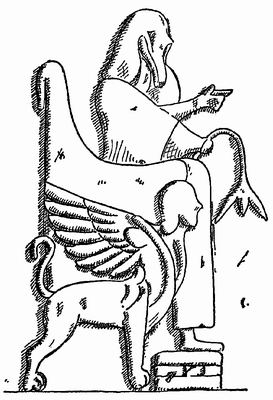
King Hiram of Byblus seated upon his cherub-throne, tenth century B.C.
The God of Israel was often designated as “He who sitteth (on) the cherubim” (I Sam. 4:4, etc.). The conception underlying this designation is well illustrated by representations of a king seated on a throne supported on each side by cherubim, which have been found at Byblus, Hamath,
and Megiddo, all dating between 1200 and 800 B.C. One shows King Hiram of Byblus (period of the Judges)
seated upon his cherub throne. Pottery incense altars found
at Taanach and Megiddo are archaeological parallels to the wheeled lavers (“bases”) of Solomon’s temple, which were decorated with lions and cherubs, according to I Kings 7:36.
The primary function of the cherub in Israelite religious symbolism is illustrated by two biblical passages. A very ancient hymn, found twice in the Bible, has the words, “And He rode upon a cherub and did fly” (I Sam. 22:11 [2 Sam. 22:11], Ps. 18:11 [English, Ps. 18:10]); the second is Ezek. 10:20. The conception of the deity as standing or as enthroned on an animal or hybrid creature was exceedingly common in the ancient Near East, but it was most common in Syria and Northern Mesopotamia between 2000 and 700 B.C. In Babylonia the figure of a deity is replaced in certain cases by a winged shrine and later by a thunderbolt. So in Israelite symbolism between 1300 and 900 B.C., the invisible Glory (Jehovah) was conceived as enthroned upon the golden cherubim or
standing on a golden bull.
For a more recent, more in-depth study, I think Alice Wood’s
Of Wings and Wheels: A Synthetic Study of the Biblical Cherubim would be a good one.



 On the other hand, I actually think they were pretty darn good artists for their time! (and tools)