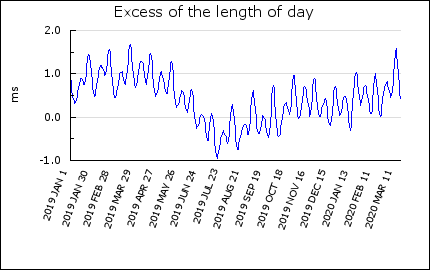
I will look into this more next week. But even the site to which you directed us has this to say:
The official ILRS combined EOP solution (avaible on our WEB/FTP site) derived by ASI from 5 individual solutions (ASI, DGFI, GFZ, JCET and NSGF) is replacing the individual SLR solutions in the EOP-PC analyses. According to this series,
there is a noticable jump in y-component of the polar motion for the day of the Sumatra Earthquake.
The bottom line, buffalo, is that the measurements detect all sorts of variability in the speed of the earth’s rotation, the wobble at its poles, etc. And some of these are linked to terrestrial events (see also, e.g.
xs4all.nl/~carlkop/longday.html) Now once again, this is either resulting from actual movements of the earth itself, or it is the entire universe bobbing and weaving.
Here is a bit of commentary from another forum, just for some additional thought food:
Well, that would be VLBI, for Very Long Baseline Interferometry. And the basics are that several large radio antennae are linked together electronically to form one very large radio telescope with ultra high angular resolution. This is then used to monitor the apparent position of several quasars in the sky. The extreme distance of these quasars means there can be no observable apparent motions intrinsic to them, which allows them to be used as extremely precise and stable markers against which to measure rotational variations in the Earth. These variations happen to match very closely the variations which should be seen due to tidal friction. . . .
Now there is a good deal of research to try to nail down all the factors that influence the variations in the Earths rotations velocity, and small wobbles in its poles position, nevertheless the upshot for you is that variations in the quasar motions must be - assuming the Earth is stationary - changes in the velocity of the quasars themselves. As such you have several issues:
- Why should variations in the observed velocity of quasars match precisely the tidal effects on the Earth. The time delay is ENORMOUS (billions of years) The entire effect of the tides would need to be directly linked to the observed motions of the heavens, whose size does not allow for any direct connection between quasar motions and the Earth. (nothing communicates faster than light, including gravity, and these objects are billions of light years hence).
- As you know, the tides are linked to the position of tthe MOON, not the external ‘star shell’ or the quasars whose postion is being measured. Does the puny moon drag the rest of the universe around with it in your physics John?
- Why do these variations in the universe’s motion about the Earth happen -once again - to match those that should be induced simply by the oceans sloshing on the EArths surface? Again, as above, an occurrence that would be a one in infinity probability unless the designer of the universe where trying to trick us.
- There is no known physics that would allow those objects - the quasars - to retain their integrity if subjected to the accelerations required.,” (theologyweb.com/campus/showthread.php?129749-Geocentrism-Discussion-II&p=2850927#post2850927)
One more time, could you please tell us why it would be “most likely” that the entire universe speeds up, slows down, bobs, and weaves, rather than these are local variations in the movement of the earth itself? This has been posed to you now a number of times. Please, could you answer it? Which is “most likely” and why?
**
How does gravitational lensing affect the positioning of the quasars?
Why? That is the purpose of the links I post.

 If the Chinese decide to stockpile all the tea in one super big pile will it cause the earth to slow?