God's anger

  • Thread starter Thread starter Eruvande
  • Start date Start date
Status
Not open for further replies.
E

Eruvande

Guest
I’ve been reading a number of things about Marian apparitions and one thing I’ve noticed is her asking for rosaries to be said to offset the wrath of God. This strikes an odd note to me, as it’s almost like Mary is more merciful than God himself. Am I missing something?
 
I’ve been reading a number of things about Marian apparitions and one thing I’ve noticed is her asking for rosaries to be said to offset the wrath of God. This strikes an odd note to me, as it’s almost like Mary is more merciful than God himself. Am I missing something?
It’s important to remember that “wrath” is an anthropomorphism. 🙂

God is perfect, and does not experience emotions (fear, anger, etc.) as we do.

What we (or the Bible) call “wrath” is an approximation to God’s justice, which entails punishment for our sins and our rebellion against Him. He’s not throwing a tantrum a la Donald Duck, but He holds our lives in his hands, and if we love Him, we must repent of our sins, and strive to avoid being “repeat offenders”. Hence the exhortation of Our Blessed Mother to repent, do penance, and avoid His wrath. 🙂
 
God’s Anger is a just Anger just as Jesus’ anger when he turned over the tables of the Money changers in the temple. I like this saying that goes along with the apparitions, “God Governs the World but Prayer governs God.” This is found in the back of the book “The Pieta” God Bless!
 
Forgive me - I do under stand the wrath of God against sinners, in a divine justice way. What I am having trouble with is Marian apparitions that talk about praying the rosary because it holds back the divine anger against sinners. Like God is actively itching to blast us all for sin, but Mary’s intercession will prevent that.
 
What good father wouldn’t want to justly chastise his children for all their terrible crimes against him and humanity? Remember, God chastises those whom he loves – not hates. Thanks be to God, Mary is so pleasing to our father that she placates him and makes up for all the crimes of Our Lord’s other children.
 
Forgive me - I do under stand the wrath of God against sinners, in a divine justice way. What I am having trouble with is Marian apparitions that talk about praying the rosary because it holds back the divine anger against sinners. Like God is actively itching to blast us all for sin, but Mary’s intercession will prevent that.
It’s not quite that way. Mary, given to us as our Mother (John 19:25-26), intercedes for us, that we may receive the graces necessarily to follow God faithfully. Left to our own devices, many of us will not (“broad is the gate that leads to destruction”), hence her exhortation to pray and do penance.

God isn’t “itching to blast us” (that’s a “pop Protestant” notion); but our own sinful and selfish choices may “blast us”; as the Catechism says, God does not want us to be lost, but we often lose our way. When we pray the Rosary, we pray for sinners (us and others), and by doing so, we may save some of them (1 John 5).
 
But why is there a tradition that Mary specifically both holds back His anger against sinners, and all graces come though her?
 
Initially, I had the same problem understanding this as you do. However, this is how I think of it if this helps:

Because of man’s unrepentant evil, man draws the effects of sin onto themselves, which is pain. This suffering is the direct consequence of sin. God’s wrath is not so much something that he forcefully brings out as it is suffering brought down on ourselves. God does not punish and does not want to see his people suffer, but we are self-destroying ourselves and we draw upon ourselves evil.

As for the Blessed Mother, God gave her to us for exactly this reason. She intercedes for us all the time, and God created her just to do that. Why does God need Mary’s intersession? Because through her intersession, God is justified in mitigating the suffering (in a sense his wrath) that is caused by our sin. She is a powerful channel of grace in which God works in the world.

I hoped this helped.
 
In addition to my previous post, Mary is not specifically the one to hold back God’s anger, and not ALL graces come though her, although it is very important to have a devotion to her. She is the saint that will provide the MOST grace because she is the new ark of the covenant. However, prayers from Christians all around the world provide grace as well, and prayers from the faithful hold back suffering too!
 
+JMJ+
But why is there a tradition that Mary specifically both holds back His anger against sinners, and all graces come though her?
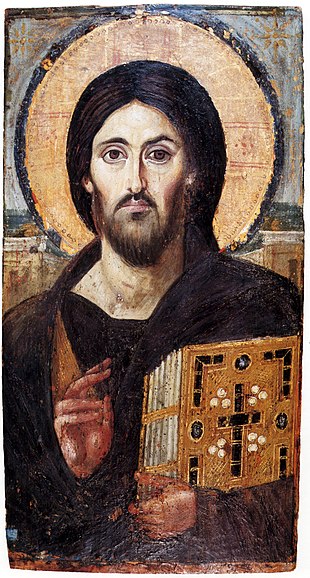
In the Bible, we see that Jesus is both our Merciful Savior and Stern Judge. That always has been the traditional view of God. Look for example at the oldest known iconography of “Jesus Christ, Pantokrator” or “Almighty”.


Notice the two different expressions in Jesus’ face. On our left is His merciful side, His right (our left) face mellow, and his right (our left) hand is in the gesture of benediction. On the other side (our right side) is His just side, with His face stern and even his eyebrow notched, and his left (our right) hand holding the Book of Life, where it is written who is saved, and those whose names are not written there are thrown into the fires of hell (cf. Revelation 20:15).

Now as for Mary, her queenship is deeply rooted in Tradition, based on the Biblical promise that those who persevere in God in this life will be placed in charge “over much” (see Matthew 25), as well as the tradition of the “Mother Queen” of the Davidic Kingdom. But since not only was Mary the most faithful of all of God’ servants, but she is the mother of the King of Kings, she was given “over much” according to her faithfulness on Earth and being the Mother of God, i.e. over the whole universe, and even the whole economy of salvation, i.e. all graces.

And yet never was Mary, in Holy Tradition, called the Mother of Justice, but she is well loved as the Mother of Mercy:

Theologians note that she does not seem to share in any special way in the royal judicial power of inflicting punishment for sin, for Tradition calls her not the Mother of justice but the Mother of mercy, a title which is hers in virtue of her mediation of all graces. Jesus seems to have kept to Himself the reign of justice as is becoming Him Who is the ‘Judge of the living and the dead.’

source

Therefore, Mary is the Refuge of Sinners, because she never judges her children but leaves that to God, and thus she is the one who “holds back His anger against sinners.”

 
+JMJ+

I think St. Alphonsus de Liguori said it best in this parable:

In the second book of Kings (2 Kings, xiv. 5), we read that a wise woman Thecua addressed King David in the following words: “My lord, I had two sons, and for my misfortune, one killed the other; so that I have now lost one, and justice demands the other, the only one that is left, take compassion on a poor mother, and let me not be thus deprived of both.” David, moved with compassion towards the mother, declared that the delinquent should be set at liberty and restored to her. Mary seems to say the same thing when God is indignant against a sinner who has recommended himself to her. “My God,” she says, “I had two sons, Jesus and man; man took the life of my Jesus on the cross, and now Thy justice would condemn the guilty one. O Lord, my Jesus is already dead, have pity on me, and if I have lost the one, do not make me lose the other also.”

marys-touch.com/Glories/ChI.htm
 
Thank you for your thoughtful replies. Not sure I understand it fully, but you’ve given me plenty to think about.
 
But why is there a tradition that Mary specifically both holds back His anger against sinners, and all graces come though her?
I think you can see that there has been somewhat a change over the years on how theologians view God. Modern theology emphasizes that God is not wrathful, that the consequences we experience are not because of a wrathful God, but because we set ourselves up for natural disaster. If I drink too much, I am going to get sick. God doesn’t do this to me because of His wrath.

That said, there is a place, however, for thinking of God as wrathful. When we are children, it is the natural wrath of the parent against misbehavior that serves as a guide to the child. Children are not born with the experience and empathy to let “love be the guide” so to speak. As a young adult, it may be helpful for a person to project that God is wrathful so that the person will continue to keep their own behaviors in check. Indeed, self-condemnation (with the projection that God condemns us for certain acts) seems to be a integral part of conscience formation.

The ultimate guide for our spirituality is that Jesus forgave us unconditionally from the cross. When we learn to unconditionally forgive others, we know the unconditional love and forgiveness from God. In the mean time, if the God I project is an angry God, we may get some relief from our anxiety by thinking we can call on an intercessor. Does the intercessor tell us “Forgive always, and you will know that God always forgives”? I think so, yes.

So, I think the tradition is there to help us through the times when we project that God is wrathful. Sure, we could tell people that they have it all wrong, that God is not wrathful, the problem is the perception, etc. etc. But will people believe this? Nope. Until we ourselves forgive everyone that we hold something against (including ourselves) the idea of an unconditionally loving and forgiving God, even though it has its appeal, seems preposterous. Look at what the Mayan, Aztec, and many other cultures did to appease an angry God. The projection of an angry God is universal and normal. Jesus turns the whole thing over when He has us refer to God as “Daddy”, the Father who forgives our trespasses.
 
Status
Not open for further replies.
Back
Top