Gospel of Judas (revisited)

  • Thread starter Thread starter ewiggins
  • Start date Start date
Status
Not open for further replies.
E

ewiggins

Guest
The Gospel of Judas was a Gnostic gospel written in the Second Century AD. It details Christ’s direct techings to Judas. Judas Iscariot in my opnion was the greatest of the disciples as he was told by Christ to hand over Christ to the Pharasies to allow His death and resulting resurection. The Gospel of Judas does not claim that the other disciples knew about Jesus’s true teachings. On the contrary, it asserts that they had not learned the true Gospel, which Jesus taught only to Judas Iscariot, the sole follower belonging to the “holy generation” among the disciples. Of crucial importance is the author’s understanding of Jesus’ death. The other Gospels argue that Jesus had to die in order to atone for the sins of humanity. The author of Judas’ Gospel who was not Judas himself claims this sort of substitutionary justice pleases the lower gods and angels. The true God is gracious and thus does not demand any sacrifice. In the Gospel of Judas, Jesus’s death is simply a final way for him to leave the realm of the flesh and return to the luminous cloud. “Judas” is not Judas Iscariot, who is fictional, but Jesus’ brother James, the successor to Jesus in all period church sources. And Judas did not hang himself as is written in the other Gospels. This can only be the work of those who were either envious of Judas’ sacred place among Christ’s disciples or purely a work of fancy. If you want to call me a heretic or blasphemer that is your right, but I do not agree and I am a devout Catholic who has had many discussions about Judas with my Pastor.

Eric FX Wiggins
 
The Gospel of Judas was a Gnostic gospel written in the Second Century AD. It details Christ’s direct techings to Judas. Judas Iscariot in my opnion was the greatest of the disciples as he was told by Christ to hand over Christ to the Pharasies to allow His death and resulting resurection. The Gospel of Judas does not claim that the other disciples knew about Jesus’s true teachings. On the contrary, it asserts that they had not learned the true Gospel, which Jesus taught only to Judas Iscariot, the sole follower belonging to the “holy generation” among the disciples. Of crucial importance is the author’s understanding of Jesus’ death. The other Gospels argue that Jesus had to die in order to atone for the sins of humanity. The author of Judas’ Gospel who was not Judas himself claims this sort of substitutionary justice pleases the lower gods and angels. The true God is gracious and thus does not demand any sacrifice. In the Gospel of Judas, Jesus’s death is simply a final way for him to leave the realm of the flesh and return to the luminous cloud. “Judas” is not Judas Iscariot, who is fictional, but Jesus’ brother James, the successor to Jesus in all period church sources. And Judas did not hang himself as is written in the other Gospels. This can only be the work of those who were either envious of Judas’ sacred place among Christ’s disciples or purely a work of fancy. If you want to call me a heretic or blasphemer that is your right, but I do not agree and I am a devout Catholic who has had many discussions about Judas with my Pastor.

Eric FX Wiggins
Gnostic thought is heretical. Whether you are or not I don’t know. It is dualist in the sense that matter is evil and not created by God and thus in contradiction to the opening words of Scripture. What could the words " lower gods" possibly mean to a Catholic? You also reject the inspired gospels or at least parts of them as products of jealousy and fancy! Sorry Brother but you are way off the tract.
 
This is a 7 year old dormant thread which is against forum rules to resurrect.
 
Gnostic thought is heretical. Whether you are or not I don’t know. It is dualist in the sense that matter is evil and not created by God and thus in contradiction to the opening words of Scripture. What could the words " lower gods" possibly mean to a Catholic? You also reject the inspired gospels or at least parts of them as products of jealousy and fancy! Sorry Brother but you are way off the tract.
The lower gods I spoke of were those worshiped by pagans of the Roman empire. Gnostic thought is only heretical because the pope says so. He isn’t God. The gospels were written by many people not just Matthew, Mark, Luke, and John. The gospels (and Acts) are anonymous, in that none of them name an author. Whilst the Gospel of John might be considered somewhat of an exception, because the author refers to himself as “the disciple Jesus loved” and claims to be a member of Jesus’s inner circle, most scholars today consider this passage to be an interpolation. The Gospel of Judas does not claim that the other disciples knew about Jesus’s true teachings. On the contrary, it asserts that they had not learned the true Gospel, which Jesus taught only to Judas Iscariot, the sole follower belonging to the “holy generation” among the disciples. This may be quite difficult for some of us to accept having learned from the Gospels but is it possible that only Judas knew Christ’s ultimate plan to be sacraficed? It seems possible given Peters reaction to the arrest of Christ. Had he known why would he given such resistance to draw a sword and cut off a man’s ear?
Who suffered more than Judas other than Christ himself? To be called the betrayer of the Son of Man is more than I could bare. I don’t reject the Gospels as the work of jealousy. This is nonsense since I believe that it is the inspired word of God. I realize what I am saying is controversial to say the least but is it not at least possible that Judas was really a great and holy man and not the betrayer as he is portrayed?

Eric FX Wiggins
 
Continuing the discussion from this thread, I’d like to give my two cents.
The Gospel of Judas was a Gnostic gospel written in the Second Century AD.
To be more specific, it is probably a tractate from Sethian gnosticism. And yes, it is probably written no earlier than the 2nd century, because St. Irenaeus, writing in AD 180, speaks of it.

What the Gospel of Judas purports to be is a secret revelation of a conversation between Jesus and Judas that occurred three days before Jesus’ final Passover. In the Sethian belief system, the divine unassailable God exists beyond the reach of the base material realm (in true gnostic fashion). From His mind comes His “first-thought,”
the feminine deity Barbelo, and in turn from her emanates her son Autogenes (‘the self-begotten’). After various stages of emanations, heavenly Seth, the perfect man, comes forth and his seed is the souls of repentant humanity. We can find an abridged version of this cosmological salvation myth within GJ (47.1-54.12), and it is this understanding that shapes the thought-world of the text.
The Gospel of Judas does not claim that the other disciples knew about Jesus’s true teachings. On the contrary, it asserts that they had not learned the true Gospel, which Jesus taught only to Judas Iscariot, the sole follower belonging to the “holy generation” among the disciples.
A number of scholars (such as April D. DeConick) have actually complained the original National Geographic translation was critically faulty in many substantial respects, which can be attributed to the rush to publish an English translation of the gospel for public consumption. Part of the faulty information is the consequence of the fact that the scholars who made the first English translation based it on a provisional unfinished Coptic transcription. This transcription was released on the National Geographic website at the same time the English translation was made available in bookstores. We now know that the provisional transcription was flawed in crucial areas of the text - and these were corrected a year later in the critical edition of GJ, but not before they already became part of the academic discourse and public consciousness.
 
According to the interpretation of the original translators (Rodolphe Kasser, Marvin Meyer, and Gregor Wurst), GJ singles Judas Iscariot (cf. 33.2-3, 35.9, ΙΟΥΔΑϹ ΠΙϹΚΑΡΙωΤΗϹ Ioudas pIskariōtēs) is singled out as Jesus’ greatest disciple. He alone is able to receive Jesus’ most profound teaching and revelation. Jesus laughs at the disciples’ prayers and sacrifices and explains that they do not realize that they are worshiping a false god (33.22-34.11). They do not fully grasp who Jesus really is and from whom and from where He has come from, but Judas does (35.8-9), declaring that He is " from the immortal realm of Barbelo," and that “[he is] not worthy to utter the name of the one who has sent [Him]” (35.15–21). After this confession, Jesus then teaches Judas in private (35.23–26): “Step away from the others and Ishall tell you the mysteries of the kingdom.”

At the conclusion of this private teaching, in which Judas is invited to enter the cloud (and be transformed?), Jesus says to Judas: “You will exceed them all. For you will sacrifice the man who clothes me” (56.18–20). That is, while the other disciples are wasting time in inferior worship and activity (sacrificing animals in the Jewish fashion, presumably, as well as observing the Christian Eucharist), Judas will carry out the sacrifice that truly counts, the sacrifice that will result in salvation: he will sacrifice the physical body of Jesus, thus allowing Jesus to complete His mission. Thus, Judas becomes the greatest of the disciples. The narrative then ends with Judas’ handing Jesus over to the authorities. There is no mention of a trial, execution, or resurrection. The Gospel of Judas has related what it wanted to relate: the obedience of Judas and how that obedience assisted Jesus in fulfilling his saving mission.
 
But is this really what the Gospel of Judas is saying? Let’s look at a few excerpts from the National Geographic English translation. First of these is:

Knowing that Judas was reflecting upon something that was exalted, Jesus said to him, “Step away from the others and I shall tell you the mysteries of the kingdom. It is possible for you to reach it, but you will grieve a great deal. For someone else will replace you, in order that the twelve [disciples] may again come to completion with their god.”
Judas said to him, “When will you tell me these things, and [when] will the great day of light dawn for the generation?”
But when he said this, Jesus left him.

The original translation implies that Judas will reach the the Kingdom, but he will have to grieve a lot. However, after a reexamination of the ink traces on the edges of a lacunae in line twenty-six and the adjustment of the readin oun com “it is possible” to ouk hina, “not so that,” this is what we will get:

Knowing that Judas was reflecting upon something that was exalted, Jesus said to him, “Step away from the others and I shall tell you the mysteries of the kingdom, not so that you will reach it, but you will grieve a great deal. For someone else will replace you, in order that the twelve [disciples] may again come to completion with their god.”
Judas said to him, “When will you tell me these things, and [when] will the great day of light dawn for the generation?”
But when he said this, Jesus left him.

In other words, Jesus teaches Judas “the mysteries of the kingdom” not so much because it is possible for him to reach it - in fact, His teaching will not benefit Judas in any way. On the contrary, Judas will never attain it and will even grieve when he sees it. This kingdom is related to the “error of the stars” in 46.1-2 below (in fact, Jesus will later say that Judas had been led astray by his star!)

Judas said, “Master, as you have listened to all of them, now also listen to me. For I have seen a great vision.”
When Jesus heard this, he laughed and said to him, “You thirteenth spirit, why do you try so hard? But speak up, and I shall bear with you.”
Judas said to him, “In the vision I saw myself as the twelve disciples were stoning me and persecuting [me severely]. And I also came to the place where …] after you. I saw [a house …], and my eyes could not [comprehend] its size. Great people were surrounding it, and that house a roof of greenery, and in the middle of the house was [a crowd—two lines missing—], saying, ‘Master, take me in along with these people.’”
[Jesus] answered and said, “Judas, your star has led you astray.” He continued, “No person of mortal birth is worthy to enter the house you have seen, for that place is reserved for the holy. Neither the sun nor the moon will rule there, nor the day, but the holy will abide there always, in the eternal realm with the holy angels. Look, I have explained to you the mysteries of the kingdom and I have taught you about the error of the stars; and …] send it …] on the twelve aeons.”

The word translated as “spirit” here is actually the word daimōn, from where get the word “demon” from. In other words, Jesus literally calls Judas “the thirteenth demon.” The original translators have defended their choice of wording here, claiming that Judas is called a daimōn “because his true identity is spiritual.” They then appeal to Plato’s usage of the word (such as in Symposium 202e-203a), where “spirit” or “god” is a fair rendering of daimōn and cognates. The problem here is that whereas daimon in Plato and other non-Jewish and non-Christian literature can indeed mean “spirit” or “god”, in either a neutral or even positive sense, the word never has this meaning in Jewish, Christian, and gnostic Christian texts. (Of the gnostic books from Nag Hammadi, the 50 occurrences of the word daimōn or cognates always refers to an Archon - i.e. the Demiurge, the inferior “creator god” that stood between the human race and the true God - or one of his demonic assistants.) In Jewish and Christian texts, including gnostic texts, demons are always seen as entities antagonistc to God and His people.

Kasser, Meyer, and Wurst apparently have heard the criticism, since they revise the translation in the second edition to read: “You thirteenth daimon, why do you try so hard?” But they still try to maintain the ambiguity, leaving readers who have little or no expertise with the impression that here daimōn is not necessarily negative. In the footnote they also mention that while the “word daimon can mean ‘demon’ in a thoroughly negative sense of the term, as in Jewish and Christian literature,” it “can also be used in a more neutral, or even positive sense, in Platonic, Middle Platonic, Neoplatonic, Hermetic, and magical texts.” Which is true enough, but in the context of the Gospel of Judas, which the translators regard as Christian in a very broad sense, the word is surely not positive. It never is in Jewish, Christian, and (semi-Christian) gnostic texts. To be sure, these other texts were of interest to various Christian groups, especially some gnostic groups, but the mere fact of interest in these texts does not override the uniformity of the evidence for the negative understanding of daimōn in Jewish, Christian, and gnostic literature.
 
With this in mind, this is how the passage will now look like (in context):

Judas said, “Master, as you have listened to all of them, now also listen to me. For I have seen a great vision.”
When Jesus heard this, he laughed and said to him, “O thirteenth demon, why do you compete (with them)? But speak up, and I shall bear with you.”
Judas said to him, “In the vision I saw myself as the twelve disciples were stoning me and persecuting [me severely]. And I also came to the place where …] after you. I saw [a house …], and my eyes could not [comprehend] its size. Great people were surrounding it, and that house a roof of greenery, and in the middle of the house was [a crowd—two lines missing—], saying, ‘Master, take me in along with these people.’”
[Jesus] answered and said, “Judas, your star has led you astray.” He continued, “No person of mortal birth is worthy to enter the house you have seen, for that place is reserved for the holy. Neither the sun nor the moon will rule there, nor the day, but the holy will abide there always, in the eternal realm with the holy angels. Look, I have explained to you the mysteries of the kingdom and I have taught you about the error of the stars; and …] send it …] on the twelve aeons.”

In context, the disciples have just told Jesus about a rather nasty dream vision that they have all had.

Another day Jesus came up to [them]. They said to [him], “Master, we have seen you in a [vision], for we have had great [dreams …] night …].”
[He said], “Why have [you … when] have gone into hiding?”
They [said, “We have seen] a great [house with a large] altar [in it, and] twelve men—they are the priests, we would say—and a name; and a crowd of people is waiting at that altar, [until] the priests … and receive] the offerings. [But] we kept waiting.”
[Jesus said], “What are [the priests] like?”
They [said, “Some …] two weeks; [some] sacrifice their own children, others their wives, in praise [and] humility with each other; some sleep with men; some are involved in [slaughter]; some commit a multitude of sins and deeds of lawlessness. And the men who stand [before] the altar invoke your [name], and in all the deeds of their deficiency, the sacrifices are brought to completion …].”
After they said this, they were quiet, for they were troubled.

Jesus reveals to them that they are the twelve priests who are committing the sacrilege, and that they are committing it to the chief Archon and the creator of this world, Yaldabaoth (aka Nebro or Saklas).

Jesus said to them, “Those you have seen receiving the offerings at the altar—that is who you are. That is the god you serve, and you are those twelve men you have seen. The cattle you have seen brought for sacrifice are the many people you lead astray before that altar. …] will stand and make use of my name in this way, and generations of the pious will remain loyal to him. After him another man will stand there from [the fornicators], and another [will] stand there from the slayers of children, and another from those who sleep with men, and those who abstain, and the rest of the people of pollution and lawlessness and error, and those who say, ‘We are like angels’; they are the stars that bring everything to its conclusion. For to the human generations it has been said, ‘Look, God has received your sacrifice from the hands of a priest’—that is, a minister of error. But it is the Lord, the Lord of the universe, who commands, ‘On the last day they will be put to shame.’

After Jesus leaves the disciples, Judas then comes to Him and says that he’s also had “a great vision,” which prompts Jesus to laugh (Jesus laughs a lot in this gospel). He then mockingly asks Judas why he is trying to one-up the others: “O thirteenth demon, why do you compete with them (the disciples)?” but offers to hear what Judas had to say anyway. Judas then tells Jesus that he saw the twelve disciples stoning him, and so he ran away from them and he came to a beautiful house full of prominent people. He then begs Jesus to let him into that house. Judas apparently understands the dream to mean that he will transcend the other disciples, and that he will be able to reach the kingdom.
 
It is here that Jesus bursts Judas’ bubble, commenting how Judas’ star had led him astray. Only the holy ones can be part of the kingdom, He says. (He had also said the same thing to the other disciples earlier - noting that they will not be able to reach “the great and holy generation” because they are “from the generation of humanity.”) After this:

Judas said, “Master, could it be that my seed is under the control of the rulers?”
Jesus answered and said to him, “Come, that I —two lines missing—], but that you will grieve much when you see the kingdom and all its generation.”
When he heard this, Judas said to him, “What good is it that I have received it? For you have set me apart for that generation.
Jesus answered and said, “You will become the thirteenth, and you will be cursed by the other generations—and you will come to rule over them. In the last days they will curse your ascent to the holy [generation].

The 2006 translation of akporj[sup]e[/sup]t et-genea et-[sup]e[/sup]mmau gives the impression that Judas has been destined for the holy generation, which is a good thing. However, once again, this is not what the Coptic text actually says. In this phrase, the verb porje cannot mean “set apart for,” implying access to the holy generation, but “set apart from,” (which is its normal meaning in Coptic) clearly implying failure to gain access to the holy generation. The meaning is perfectly appropriate in context: Judas, understanding that Jesus’ response has separated him away from “the holy generation,” therefore asks Jesus what his profit or his advantage is, or what remains for him. In other words, if Judas could not be part of the holy generation anyway what good is it for him to know about it?

By contrast, the 2006 translation is nonsensical - why would Judas be upset about receiving esoteric teaching if he were to be included among the holy? - and is verbally impossible in Coptic. The verb porj means to “to divide; be divided; or separate.” The preposition that follows this verb is e, which by itself can mean “for” as well as “to,” “as regards,” and “according to,” but when linked with pōrj expresses an idiomatic statement: “to be divided or separated from.” The linkage of certain verbs with certain prepositions to render idiosyncratic meanings is a common aspect of Coptic. When such constituents as e are present with particular verbs, certain intended meanings are expressed. The replacement or absences of the constituent causes entirely different verbal meanings.

Jesus’ statement immediately preceding Judas’ question: “…but that you will grieve much when you see the kingdom and all its generation” may harken back to what is said earlier: “Step away from the others and I shall tell you the mysteries of the kingdom, not so that you will reach it, but you will grieve a great deal.” Again, Judas will be (according to Jesus) excluded from the kingdom - in effect, the Gospel of Judas’ Jesus seems to wag before Judas’ nose the knowledge of the things that he will never attain.

http://www.nationalgeographic.com/lostgospel/_images/_timeline/22_01.jpg

In the 2006 translation, Jesus tells Judas: “They will curse your ascent to the holy [generation].” However, n the Coptic text there is no word equivalent to “curse” here: in fact, it simply reads: se …] nak’ auō nekbōk epshoi et-ge[nea et]-ouaab “They [will? …] you, and you will not [go] up to the holy generation” (the scribe may have omitted a line between “they” and “you”). The negative future particle (“will not”), which is present, has unfortunately been obscured by an emendation (specifically: the addition of a sonorant n before nekbōk, or as they had earlier reconstructed it, nekktē, which reads it as a noun rather than an emphatic negative future verb).

In effect, this is now how the text will look like:

Judas said, “Master, could it be that my seed is under the control of the rulers?”
Jesus answered and said to him, “Come, that I —two lines missing—], but that you will grieve much when you see the kingdom and all its generation.”
When he heard this, Judas said to him, “What good is it that I have received it, for you have set me apart from that generation?
Jesus answered and said, “You will become the thirteenth, and you will be cursed by the other generations—and you will come to rule over them. In the last days they [will …] you, and you will not ascend to the holy [generation].

The text does not say that Judas will ascend to the holy generation and be cursed for it: in fact, it implies the opposite.

 
A little digression. What does it mean when GJ calls Judas “the thirteenth demon”?

In another passage in the gospel, Judas is connected with the thirteenth realm and its star or planet, which is a reference to the partcular Archon who resides there.

Judas said to Jesus, “So what will those generations do?”
Jesus said, “Truly I say to you, for all of them the stars bring matters to completion.
When Saklas completes the span of time assigned for him, their first star will appear with the generations, and they will finish what they said they would do. Then they will fornicate in my name and slay their children and they will …] and —about six and a half lines missing—] my name, and he will …] your star over the [thir]teenth aeon.”

These are references to Sethian cosmology, which is mapped out in terms of thirteen realms. There are five hells or abysses and seven heavens which are ruled by the Archons, the creators and rulers of the material world. These twelve realms were created by Yaldabaoth, Saklas, and Nebroel, the chief Archons who reside above them in the uppermost, thirteenth realm. (Sometimes these three are identified with one another, in others they are thought to be distinct entities.)

Let’s have another review of Sethian myth. The Sethian cosmogony was most famously contained in the Apocryphon of John, which describes an unknown God who is immovable, invisible, intangible, and ineffable. This God went through a series of emanations, during which its essence is seen as spontaneously expanding into many successive ‘generations’ of paired male and female beings, called aeons. The very first aeon is the androgynous (though referred to as a ‘she’) Barbelo, who is coactor in the emanations that follow. Collectively, God and the aeons comprise the sum total of the spiritual universe, known as the Pleroma (‘Fullness’).

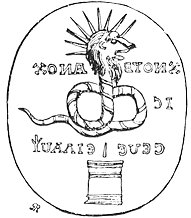
When God emanated Barbelo, she asked Him persmission to grant the creation of the other aeons. Eventually, the Pleroma came to be filled with 365 aeons and their respective angels. The latest aeon in the chain, Sophia, pondered how to get back to the center of divine nature closest to God (the repeated act of emanation had brought a sort of imbalance to the spiritual world). She finally decided to imitate God’s original action of emanating, asking no permission from her male counterpart nor from God. The experiment ends in a disaster: she produces a lion-headed snake creature called Yaldabaoth.


"And the Sophia of the Epinoia, being an aeon, conceived a thought from herself and the conception of the invisible Spirit and foreknowledge. She wanted to bring forth a likeness out of herself without the consent of the Spirit, - he had not approved - and without her consort, and without his consideration. And though the person of her maleness had not approved, and she had not found her agreement, and she had thought without the consent of the Spirit and the knowledge of her agreement, (yet) she brought forth. And because of the invincible power which is in her, her thought did not remain idle, and something came out of her which was imperfect and different from her appearance, because she had created it without her consort. And it was dissimilar to the likeness of its mother, for it has another form.
"And when she saw (the consequences of) her desire, it changed into a form of a lion-faced serpent. And its eyes were like lightning fires which flash. She cast it away from her, outside that place, that no one of the immortal ones might see it, for she had created it in ignorance. And she surrounded it with a luminous cloud, and she placed a throne in the middle of the cloud that no one might see it except the holy Spirit who is called the mother of the living. And she called his name Yaltabaoth.

“This is the first archon who took a great power from his mother. And he removed himself from her and moved away from the places in which he was born. He became strong and created for himself other aeons with a flame of luminous fire which (still) exists now.”

When the time came, Yaldabaoth finally managed to break free of his confinement, stealing his mother’s divine power in the process. Making ‘angelic’ henchmen of his own, the Archons (the ‘Rulers’, who like him also have heads of animals), Yaldabaoth creates the material universe with their assistance, not realizing that he is making a flawed, imperfect copy of the Pleroma.
 
The Apocryphon of John continues:

And he joined with his arrogance which is in him and begot authorities for himself. The name of the first one is Athoth, whom the generations call the reaper. The second one is Harmas, who is the eye of envy. The third one is Kalila-Oumbri. The fourth one is Yabel. The fifth one is Adonaiou, who is called Sabaoth. The sixth one is Cain, whom the generations of men call the sun. The seventh is Abel. The eighth is Abrisene. The ninth is Yobel. The tenth is Armoupieel. The eleventh is Melceir-Adonein. The twelfth is Belias, it is he who is over the depth of Hades. And he placed seven kings - each corresponding to the firmaments of heaven - over the seven heavens, and five over the depth of the abyss, that they may reign. And he shared his fire with them, but he did not send forth from the power of the light which he had taken from his mother, for he is ignorant darkness.

"And when the light had mixed with the darkness, it caused the darkness to shine. And when the darkness had mixed with the light, it darkened the light and it became neither light nor dark, but it became dim.

"Now the archon who is weak has three names. The first name is Yaltabaoth, the second is Saklas, and the third is Samael. And he is impious in his arrogance which is in him. For he said, ‘I am God and there is no other God beside me,’ for he is ignorant of his strength, the place from which he had come.

"And the archons created seven powers for themselves, and the powers created for themselves six angels for each one until they became 365 angels. And these are the bodies belonging with the names: the first is Athoth, a he has a sheep’s face; the second is Eloaiou, he has a donkey’s face; the third is Astaphaios, he has a hyena’s face; the fourth is Yao, he has a serpent’s face with seven heads; the fifth is Sabaoth, he has a dragon’s face; the sixth is Adonin, he had a monkey’s face; the seventh is Sabbede, he has a shining fire-face. This is the sevenness of the week.

“But Yaltabaoth had a multitude of faces, more than all of them, so that he could put a face before all of them, according to his desire, when he is in the midst of seraphs. He shared his fire with them; therefore he became lord over them. Because of the power of the glory he possessed of his mother’s light, he called himself God. And he did not obey the place from which he came. And he united the seven powers in his thought with the authorities which were with him. And when he spoke it happened. And he named each power beginning with the highest: the first is goodness with the first (authority), Athoth; the second is foreknowledge with the second one, Eloaio; and the third is divinity with the third one, Astraphaio); the fourth is lordship with the fourth one, Yao; the fifth is kingdom with the fifth one, Sabaoth; the sixth is envy with the sixth one, Adonein; the seventh is understanding with the seventh one, Sabbateon. And these have a firmament corresponding to each aeon-heaven. They were given names according to the glory which belongs to heaven for the destruction of the powers. And in the names which were given to them by their Originator there was power. But the names which were given them according to the glory which belongs to heaven mean for them destruction and powerlessness. Thus they have two names.”

"And having created …] everything, he organized according to the model of the first aeons which had come into being, so that he might create them like the indestructible ones. Not because he had seen the indestructible ones, but the power in him, which he had taken from his mother, produced in him the likeness of the cosmos. And when he saw the creation which surrounds him, and the multitude of the angels around him which had come forth from him, he said to them, ‘I am a jealous God, and there is no other God beside me.’ But by announcing this he indicated to the angels who attended him that there exists another God. For if there were no other one, of whom would he be jealous?
 
In Sethian literature, Yaldabaoth is known as “the god of the thirteen realms” (Gospel of the Egyptians 63.19). In this same text, Nebroel - here one of Yaldabaoth’s (or as the text names him, Sakla’s) chief archons living in the thirteenth realm - is twice called “the great demon” (pnoc ndaimon, 57:10-20). Compare this text to the version found in the Apocryphon of John:

After five thousand years, the great light Eleleth spoke: “Let someone reign over the chaos and Hades.” And there appeared a cloud whose name is hylic Sophia …] She looked out on the parts of the chaos, her face being like …] in her form …] blood. And the great angel Gamaliel spoke to the great Gabriel, the minister of the great light Oroiael; he said, “Let an angel come forth, in order that he may reign over the chaos and Hades.” Then the cloud, being agreeable, came forth in the two monads, each one of which had light. …] the throne, which she had placed in the cloud above. Then Sakla, the great angel, saw the great demon who is with him, Nebruel. And they became together a begetting spirit of the earth. They begot assisting angels. Sakla said to the great demon Nebruel, “Let the twelve aeons come into being in the …] aeon, worlds …].” …] the great angel Sakla said by the will of the Autogenes, “There shall be the …] of the number of seven …].” And he said to the great angels, “Go and let each of you reign over his world.” Each one of these twelve angels went forth. The first angel is Athoth. He is the one whom the great generations of men call …]. The second is Harmas, who is the eye of the fire. The third is Galila. The fourth is Yobel. The fifth is Adonaios, who is called ‘Sabaoth’. The sixth is Cain, whom the great generations of men call the sun. The seventh is Abel; the eighth Akiressina; the ninth Yubel. The tenth is Harmupiael. The eleventh is Archir-Adonin. The twelfth is Belias. These are the ones who preside over Hades and the chaos.


And after the founding of the world, Sakla said to his angels, “I, I am a jealous god, and apart from me nothing has come into being,” since he trusted in his nature. …

… [Seth] passed through the three parousias which I mentioned before: the flood, and the conflagration, and the judgment of the archons and the powers and the authorities, to save her (the race) who went astray, through the reconciliation of the world, and the baptism through a Logos-begotten body which the great Seth prepared for himself secretly through the virgin, in order that the saints may be begotten by the holy Spirit, through invisible, secret symbols, through a reconciliation of the world with the world, through the renouncing of the world, and the god of the thirteen aeons, and (through) the convocations of the saints and the ineffable ones, and (through) the incorruptible bosom, and (through) the great light of the Father, who pre-existed with his Providence, and established through her the holy baptism that surpasses the heaven, through the incorruptible, Logos-begotten one, even Jesus the living one, even he whom the great Seth has put on.

The version in the Gospel of Judas is somewhat close to the Gospel of the Egyptians: Nebroel (as Nebro) is equated with Yaldabaoth, and is distinct from Saklas (although Saklas seems to become conflated with Nebro(el) by the end of the work).

“The multitude of those immortals is called the cosmos— that is, perdition—by the Father and the seventy-two luminaries who are with the Self-Generated (=Autogenes) and his seventy-two aeons. In him the first human appeared with his incorruptible powers. And the aeon that appeared with his generation, the aeon in whom are the cloud of knowledge and the angel, is called El. …] aeon …] after that …] said, ‘Let twelve angels come into being [to] rule over chaos and the [underworld].’ And look, from the cloud there appeared an [angel] whose face flashed with fire and whose appearance was defiled with blood. His name was Nebro, which means ‘rebel’; others call him Yaldabaoth. Another angel, Saklas, also came from the cloud. So Nebro created six angels—as well as Saklas—to be assistants, and these produced twelve angels in the heavens, with each one receiving a portion in the heavens.

In other words, Judas “the thirteenth demon” in GJ is Nebro(el)-Yaldabaoth, who is also called the “rebel,” who will eventually be destroyed.
 
“…] light —nearly two lines missing—] around …] let …] spirit [that is] within you dwell in this [flesh] among the generations of angels. But God caused knowledge to be [given] to Adam and those with him, so that the kings of chaos and the underworld might not lord it over them.”
Judas said to Jesus, “So what will those generations do?”
Jesus said, “Truly I say to you, for all of them the stars bring matters to completion. When Saklas completes the span of time assigned for him, their first star will appear with the generations, and they will finish what they said they would do. Then they will fornicate in my name and slay their children and they will …] and —about six and a half lines missing—] my name, and he will …] your star over the [thir]teenth aeon.”
After that Jesus [laughed].
[Judas said], “Master, [why are you laughing at us]?”
[Jesus] answered [and said], “I am not laughing [at you] but at the error of the stars, because these six stars wander about with these five combatants, and they all will be destroyed along with their creatures.”

As said earlier, Judas is connected with the thirteenth realm and its star or planet (the text may be reconstructed as “and your star will rule over the thirteenth aeon”), which isn’t a very favorable thing to say, since it suggests that he will never ascend beyond the cosmic girdle and thirteen realms (the seven heavens and the five abysses).

Thirteen is an unlucky number in Sethian numerology and cosmology, since it is the number associated with Yaldabaoth and his Archons and his heaven. Recapping the Gospel of the Egyptians, we are told that two angels - Saklas and “the great demon” Nebruel - who would rule Chaos and Hades were brought forth. The two established twelve spheres below them, which they populated with twelve archons, while they occupy the thirteenth heaven along with “the god of the thirteen aeons,” Yaldabaoth. Through the body of Jesus (who is actually Seth), these thirteen aeons were “nailed.” Also in the Apocryphon of John, there are twelve archons below Yaldabaoth: seven rule the spheres of heaven and five rule Hades. Another Sethian work, the Apocalypse of Adam, recounts thirteen kingdoms ruled by archons, in contrast to the holy “generation without a king” (Sakla is also given as the name of the creator Demiurge). In Zostrianos, the initiate tells us that he cast his body “upon the earth to be guarded by glories.” In the process of this spiritual ascent he “was rescued from the whole world and the thirteen aeons in it and their angelic beings.” As said earlier, this is the same cosmology assumed by GJ, where Nebro-Yaldabaoth and Saklas produce “twelve angels in the heavens, with each one receiving a portion in the heavens.”

Judas is the “thirteenth demon” and his star belongs to the thirteenth aeon. Both of these expressions mean that Judas is not some blessed gnostic, but Yaldabaoth’s “man.” Unlike the initiate in Zostrianos who is able to pass the thirteenth heaven into the world beyond, Judas’ best fate is a final ascent to Yaldabaoth’s thirteenth heaven, where he will rule over the twelve disciples who have cursed him. This is transparent in Judas’ vision of the heavenly Temple; Jesus tells him that he has been misled by his star to think that he could become part of “the holy generation.” Judas asks if “[his] seed is under the control of (or controls) the rulers” (i.e. the Archons) or protests against such an idea, at which Jesus simply reaffirms the curse that Judas will be overcome with lamentation when he sees the Kingdom and its fabulous generation, even though he will rule over the Archons.
 
Judas said to Jesus, “Look, what will those who have been baptized in your name do?”
Jesus said, “Truly I say [to you], this baptism …] my name —about nine lines missing—] to me. Truly * say to you, Judas, [those who] offer sacrifices to Saklas …] God —three lines missing—] everything that is evil.
But you will exceed all of them. For you will sacrifice the man that clothes me.

Already your horn has been raised,
your wrath has been kindled,
your star has shown brightly,
and your heart has
…].

“Exceed” does not capture the true sense of the language: literally translated, the statement actually goes like “But you will do more than (*[sup]e[/sup]*r-houo eroou terou) all of them.” Now the question is, do more than what? Let’s go back again to the earlier parts of the gospel.

One day he was with his disciples in Judea, and he found them gathered together and seated in pious observance. When he [approached] his disciples, gathered together and seated and offering a prayer of thanksgiving over the bread, [he] laughed.
The disciples said to [him], “Master, why are you laughing at [our] prayer of thanksgiving? We have done what is right.”
He answered and said to them, “I am not laughing at you. are not doing this because of your own will but because it is through this that your god [will be] praised.”
They said, “Master, you are …] the son of our god.”
Jesus said to them, “How do you know me? Truly * say to you, no generation of the people that are among you will know me.”
When his disciples heard this, they started getting angry and infuriated and began blaspheming against him in their hearts. …

… Another day Jesus came up to [them]. They said to [him], “Master, we have seen you in a [vision], for we have had great [dreams …] night …].”
[He said], “Why have [you … when] have gone into hiding?”
They [said, “We have seen] a great [house with a large] altar [in it, and] twelve men—they are the priests, we would say—and a name; and a crowd of people is waiting at that altar, [until] the priests … and receive] the offerings. [But] we kept waiting.”
[Jesus said], “What are [the priests] like?”
They [said, “Some …] two weeks; [some] sacrifice their own children, others their wives, in praise [and] humility with each other; some sleep with men; some are involved in [slaughter]; some commit a multitude of sins and deeds of lawlessness. And the men who stand [before] the altar invoke your [name], and in all the deeds of their deficiency, the sacrifices are brought to completion …].”
After they said this, they were quiet, for they were troubled.
Jesus said to them, “Why are you troubled? Truly I say to you, all the priests who stand before that altar invoke my name. Again I say to you, my name has been written on this …] of the generations of the stars through the human generations. [And they] have planted trees without fruit, in my name, in a shameful manner.”

Jesus said to them, “Those you have seen receiving the offerings at the altar—that is who you are. That is the god you serve, and you are those twelve men you have seen. The cattle you have seen brought for sacrifice are the many people you lead astray before that altar. …] will stand and make use of my name in this way, and generations of the pious will remain loyal to him. After him another man will stand there from [the fornicators], and another [will] stand there from the slayers of children, and another from those who sleep with men, and those who abstain, and the rest of the people of pollution and lawlessness and error, and those who say, ‘We are like angels’; they are the stars that bring everything to its conclusion. For to the human generations it has been said, ‘Look, God has received your sacrifice from the hands of a priest’—that is, a minister of error. But it is the Lord, the Lord of the universe, who commands, ‘On the last day they will be put to shame.’”**
 
Hi,

Why are we revisiting this? If we know the purpose, at least we can prepare for the discussion. Is there new information that requires a rethink? There are many other gnostic writings too. Is there a particular reason to visit this particular gnostic writing?

I see a lot of materials being posted but if that came from another source, a link to it can be helpful so that we are aware of the nature of the source as well as its credibility.
 
Hi,

Why are we revisiting this? If we know the purpose, at least we can prepare for the discussion. Is there new information that requires a rethink? There are many other gnostic writings too. Is there a particular reason to visit this particular gnostic writing?

I see a lot of materials being posted but if that came from another source, a link to it can be helpful so that we are aware of the nature of the source as well as its credibility.
This is meant to be a continuation of a former thread from a few years about the Gospel of Judas, which the OP has originally resurrected. I originally made a new thread to continue the discussions but the mods have kindly moved the newer posts from that older thread here as well. (For the record, I’m not responsible for the ‘revisited’ bit. ;))

As for my sources:

Gospel of Judas,Understanding the by Craig A. Evans
The Gospel of Judas in Context: Proceedings of the First International Conference on the Gospel of Judas, edited by Maddalena Scopello
The Gospel of Judas: Coptic Text, Translation, and Historical Interpretation of ‘the Betrayer’s Gospel’, by Lance Jenott
The Non-Canonical Gospels, by Paul Foster
The Apocryphal Gospels (part of Oxford University Press’ A Very Short Introduction series), also by Paul Foster
The 2006 English translation, by Rodolphe Kasser, Marvin Meyer, and Gregor Wurst
 
A number of scholars (such as April D. DeConick) have actually complained the original National Geographic translation was critically faulty in many substantial respects, which can be attributed to the rush to publish an English translation of the gospel for public consumption. Part of the faulty information is the consequence of the fact that the scholars who made the first English translation based it on a provisional unfinished Coptic transcription. This transcription was released on the National Geographic website at the same time the English translation was made available in bookstores. We now know that the provisional transcription was flawed in crucial areas of the text - and these were corrected a year later in the critical edition of GJ, but not before they already became part of the academic discourse and public consciousness.
Didn’t know. Thanks.
 
Status
Not open for further replies.
Back
Top