"History and tradition in movie depictions of the Cross"

  • Thread starter Thread starter patrick457
  • Start date Start date
Status
Not open for further replies.
A couple of back info:

There are at least two films which depicted Jesus carrying a T-shaped cross mentioned in Chattaway’s article: the 1912 From the Manger to the Cross and the 1959 Ben-Hur. Both films were heavily influenced by the artworks of the 19th-century French artist John Jacques Tissot (aka James Tissot), with From the Manger even outright basing the costumes and the sets on Tissot’s artworks. (One thing Tissot and From the Manger has in common is that Tissot traveled to the Holy Land for his biblical artworks; From the Manger was also filmed on location in the Holy Land.)


(Trivia: From the Manger was actually a very controversial film back in its day. There was of course the issue of people being up in arms with the idea of Jesus being depicted in film, but there was also the issue of the film eschewing traditional artistic conventions - showing a t-shaped cross, a long table at the Last Supper - in favor of copying Tissot’s depictions - a T-shaped cross, a round table at the Last Supper - which was quite unconventional at that time. That, and the fact that the original film ended at the crucifixion, omitting the resurrection entirely.)
 
Have yet to see it, but the BBC did a miniseries called The Passion in 2008. Jesus was crucified like this:

The Telegraph - Telegraph Online, Daily Telegraph, Sunday Telegraph - Telegraph
Oh yes, that. That’s one of my favorite Jesus films, actually. And yes, The Passion did generate a (very minor) controversy over the artistic decision to have the nails go through the forearms rather than the wrists or the palm. Admittedly, it’s a rather odd artistic decision, but not entirely ‘way out there’: there was, after all, no ‘standard procedure’ when it came to crucifixions.
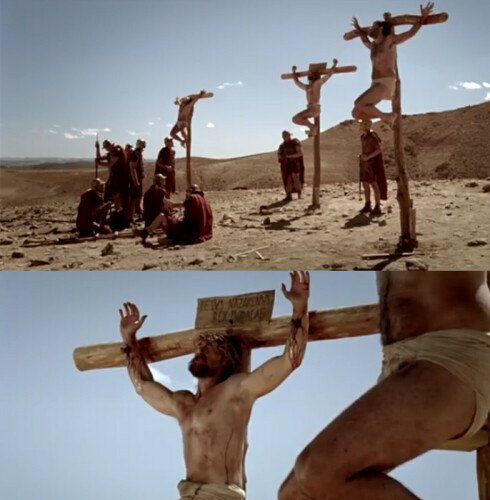


(In a way, I could even laud the filmmakers for trying to do something different, since if you’re like me who have watched Jesus films :D, the crucifixion is one of the places where filmmakers - even some of the more daring ones - will for some reason automatically default to the conventional Western depiction: Jesus in a loincloth crucified on a t-shaped cross with nails in palms or wrists and one nail through both feet, with a sign saying ‘INRI’ - not the trilingual “King of the Jews” version - above His head. It’s even more odd, because filmmakers are generally not hesitant to depict ‘different’ forms of crucifixion - even more historically-accurate ones - when it comes to people other than Jesus. I mean, just watch Spartacus - either the 1960 Stanley Kubrick film or the 2010 TV series should do. I guess the crucified Jesus has become too iconic?)

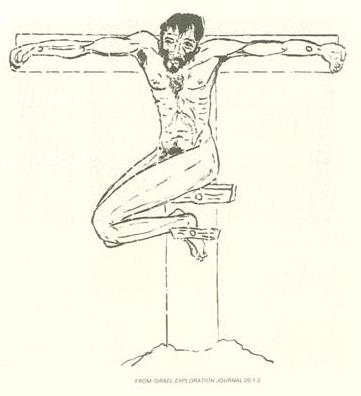
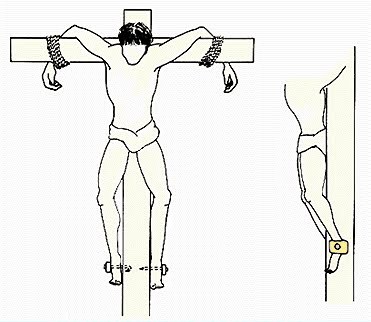
Speaking of which, the posture adopted in this film seems to be based on the initial reconstruction of how a 1st-century man named Jehohanan (whose heelbone had a nail sticking out of it, implying that he was a crucifixion victim) was crucified.


Note the squatting position of the legs.

This reconstruction was eventually proved to be erroneous after a reappraisal of the bones in 1985: Jehohanan’s heels were not nailed with a single nail (the nail was found to be shorter than its claimed size), and he doesn’t seem to have been nailed on his wrists/arms: he was probably simply tied to the crossbeam.


However, by that time the earlier reconstruction had already passed into public consciousness to an extent, while the second seems to have remained obscure (from the general public’s POV, at least).

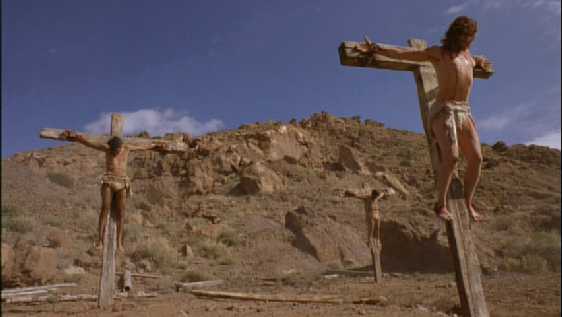
I could name at least four films that use this ‘first version’ as a base for their depiction of the crucified Jesus: aside from The Passion, you have The Last Temptation of Christ (1988), Jesus of Montreal (1989, not technically a ‘Jesus film’), and then The Miracle Maker (2000). (It also just so happens that The Last Temptation and Jesus of Montreal - two ‘unconventional’/‘unorthodox’ films - are really the only films which show Jesus naked on the cross. In fact, you might say that perhaps they adopted the earlier reconstruction because the position allows them to depict a naked Jesus without having to show the actors’ private parts on camera.)


From top: The Last Temptation, Jesus of Montreal, The Miracle Maker. Note another thing: in all three films, the nails seem to be nailed into wooden washers. That detail is also derived from Jehohanan (the nail sticking in his heelbone had traces of wood in it; the nail was driven into a sort of wooden plaque or washer first before it was nailed into Jehohanan’s heel. Perhaps to make it more difficult to break free from the nails?)

As for the second reconstruction, unlike the first one I only know of two films that use it. You might notice in The Miracle Maker still above that at least one of the two robbers is depicted as being crucified in the ‘second reconstruction’ posture. (There was another sequence in the film where Judas hallucinates that he was being crucified; that scene also employed the second version.) The only other film which depicts crucifixion in a way similar to the second reconstruction is the 2003 The Gospel of John. (Note the feet.)

 
Really odd to see a literal INRI sign on screen. Nobody at Golgotha would know what it means. “Power of iconography” winning out like having the nails through the palms, I guess.

I’m curious if the Jehovah’s Witness version, where Jesus is on a stake instead of a cross, has ever been filmed.

The upcoming movie Risen – thread about it here, Chattaway’s posts on it here and here – has those small pieces of wood between the flesh and the nails too. Though Jesus seems to be alive when he gets speared, whaaat.
 
Really odd to see a literal INRI sign on screen. Nobody at Golgotha would know what it means.
That’s really my gripe with it, too. Seriously, why bother putting up a sign when one can’t even decipher what it means? 😛
“Power of iconography” winning out like having the nails through the palms, I guess.
And having one nail through both feet (which are placed one on top of the other), which was essentially something medieval Western artists invented. The earliest depictions of crucifixion either show the feet as apparently not being nailed at all or (more commonly) nailed separately. Even today most Eastern icons show Jesus’ feet being separate.
I’m curious if the Jehovah’s Witness version, where Jesus is on a stake instead of a cross, has ever been filmed.
As far as I know, not yet. Though there was a brief animated sequence in this 1986 anti-JW documentary Witnesses of Jehovah that showed that.
The upcoming movie Risen – thread about it here, Chattaway’s posts on it here and here – has those small pieces of wood between the flesh and the nails too. Though Jesus seems to be alive when he gets speared, whaaat.
He has His eyes open, but that’s not a necessary indicator that He’s still alive.

(To be fair, a few early manuscripts of Matthew’s gospel do have this before interpolation which inserts the spearing of Jesus’ side before “And Jesus crying out with a loud voice, gave up the spirit.” But really, the only films which show Jesus being speared while still alive are adaptations of Mikhail Bulgakov’s novel The Master and Margarita.)

In one of Chattaway’s posts, he notes that “curiously, this film’s Crucifixion does not seem to be taking place on a hill.”


In a way, this is quite accurate: there is really no indication from the gospels that Golgotha was a hill, much less a mountain. In the gospels and in early Christian sources (before the 5th-6th century onwards), ‘Golgotha’ is understood to be the name of a wide region - that includes the spot where Jesus was crucified - than a specific area.

We only think of Golgotha as being (the name of) a hill because in the traditional site (the Church of the Holy Sepulchre) there is a rocky protuberance that is being held as the place where the three crosses stood, the so-called Rock of Calvary. But that outcrop’s not really a natural hill, it’s essentially a finger of rock. In fact, some scholars think that it’s unlikely that the crosses would have stood on top of that rock as we often imagine, because the outcrop - assuming that it was already in its current shape in the 1st century - is really too steep to climb and its top too narrow to have enough space for three crosses. Instead, they think that the spot where Jesus would have been crucified is somewhere else within the general region: maybe enclosed in another spot within the church or maybe not even within the church at all. The Rock of Calvary was only specifically associated with the crucifixion because by the time the basilica was built, a cross was placed on top of the rock. Later Christians seem to have confused the cross as a marker denoting the exact spot where the cross of Jesus stood.

(I should note that Risen seems to use the 1985 reconstruction of Jehohanan’s crucifixion as a base for its portrayal of crucifixion. Just note the legs of Jesus and the two robbers: they’re separate, straddling the vertical. That makes it the second film I know of to do so, after the 2003 Gospel of John.)
 
A few comments on Chattaway’s blog post in the OP.
Thinking about this, I inevitably started thinking about Jesus movies, and I began to think about the fact that the recent mini-series The Bible has joined Mel Gibson’s The Passion of the Christ in taking a step back from recent “historically accurate” depictions of the Crucifixion towards a more traditional sort of iconography.
For years, filmmakers followed centuries of artistic tradition by distinguishing Jesus from the thieves who were crucified on either side of him: where Jesus carried his entire cross, the thieves carried only crossbeams; and where Jesus was nailed to his cross, the thieves were usually tied to their crosses with ropes.
Scholars have actually known that crucifixion victims may have carried only the crossbeams (patibulum) since the mid-16th century, actually, when the Flemish author Justus Lipsius published his survey of ancient texts describing crucifixion (the three-volume De Cruce, 1593). Lipsius’ study was very influential in later studies, even though many later authors usually forget to credit him. In fact, we even use cross-related terms that he essentially invented: for example, crux simplex to describe a simple stake, crux immissa to describe the t-shaped Latin cross (the ancient authors never really had technical terms like that; to them, it was all a crux or patibulum or stauros).

(Please Note: This uploaded content is no longer available.)
The Martyrdom of St. Philip (Jusepe de Ribera, 1639). Philip is tied to his crossbeam, and the executioners are raising it to the vertical post by ropes. Told you there wasn’t much hesitancy to depict ‘different’ forms of crucifixion if it wasn’t Jesus that’s being depicted. 😃

In his book, Lipsius does conclude that crucifixion victims were made to carry the whole cross or a part of it (aut certe eius partem) - although he does not really come to any conclusion on what Jesus carried - whether it was only the crossbeam or the whole cross. Not that you would know this if you only look at artworks; even after Lipsius’ time artists stuck to the traditional convention of depicting Jesus as carrying the whole cross, up until the early 20th century, that is.

When it comes to art, I think one of the first people to depict Jesus carrying only the crossbeam is British artist Harold Copping (1863-1932).

 
Then, in the 1960s, filmmakers began to show the thieves being nailed to their crosses, just like Jesus. And then, in the 1970s, filmmakers began to show Jesus carrying only his crossbeam, just like the thieves. Around that same time, spurred by the recent work of archaeologists and other scholars, filmmakers also began to show the nails going through the wrists of Jesus and the thieves, rather than the palms of their hands.

Actually, the very first Jesus film to depict the nails going through the wrists was a 1935 French film called Golgotha (released as Ecce Homo in some countries), which also holds the credit for being the first Jesus ‘talkie’ (sound film).


Notice the nails go through Jesus’ wrists. (Speaking of which, the film also depicted Jesus’ feet nailed separately. To be fair, it is hard to replicate the ‘one foot over the other’ depiction IRL.) As for the two robbers, it’s really hard to tell whether they were nailed too or simply tied.

(Speaking of which, I think the fact that a French Jesus film is the first to depict the nails going through the wrists has to do with the fact that just around the same time the film came out, the eminent French surgeon Pierre Barbet was conducting his study on the effects of crucifixion using the Shroud of Turin as one of his basis. In a way, you might say, the film did its research.)

I should add that Golgotha depicts all three condemned as carrying the whole cross: so there’s no distinction between Jesus and the two robbers.

 
As for the crossbeam, I think one of the first - if not the first - Jesus film to show it is the 1969 televised version (BBC) of the play Son of Man by playwright Dennis Potter. It’s overlaid though with a flashback to the very first scene of the play (Jesus in the desert questioning Himself/God: “Is it me?”)


In fact, the way crucifixion is depicted in Son of Man is quite interesting. First off, the feet are not nailed (this holds true for Jesus, the two robbers, and that one other crucified guy). So the victim is essentially dangling from the cross, with only the nails in the palms and the ropes in the arms to support him.* In fact, the ‘King of the Jews’ sign is not above Jesus’ head, nor even around His neck, but is placed just beside His left hand.
  • I think this maybe has to do with the fact that around that time, there were a few scholars who doubted whether the feet were nailed to crosses at all, since John’s gospel really only speaks of the nails going through Jesus’ hands (the mention of “hands and feet” in Luke 24 doesn’t count, nor does the typological reading of Psalm 22 apparently). That, and maybe also the fact that at least a couple of the earliest depictions of Jesus’ crucifixion doesn’t really show the feet being nailed. The discovery of Jehohanan’s heelbone in 1967 changed all that: scholars recognized that there are crucifixions when the feet/heels/legs might be nailed.


If you can read Hebrew/Aramaic, you might note how inaccurate/misspelled the sign is. (It should be מלכא דיהודיא. And both Hebrew and Aramaic are read from right to left.) 😃
 
As far as I know, not yet. Though there was a brief animated sequence in this 1986 anti-JW documentary Witnesses of Jehovah that showed that.
On a related note, I should add that the LDS have a rather unique way of depicting the crucifixion. Apparently, a common line of interpretation nowadays among Mormons is that Jesus was nailed through His hands and wrists (their attempt to square the description of Jesus being nailed through His “hands” with the idea that it was the wrists that were historically nailed.) Accordingly, some LDS-made Jesus films show Him nailed in both body parts. (For example, this film called The Lamb of God, and this other one.)
 
Somebody just gave me a DVD of Roberto Rossellini’s The Flowers of St. Francis, which came out in 1950. By chance, has anyone here ever seen it? It was co-written by Federico Fellini, which seems strange to me, because I didn’t know he ever collaborated with other people. Maybe he and Rossellini were friends.🤷
 
Somebody just gave me a DVD of Roberto Rossellini’s The Flowers of St. Francis, which came out in 1950. By chance, has anyone here ever seen it? It was co-written by Federico Fellini, which seems strange to me, because I didn’t know he ever collaborated with other people. Maybe he and Rossellini were friends.🤷
Fellini also collaborated with Rossellini in Roma, città aperta (Rome, Open City). Actually, the two collaborated in a number of Rossellini’s late 1940s films (The Flowers of St. Francis was one of the last projects they collaborated on). I think the collaboration ended when Fellini started making films on his own by the 1950s. And yeah, they were friends / mentor-student of a sort, though they did get on each other’s nerves at times (differences in personality / opinions).

For the record, Rossellini’s final movie was actually a Jesus film, Il Messia (The Messiah, 1975/6). In his final years, he was making films (cinema ones and TV movie ones) out of historical figures: Louis XIV, St. Augustine, Socrates, Blaise Pascal, Cosimo de Medici, René Descartes. Jesus happened to be the last figure he would make a film about.
 
I believe the first English-language Jesus cinematic film to show Jesus carrying only His crossbeam is the 1976 film The Passover Plot. (Son of Man was a televised play.)

The film is based on a 1960s book by scholar Hugh Schonfield, which proposes the theory that Jesus, a devout Jewish guy who was convinced that He was the messiah, plotted to fake His own death by crucifixion. In other words, it’s a variation on the old ‘swoon theory’: Jesus never really died on the cross, He just fell unconscious. The variation is, that Schonfield did believe Jesus died on the cross, but only because that darned soldier who speared Him ruined His plan to stage His own ‘resurrection’. The film is based on Schonfield’s basic premise (Jesus was a guy with a messianic complex who plotted to fake His own death), but it does tweak some bits: Jesus survives the spearing, but only barely. (Spoiler: He does eventually die from His injuries by the end of the film.)

Leaving the, erm, bizarre/heretical premise :rolleyes:, a couple of highlights from the film. First, it stars a few notable actors such as Donald Pleasence (as Pilate), Hugh Griffith (Caiaphas) and Dan Hedaya (James ‘brother’ of Jesus - or as the film calls him, Yaaqov). Second, to the film’s credit, it’s one of the first Jesus films to make a conscious decision to show Jesus and the people around Him as Jewish: the Jewish characters are called by their Semitic names (so Jesus is ‘Yeshua’, etc.), Jesus, His disciples and John the Baptist wear tefillin (phylacteries) in one scene, the Last Supper is played out like a Seder, when Jesus does finally die James recites the Kaddish in Hebrew.

(Plus points in that the actor who played Jesus, Zalman King, was Jewish. Despite being born in Trenton NJ, King’s Jesus was quite exceptional for its time for being quite authentic-looking - at that time, Jesus films in general were yet to shy away from Jesuses that looked too ‘white’. It’s a shame though that King later became (in)famous as a director of soft-core erotica. 🤷)

To move on to the topic. The film doesn’t depict the carrying of the cross (the film jumps from Pilate’s sentence to Jesus being stripped of His clothing in Golgotha), but it does depict Jesus as tied to His crossbeam just before He was nailed to it. The ‘unconventional’ elements in the film’s depiction of the crucifixion is:

(1) The crosses are T-shaped.
(2) There is no ‘King of the Jews’ sign.
(3) Instead of the two robbers being positioned literally on Jesus’ right and left, one robber (the right-side one) is in front of Jesus, the other robber (the one on His left) is behind Him. Oh, and the two robbers are tied and nailed to their crosses, just like Jesus.

Aside from that, the manner of crucifixion is in ‘traditional’ way: nails through the palms, one nail through both feet (apparently), a loincloth. Power of iconography again, I guess.

 
In Cecil B. DeMille’s The King of Kings (1927, not to be confused with the 1961 King of Kings), one of the two robbers (the bad one) is crucified like this: one hand tied to the cross with rope, the other apparently nailed to it. Chattaway also notes the crow, a device which Mel Gibson also uses in The Passion of the Christ.

It really caught my eye, because the posture of the guy is so similar to a 19th century painting depicting the crucified Jesus. It’s an 1883 piece called The Martyrdom of Jesus of Nazareth (Martyre de Jésus de Nazareth) by French painter Aimé Morot. The way Morot depicts Jesus crucified is very unconventional: I don’t know of any artist from before or after that had the guts to depict Him the way Morot did. Morot depicts Jesus on a T-shaped cross. One of His hands and His feet are not nailed to the cross, but simply tied to it. (The other hand, the right one, seems to be nailed - it looks like there’s blood on it - but it is also tied.) The sign ‘King of the Jews’ is not over His head, but at the foot of His cross.

I don’t know if DeMille knew the painting and was consciously trying to emulate it, but they’re just so similar. DeMille even provided the two thieves with their own signs, which are placed at the foot of their respective crosses.

 
I’d like to talk a bit about The Passion of the Christ. I’m thinking that film was influenced by quite a number of former Jesus films, especially in some technical aspects (certain shots, etc.) Peter Chattaway already pointed out some similarities between Mel Gibson’s film and DeMille’s The King of Kings in the post I linked to in the OP and in this other post.

Other critics have pointed out Mel’s use of Middle Eastern music (a nod to The Last Temptation of Christ, the first Jesus film to use oriental music for its soundtrack?) and his decision to shoot the film in the southern Italian city of Matera (where Pier Paolo Pasolini also filmed Il Vangelo secondo Matteo, aka The Gospel according to St. Matthew in the 60s). Aside from those, one place where I really noticed a number of similarities with other Jesus films is during the crucifixion scene.
 
Risen also portrays Jesus with two nails going through his feet.
 
Patrick

Off topic, more or less, for a moment, if I may. Perhaps you can help me identify a painting I once saw (in an illustration, not the original!) many years ago.

It shows a Roman soldier (or possibly a workman) hammering a nail into Jesus’ left hand or wrist. Jesus is lying on the cross, on the ground, and the man with the hammer is looking into the camera (so to speak) with a malicious grin on his face, gloating over the pain he is causing. From what I recall, I’d say the style is probably Flemish, but of course I can’t be certain about that.

I’ve hunted for it on Google Images, but there are so many hundreds of pictures of the Crucifixion that I’ve never managed to locate it.

Does all this ring a bell at all?

Thanks
Bart
 
Patrick

Off topic, more or less, for a moment, if I may. Perhaps you can help me identify a painting I once saw (in an illustration, not the original!) many years ago.

It shows a Roman soldier (or possibly a workman) hammering a nail into Jesus’ left hand or wrist. Jesus is lying on the cross, on the ground, and the man with the hammer is looking into the camera (so to speak) with a malicious grin on his face, gloating over the pain he is causing. From what I recall, I’d say the style is probably Flemish, but of course I can’t be certain about that.

I’ve hunted for it on Google Images, but there are so many hundreds of pictures of the Crucifixion that I’ve never managed to locate it.

Does all this ring a bell at all?

Thanks
Bart
No, sorry, I’m not familiar with the exact painting. Is it a medieval artwork or something of the sort?
 
Risen also portrays Jesus with two nails going through his feet.
I haven’t watched Risen yet, but I really do like how it portrays the crucifixion.

The crucifixion scene in Killing Jesus really exemplifies what that film was to me as a whole: there is a great buildup, but it all falls flat at the end. The scene could have been better were it not for those odd artistic decisions that sort of slightly ruined it for me (that one annoying temple guard, Jesus being to the left of the two thieves, the sign on the cross just literally saying ‘INRI’).
 
Do we even know exactly what the form of the cross was? Or are people looking at the bible and making semi-educated geusses?

I was a Franciscan some time ago and the Tau cross looking like this T, was used by us often. Maybe that was the form St. Francis thought the true cross had?
 
Status
Not open for further replies.
Back
Top