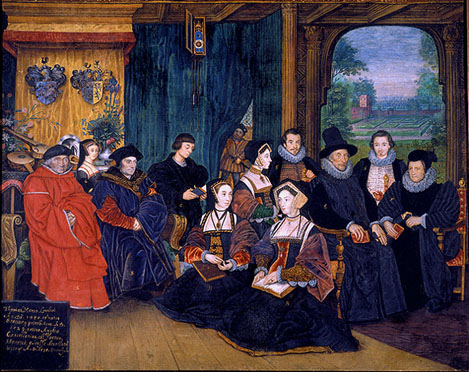
Thomas More is regarded as a saint in part because of the way that he refused to support Henry VIII’s divorce of Catharine of Aragon, even though he was under tremendous political pressure to do so, and because he died refusing to accept Henry as the leader of the church within England instead of the Pope as the Act of Supremacy demanded him to do. By doing that, he not only sacrificed the high political office that he enjoyed under his former friend Henry VIII, but also ultimately lost his head. In doing so, he displayed an incredible devotion to his faith, an extraordinary amount of courage, and an admirable degree of integrity. Those of us who have never been in a position where we had to face the choice of dying for our faith should not presume to judge him, since many of us would probably not be willing to sacrifice our lives for our faith. Also, as far as I am concerned, More’s willingness to die for his beliefs, his strong faith, his courage, his determination, and his ability to not sacrifice his morals for his career in the end make him a very good patron saint for politicians. I think the world would be a better place if more politicians were willing to stick to their beliefs even if they have to suffer for it as More did.
As far as him ordering the burning to death of many people, I think that you have to look at what he did in the context of his time. When More was alive, the punishment for heresy was burning, and so it probably never occurred to him that this was a horrible crime. Indeed, many religious authorities at the time perceived burning as a last minute method of salvation in hopeless cases, because it was believed that a person might, when feeling the flames that were supposedly a foretaste of hellfire, might repent and save themselves from eternal damnation. Thus, to a contemporary of More, burning could be regarded as a mercy insofar as a brief mortal agony might save an immortal soul from eternal agony. Therefore, More sentencing those people to be burned is not a mortal sin for him, because he didn’t knowingly commit an immoral action. Also, since he sentenced these people to death under a legitimate authority, I’m not certain I would call what he did murder. Judging More by the standards of our time isn’t fair. If future generations see animals as equal to humans, I shouldn’t be condemned as a slave owner because I own a pet dog when in the modern world there is nothing wrong with owning a pet dog, should I?
Also, I have to point out that More probably felt overwhelmed by the Protestant beliefs that he saw encroaching on England, and he probably sincerely believed that he was doing the right thing by eradicating those heresies from his country. Again, you might not agree with him, but I think you have to admire his conviction and his determination to act according to what he perceived as his Catholic duties.
Finally, if you want to drag Utopia into it as evidence that More knew execution was wrong, I have to point out that Utopia is a very complex work. It has been quoted by liberals and by conservatives alike, and by communists and capitalists. The many facets of the work are apparent even in its title, which means nowhere or no place. Using Utopia to prove that More had a particular social philosophy is a very challenging thing to do, probably because More had many different, sometimes even contradicting views on many issues. Therefore, it will probably be very hard to prove that Utopia clearly indicates that More was against execution or recognized that it was completely immoral.
All in all, I think I have provided enough reasons as to why the Catholic Church would call him a saint, and I would remind you that in a very real sense the Catholic Church doesn’t make anyone a saint; God does.

 Thanks for the answers! Things are more clear now