
F
fnr
Guest
No, they are not. But if you listen to popular music, much hip-hop and R&B refers to women as gold diggers, freaks, divas, babymamas, and plenty of words that aren’t fit to post here. Why?
I think we need to address these questions head-on if we’re ever going to build the Kingdom of God, which is inclusive to me of the term “culture of life.”
I don’t want to talk electoral politics any more. I think it’s divisive and makes adversaries out of people with common aims. Our country is divided more than it’s ever been, despite electoral outcomes hovering around 50/50 for decades. The Big Sort is a book from 2008 that I heard Boston College ecclesiologist Richard Gaillardetz cite in a talk I recently attended. It shows that if you look at locations that in the 1970s leaned one way or the other, they now are almost exclusively that way. This suggests that our culture is more divided that ever.
Here are two maps showing that on the county level, “landslides” in presidential elections have become vastly more prevalent over time, despite pretty close national totals.
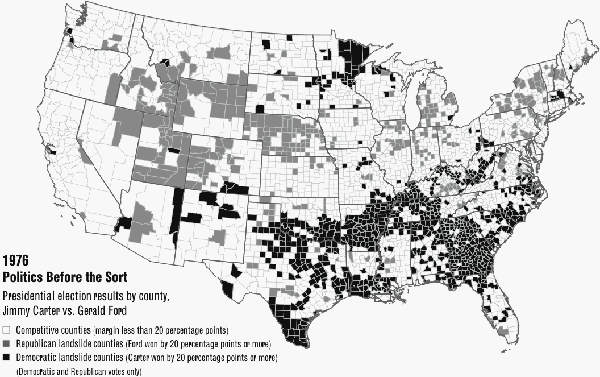

See how many fewer competitive counties there are in the lower picture? The moderate middle is falling away. These patterns tell me culture is eroding, and reducing everything to a choice of two uniform policy positions represented by party platforms. Fundamentally, I don’t believe that government is the fix to most of our problems! To quote one of my favorite political books, Civil Disobedience by Henry David Thoreau, “Voting for the right is doing nothing for it.”
I’m a liberal, but that doens’t mean I’m in favor of big government and libertine sex. I don’t think that conservatives want children to starve, nor that they want to return to the Jim Crow era. But that’s the kind of polemic that we throw at one another.
I think we can learn from one another. One of the most enlightening conversations I had was with a conservative Catholic who pointed out that marriage trends in society mean that more single-person households are cropping up, meaning fewer people per home, which is consuming more resources and is bad for the environment.
Can we have a conversation about culture? How can we change culture in a way that young people will plug into?
A few random priors. By listing them, I don’t intend to imply any conclusions. They’re just things I’ve heard or researched:
-I had a recent conversation with a suburban Detroit high school teacher who told me that 80% of her sophomores were sexually active, and that many young girls think that sex is on the critical path to romance.
-Abortion rates are highest in the northeastern US, among African Americans, and among women under 25 years old.
-Children whose mothers at birth say they were result of a mistimed or unwanted pregnancy get less emotional and learning support than kids born of an intended pregnancy.
-In the last 30 years, women in the lower 2/3 of the income distribution have become much more likely to become single mothers than women in the upper 1/3 of the income distribution.
-The vast majority of children in Detroit, near my home, are raised in single-parent homes.
-Productivity gains have meant that fewer workers are needed to do the same work.
-The offshoring of manufacturing jobs that require a lot of manual labor has meant that it’s hard to get a stable job in America without some post-high school education.
How do we fix our culture?
I think we need to address these questions head-on if we’re ever going to build the Kingdom of God, which is inclusive to me of the term “culture of life.”
I don’t want to talk electoral politics any more. I think it’s divisive and makes adversaries out of people with common aims. Our country is divided more than it’s ever been, despite electoral outcomes hovering around 50/50 for decades. The Big Sort is a book from 2008 that I heard Boston College ecclesiologist Richard Gaillardetz cite in a talk I recently attended. It shows that if you look at locations that in the 1970s leaned one way or the other, they now are almost exclusively that way. This suggests that our culture is more divided that ever.
Here are two maps showing that on the county level, “landslides” in presidential elections have become vastly more prevalent over time, despite pretty close national totals.


See how many fewer competitive counties there are in the lower picture? The moderate middle is falling away. These patterns tell me culture is eroding, and reducing everything to a choice of two uniform policy positions represented by party platforms. Fundamentally, I don’t believe that government is the fix to most of our problems! To quote one of my favorite political books, Civil Disobedience by Henry David Thoreau, “Voting for the right is doing nothing for it.”
I’m a liberal, but that doens’t mean I’m in favor of big government and libertine sex. I don’t think that conservatives want children to starve, nor that they want to return to the Jim Crow era. But that’s the kind of polemic that we throw at one another.
I think we can learn from one another. One of the most enlightening conversations I had was with a conservative Catholic who pointed out that marriage trends in society mean that more single-person households are cropping up, meaning fewer people per home, which is consuming more resources and is bad for the environment.
Can we have a conversation about culture? How can we change culture in a way that young people will plug into?
A few random priors. By listing them, I don’t intend to imply any conclusions. They’re just things I’ve heard or researched:
-I had a recent conversation with a suburban Detroit high school teacher who told me that 80% of her sophomores were sexually active, and that many young girls think that sex is on the critical path to romance.
-Abortion rates are highest in the northeastern US, among African Americans, and among women under 25 years old.
-Children whose mothers at birth say they were result of a mistimed or unwanted pregnancy get less emotional and learning support than kids born of an intended pregnancy.
-In the last 30 years, women in the lower 2/3 of the income distribution have become much more likely to become single mothers than women in the upper 1/3 of the income distribution.
-The vast majority of children in Detroit, near my home, are raised in single-parent homes.
-Productivity gains have meant that fewer workers are needed to do the same work.
-The offshoring of manufacturing jobs that require a lot of manual labor has meant that it’s hard to get a stable job in America without some post-high school education.
How do we fix our culture?

 Say what, now?!?! I dont want yours or anyone else’s money, Thank you very much!!
 Whether it’s fair of me or not I refuse to expose myself to blatantly racist and offensive things. If the thread is in fact not what the title says then the OP made a huge judgement error.
