A congregation calling someone to “be the local bishop” is not
, and consecrated by the provincial bishops with the consent of the metropolitan.”
Note:
and
There’s more to it than just a local congregation calling someone to “be the local bishop.” Nowhere in Scripture do we see sheep picking their shepherd
solely on their own authority (in fact they have zero (name removed by moderator)ut into the process). Likewise, nowhere do we see the flock of God’s people picking their shepherd
solely on their own authority (though they have varying degrees of (name removed by moderator)ut into the process).
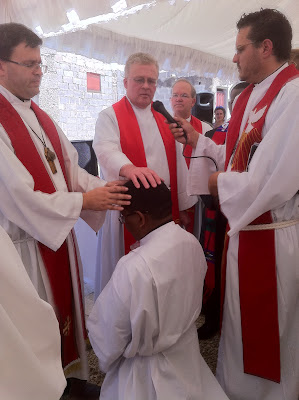
The laying on of hands still takes place in a Lutheran presbyter ordination. A simple confirmation of the local congregation’s
choice, in keeping with the early church.
What’s the sequence of events after completing one’s studies in a Lutheran seminary? Is one ordained, then placed on a list of those eligible to receive a call? Or is one not ordained until he receives a call? Regardless of sequence, what happens when this person moves on to his next (and every subsequent) assignment? Is he re-ordained each time? Or is his original ordination still “good”?
And who does the laying on of hands? The congregation president? The local Lutheran bishop? Whoever it is, by what authority does he claim his title and position, and who gave him this authority? This is indeed a legitimate question, one that was asked of Jesus Himself: “And when he entered the temple, the chief priests and the elders of the people came up to him as he was teaching, and said, ‘By what authority are you doing these things, and who gave you this authority?’” (Matt. 21:23) Authority flows from the top down (God the Father, Jesus, the Apostles, bishops/overseers/episkopoi, pastors, sheep); it doesn’t flow from the bottom up.
2 Tim. 3:16-17 shows the relationship between the legitimate ambassador and Scripture: “All scripture is inspired by God and profitable for teaching, for reproof, for correction, and for training in righteousness, that the man of God may be complete, equipped for every good work.” There is the relationship: the Scriptures are a tool for “teaching, for reproof, for correction, and for training in righteousness,” but who is to use this tool for these purposes? That is, who has the authority to teach, reproof, correct, and train others in righteousness? The “man of God” has this authority.
But, who is the “man of God?” A short survey of Scripture’s use of the title reveals that this, too, is a privileged title that cannot be simply taken upon oneself:
Moses - “This is the blessing with which Moses the man of God blessed the children of Israel before his death.” (Deut. 33:1)
“Then the people of Judah came to Joshua at Gilgal; and Caleb the son of Jephunneh the Kenizzite said to him, ‘You know what the LORD said to Moses the man of God in Kadesh-barnea concerning you and me.’” (Josh. 14:6)
The Angel of the Lord - “Then the woman came and told her husband, ‘A man of God came to me, and his countenance was like the countenance of the angel of God, very terrible; I did not ask him whence he was, and he did not tell me his name…’ Then Manoah entreated the LORD, and said, ‘O, LORD, I pray thee, let the man of God whom thou didst send come again to us, and teach us what we are to do with the boy that will be born.’” (Jud. 13:6, 8)
Samuel - “The servant answered Saul again, ‘Here, I have with me the fourth part of a shekel of silver, and I will give it to the man of God, to tell us our way.’” (1 Sam. 9:8)
Elijah - “And she said to Elijah, ‘What have you against me, O man of God? You have come to me to bring my sin to remembrance, and to cause the death of my son!’” (1 Kings 17:18)
Elisha - “And she went up and laid him on the bed of the man of God, and shut the door upon him, and went out… When Elisha came into the house, he saw the child lying dead on his bed.” (2 Kings 4:21, 32)
David - “According to the ordinance of David his father, he appointed the divisions of the priests for their service, and the Levites for their offices of praise and ministry before the priests as the duty of each day required, and the gatekeepers in their divisions for the several gates; for so David the man of God had commanded.” (2 Chr. 8:14)
St. Timothy - “But as for you, man of God, shun all this; aim at righteousness, godliness, faith, love, steadfastness, gentleness.” (1 Tim. 6:11)
Contrary to the opinion that the “man of God” can be any Christian without distinction, Scripture itself will not allow such an interpretation, insisting that the “man of God” is a figure of authority, either commissioned by God directly through Divine Intervention (such as Moses or the Angel), or appointed by another holder of authority (such as Samuel, David, Elisha, and St. Timothy).
From this very brief survey of the phrase “man of God,” it should become apparent that what holds true for “pastors” holds true for the “man of God”: it is a title of authority that can in no way be taken upon oneself, but rather, it is bestowed upon a man by a higher authority. Oh, and if the “man of God” is truly called by God directly to his ministry (Moses, Jesus, the first generation of Apostles), Scripture requires the proof of miracles, signs, and wonders for authenticity.