How fast is the West secularizing?

  • Thread starter Thread starter Timi_Celcer
  • Start date Start date
Status
Not open for further replies.
In other words, the children of Gen X will lead the recovery charge? Not sure if Poland is similar in that regard to US demographics, but Gen X is tiny compared to boomers and if they have 1.3 kids, well… don’t go investing in Polish real estate anytime soon. Even if those Gen X offspring have 2.5 kids apiece, the population will take a long time to recover.
 
I don’t think anyone could give a number how fast, but there is no stopping it. Without God, man’s sinful nature guarantees death. Over the years we have seen how God has intervened to put man back on the right track. It never works forever. Man slowly falls every time. We know God will intervene with the Second Coming, but that may still be thousands of years from now or more.

That doesn’t mean we Catholics are off the hook though. We should try our hardest to convert the non-believers. God desires all to be in heaven with him. He will convert many of them on his own, but we are all called to help in this good work. We can’t stop secularization, but we can definitely slow it down.
 
I don’t think anyone could give a number how fast, but there is no stopping it. Without God, man’s sinful nature guarantees death. Over the years we have seen how God has intervened to put man back on the right track. It never works forever. Man slowly falls every time. We know God will intervene with the Second Coming, but that may still be thousands of years from now or more.
But it seems to me that God only intervened in very obvious ways during the Old Testament and New Testament eras–nothing since about 100 AD. I wonder why he’s taken a hands-off approach for the past two thousand years…?
That doesn’t mean we Catholics are off the hook though. We should try our hardest to convert the non-believers. God desires all to be in heaven with him. He will convert many of them on his own, but we are all called to help in this good work. We can’t stop secularization, but we can definitely slow it down.
Christians certainly face a tough challenge. How do you think it should be approached, given the popularity of New Atheism and postmodern relativism/hedonism?
 
But it seems to me that God only intervened in very obvious ways during the Old Testament and New Testament eras–nothing since about 100 AD. I wonder why he’s taken a hands-off approach for the past two thousand years…?
That is something I wonder about quite often, but have not figured it out yet.

It doesnt make sense that Jesus would get so involved with mankind during the time he walked the earth and then have no interaction at all in modern times, when people need to see him most.

I truly think if God were to come back in glory and do the same things he did in biblical times, there would be a mass conversion of 100s of thousands of people and the world would be changed, abortions would likely be stopped immediately!

In regards to chrisitan persecution…I believe it is right around the corner in the US…I believe alot of people will deny their faith in exchange for their quality of life to continue on, and we will see most churches boarded up and closed down by law enforcement. The true believers will be forced to practice in secret. I dont think many people will be able to withstand being sent to prison, tortured, or worse just because of what they believe in. I fear this will be a very bad time.
 
I’d posit that Poland is as close as you get, given that meeting like these are held regularly:

The guys on the right are the current cabinet.
Sorry, but having clergy at your cabinet doesn’t mean anything. Even President Obama has regular meetings with clergymen. Simply having clergy present doesn’t mean that Poland (or any other government) are following the philosophy or theology of the religious group present.
…in exchange for what, if the US does not manufacture anything by itself? Oh, I know: in exchange for Federal Reserve Notes, which FED makes out of thin air.
The value of money is hasn’t been dependent upon gold, silver, etc since 1966. We’ve had fiat money with a strong economy for decades. The fed has been “making money out of thin air” for over 50 years. That’s irrelevant. So long as people SEE fiat money as valuable, it’s still USED as valuable. Whether or not it’s backed by gold, silver, etc is irrelevant.
That would be the case if the age structure was an inverted pyramid. However, in reality it looks like this:
There are two large cohorts. One is baby boomers, the other one is millenials.
Poland doesn’t have an upside down pyramid because so many people have immigrated. That skews your demographics greatly.
Poland has essentially “solved” the problem by reforming the pension system in 1999. Without getting into details, the reform means that boomer’s retirement will be funded by millenials, but the millenials’ retirement will be funded by the millenials themselves. (Yep, this means that millenials will never get their retirement money, thanks for asking!).
So the government will tax the millenials to pay for BOTH the boomers retirements AND their own. I wouldn’t call that “Poland solving” anything. No wonder Poland still has a bad economy and all of the young Poles have left to England, Ireland, etc.
However – and here is the crucial part – observe that the two cohorts are 30 years apart. Which means that after the boomers die off, millenials get a ~20 year window of opportunity: the number of pensioners decreases, and they are 20 years away from retirement themselves. What they will do with opportunity remains to be seen, but they will have it.
This was already addressed by someone on page 2. How you expect millenials to build a strong economy with a shrinking population and a weak economy is beyond me. Pretty radically optimistic .
By the way, abortion is a red herring. Polish women who emigrate to UK (where on-demand abortion is legal) have a TFR well above 2.
As has been addressed here already, the fertility rate across Europe is super low. Pointing to a small group (just Polish immigrants in one country) doesn’t give any decent representation of Poland itself, let alone Europe as a whole. Europeans are aborting and contracepting themselves to oblivion, and their economy and future prosperity are suffering because of it.
 
Sorry, but having clergy at your cabinet doesn’t mean anything. Even President Obama has regular meetings with clergymen. Simply having clergy present doesn’t mean that Poland (or any other government) are following the philosophy or theology of the religious group present.
Obviously you haven’t lived in Poland.
The value of money is hasn’t been dependent upon gold, silver, etc since 1966. We’ve had fiat money with a strong economy for decades. The fed has been “making money out of thin air” for over 50 years. That’s irrelevant. So long as people SEE fiat money as valuable, it’s still USED as valuable. Whether or not it’s backed by gold, silver, etc is irrelevant.
Fiat has no value in itself, it is a medium of exchange. Until 1980s, US fiat was useful, because it could be exchanged for high-quality US-produced industrial goods, which were in demand elsewhere in the world. Since the US manufacturing has been moved to China, if I want to buy industrial goods, then I don’t need US fiat – I need Chinese fiat. Or, I can give the Chinese Euro fiat, which they will take, because Euro fiat can be exchanged for high-quality German cars. But since the US no longer manufactures anything, then I don’t need US fiat. There’s precisely one situation where you still need US fait outside US, and it’s oil trade – but if oil sellers started accepting anything else instead of US fiat (say, gold), then US fiat would become totally worthless over night.

The US currently manufactures fiat out of thin air, gives it to China in exchange for industrial goods, and China gives that fiat back to US gov’t by buying T-bills.
So the whole system only functions because the Chinese want it to function. But if the Chinese gov’t decided to dump its store of T-bills / US fiat on FOREX tomorrow, that would be literally the end of US economy.

Also, the Euro economy is doing so badly, that the US gov’t is currently begging the EU to enter a free-trade agreement with US. Go figure.
Poland doesn’t have an upside down pyramid because so many people have immigrated. That skews your demographics greatly.
Your argument is backwards – young people are emigrating, not old ones.
So the government will tax the millenials to pay for BOTH the boomers retirements AND their own. I wouldn’t call that “Poland solving” anything. No wonder Poland still has a bad economy and all of the young Poles have left to England, Ireland, etc.
Indeed. However, the inter-generational transfer ends with the boomers. Under the 1999 law, retirement of Gen-Xers will be paid by capital gains from their own social security payments, NOT from the taxes of the millenials. Same for the following generations. So the excessive tax burden due to aging society will decrease after the boomers die off (2030s). So the millenial cohort retiring in 2050s will not cause an additional fiscal stress.

That’s the problem with the “Demographic death spiral” argument – it assumes that the fiscal regime will be unchanged for several hundred years!
This was already addressed by someone on page 2. How you expect millenials to build a strong economy with a shrinking population and a weak economy is beyond me. Pretty radically optimistic .
Technology is currently destroying jobs at such rate, that reduced population may be actually a blessing. Yesterday, this article was published, where an early investor in Amazon.com said that Amazon has destroyed a million jobs. Mind you, this is coming from the guy who actually invested in the venture and made good money out of it, not some leftist hippie. A few weeks ago, the go-to example was Kodak vs. Instagram. The former, at its peak, employed 145 thousand people and was worth $28B – so, one Kodak employee created $193K of value. Instagram employs fifteen people and was sold for $1B – so, one Instagram employee creates $66.6M in value. In other words, today we need 345 times less people for creating the same value. Even if you assume that Facebook overpaid for Instagram by a factor of 100, and the company is actually worth “only” $10M, it still means that we need 3.45 times less jobs per $ of GDP today than in Kodak’s heyday.
As has been addressed here already, the fertility rate across Europe is super low. Pointing to a small group (just Polish immigrants in one country) doesn’t give any decent representation of Poland itself, let alone Europe as a whole. Europeans are aborting and contracepting themselves to oblivion, and their economy and future prosperity are suffering because of it.
Facts of the matter are:
  1. In Poland, abortion is illegal. TFR is 1.3.
  2. In UK, where on-demand abortion is legal, TFR is 1.9.
  3. For Polish immigrants in the UK, TFR is 2.3.
So Poland demonstrates that you can have a demographic catastrophe under an ontensibly pro-Catholic and pro-life regime, while the “culture of death” is doing much better. And young Poles are emigrating away from Catholicism and to the “culture of death”, not the other way. And once they reach the “culture of death” they start multiplying like rabbits.
 
… But if the Chinese gov’t decided to dump its store of T-bills / US fiat on FOREX tomorrow, that would be literally the end of US economy.
Facts of the matter are:
  1. In Poland, abortion is illegal. TFR is 1.3.
  2. In UK, where on-demand abortion is legal, TFR is 1.9.
  3. For Polish immigrants in the UK, TFR is 2.3.
So Poland demonstrates that you can have a demographic catastrophe under an ontensibly pro-Catholic and pro-life regime, while the “culture of death” is doing much better. And young Poles are emigrating away from Catholicism and to the “culture of death”, not the other way. And once they reach the “culture of death” they start multiplying like rabbits.
Minor quibble on the otherwise excellent fiat money discussion: Said move by the Chinese would also destroy their OWN economy. They’ve used much fiat dollars to buy US natural resources and real estate over the years. If they started a trade war, they’d likely forfeit those as well as the potential value of their dumped fiat money. I’m not at all convinced they’d survive that, economically, any better than we would.

On the TFR discussion, as usual, we don’t agree. Communism did it’s best to industrialize Poland and destroy distributed private agricultural economics. They did better at the latter than the former. After the wall fell, things were an economic disaster and it’s been hard for anybody to raise children. In case you missed it, communist economic policies are hardly the result of catholic theocracy… :rolleyes:

Your overall UK TFR numbers are misleading. First, that number is skewed slightly higher by the high TFR of immigrants and their recent offspring. IIRC, third generation or later UK citizens have TFRs under 1.8 (well below replacement rate). Second, the UK still reaps large economic benefits from the legacy of its empire years, which tends to skew the concentration of wealth and subsequently creates better economic opportunity. Third, the UK was one of the earlier countries to go through industrialization, so represents much less recent social upheaval compared to Poland’s traumatic experience under Soviet-style communist industrialization.

The 2.3 TFR for Polish immigrants is not the result of exposure to licentious moral climates, but the result of sudden freedom from the crushing legacy of communist economic destruction. You can’t seriously be arguing that Polish people come to England and say “Whesh! What a breath of fresh air! We can divorce on a whim, abort and contracept all we want, marry those of the same sex and get euthanized when we’re terribly sick. Let’s celebrate and make some babies!” Isn’t it rather more reasonable to suggest that they’re saying “Finally I can earn enough income that we can have 3 children and be confident that we can feed, clothe and educate them.” It then takes a generation or two for the culture to teach their children that food, clothing, shelter and medicine aren’t enough. One needs computers, cell phones, jet vacations and luxury cars to be happy. Now they can only afford under 2 kids again. I know which one sounds more likely to me!
 
Minor quibble on the otherwise excellent fiat money discussion: Said move by the Chinese would also destroy their OWN economy. They’ve used much fiat dollars to buy US natural resources and real estate over the years.
In other words, the US is paying Chinese with its own natural resources and real estate. As opposed to “economically dying” Germany which is paying Chinese with its industrial products. Now, which country should I bet on in the long run…
On the TFR discussion, as usual, we don’t agree. Communism did it’s best to industrialize Poland and destroy distributed private agricultural economics. They did better at the latter than the former. After the wall fell, things were an economic disaster and it’s been hard for anybody to raise children. In case you missed it, communist economic policies are hardly the result of catholic theocracy… :rolleyes:
Let’s have a look at data, shall we? Black line is the number of births, pink line is deaths, in thousands:

http://www.dziecigwiazd.pl/fm/upload/sty2012/luty/kNTU0MDI1ODksODEwMDU4fwykres_3.jpg

As you can see, Poland was doing just fine demographically under the evil commies. The demographic decline started with independence – explain how the commies are to blame for that. Bonus points if you can spot the abortion ban on this graph.

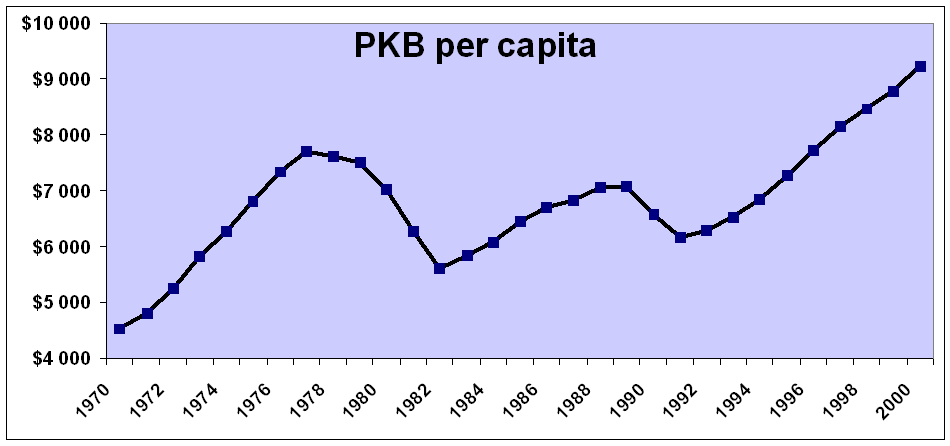
Now, let’s have a look at GDP per capita:
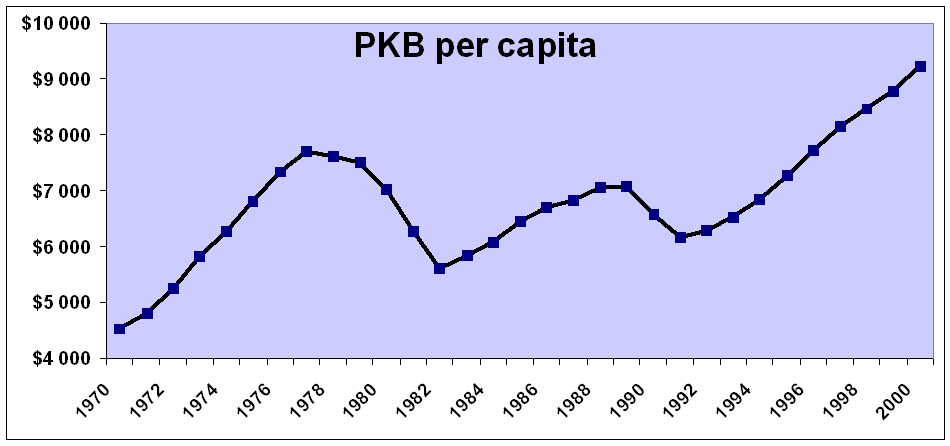


As you can see, the commies did cause a deep crisis around 1980 – paradoxically though, the birth rate during this crisis was high. This crisis lead to hyperinflation in late 1980s. However, the deepest crisis started in 1990, i.e. after the commies lost power on June 4,1989. It was caused by the new economic policy, which the new Polish government enacted under the instructions from the IMF. Long story short, the late commie economy had a hyperinflation and liquidity crisis, but it had a lot of assets and full employment. The IMF gave the Polish gov’t emergency loan (to provide the much needed liquidity), but required (1) a massive sell off of state assets (i.e. selling companies to their direct western competitors) and (2) stabilization of currency using a plan developed by Jeffrey Sachs (to Sach’s credit, 20 years later he denounced his own policy as incorrect). The currency stabilized, but at the cost of destroying industrial base on a scale comparable to a nuclear war. The result was mass unemployment:


The difference between the 1980 crisis and the 1990 crisis was that the 1980 crisis was accompanied by full employment (a direct result of communist economy), while the 1990 crisis was accompanied by mass unemployment (that true wonder of capitalism). So people reproduced just fine during the 1980 crisis, but stopped reproducing after the 1990 crisis.

And this brings us back to demographic issues. As you should have already noticed from the graphs, the 1980 cohort should have started reproducing about 2000 – however, it did not. Now observe that in 2000 and following years, you have 20% unemployment, and that usually means over 50% youth (under 35) unemployment. The unemployment rate started dropping in 2004 – and 2004 is when Poland joined the European Union and mass emigration to UK started. In other words, unemployment has only dropped because the young people have emigrated to the UK.

So, to rehash: Sachs plan → destruction of industrial base → mass unemployment → hands-off economic policy for the next 20 years → no children & mass emigration of young people → demographic disaster.

All that under the loving pastoral care of the Church openly supporting politicians directly responsible for the whole disaster. But hey, these guys are pro-life – and you should always vote for a pro-life candidate, remember 😃
You can’t seriously be arguing that Polish people come to England and say “Whesh! What a breath of fresh air! We can divorce on a whim, abort and contracept all we want, marry those of the same sex and get euthanized when we’re terribly sick. Let’s celebrate and make some babies!”
A lot of people on the board (yourself included) are arguing that Europe is dying out due to massive contraception and abortion. As acceptance of these things is negatively correlated with Catholicism, you’d expect that the more Catholic countries should have higher TFRs, and the more secular countries should have lower TFRs. In reality, the opposite is true. Here, have a map:


With the exception of Ireland, strongly Catholic countries (PL, SK, AT, IT, ES, PT) have very low TFRs (1.3-1.5), while the “culture of death” countries have TFR 1.8 and above. Who’s dying out, again?

 
So to summarize your argument, communism did, in fact live up to the billing of it’s critics (who have always said that it only works until it runs out of other people’s money to seize), but since free markets didn’t IMMEDIATELY and universally fix all those problems and show instant improvement trends, they are no better than communism.

I KNOW you’re smarter than that. Your own graph shows that after the trauma of the communist collapse and the economic chaos that created, a recovery did eventually begin that continues to this day. And I actually agree with you that the IMF cares less about universal prosperity than about protecting certain narrow hegemonies (that’s another topic that we might actually agree on quite well as I’m quite critical of “capitalist” free markets. I’d rather see free markets that skew towards). But it’s absurd to assert that the self-interested policies of the IMF are what destroyed Poland’s industrial base. Poland’s industrial base by the late 1980’s was an antiquated mess inherently incapable of competing with efficient western industry. You can’t turn an obsolete 1950’s tech steel mill into a profitable one just by firing the commie managers and selling it to private interests. Just as it takes time to run things into the ground, it takes time (and investment) to build things up.

You make an interesting point noting the TFR differences within Europe, but rather oversimplify. Both Ireland and France with long catholic cultural traditions are among the healthiest TFRs in Europe. Aside from them, EVERYBODY is dying out slowly. Yup, Italy is among the fastest dying. France is doing better than nearly everybody. Based on that, it looks like the catholic factor is NOT the determinator of TFR. Some other European characteristic must be.
 
So to summarize your argument, communism did, in fact live up to the billing of it’s critics (who have always said that it only works until it runs out of other people’s money to seize), but since free markets didn’t IMMEDIATELY and universally fix all those problems and show instant improvement trends, they are no better than communism.
Let’s do a small experiment. Assume that overnight aliens take over US gov’t. You wake up in the morning and you discover that:
  • The interest rate has been increased 20 times – i.e. the bank prime loan which was 3.25% is now 65%. Which means that the operational credit your company had at 10% yesterday, is now at 200%. You come to work to learn that the company has folded due to that and you are now unemployed.
  • At the same time, the USD will remain pegged to EUR for 6 months. FOREX investors immediately create a machine for siphoning trillions out the internal market.
  • All import tariffs have been abolished, and a line of ships filled with subsidized European steel is heading to US ports. Your wife who works at a steel mill is fired in the afternoon (along with everyone else), because the US steel industry can no longer compete.
Will you blame the pre-alien administration for the resulting train wreck?

And none of the above is made up. If you don’t believe me, read Globalization by Joseph Stiglitz, Nobel Prize winner and a former World Bank director.
But it’s absurd to assert that the self-interested policies of the IMF are what destroyed Poland’s industrial base. Poland’s industrial base by the late 1980’s was an antiquated mess inherently incapable of competing with efficient western industry.
The 1990 board of Siemens disagrees with you. They paid millions of dollars to buy a Polish electronic company and then close it down. A strange way of dealing with something which is “inherently incapable of competing”.
You can’t turn an obsolete 1950’s tech steel mill into a profitable one just by firing the commie managers and selling it to private interests.
Funny thing, that’s exactly what happened to the steel mill in my town.
You make an interesting point noting the TFR differences within Europe, but rather oversimplify. Both Ireland and France with long catholic cultural traditions are among the healthiest TFRs in Europe.
So France has (and always had) the most anti-Catholic government in Europe has the highest TFR, while Poland, which has arguably the most pro-Church government in Europe has the lowest TFR… Interesting , isn’t it?
 
Aliens didn’t create a liquidity crisis in Poland. Nice try though. Their liquidity crisis came because nobody in his right mind would willingly lend the Polish communist government (i.e. industry owners) investment capital since they’d never get it back. Industry operated at a loss with no investors to make up the difference DOES eventually face financial crisis. That’s not random and external like an “alien invasion.” It’s organically part of the problem.

Really? All it took was new management (as opposed to major outside capital investment) to turn around a 50’s era Polish steel mill? Forgive me, but I disbelieve you without evidence. I suspect you aren’t telling me about the tens of millions of dollars the outside guy pumped into the plant to upgrade the systems.

Governments in Europe aren’t the major factor determining how many kids people have. China, yes. But the effects government have on culture vary in strength and time. Since the revolution, yes, France has had some very anti-Catholic governments. Nevertheless, the prior 1,700 years of catholic culture still pose an strong cultural influence, especially in regards to the family (French Catholicism is rather John-flavored, which explains the prevalence of French Marian devotions). Just ask Josef Stalin or Napoleon Bonaparte how quick and easy it is for a government to abolish the legacy of Christianity in a nation. 😉

I can’t comment on the Siemmans assertion since I lack the specific facts, but I highly doubt any capitalist company is going to buy another company at market rates just to throw it away to eliminate competition. Any good ruthless capitalist would have taken the opportunity to close the LESS efficient plant. You think Siemmans has any innate loyalty to Germany? Like all corporations, they only care about the bottom line. If they closed your plant, it was because it was less efficient. Why’d they buy it in the first place? All sorts of potential reasons. Perhaps to acquire their long term contracts with suppliers, maybe for international patent rights, maybe to bolster their own staff in certain critical areas where supply of labor is tight. Could be dozens of reasons. But buy a company at market rates just to bury it? Tinfoil hat stuff. You can’t make such an approach make economic sense. If the Polish plant were more efficient, they’d have kept it and closed theirs. If their own plants were more efficient, they’d just have run a price war on product until the Polish firm went under. Much cheaper than buying and burning.

But hey, we agreed to criticize the motives and ideologies of the IMF. For us, that’s real progress! Anybody else still reading this thread?
 
Hi manualman,

Thanks, I’m also enjoying our conversation 🙂
Governments in Europe aren’t the major factor determining how many kids people have. China, yes.
Wait, wait. Are you saying that abortion legislation has no impact on TFR? 🙂

You’re saying that France has a strong Catholic legacy, so the left-wing regime and free abortion on demand does not matter. But you also have Sweden (and the rest of Scandinavia), which does not have Catholic legacy, the regime is extremely left-wing, and still, the TFR is 1.67. Then you have Poland, which has much stronger Catholic self-identification than France, where abortion is illegal, contraceptives are not covered by health insurance, there has been an attempt to outlaw IVF last year, Catholicism is taught in public schools, the Church is funded with about $1B of state money per year – and still, the TFR is 1.3 and there is mass emigration of young people away from that wonderful regime.

Explain that.

Regarding your characterization of capitalism, this is exactly what I was being told 20 years ago, and have since learned that it is not true:
  • Why would you fight a liquidity crisis by lowering import tariffs and freezing the exchange rate? You should do the exact opposite! But hey, you do what the IMF tells you to! (While quoting JP2’s encyclicals out of context 🙂 )
  • You are mischaracterizing Polish industrial base in 1990. Large parts of it were actually based on Japenese and German equipment purchased in 1970s (or domestically produced licensed clones thereof). Which means that in 1990, the equipment was at most 20 years old. NB it were these massive industrial upgrades in 1970s which led to the liquidity crisis in 1980s. Besides, a lot of indutrial processes haven’t really changed since 19th century, so in many applications, 30-year-old equipment is perfectly fine. As an anecdote, I know a company which has decided to replace a 30-year-old piece of equipment. The business end of the new machine turned out to exactly the same design as in the old machine (and closer inspection revealed that parts were actually cast from the same forms), the only difference was that the new machine was computer-controlled. Of course, the same effect could be achieved by putting modern process control on old machine, which is what a lot of people do instead of replacing the equipment.
  • Capital does, in fact, have nationality, especially European capital. Here is an example of a company relocating manufacturing from a more effective factory abroad to a less effective plant in its homeland.
  • Companies, in addition to production lines, usually have some thing else: market. It is therefore advantagous to purchase a competing company just to take over its customers. This is particularly true if capital has nationality. Here is an example of Siemens I was referring to before.
 
  1. Wait, wait. Are you saying that abortion legislation has no impact on TFR? 🙂
  2. You’re saying that France has a strong Catholic legacy, so the left-wing regime and free abortion on demand does not matter. …Then you have Poland, which has much stronger Catholic self-identification than France, where abortion is illegal, contraceptives are not covered by health insurance, there has been an attempt to outlaw IVF last year, Catholicism is taught in public schools, the Church is funded with about $1B of state money per year – and still, the TFR is 1.3 and there is mass emigration of young people …
Explain that.


  1. Why would you fight a liquidity crisis by lowering import tariffs and freezing the exchange rate? You should do the exact opposite! But hey, you do what the IMF tells you to! (While quoting JP2’s encyclicals out of context 🙂 )
  2. You are mischaracterizing Polish industrial base in 1990. Large parts of it were actually based on Japenese and German equipment purchased in 1970s (or domestically produced licensed clones thereof). Which means that in 1990, the equipment was at most 20 years old. NB it were these massive industrial upgrades in 1970s which led to the liquidity crisis in 1980s. Besides, a lot of indutrial processes haven’t really changed since 19th century, so in many applications, 30-year-old equipment is perfectly fine. As an anecdote, I know a company which has decided to replace a 30-year-old piece of equipment. The business end of the new machine turned out to exactly the same design as in the old machine (and closer inspection revealed that parts were actually cast from the same forms), the only difference was that the new machine was computer-controlled. Of course, the same effect could be achieved by putting modern process control on old machine, which is what a lot of people do instead of replacing the equipment.
…5. Here is an example of Siemens I was referring to before.
  1. Abortion law comes in two kinds. In America, abortion was imposed by artificial judicial fiat, not democratic changes in law. In other countries, it was legalized via popular support. Obviously laws DO have an effect on culture, but not necessarily the deciding one. When a law comes about by democratic efforts, it is simply reflecting the culture that it, rather than being a shaping effect. When a radical change in law is imposed by undemocratic means, it can have a more significant effect. I actually don’t think abortion laws are a major driver of TFR in the long run (though I would say it has AN effect in lowering them as the attitudes towards the unborn that are inherent to legal abortion sink into the populace). I think where a nation stands in the industrialization cycle and it’s cultural acceptance of contraception is what drives TFR. If you look at the TFR trend in America, for example, you don’t see it drop off a cliff suddenly after 1972 (Roe decision). It had already been trending way down even before then. The TFR crash trends with contraceptive acceptance and use. I don’t favor banning abortion in order to increase TFR. I favor banning abortion because it’s murder. It’s moral, not pragmatic.
  2. Not quite. The French leftist government and abortion policies DO have a negative effect on TFR, but are obviously not the largest influences. You can’t hardly take a walk in France without tripping on shrines to the Blessed Mother. That has an effect! I’m not enough of a Francophile to put my finger on it, but my sense is that the French tend towards socialism less from enthusiasm about the capability and benevolence of government and more from a wariness of the rich and powerful (200+ years after the end of monarchy there! See how long cultural influence lasts?) This differs a lot from American leftism that has never seen a problem that they don’t think should be fixed by a government program. I’m not an American supremacist (you might have noticed). I find much repugnant in dehumanizing corporate capitalism, but I also find much repugnant in an overly powerful state. The ideal socio-economic system might be something that weeds out the worst in both French and American approaches and keeps the best. (Complimenting the French! Now you KNOW I’m not a Dittohead) If you meant to hold up Sweden as an example of a healthy TFR, count me unimpressed. 1.67 is still a pretty rapid decline in the long run. We’ve beaten Poland to death (and honestly you’re clearly closer to the situation than I am). I still say that it’s economic privation causing their 1.3 and their UK emigrant jump to 2.3 illustrates what happens when you remove the economic burden from people still culturally Polish and largely catholic.
  3. I think we at least partially agree that some bad and exploitive things happened to the Polish after communism collapsed. But I still maintain that they collapsed because communism was never sustainable in the first place.
  4. A properly run business budgets its capital improvements in a manner it can afford to pay for via the payoff from those investments. Every bankrupt businessman you’ll ever meet will claim that it wasn’t his fault, the banks screwed him. Sometimes it’s true. Mostly it’s that he can’t face his failure and needs a scapegoat.
  5. I tried, but found it hard to follow the translation. I’ll have to take your word for it that at times a distressed business might be worth acquiring purely for their customer list. I’d assert that it’s more exception than rule, however. And certainly less likely under free market democratic conditions than when a Politburo member’s whim could simply take it all away from you.
 
Another example is Germany. TFR is still quite a bit lower in the former East German portions than in the West German portion. The have the same government and same policies. The simplest explanation is that the former East Germans still suffer more from the economic catastrophe of communism. They haven’t recovered financially yet, so they haven’t recovered even to the low fertility standards of Western Germany.
 
Another example is Germany. TFR is still quite a bit lower in the former East German portions than in the West German portion. The have the same government and same policies. The simplest explanation is that the former East Germans still suffer more from the economic catastrophe of communism. They haven’t recovered financially yet, so they haven’t recovered even to the low fertility standards of Western Germany.
Do you know what the TFR is in the former West Germany and what it stands at in the ex-East Germany?
 
And when will the de-secularization begin? What will happen when there will be only 10-15 % Christians in traditional Christian countries. Are we going to be persecuted like in Roman times? Because of our abortion and “anti-gay” beliefs? How will the Church tackle secularization and bring most of the former Christian populace back?
Look to the first three or four centuries of Church history. When Christians start living as Christians and when being a Christian is a great sacrifice to well being. We currently have too many “cultural Christians” – people who identify as Christian but for whom Christianity has no transformative effect on their lives and who know very little about Christianity. It is Christians not living and behaving as Christians–that has led to the secularization of the west. And I would say our beliefs are not “anti-gay” – we call all people, as did Christ, to “repent for the kingdom of heaven is at hand” and to live in accordance with the Gospel message–in chasity according to their vocation, and with great charity for all, etc. We would like non-married people to live a chaste life and we would like it if the word marriage was not redefined–that does not make one “anti-gay.”

The peace of Christ,
Mark
 
Status
Not open for further replies.
Back
Top