How is the LDS a cult?

  • Thread starter Thread starter Kanuckistani
  • Start date Start date
Status
Not open for further replies.
So, you’re saying the book that was supposedly the most correct book ever published was translated incorrectly or haphazardly?
No - I’m saying that the word Adieu fit just fine, and there’s no reason to think otherwise.
He would then see words/characters etc. that he would then speak to his scribe. It was also told that the translation could not proceed until it was written down correctly. Was your church’s position on this wrong?
I don’t know, I wasn’t there. But there’s no problem with using the word Adieu.
This coupled with the fact that he was supposedly translating “reformed egyptian” (which doesn’t/didn’t/never has existed) poses problems don’t you think.
No, I don’t think that at all. Because again, the english word “adieu” was an english word, and was appropriate to understand, because being an english word, one would see no problem with using it when translating a book into english.

I guess I’m missing why you think there’s a problem with the word “adieu” in the first place. Could you clarify?
 
No - I’m saying that the word Adieu fit just fine, and there’s no reason to think otherwise.

I don’t know, I wasn’t there. But there’s no problem with using the word Adieu.

No, I don’t think that at all. Because again, the english word “adieu” was an english word, and was appropriate to understand, because being an english word, one would see no problem with using it when translating a book into english.

I guess I’m missing why you think there’s a problem with the word “adieu” in the first place. Could you clarify?
I think what you may be missing is that your church at one time said that this was the most accurate book ever published, but yet JS picked a word he thought would fit instead of what the correct one was.

Do you think the nephites or whomever it was used the word adieu? Were they French? Why were they using “reformed egyptian”, and throwing in a french word every so often, or on a whim?

Couple that with a description of the translation process saying that it couldn’t continue until everything was transcribed correctly. If JS used the word adieu, which an “ancient civilization” didn’t use, then the transcription would be incorrect, and could not proceed.

If you are making your best guess when translating, then it can’t be to accurate.
 
Are you serious? I can help you out.

Adieu in an English word. Webster’s 1828 American Dictionary of the English Language includes “adieu”. If you do a google books search of the word, you will find it appearing all over the place in English-language books written at the time. Louisa May Alcott, Jane Austen, James Fenimore Cooper, Nathaniel Hawthorne - all wrote books in English containing the word Adieu. Poe used it. Harriet Beecher Stowe did. Fredereick William Thomas. Heck, Mark Twain used it in 3 different books. I could post all 956 books from my google search if you like.

Consider the claim: Joseph had a record in a foreign language, which he translated by the power of God. (Insert all the rock-in-a-hat stories all you like - the claim is that God had Joseph translate.) Maybe he could have translated the Nephite word (whatever it was) as “shalom,” “ciao,” or “sayonara.” “Adieu” was simply a word in his vocabulary. That’s what translators do - they move words and concepts from one language into another. When Joseph used “adieu”, he picked a word all english speakers in 1800’s America (and probably worldwide) knew and understood.

Does this help you out, twopekinguys?
lol…this is what I was talking about.

Joseph was allegedly NOT very educated and just a country boy without much learning when they need him to be. Then, when a word like “adieu” becomes a problem, then Joseph was learned man to know such foreign words not used much, but in the dictionary.

pretty funny, really.
 
I think I understand the issue here. You guys seem to have an inexact understanding of 19th century frontier American language. Not really anything to be ashamed of - it’s not like they teach this stuff in school. And I’m hardly an expert myself, only really having learned about it because of the ‘adieu’ criticism.

But no, really, thousands of english books were published on both sides of the ocean containing the word adieu. The first I know about was published in 1684. But there were thousands published in the late 18th and early 19th centuries.

The word was in semi-common usage. TexasKnight, could you give me a source for your belief that adieu was considered a “foreign word not used much, but in the dictionary”? Everything I’ve seen on the subject, written by lexicographers and other such folks with no concern about anything to do with mormons, seem to believe the exact opposite. Adieu isn’t a ‘foreign word’, it’s an english word with roots in another language - just like any other english word.

You can reference Loanwords-Major Periods of Borrowing in the History of English by Professor Suzanne Kemmer - 2001. Or any good online etymology dictionary like www.etymonline.com will tell you it’s been part of the english language since the late 14th century.

Here’s something else I can try. Can you guys open your Bibles and look up two verses for me? I assume they are Bibles in english, written for english speakers. Please forgive me - I don’t know that much about which versions of the Bible Catholics prefer. I have had catholic coworkers and neighbors tell me over the years that their bible is different than mine, but I don’t know the details. Maybe I can learn a little more here in this thread.

Anyway, could you folks turn to St. Luke Chapter 9 verse 61, and Second Corinthians 13 v.11? I know both verses contain the word “adieu” in the Darby Bible (DBY, published in 1867). You probably have “farewell” in yours. There’s not a whole lot of difference between the two words. Adieu was/is something said at parting, usually by the the party leaving, to the party remaining. It means “I commend you to God”, and comes from latin. Farewell was/is something said to the person departing, a wish to fare well through the journey. It’s roots are middle english. Both were commonplace, everyday, often-used english terms. In the verse in the BoM, Jacob is both ending his account and the reader will go on, and he is also dying and leaving his brethren - he uses both terms.

Since humans from cultures all over the world have many such terms, said in parting to a friend or loved one, wishing them well (sayonara, adios, au revoir), it makes sense that Nephites had one as well. No matter what the means of translation, whether words placed by God showing in a hat, or Joseph’s understanding being aided by God, or whatever, it makes sense that ‘adieu’ would be the preferred, best english term to convey what was written in reformed egyptian.

No really, there is absolutely nothing wrong with seeing adieu in the 1830’s BoM. It does not help or harm the claim about the BoM being “most correct on earth”. This criticism was so soundly and completely debunked decades ago, there’s really no reason to carry it around with you. There are plenty of criticisms of my faith, and Joseph, and all things mormon that you can argue while in full command of the facts. I don’t see how someone can be informed about 19th century english in that part of America, know a thing or two about how translation works, and believe there’s any weight to this particular criticism.
 
Let’s not forget the word “Adieu” either.

Still haven’t heard a good explanation for that one.
Do you think the nephites or whomever it was used the word adieu? Were they French? Why were they using “reformed egyptian”, and throwing in a french word every so often, or on a whim?
I believe I’ve explained this to you before.

As has already been demonstrated, “adieu” was part of the English language when the Book of Mormon was translated. The Book of Mormon is full of a host of English words, isn’t it (just like the Bible is full of English words that the Biblical people certainly didn’t say, since they didn’t speak English, anymore than the Nephites spoke French). The Nephies or whomever were no more French than they were English (nor were the Biblical peoples). They no more threw in a French word every so often than they did an English word, correct? This is a translation. Being such, it does not mean that the word “the” or “and” or “water”, or etc actually were in the original text, of the Bible or the Book of Mormon, no more than it means that the word “adieu” was in the original text of the Book of Mormon. What was there were words in the original languages, which were than translated into “the”, “and”, “water”, “angel”, “bless”, and “adieu”.

For your argument to work, we’d have to accuse the Book of Mormon and Biblical peoples of being English, since both texts have English words, just like there is a French word (that was part of the English language already).
 
Why do so many people believe the LDS is a cult? I personally think otherwise. How could a church with nearly 15 million members, be a cult? And I know some Mormons and they told me the church doesn’t dictate what they can and cannot do. Look at many Mormon politicians. They let their positions known and receive no criticism towards them from the LDS church. It’s not like Mormons are held on a leash or anything.

Also, the church has no charismatic or authoritarian leader, and I recently talked to a Mormon who told me they don’t worship any of their prophets (even Joseph Smith!). The current president seems like a genuinely nice, and democratic leader.

Here’s what a cult is defined as:
  1. A system of religious veneration and devotion directed toward a particular figure or object.
  2. A relatively small group of people having religious beliefs or practices regarded by others as strange or sinister.
If the LDS is a cult, then us Catholics and protestants are as well, since we devote our lives to Jesus Christ. Also, the LDS is by no means small, and it’s practices are not too strange (besides wearing special undergarments and not being able to drink coffee or alcohol).

Also, I don’t want to come off as pro-Mormon or anti-Catholic (I love my Catholic faith). So lets keep this civil.

Regards,
Kanuck
Oh Kanuck, and every poster in the thread, I am a late arrival just lurking around.so i comment here only on what dear Kanuck has to say.

I simply say concerning Christianity only. If when you ask someone about their particular religion and who their leader is, or from whom they receive their authority, If they answer anyone other than Jesus Christ.and yet claim to be a Christian religion It is a cult. In my opinion.
Peace, Carlan
 
I believe I’ve explained this to you before.

As has already been demonstrated, “adieu” was part of the English language when the Book of Mormon was translated. The Book of Mormon is full of a host of English words, isn’t it (just like the Bible is full of English words that the Biblical people certainly didn’t say, since they didn’t speak English, anymore than the Nephites spoke French). The Nephies or whomever were no more French than they were English (nor were the Biblical peoples). They no more threw in a French word every so often than they did an English word, correct? This is a translation. Being such, it does not mean that the word “the” or “and” or “water”, or etc actually were in the original text, of the Bible or the Book of Mormon, no more than it means that the word “adieu” was in the original text of the Book of Mormon. What was there were words in the original languages, which were than translated into “the”, “and”, “water”, “angel”, “bless”, and “adieu”.

For your argument to work, we’d have to accuse the Book of Mormon and Biblical peoples of being English, since both texts have English words, just like there is a French word (that was part of the English language already).
So why doesn’t the LDS church provide a modern translation?
 
I think I understand the issue here. You guys seem to have an inexact understanding of 19th century frontier American language. Not really anything to be ashamed of - it’s not like they teach this stuff in school. And I’m hardly an expert myself, only really having learned about it because of the ‘adieu’ criticism.

Inexact? Could you provide evidence of this?

The word was in semi-common usage. TexasKnight, could you give me a source for your belief that adieu was considered a “foreign word not used much, but in the dictionary”?

Actually, you are the one making a claim I responded to. How about you showing me that uneducated young men used the word in Rural New York? I read lots of books and articles quoting Joseph and never saw him use this word. How about showing he used it often? The problem is, you can;t. So, you try to shift the burden of proof.

Everything I’ve seen on the subject, written by lexicographers and other such folks with no concern about anything to do with mormons, seem to believe the exact opposite. Adieu isn’t a ‘foreign word’, it’s an english word with roots in another language - just like any other english word.

No…it is a french word

You can reference Loanwords-Major Periods of Borrowing in the History of English by Professor Suzanne Kemmer - 2001. Or any good online etymology dictionary like www.etymonline.com will tell you it’s been part of the english language since the late 14th century.

Read it…does not help you. Makes general observations.

Here’s something else I can try. Can you guys open your Bibles and look up two verses for me? I assume they are Bibles in english, written for english speakers. Please forgive me - I don’t know that much about which versions of the Bible Catholics prefer. I have had catholic coworkers and neighbors tell me over the years that their bible is different than mine, but I don’t know the details. Maybe I can learn a little more here in this thread.

Anyway, could you folks turn to St. Luke Chapter 9 verse 61, and Second Corinthians 13 v.11? I know both verses contain the word “adieu” in the Darby Bible (DBY, published in 1867). You probably have “farewell” in yours. There’s not a whole lot of difference between the two words. Adieu was/is something said at parting, usually by the the party leaving, to the party remaining. It means “I commend you to God”, and comes from latin. Farewell was/is something said to the person departing, a wish to fare well through the journey. It’s roots are middle english. Both were commonplace, everyday, often-used english terms. In the verse in the BoM, Jacob is both ending his account and the reader will go on, and he is also dying and leaving his brethren - he uses both terms.

Bad example. Does not say adieu. But, even if it did, so what? We are talking about very educated Brits using a French word. So what? They are neighbors. Much different than an uneducated American using it in a book translated from reformed egyptian into King James English
 
I believe I’ve explained this to you before.

As has already been demonstrated, “adieu” was part of the English language when the Book of Mormon was translated.

and you have been asked to prove this…and you have been unable to do so. At least as regarding a young rural American
 
I’m afraid I’ve said something incorrect on this thread.

When I heard twopekinguys still believed the long and soundly debunked ‘adieu’ criticism of the BoM, I said “I can help you out”.

Obviously, I can help neither him nor TexanKnight. Looks like they’ll be holding on to their opinion that the english word ‘adieu’ in the english translation of the BoM, is some sort of issue for the truth claims of Joseph Smith and the BoM.

shrug Can’t help everybody, I guess.
 
Let’s not forget the word “Adieu” either.

Still haven’t heard a good explanation for that one.
That’s actually rather simple - the text used to teach reading typically was the KJV bible.

From the time he started learning to read, if not before, Joseph Smith would have been inculcated into the rhythms and lexicon of the KJV.

In any protestant church, he’d most likely have heard the KJV.

In most schools of the era of Joseph Smith, the schools generally were privately run, tuition funded, and used the only book most students would have access to as the primary text - the KJV. Even the few public school districts (city funded) usually charged tuition, and relied extensively on the KJV.
 
I’m afraid I’ve said something incorrect on this thread.

When I heard twopekinguys still believed the long and soundly debunked ‘adieu’ criticism of the BoM, I said “I can help you out”.

Obviously, I can help neither him nor TexanKnight. Looks like they’ll be holding on to their opinion that the english word ‘adieu’ in the english translation of the BoM, is some sort of issue for the truth claims of Joseph Smith and the BoM.

shrug Can’t help everybody, I guess.
And yet, you even got that wrong.

What we have is not opinion…it is fact. Your inability to prove what I have asked you to prove is evidence of that.
 
I’m afraid I’ve said something incorrect on this thread.

When I heard twopekinguys still believed the long and soundly debunked ‘adieu’ criticism of the BoM, I said “I can help you out”.

Obviously, I can help neither him nor TexanKnight. Looks like they’ll be holding on to their opinion that the english word ‘adieu’ in the english translation of the BoM, is some sort of issue for the truth claims of Joseph Smith and the BoM.

shrug Can’t help everybody, I guess.
Rather a pompous assumption you’ve got going on there don’t you think?

You just exhibited an often used mormon tactic, which is. When you can’t adequately talk, discuss, defend your position, go after the individual.

With that being said, no one is disputing the word Adieu was around. But then again, I can’t help you with reading comprehension (see how that works ;))

I will say this for the third time. The mormon church said the translation process occurred with JS’s head in the hat, and the words/characters appeared to him. He would pass the information on to his scribe. They could not continue until it was translated/transcribed correctly.

You stated in an earlier post that any number of words could have been used. Why did the mormon god use a French word (which was not as widely used as you assume) instead of one that is/was more commonly used? Is the mormon god that haphazard that any word can be used? Or do we go with what your church said, that it had to be correct before continuing.

Your so called ability to explain this away has failed miserably…🤷 …Just sayin
 
I’ve never heard God referred to as, or thought of Him as, a “human person”. We do believe what the Bible says about me being a child of God though. We do take it literally. We do count on Christ’s words about us becoming joint heirs with Christ, and how He has inhereted everything God has. So yes, we believe we have a divine nature, and we believe in exhaltation. That’s very, very different than the dismissive scare tactic of “yoo marminz think god is nuthin’ more than a common human”.
Neuro,

I am assuming you are aware of this then?

22 The Father has a body of flesh and bones as tangible as man’s; the Son also; but the Holy Ghost has not a body of flesh and bones, but is a personage of Spirit. Were it not so, the Holy Ghost could not dwell in us

This is from D & C 130:22.

“Body of flesh and bones as tangible as man’s”. is pretty clear wouln’t you say?

How did the mormon god get this body if he wasn’t an exalted human?
I posted this for you on post #263, but there was no response. I am assuming you did not intentionally overlook this.

Does this mormon scripture disagree with what you stated or understand?
 
Aelred Minor:
Quote:

Originally Posted by Jerusha

“Cult” as it is used by many anti-Mormons, is just a derogatory label. Labels distance people from people. Describe the inner secrets of Mormonism, and its character is illuminated. The people are deceived-- pitiable, like Gollum. I mean, you can’t really hate Gollum-- or at least I can’t. You just can’t trust him. In a sense, he is a victim of his environment-- isolated from the rest of humanity for so long, he invented his own reality, revolving around the ring, which had to be destroyed. He loved it so much he followed it down into Mount Doom.

Pray for them-- don’t label them.

Smeagol’s descent into complete slavery to evil, and destruction by it, was a gradual process that began even before Deagol found the ring, with his always looking down rather than up. Pitiable though he was his doom was also ultimately of his own making.

I’m not sure whether Mormonism actually fits the Gollum model of descent into sin that well. That is a very individual story of vice and temptation, while this is a case of a culture of sin and error (mixed with virtue and even an element of truth here and there, let’s not forget).
Posted from Catholic.com App for Android
 
With that being said, no one is disputing the word Adieu was around.
TexanKnight is. Here is a collection of his quotes:
when a word like “adieu” becomes a problem, then Joseph was learned man to know such foreign words not used much, but in the dictionary.
Adieu isn’t a ‘foreign word’, it’s an english word with roots in another language - just like any other english word.
No…it is a french word
“adieu” was part of the English language when the Book of Mormon was translated.
and you have been asked to prove this…and you have been unable to do so. At least as regarding a young rural American
I will say this for the third time. The mormon church said the translation process occurred with JS’s head in the hat, and the words/characters appeared to him. He would pass the information on to his scribe. They could not continue until it was translated/transcribed correctly.
I’ve heard you saying it over and over again. I don’t understand why you’re saying it, or what you think it proves.

So we claim words/english characters appeared to him. “Adieu” appeared to him. The scribe wrote it down. Everybody knew what it meant. There’s no problem here.
You stated in an earlier post that any number of words could have been used.
Actually, my exact quote was “I don’t know, I wasn’t there.”. I haven’t seen the original record. I don’t know how to read reformed egyptian. I don’t know what the original word was. I assume it translated quite nicely into ‘adieu’.
Why did the mormon god use a French word (which was not as widely used as you assume) instead of one that is/was more commonly used?
Again, I’m not assuming. Again, words appearing in english dictionaries are english words. Again, there were thousands of english books published within a few years of the BoM translation containing the word adieu. Again, at least one english translation of the Holy Bible contains the word adieu in two different verses.
Or do we go with what your church said, that it had to be correct before continuing.
Again, there’s no reason to think ‘adieu’ isn’t a totally correct translation of whatever was written in reformed egyptian.
Your so called ability to explain this away has failed miserably…🤷 …Just sayin
Oh, I’ve been explaining this one for many years. It’s my ability to explain it to you and Texan that is lacking. This was a very common criticism up until the mid-'90’s when LDS apologetics started taking off online. It’s slowly dissapeared from the critical toolbox as it was so easily answered. But it hasn’t dissapeared from you and Texan.
 
As has already been demonstrated, “adieu” was part of the English language when the Book of Mormon was translated.
Maybe you could give me some insight into what level of proof you need?

Consider the following letter written by Mark Twain on Nov. 20, 1905. I assume we can agree that Samuel clemans was not French.
J. H. Todd 1212 Webster Street San Francisco, Cal.
Dear Sir,
Your letter is an insoluble puzzle to me. The handwriting is good & exhibits considerable character, & there are even traces of intelligence in what you say, yet the letter and the accompanying advertisements profess to be the work of the same hand. The person who wrote the advertisements is without doubt the most ignorant person now alive on the planet; also without doubt he is an idiot, an idiot of the 33rd degree, & scion of an ancestral procession of idiots stretching back to the Missing Link. It puzzles me to make out how the same hand could have constructed your letter & your advertisements. Puzzles fret me, puzzles annoy me, puzzles exasperate me; & always, for a moment, they arouse in me an unkind state of mind toward the person who has puzzled me. A few moments from now my resentment will have faded & passed & I shall probably even be praying for you; but while there is yet time I hasten to wish that you may take a dose of your own poison by mistake, & enter swiftly into the damnation which you & all other patent medicine assassins have so remorselessly earned & do so richly deserve.
Adieu, adieu, adieu !
Mark Twain
Geoffrey Chaucer, father of English literature, used adieu around 1374:
And said, he wold in trouthe alwey hym holde, And his adew [adieu] made (Troilus and Criseyde 2:1084).
William Shakespeare - widely believed to be the greatest english writer in the history of all english writing. He uses adieu frequently in his plays. There are hundreds of examples, here are a few:
Hamlet, Act 1, Scene 5
GHOST:Adieu, adieu! Hamlet, remember me.
The Merchant of Venice, Act 2, Scene 3
LAUNCELOT Adieu! tears exhibit my tongue. Most beautiful/ pagan, most sweet Jew!
]Romeo and Juliet, Act 3, Scene 5
ROMEO: Dry sorrow drinks our blood. Adieu, adieu!
The Merry Wives of Windsor, Act 2, Scene 1
NYM: Adieu. I love not the humour of bread and cheese,/ and there’s the humour of it. Adieu.
Thomas Jefferson’s original draft of the Declaration of Independence:
…be it so, since they will have it: the road to glory & happiness is open to us too; we will climb it in a separate state, and acquiesce in the necessity which pronounces our everlasting Adieu!
(Jefferson later crossed out “everlasting Adieu,” and replaced it with “eternal separation.”)

Noah Webster’s 1828 American dictionary:
ADIEU’, Adu’.
Farewell; an expression of kind wishes at the parting of friends.
ADIEU’, n. A farewell, or commendation to the care of God; as an everlasting adieu.
John and Charles Wesley, founders of Methodism, used Adieu in hymn 285 and 809, and used the word many times in their letters.
40.png
TexanKnight:
I read lots of books and articles quoting Joseph and never saw him use this word. How about showing he used it often? The problem is, you can;t. So, you try to shift the burden of proof.
Wait - am I hearing you correctly? You are saying that if we had evidence of Joseph using the word ‘adieu’ in conversation and letters and whatnot, then you would no longer see it as a valid issue against the BoM? If not, then what are you saying?

Anyway, there are some historical letters to Joseph containing the word that I found at the Josephsmithpapers.org searchable site:

Letter from Elias Highbee, 26 Feb 1840: “…I shall bid adieu to this City, , to return to my family and friends…”

Letter from John P. Greene 30 June 1839: “…I must bid you adieu for the present, but I will write you again & I wish you to write to me at philadelphia or New York…”

Letter from Emma Smith, 3 May 1837: “…Br Robinson must the rest as he is waiting so adieu my Dear Joseph.”

History of the church 1838-1856, volume A-1: “…they bade adieu to their Brethren and friends and commenced their journey, preaching by the way…”

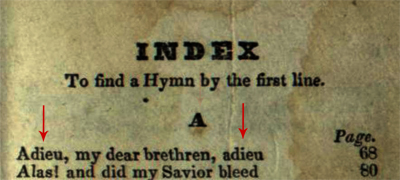
Also, consider the 1835 book of hyms collected by Emma Smith:


I don’t know Texan - what sort of proof would satisfy you?
 
TexanKnight is. Here is a collection of his quotes:

lol…so you need to make false claims about me? I NEVER said the word was not around. I said it was a foreign word. I also said that, while it might be more used in educated circles, Joseph did not travel in those circles. Look, there is no need to be dishonest when talking about me. It causes you to lose credibility.

Actually, my exact quote was “I don’t know, I wasn’t there.”. I haven’t seen the original record. I don’t know how to read reformed egyptian. I don’t know what the original word was. I assume it translated quite nicely into ‘adieu’.

No worries…no one knows how…the language does not exist

Again, I’m not assuming. Again, words appearing in english dictionaries are english words. Again, there were thousands of english books published within a few years of the BoM translation containing the word adieu. Again, at least one english translation of the Holy Bible contains the word adieu in two different verses.

I have NEVER denied the fact that Joe wrote the book copying from the Bible. Thank you for acknowledging that

Oh, I’ve been explaining this one for many years. It’s my ability to explain it to you and Texan that is lacking. This was a very common criticism up until the mid-'90’s when LDS apologetics started taking off online. It’s slowly dissapeared from the critical toolbox as it was so easily answered. But it hasn’t dissapeared from you and Texan.

Because we are not fooled by weak apologetics.
 
Maybe you could give me some insight into what level of proof you need?

I already told you. And you are still dodging

Consider the following letter written by Mark Twain on Nov. 20, 1905. I assume we can agree that Samuel clemans was not French.

And I assume you will agree that Joseph was not Samuel…and that Joseph did not have near Samuel’s education and literary prowess

Geoffrey Chaucer, father of English literature, used adieu around 1374:

lol…so now you compare an English Scholar with an uneducated rural American? This your idea of convincing apologetics?

William Shakespeare - widely believed to be the greatest english writer in the history of all english writing. He uses adieu frequently in his plays. There are hundreds of examples, here are a few:

Thomas Jefferson’s original draft of the Declaration of Independence:

(Jefferson later crossed out “everlasting Adieu,” and replaced it with “eternal separation.”)

Noah Webster’s 1828 American dictionary:

John and Charles Wesley, founders of Methodism, used Adieu in hymn 285 and 809, and used the word many times in their letters.

Wait - am I hearing you correctly? You are saying that if we had evidence of Joseph using the word ‘adieu’ in conversation and letters and whatnot, then you would no longer see it as a valid issue against the BoM? If not, then what are you saying?

Anyway, there are some historical letters to Joseph containing the word that I found at the Josephsmithpapers.org searchable site:

Letter from Elias Highbee, 26 Feb 1840: “…I shall bid adieu to this City, , to return to my family and friends…”

Letter from John P. Greene 30 June 1839: “…I must bid you adieu for the present, but I will write you again & I wish you to write to me at philadelphia or New York…”

Letter from Emma Smith, 3 May 1837: “…Br Robinson must the rest as he is waiting so adieu my Dear Joseph.”

History of the church 1838-1856, volume A-1: “…they bade adieu to their Brethren and friends and commenced their journey, preaching by the way…”

Also, consider the 1835 book of hyms collected by Emma Smith:
http://en.fairmormon.org/images/f/fd/Emma_hymn_book_2.jpg

I don’t know Texan - what sort of proof would satisfy you?

lol…I asked for proof that it was part of his daily language as a youth…all you can do is show me stuff he wrote as an adult and compare him as a youth with English and American adult scholars/writers. Sigh…of course, if that is the best you can do…

 
I believe they are labled becuase other churches find them as a threat to their own denomination. Becuase of their superior efficeny, if you go to an LDS ward the people there are sincerly happy ? and care about family , its shockingly nice
 
Status
Not open for further replies.
Back
Top