How useful is guilty-feelings?

  • Thread starter Thread starter roseproject
  • Start date Start date
Status
Not open for further replies.
R

roseproject

Guest
There’s the initial guilt when one knows they did something wrong, apologize, and then they make the decision to make reparation… but until the reparation is done, is it still becoming of the person to be writhing in their own guilt; feeling bad about themselves, until things are set right? I almost feel like I shouldn’t feel forgiven until I actually go to confession; as if feeling guilty all the time will make me sure to remember going to confession. I don’t even know for sure if what I did was a sin or not (I am a bit scrupulous so there’s that). Should a person only be truly at peace until they went to confession?
…but then what if I don’t “feel” better after confession? In general, confession to me, feels like a ticking time bomb; I’m clean now, but it just feels like a matter of time before that one bit of mud soils me again. I feel like if I keep going to confession for every little sin I do, it’s just going to make my scruples worse, but if I don’t go, the health of my soul is at stake. It’s a frustrating feeling :confused:
 
That really can be frustrating.

I feel like “guilt” is way overdone, and traditionally the Catholic Church and her members have been associated with not only a feeling of “guilt” but special forms of “catholic guilt.” There are many popular jokes about “catholic guilt” and I can’t say they are all without merit. Wikipedia defines “Catholic guilt is a term used to identify the supposed excess guilt felt by Catholics and lapsed Catholics.”

They can be funny though… the jokes that is, not the guilt. The guilt is deadly and is not healthy beyond that which inspires you to repent, if it does that at all and doesn’t just get buried somehow and internalized for future use. And IMO about 90% of the time someone asks if something is a mortal sin, the answer turns out to be no because not all three required components are involved: a) grave matter, b) full knowledge and c) free consent. It’s pretty rare this formula ever gets met by someone who is even trying not to mortally sin at all.

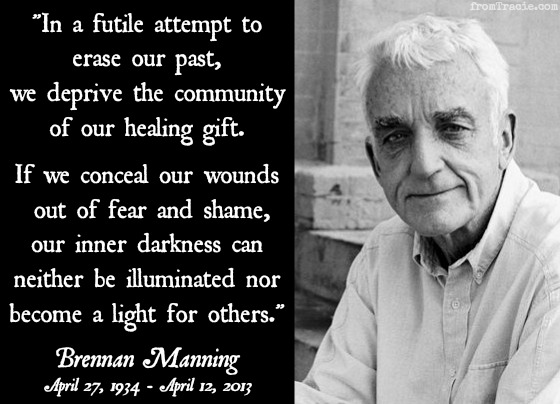
Here’s a quote meme from Brennan Manning, who wrote the “Ragamuffin Gospel” and was inspirational to Rich Mullins and even the name of Mullins’ band:


One problem people have is to be stuck in the “first half of spiritual life” as some put it, where we are all worried about sin and doing wrong and offending God and “step on a crack break your mother’s back.” This is all good for the formation of conscience, but is not equivalent to actually entering into the kingdom and cannot enter one into the kingdom.

The goal of Catholic life would seem to be guided by fear and guilt rather than the Holy Spirit. But it isn’t.

I suggest you read carefully, and repeatedly, Rom 8. Then Rom 7. Then Rom 7 and 8 then maybe Rom 6-8. Then Rom 8. Etc… see what I mean? Romans 7 describes in detail how sinful thoughts are actually begotten by being told of a law. Sinful nature immediately upon hearing that law, imagines all sorts of transgressions against the law it otherwise may never have thought of… like where Paul says he never even know what coveting was until the law said “do not covet” and then the sin in his mind ran every possible scenario he could think of as coveting, and this put him to death. The purpose of the law is to put our sinful selves to death, which is a required step (deny ourselves) before we can really follow Jesus and enter into this world even now where the greatest is the one who serves, and there is no condemnation.

And then in Rom 8 we have what it’s like when we finally begin to open our eyes into the kingdom and begin to walk in the way of spirit and life. Not the “law of sin and death” anymore.

Rom 8:1-13, 26-28, 31-39
Hence, now there is no condemnation for those who are in Christ Jesus. For the law of the spirit of life in Christ Jesus has freed you from the law of sin and death. For what the law, weakened by the flesh, was powerless to do, this God has done: by sending his own Son in the likeness of sinful flesh and for the sake of sin, he condemned sin in the flesh, so that the righteous decree of the law might be fulfilled in us, who live not according to the flesh but according to the spirit.

For those who live according to the flesh are concerned with the things of the flesh, but those who live according to the spirit with the things of the spirit. The concern of the flesh is death, but the concern of the spirit is life and peace. For the concern of the flesh is hostility toward God; it does not submit to the law of God, nor can it; and those who are in the flesh cannot please God. But you are not in the flesh; on the contrary, you are in the spirit, if only the Spirit of God dwells in you. Whoever does not have the Spirit of Christ does not belong to him. But if Christ is in you, although the body is dead because of sin, the spirit is alive because of righteousness.

If the Spirit of the one who raised Jesus from the dead dwells in you, the one who raised Christ from the dead will give life to your mortal bodies also, through his Spirit that dwells in you. Consequently, brothers, we are not debtors to the flesh, to live according to the flesh. For if you live according to the flesh, you will die, but if by the spirit you put to death the deeds of the body, you will live.

In the same way, the Spirit too comes to the aid of our weakness; for we do not know how to pray as we ought, but the Spirit itself intercedes with inexpressible groanings. And the one who searches hearts knows what is the intention of the Spirit, because it intercedes for the holy ones according to God’s will. We know that all things work for good for those who love God, who are called according to his purpose.

What then shall we say to this? If God is for us, who can be against us? He who did not spare his own Son but handed him over for us all, how will he not also give us everything else along with him? Who will bring a charge against God’s chosen ones? It is God who acquits us. Who will condemn? It is Christ [Jesus] who died, rather, was raised, who also is at the right hand of God, who indeed intercedes for us. What will separate us from the love of Christ? Will anguish, or distress, or persecution, or famine, or nakedness, or peril, or the sword? it is written:

“For your sake we are being slain all the day;
we are looked upon as sheep to be slaughtered.”

No, in all these things we conquer overwhelmingly through him who loved us. For I am convinced that neither death, nor life, nor angels, nor principalities, nor present things, nor future things, nor powers, nor height, nor depth, nor any other creature will be able to separate us from the love of God in Christ Jesus our Lord.

 
Guilt feelings would be contingent on our backgrounds, culture, sense of right or wrong or the ability to realize that any- or all- or some -of our actions might be in conflict with what we perceive to be correct or unacceptable to and in society.

A person can commit murder and not feel guilty. That same person might think that stealing a pack of gum is wrong. Strange creatures , are we. I don’t know a pre- packaged answer, but am open to learn from others. I have deliberately steered away from “religion” here because there are groups or societies that have never heard of God or Gods, but do seem to live a kind of moral, ethical life style. Others will chime in on that, I am sure. Peace.
 
That really can be frustrating.

I feel like “guilt” is way overdone, and traditionally the Catholic Church and her members have been associated with not only a feeling of “guilt” but special forms of “catholic guilt.” There are many popular jokes about “catholic guilt” and I can’t say they are all without merit. Wikipedia defines “Catholic guilt is a term used to identify the supposed excess guilt felt by Catholics and lapsed Catholics.”

They can be funny though… the jokes that is, not the guilt. The guilt is deadly and is not healthy beyond that which inspires you to repent, if it does that at all and doesn’t just get buried somehow and internalized for future use. And IMO about 90% of the time someone asks if something is a mortal sin, the answer turns out to be no because not all three required components are involved: a) grave matter, b) full knowledge and c) free consent. It’s pretty rare this formula ever gets met by someone who is even trying not to mortally sin at all.

Here’s a quote meme from Brennan Manning, who wrote the “Ragamuffin Gospel” and was inspirational to Rich Mullins and even the name of Mullins’ band:

http://www.quotationof.com/images/catholic-guilt-quotes-6.jpg

One problem people have is to be stuck in the “first half of spiritual life” as some put it, where we are all worried about sin and doing wrong and offending God and “step on a crack break your mother’s back.” This is all good for the formation of conscience, but is not equivalent to actually entering into the kingdom and cannot enter one into the kingdom.

The goal of Catholic life would seem to be guided by fear and guilt rather than the Holy Spirit. But it isn’t.

I suggest you read carefully, and repeatedly, Rom 8. Then Rom 7. Then Rom 7 and 8 then maybe Rom 6-8. Then Rom 8. Etc… see what I mean? Romans 7 describes in detail how sinful thoughts are actually begotten by being told of a law. Sinful nature immediately upon hearing that law, imagines all sorts of transgressions against the law it otherwise may never have thought of… like where Paul says he never even know what coveting was until the law said “do not covet” and then the sin in his mind ran every possible scenario he could think of as coveting, and this put him to death. The purpose of the law is to put our sinful selves to death, which is a required step (deny ourselves) before we can really follow Jesus and enter into this world even now where the greatest is the one who serves, and there is no condemnation.

And then in Rom 8 we have what it’s like when we finally begin to open our eyes into the kingdom and begin to walk in the way of spirit and life. Not the “law of sin and death” anymore.

Rom 8:1-13, 26-28, 31-39
Hence, now there is no condemnation for those who are in Christ Jesus. For the law of the spirit of life in Christ Jesus has freed you from the law of sin and death. For what the law, weakened by the flesh, was powerless to do, this God has done: by sending his own Son in the likeness of sinful flesh and for the sake of sin, he condemned sin in the flesh, so that the righteous decree of the law might be fulfilled in us, who live not according to the flesh but according to the spirit.

For those who live according to the flesh are concerned with the things of the flesh, but those who live according to the spirit with the things of the spirit. The concern of the flesh is death, but the concern of the spirit is life and peace. For the concern of the flesh is hostility toward God; it does not submit to the law of God, nor can it; and those who are in the flesh cannot please God. But you are not in the flesh; on the contrary, you are in the spirit, if only the Spirit of God dwells in you. Whoever does not have the Spirit of Christ does not belong to him. But if Christ is in you, although the body is dead because of sin, the spirit is alive because of righteousness.

If the Spirit of the one who raised Jesus from the dead dwells in you, the one who raised Christ from the dead will give life to your mortal bodies also, through his Spirit that dwells in you. Consequently, brothers, we are not debtors to the flesh, to live according to the flesh. For if you live according to the flesh, you will die, but if by the spirit you put to death the deeds of the body, you will live.

In the same way, the Spirit too comes to the aid of our weakness; for we do not know how to pray as we ought, but the Spirit itself intercedes with inexpressible groanings. And the one who searches hearts knows what is the intention of the Spirit, because it intercedes for the holy ones according to God’s will. We know that all things work for good for those who love God, who are called according to his purpose.

What then shall we say to this? If God is for us, who can be against us? He who did not spare his own Son but handed him over for us all, how will he not also give us everything else along with him? Who will bring a charge against God’s chosen ones? It is God who acquits us. Who will condemn? It is Christ [Jesus] who died, rather, was raised, who also is at the right hand of God, who indeed intercedes for us. What will separate us from the love of Christ? Will anguish, or distress, or persecution, or famine, or nakedness, or peril, or the sword? it is written:

“For your sake we are being slain all the day;
we are looked upon as sheep to be slaughtered.”

No, in all these things we conquer overwhelmingly through him who loved us. For I am convinced that neither death, nor life, nor angels, nor principalities, nor present things, nor future things, nor powers, nor height, nor depth, nor any other creature will be able to separate us from the love of God in Christ Jesus our Lord.
Yes. Conscience is vital fro our spiritual development.
We must go beyond guilt to repentance.
 
Guilty feelings are from the devil side of man and absolutely pointless, " Just don`t do it again " . : )
 
Guilty feelings are from the devil side of man and absolutely pointless, " Just don`t do it again " . : )
You don’t believe our Guardians angels can steer us to good?
Conscience is a good thing.
Guilt is necessary for repentance. Otherwise, no one would ever repent of their bad behavior. Why would they need to?
 
I’m reminded of my constant refrain: Faith Is Not A Feeling.

Feelings of guilt and shame may be helpful in motivating us to repentance but for the scrupulous they can be a heavy burden - that’s what it sounds like you are bearing at this time. Ignore the feelings as they will only weigh you down. Trust in the Mercy of God.

If you have gone to Confession, trust in the words of absolution and put those sins and any feelings related to them behind you, knowing that God has done exactly that. If you have sinned and not yet gone to Confession, acknowledge your sin and repent, resolving to go to Confession, and place your sins in the hands of our merciful Savior who does not want you given over to despair.

Remember that God is not a taskmaster just waiting for you to trip up so that he can punish you. He is a loving, merciful, and just God. He does not want you to wallow in guilt to the point of despair over your sinfulness. An honest and humble attitude is healthy but you seem to be suffering from scruples which sways your self-image to the negative. Concentrate on and trust in the Merciful Love of God.

Be at peace.
 
You don’t believe our Guardians angels can steer us to good?
Conscience is a good thing.
Guilt is necessary for repentance. Otherwise, no one would ever repent of their bad behavior. Why would they need to?
👍 I agree. I still feel much guilt in respect to my sinful past, but it’s truly a type of guilt that leads good character traits, like humility. Guilt can be very beneficial spiritually.

I listen to The Way of the Cross by St Francis of Assisi every day and I find it especially beneficial in cleansing my soul by evoking guilt and promoting perseverance.
 
👍 I agree. I still feel much guilt in respect to my sinful past, but it’s truly a type of guilt that leads good character traits, like humility. Guilt can be very beneficial spiritually.

I listen to The Way of the Cross by St Francis of Assisi every day and I find it especially beneficial in cleansing my soul by evoking guilt and promoting perseverance.
I agree.

I once read a fascinating short story about a young boy who dreaded going to confession and knew he would still feel guilt; first because he wasn’t sure how to explain his sins well enough to “fit” them into a learned category, but also because sin bespoke (to him) a character flaw that wouldn’t likely go away just because he was going to confession.

In the course of the story, (he was staying with his grandmother) his grandmother told him a story about a sin she committed decades before, and how she felt “marked” by it on her soul; not that it wasn’t forgiven, but because it opened her to a particular expression of charity related to the reason for her guilt; the flaw in charity that led to the sin and the guilt. She considered the “mark” (the guilt, and the lingering pain of remembrance) a blessing.

And it was truly believable, as told in the story. It’s hard to explain (as all good literature is) just why it was persuasive. But it was.

I say guilt, which is really the pain of remembrance, is a blessing.
 
Status
Not open for further replies.
Back
Top