Hyssop Parallel

  • Thread starter Thread starter Augustine3
  • Start date Start date
Status
Not open for further replies.
A

Augustine3

Guest
Does anybody see the parallel between the two verses below, in particular regarding the hyssop in conjunction with the Passover sprinkling of blood over the door posts with a hyssop branch?

“As for the live bird, he shall take it together with the cedar wood and the scarlet string and the hyssop, and shall dip them and the live bird in the blood of the bird that was slain over the running water.” – Leviticus 14:6

And

“A jar full of sour wine was standing there; so they put a sponge full of the sour wine upon a branch of hyssop and brought it up to His mouth.” – John 19:29
 
Does anybody see the parallel between the two verses below, in particular regarding the hyssop in conjunction with the Passover sprinkling of blood over the door posts with a hyssop branch?

“As for the live bird, he shall take it together with the cedar wood and the scarlet string and the hyssop, and shall dip them and the live bird in the blood of the bird that was slain over the running water.” – Leviticus 14:6

And

“A jar full of sour wine was standing there; so they put a sponge full of the sour wine upon a branch of hyssop and brought it up to His mouth.” – John 19:29
Indeed there is!

The parallels are in fact direct.

A knowledgeable priest has told me that the horizontal crossbeam used in crosses was, in fact, a doorway lintel. Not only that, but on the Cross, our LORD’s head would have been at doorway height.

ICXC NIKA
 
Yes,
Though they seem more anti-parallel than parallel.
See psalm 68/69 vs:21-27.

The events in John actually point to the bringing about a curse on at least some in Israel, whilst the ones in Leviticus are about atonement and cleansing of leprosy.

The reference to “nets” in the psalm would suggest that which is used to capture birds, but it lets not one go free as in Leviticus.

A good wine might represent blood; but vinegar is corrupt.
Also, Jesus said in the upper room: “I will NOT drink of the fruit of the vine, until I drink it NEW WITH YOU”; and upon the cross, there was no one drinking it with him.

The people doing the act, I have good reason to believe, knew the verses of the psalm, and were purposely mocking him attempting to force God’s hand if he were the messiah, and in boast about the triumph of their disbelief if he were not. (also, the words of the reviling theif are the same purpose)

So, there really is no reference to the atonement at hand that hyssop would represent for the people giving him vinegar. This psalm is Davidic, and specifically a vision of the messiah bringing forth a curse; See Roman 11:9.

The elements of Leviticus, blood, running water, slain bird, and live bird; are only partially fulfilled in the passage in John. It is fairly clear that “wood” is parallel; but the Leprosy, and the sight of a bird throwing blood off its wings as it flies away don’t seem to correlate well.

In Psalm 68/69; there are allusions to the baptism of Jonas in the “sea”, and we know that when Jesus side was open the witnesses of blood and water came forth. (Life and Life); There is also the statement Jesus makes about springs of flowing water coming forth from his “belly” (which is equivalent to “womb” in earlier passages during a feast, and near the bronze “sea” in the temple.)

Similarly, Jonah himself was in the “Koils” (guts) of the fish, which is an even more explicit reference to womb; (There is little difference in appearance of the parts of the womb, uterus to that of the intestinal coils ; they apparently were considered the same in general ability/function by the Greeks and others of that time).

However, in general – atonement based on two birds is mentioned for all kinds of other issues; An important part of the rite, known both to Cain and to Abraham was that the bird was not to be cut up in the way a lamb was; The priest was to wring its neck, only.
(But the birds, Abraham did not cut up. however, it appears Cain DID something similar but wrongly! )

It might be useful for you to do a word search on cedar, scarlet thread, to find out what other relationships are meant by the signs. I would also re-read Isaiah; because I am hearing a reference to hyssop in my head, and I know Isaiah spoke of these things; but I don’t recall how the cleansing was talked of.
 
A knowledgeable priest has told me that the horizontal crossbeam used in crosses was, in fact, a doorway lintel. Not only that, but on the Cross, our LORD’s head would have been at doorway height.

ICXC NIKA
Hmm…
He has a pretty good connection! and there seems to be a-lot of information converging on this very same issue. (I apologize in advance for my rambling format, my meds aren’t helping stop shaking right now.)

Exodus 12:22; Ezekiel 9:4;

In both we have a lintel (about the height of a man’s head) and at least one post which is to be “struck” (marked) with hyssop.

In Greek and in Hebrew, a door etymologically comes from the idea of a shield, or a shutter. Thyra in Greek, and if I have gotten the right word from exodus 12:22 –
we have a sequence saying: “לֹא תֵצְאוּ” with the leftmost word representing a door. ( I could be wrong, and would appreciate a second opinion… 🙂 )

So the door seals them in, and is a shield they can hide behind in God’s war. (notice a gate/door is a protection device of cities and of homes both.)

I am guessing the Hebrew is along the lines of, do not go to the door to “unlock/un-shield”. The houses themselves may have included tents in Egypt for flock tending and I have heard that in those structures, the lintel, or top bar is where traditionally a small flap-window would be made to “look over” the lintel and see who begs entrance. A thick leather/wool flap (curtain like) would also be involved as “door” material itself.

(another provocative connection: The priest sprinkled blood, 7 times (Cain’s mark), before the holy of holies curtain also door, shield, and veil like. )

I find it interesting that the Exodus writer chose the particular words having a sequence “aleph-tav” regarding the marking of the door; When transliterating the letters into Greek that would become the more familiar “alpha-omega” that St. John talks of in Revelation.

So the door was seen as a shield against the destroying angel, and perhaps also an altar representing the expiation/cleansing of the house; Connect that with what Jesus says shortly after the transfiguration where Jesus calls the path to the cross (ex-hodous) “the road out”; and now you have a large number of elements where the cross is a door leading to a safe hiding place, and also the afterlife and this very door was always “struck”.

I would be interested, if anyone can tell me what the “tav” letter in Hebrew was originally derived from (the glyph itself, what image was the inspiration for creation of that shape?).

I seem to recall Scot Hahn mentioning something about a certain letter/glyph that represents “mark” in both Hebrew and Greek; Tav and Chet are two extremely similar looking letters in Hebrew; and they correspond to Tau and Chi in Greek; t and x; and those happen to be the common shapes of crosses. (t is Christ’s cross, and X or roman numeral 10 is St. Andrew’s cross’s traditional shape, eg: my namesake’s cross :cool:).
 
Even better is the clear parallel of the doorposts and lintel marked with the hyssop and paschal lamb’s blood. Notice, if you will, the sign that it forms.
Exodus 12: 22] Take a bunch of hyssop and dip it in the blood which is in the basin, and touch the lintel and the two doorposts with the blood which is in the basin; and none of you shall go out of the door of his house until the morning.
(Please Note: This uploaded content is no longer available.)
 
I would be interested, if anyone can tell me what the “tav” letter in Hebrew was originally derived from (the glyph itself, what image was the inspiration for creation of that shape?).

I seem to recall Scot Hahn mentioning something about a certain letter/glyph that represents “mark” in both Hebrew and Greek;
Tav that is.
Tav and Chet are two extremely similar looking letters in Hebrew;
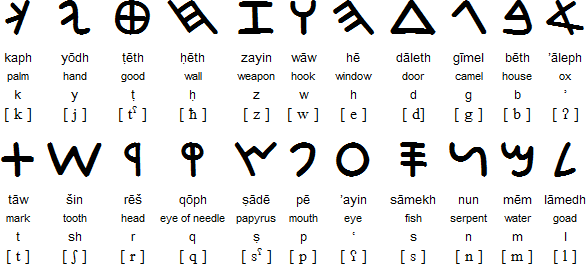
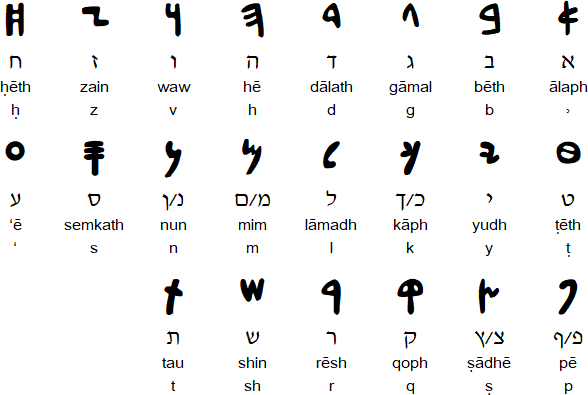
In the modern Hebrew alephbet (aka Kitav Ashuri) at least. In Phoenician / Paleo-Hebrew (aka Kitav Ivri, really just the local Israelite variant of the Phoenician script, just as the Aramaic script adopted by the Jews during the Exile - the modern Hebrew square-script is actually derived from the Aramaic - and archaic Greek scripts were all ultimately localized forms of it; the Phoenicians were THAT influential among the peoples of the Levant and the Mediterranean), Cheth looks like the modern Chinese character for ‘sun’: 日. The glyph itself can ultimately be traced to an Egyptian hieroglyph for ‘courtyard’, while the name seems to derive from a hieroglyph for ‘thread’.
and they correspond to Tau and Chi in Greek; t and x;
Nope, they correspond to Tau and Eta, to T and H. Chi (X) is an original Greek invention.
 
Tav that is.

In the modern Hebrew alephbet (aka Kitav Ashuri) at least. In Phoenician / Paleo-Hebrew (aka Kitav Ivri, really just the local Israelite variant of the Phoenician script, just as the Aramaic script adopted by the Jews during the Exile - the modern Hebrew square-script is actually derived from the Aramaic - and archaic Greek scripts were all ultimately localized forms of it; the Phoenicians were THAT influential among the peoples of the Levant and the Mediterranean), Cheth looks like the modern Chinese character for ‘sun’: 日. The glyph itself can ultimately be traced to an Egyptian hieroglyph for ‘courtyard’, while the name seems to derive from a hieroglyph for ‘thread’.

Nope, they correspond to Tau and Eta, to T and H. Chi (X) is an original Greek invention.
I was only talking about the “sound”/phoneme 🙂 Cheth makes the “H” sound, to be sure, but it also makes the Ch sound, ergo the name ; otherwise I would expect it to be “Heth”.

In any event, in Egyptian hieroglyphs, the letters themselves are usually pictures of birds, etc; and often stylistically interpreted. The Hebrews did spend quite some time in Egypt, so the relationship isn’t surprising. (Even the Patriarch’s did, long before…)

Quite a bit of the “wisdom” tradition found in the OT, is also something that Egyptian writers engaged in; along with the wasif descriptions found in song of Solomon, etc.

So, I would think a path to take would be to examine what the Egyptian pictures for thread and courtyard look like; and see if there is information in Egyptian writings that would explain the signs made on the doors. Often, the Egyptians would seal doors of crypts with a curse; such as is found in many of the tombs of the kings. So, it is fairly clear that one interpretation is that to open the door would break the seal and bring about a curse (eg: as an oath)
.
This would be one way that the Israelites may have been showing their Egyptian neighbors that they themselves weren’t sneaking out of the house at night, and killing the firstborn of the Egyptians in stealth.

The same problem shows up parallel with respect to Christ’s tomb by the Romans, for a similar purpose. However, although the tradition that the Roman solders were subject to death regardless of angels or sleep breaking the seal – gave the guards a motive to give a false story in exchange for their lives; no information that the Egyptians accusing the Hebrews of killing their firstborn is extant, which suggests that the Egyptians had a reason to believe the Hebrew’s were innocent.
 
I was only talking about the “sound”/phoneme 🙂 Cheth makes the “H” sound, to be sure, but it also makes the Ch sound, ergo the name ; otherwise I would expect it to be “Heth”.
The letter http://upload.wikimedia.org/wikiped...enician_heth.svg/30px-Phoenician_heth.svg.png (ḥēth) originally represented a voiceless fricative, either pharyngeal /ħ/, or velar /x/. In Modern Israeli Hebrew, the letter usually has the sound value of a voiceless uvular fricative (/χ/), due to European influence, where the phonemes of ḥēth ח (/ħ/) and kaf without the dagesh כ (/x/) merged. The original /ħ/ pronunciation is current still among Mizrahim (especially among the older generation and popular Mizrahi singers), in accordance with oriental Jewish traditions.

The ability to pronounce the Arabic letter ḥāʾ (ح) correctly as a voiceless pharyngeal fricative /ħ/ (note that in modern Arabic, unmodified ḥāʾ ح represents /ħ/, while ḫāʾ خ - with an upper dot - represents /x/) is often used as a shibboleth to distinguish Arabic-speakers from non-Arabic-speakers; in particular, pronunciation of the letter as /x/ is seen as a hallmark of Ashkenazi Jews and Greeks.
In any event, in Egyptian hieroglyphs, the letters themselves are usually pictures of birds, etc; and often stylistically interpreted. The Hebrews did spend quite some time in Egypt, so the relationship isn’t surprising. (Even the Patriarch’s did, long before…)
According to one theory, the Phoenician alphabet is a descendant of the so-called Proto-Sinaitic alphabet mainly attested in a very small collection of inscriptions at the turquoise mines of Serabit el-Khadim in the Sinai Peninsula. It is thought that the script was mainly used by Asiatics who worked in the mines during the Middle Bronze Age (ca. 1850 BC) and who spoke the Canaanite subfamily of the Semitic language group (the ancestor of Phoenician and Hebrew). There are also sporadic attestations of very short Proto-Sinaitic inscriptions in Canaan proper in the late Middle and Late Bronze Age, but the script was not widely used until the rise of new kingdoms in the 13th and 12th centuries BC.

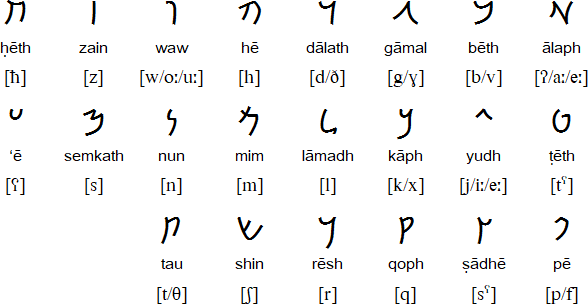
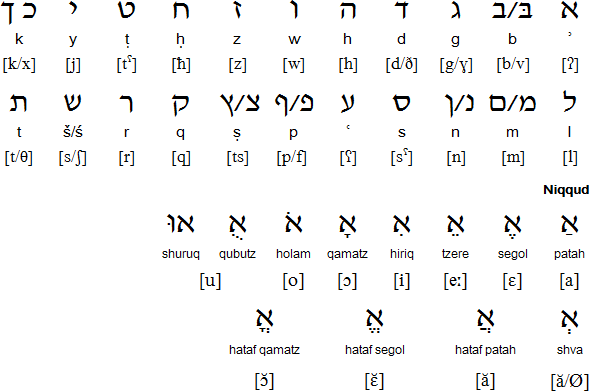
Furthermore, the theory is that Proto-Sinaitic split into the South Arabian script (the ancestor of Ethiopian Ge’ez) and the Proto-Canaanite script in the Late Bronze Age. The Proto-Canaanite script would then have evolved into Phoenician proper by 1100 BC. This Phoenician script then developed local variants in Canaan (as well as in other places where the Phoenicians have spread their influence), Aramaic and Paleo-Hebrew being two of them. After the Babylonian capture of Judea, when most of the nobles were taken into exile, the Paleo-Hebrew alphabet continued to be used by the people who remained, while those who were exiled began to adopt Imperial Aramaic, the lingua franca of the Persian Achaemenid Empire. The Exiles brought the script and the language home with them, thereby giving birth to the square alphabet we recognize today as ‘Hebrew’, though Paleo-Hebrew still saw some use as a script of choice for Scripture and coinage among the Jews, while the Samaritans have retained wholesale use of it, resulting in the Samaritan alphabet.


Traces of the 16 and 12 characters of the two Wadi el-Hol inscriptions.

http://img651.imageshack.us/img651/1903/protosinaitic.png
Proto-Sinaitic (c. 1500 BC), based from here; unattested letters missing


Phoenician (c. 1050 BC-300 AD)
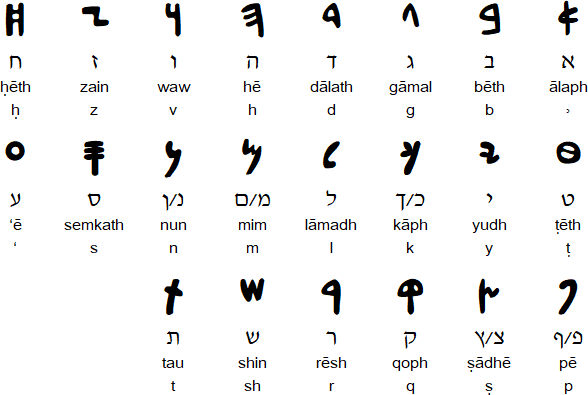

Early Aramaic (ca. 10th-9th century BC)

http://www.typophile.com/files/hebrew-script_5538.jpg
Paleo-Hebrew (10th century BC-AD 135)

1: Gezer Calendar (10th century BC)
2: Mesha stele (Moabite; 9th century BC)
3: Siloam inscription (8th century BC)
4: 7th century BC seals
5: Early 6th century ostracon from Arad
6: 2nd century BC Leviticus fragment
7: Medieval Samaritan bookhand


Imperial Aramaic (ca. 5th century BC)

 
(continued)


Modern-day Hebrew alphabet

(Please Note: This uploaded content is no longer available.)
Archaic Greek (Cretan)

More comprehensive list of various archaic Greek alphabets and the evolution of Greek from Phoenician
So, I would think a path to take would be to examine what the Egyptian pictures for thread and courtyard look like; and see if there is information in Egyptian writings that would explain the signs made on the doors.
The hieroglyph for ‘courtyard’ (or ‘mansion’) is http://bits.wikimedia.org/w/extensions-1.19/wikihiero/img/hiero_O6.png, hypothesized to have been named ḥasir in Proto-Sinaitic. (Another theory has it that it represents a ‘fence’.) The name ḥēth meanwhile is thought to come from http://bits.wikimedia.org/w/extensions-1.19/wikihiero/img/hiero_V28.png ḫayt, the name reconstructed for a letter derived from a hieroglyph for ‘thread’ or ‘hank of yarn’.
 
The letter http://upload.wikimedia.org/wikiped...enician_heth.svg/30px-Phoenician_heth.svg.png (ḥēth) originally represented a voiceless fricative, either pharyngeal /ħ/, or velar /x/.
I am going to go against your interpretation here. I would still claim “Chet”
The original /ħ/ pronunciation is current still among Mizrahim (especially among the older generation and popular Mizrahi singers), in accordance with oriental Jewish traditions.
There is little evidence that the Mizrahim have the “original” pronunciation. In tracing the lines out, I’ve come to the conclusion that there were influences in the places they went which would have encouraged that particular pronunciation whether or not it was “original”. The presence of Greeks, as you note, would be the reason for heth being pronounced alternatively as “Ch”. That is, the letter came to represent the sound inclusively not exclusively. But even if I concede your argument about the Mizrahim, there is a larger issue:

Chet (Chi sound) , If I take it to be an influence of the Hellenistic (Greek/Macedonian) empire that had ruled the area since circa 300BCE; then it is clear that the poor who remained in the promised land during the Babylonian Exile were under Greek influence; it is also patently clear that those who came back from Babylon met heavy Greek linguistic influence; such that – by the time of Jesus – the Chet sound was arguably prevalent. Scripture itself was, recall, written in Greek with the exception (perhaps) of St. Matthew; and the Sadducees are a direct result of Hellenistic ideas. The Chi sound, then, can’t be eliminated from any arguments which became finalized at the time of Christ.
According to one theory, the Phoenician alphabet is a descendant of the so-called Proto-Sinaitic alphabet mainly attested in a very small collection of inscriptions at the turquoise mines of Serabit el-Khadim in the Sinai Peninsula. It is thought that the script was mainly used by Asiatics who worked in the mines during the Middle Bronze Age (ca. 1850 BC) and who spoke the Canaanite subfamily of the Semitic language group (the ancestor of Phoenician and Hebrew). There are also sporadic attestations of very short Proto-Sinaitic inscriptions in Canaan proper in the late Middle and Late Bronze Age, but the script was not widely used until the rise of new kingdoms in the 13th and 12th centuries BC.
Furthermore, the theory is that Proto-Sinaitic split into the South Arabian script (the ancestor of Ethiopian Ge’ez) and the Proto-Canaanite script in the Late Bronze Age. The Proto-Canaanite script would then have evolved into Phoenician proper by 1100 BC. This Phoenician script then developed local variants in Canaan (as well as in other places where the Phoenicians have spread their influence), Aramaic and Paleo-Hebrew being two of them
That’s reasonable.
Paleo-Hebrew still saw some use as a script of choice for Scripture and coinage among the Jews, while the Samaritans have retained wholesale use of it, resulting in the Samaritan alphabet.
My browser is malfunctioning (cursor is off by two letters from where the typing is); I need to restart before going crazy… So, I’ll quit for now and come back later when I have more time. The relationship of the letters to picture drawing – particularly the “wall” and “window” of “heth/chet” appear to be very strongly related to the Davidic construction of the same items; eg: the triple gate and window are hallmarks of the Davidic dynastic construction. That type of evidence is very suggestive of the kind of idea I am looking for.

Thanks Patrick.
 
Status
Not open for further replies.
Back
Top