I once asked about upraised hands during the "Our Father"

  • Thread starter Thread starter Hound_Dog
  • Start date Start date
Status
Not open for further replies.
The missal has both Latin and English side by side, so you follow along with mass in your missal and then you know what the priest is saying, which is a very good idea. More people should do that at the OF also.
There’s a mouthful! 👍
 
Almost all of us have a little book with all the prayers in Latin and English, side-by-side, so we know every word that’s said.

I don’t know if you’re aware, but the prayers are different, not just in a different language. Very few prayers from the EF Mass were retained in the OF, and these prayers (read in English during Mass) are just a treasure. They explain the Faith beautifully and clearly in ways the OF doesn’t. I love the EF more for what it prays than for what language it uses to pray.
Yes, when I was little I had a missal with Latin on one side and English on the other.

I had no idea what we were saying, though, because I was too young to understand and the nuns didn’t teach us squat about anything important outside of perfect behavior. 😦

I know what it’s like to be taught something when we’re young and it seems like nobody but me does it right. Good thing I don’t normally stand in Communion lines anymore – the musicians are handled separately. I still get distracted when in a Communion line and the heads in front of me weave back and forth like Weebles. We were taught that heads should be lined up perfectly and we had to walk such that if sister looked from the end she could only see one head – or else!!! :sad_bye:

So do they keep their heads perfectly aligned in a Communion line at an EF Mass? If so, maybe I’ll ask for a day off and check it out. If not, then big deal, I’m not impressed, and maybe even a harrumph or two. I don’t see raising hands nearly as distracting as Communion line standers doing Brownian motion. But in a Communion line my eyes are supposed to be toward the heads in front of me so there is another difference. :rolleyes:

Alan
 
So do they keep their heads perfectly aligned in a Communion line at an EF Mass? If so, maybe I’ll ask for a day off and check it out. If not, then big deal, I’m not impressed, and maybe even a harrumph or two.
You are a master of satire, sir. :rotfl:

Usually we are in perfect lines going up but you know we all kneel side-by-side along the altar rail for Holy Communion, so when people backtrack down the aisle, little traffic jams do happen.
 
When we pray the Our Father what exactly are we praying?

Abba… daddy…

An utterly radical way of addressing God, who was previously always the unnameable, or was addressed using a title like Lord of Hosts.

This prayer of Jesus would have shocked the disciples to the core.

So if His children raise their hands to their daddy, is He going to be displeased?:confused:

We’ve got bigger things to worry about than the slight raising of forearms, hand held upwards that we see in Canadian parishes.
Question for you. If the Pope himself were to approach you after Holy Mass and ask you not to hold hands with your family, and to avoid the orans posture because it is not part of the liturgy of the mass or in the rubrics of the mass, would you stop?
 
Question for you. If the Pope himself were to approach you after Holy Mass and ask you not to hold hands with your family, and to avoid the orans posture because it is not part of the liturgy of the mass or in the rubrics of the mass, would you stop?
Question for you.

If the pope asked you to hold hands with your family and hold them up in the orans position during the Our Father would you?
 
Situation: Left the church in the early 80’s. Came back 2003 to my current parish. I had to double check the name outside to see if I was at a Catholic church. No bells during consecration. Raised hands. Thought I had stumbled into a din of Evangelical fanatics. Zero reverance before or after mass (loud talking). The list is numerous.

I should have stuck around to acclimate with the changes. Would have been less of a shock.
 
Question for you.

If the pope asked you to hold hands with your family and hold them up in the orans position during the Our Father would you?
No because it isn’t part of the Rubrics of the Mass. Only the Priest is allowed to be in the orans posture during the our father. And priests who hold hands are going against Catholic teaching. Sounds familiar, being Canadian and all. Just like the vote on Humanae Vitae. And they wonder why their churches are empty. HUH!!!

So now that you are aware of this, would you put your hands down or not hold hands if the Pope asked you to because it’s not part of the Rubrics of the Mass?
 
Situation: Left the church in the early 80’s. Came back 2003 to my current parish. I had to double check the name outside to see if I was at a Catholic church. No bells during consecration. Raised hands. Thought I had stumbled into a din of Evangelical fanatics. Zero reverance before or after mass (loud talking). The list is numerous.

I should have stuck around to acclimate with the changes. Would have been less of a shock.
Unfortunately for you, you’ve chosen one of those cafeteria catholic churches! Come one, come all to this protestant, I mean, ‘catholic’ church! We bend the rules to accommodate YOU! That’s the impression I get… it’s sad but true, my friend.

FORTUNATELY for you, there are still some who maintain allegiance with Rome! It’s just a little bit of a search to find one. It took me about a year after moving to the United States to find an actual parish in my area that followed Church teachings.

I’ll pray you find that. God bless.

Dom
 
Question for you.

If the pope asked you to hold hands with your family and hold them up in the orans position during the Our Father would you?
Just the way you put your question together shows your ignorance in what is supposed to go on during Holy Mass. Re read my question please. Thanks.
 
Why do I attend Latin Mass? It is simply a beautiful experience. One acquires the English meaning of the Latin words over time without looking at adjoining text. Plus, the Mass sounds so beautiful when sung and spoken in Latin. I enjoy the ritual and solemnity of the Latin Mass, as well as the hymns performed with the traditional organ and choir. Incense adds to the atmosphere of solemnity. Nothing like it.
 
Question for you.

If the pope asked you to hold hands with your family and hold them up in the orans position during the Our Father would you?
Come on now, you, being a teacher and in the diaconate program, should know better than this! (Right?)
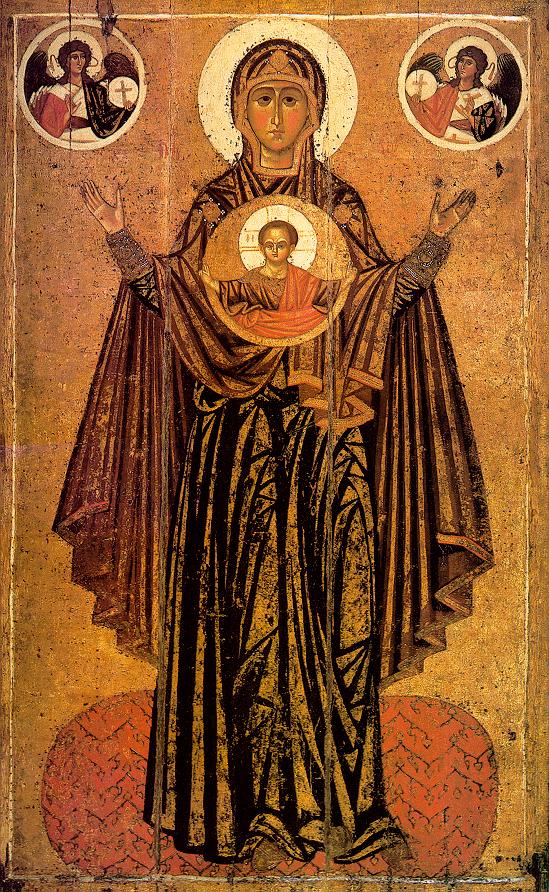
Orans Posture (“Praying” Hands Extended)
The following explains the origin of the Orans position, in which the priest intercedes during the liturgy on behalf of all. In the last couple decades this posture of praying with hands extended and lifted upwards has become a popular prayer posture for many laity, especially in the Charismatic Renewal.
The Orans position (Latin for “praying”) or some variation of it, was common to almost all ancient religions as an outward sign of supplicating God (or if a pagan religion, the gods). Consider what we do when we plead with someone. We might put our arms out in front of us as if reaching for the person and say “I beg you, help me.” This seems to be a natural human gesture coming from deep within us - like kneeling to adore or to express sorrow. Now, turn that reach heavenwards and you have the Orans position.
The ancient monuments of Christianity, such as the tombs in the catecombs, often show someone in the Orans position supplicating God, to show that the prayers of the Church accompany the person in death.
The liturgical use of this position by the priest is spelled out in the rubrics (the laws governing how the Mass is said). It indicates his praying on BEHALF of us, acting as alter Christus as pastor of the flock, head of the body. It used to be minutely defined in the rubrics, which now say only, “extends his hands” or “with hands extended.” Priests understand what is meant (from observation and training), and although there is some variability between priests basically the same gesture is obtained from all of them by these words.
In the rubrics the Orans gesture is asked principally of the Main Celebrant, but on those occasions where either a priestly action is done (Eucharistic Prayer) or prayer in common (Our Father) all the concelebrants do it.
It is never done by the Deacon, who does not represent the People before God but assists him who does.
Among the laity this practice began with the charismatic renewal. Used in private prayer it has worked its way into the Liturgy. It is a legitimate gesture to use when praying, as history shows, however, it is a private gesture when used in the Mass and in some cases conflicts with the system of signs which the rubrics are intended to protect. The Mass is not a private or merely human ceremony. The symbology of the actions, including such gestures, is definite and precise, and reflects the sacramental character of the Church’s prayer. As the Holy See has recently pointed out, confusion has entered the Church about the hierarchical nature of her worship, and this gesture certainly contributes to that confusion when it conflicts with the ordered sign language of the Mass.
Lets take each case.
Our Father. The intention for lay people using the Orans position at this time is, I suppose, that we pray Our Father, and the unity of people and priest together is expressed by this common gesture of prayer. Although this gesture is not called for in the rubrics, it does at least seem, on the surface, to not be in conflict with the sacramental sign system at the point when we pray Our Father. I say on the surface, however, since while lay people are doing this the deacon, whose postures are governed by the rubrics, may not do it. So, we have the awkward disunity created by the priest making an appropriate liturgical gesture in accordance with the rubrics, the deacon not making the same gesture in accordance with the rubrics, some laity making the same gesture as the priest not in accordance with the rubrics, and other laity not making the gesture (for various reasons, including knowing it is not part of their liturgical role). In the end, the desire of the Church for liturgical unity is defeated.

After Our Father. This liturgical disunity continues after the Our Father when some, though not all, who assumed the Orans position during the Our Father continue it through the balance of the prayers, until after “For thine is the kingdom etc.” The rubrics provide that priest-concelebrants lower their extended hands, so that the main celebrant alone continues praying with hands extended, since he represents all, including his brother priests. So, we have the very anomalous situation that no matter how many clergy are present only one of them is praying with hands extended, accompanied by numbers of the laity.
So, while we shouldn’t attribute bad will to those who honestly have felt that there was some virtue in doing this during the Mass, it is yet another case where good will can achieve the opposite of what it intends when not imbued with the truth, in this case the truth about the sacramental nature of the postures at Mass and their meaning.
ewtn.com/expert/answers/orans_posture.htm
 
Firstly I was just turning the question round.

A question that was redundant since I don’t use the orans postion.

So…🤷

And I still think there’s more to worry about in parishes than whether they hold hands during the Our Father.

Finally, if the Holy Father asked me to lie on my stomach during mass I would.

But he hasn’t.
 
Firstly I was just turning the question round.

A question that was redundant since I don’t use the orans postion.

So…🤷

And I still think there’s more to worry about in parishes than whether they hold hands during the Our Father.

Finally, if the Holy Father asked me to lie on my stomach during mass I would.

But he hasn’t.
Wait until (and if) you are ordained a deacon…then the Bishop will…
:yup:
 
IF I wanted to go to the pentecostal church I would. I am not into speaking in tongues or snake handling or the constant preaching of end time prophesies.

As a Catholic from birth I have seen more “evangelical” or “pentecostal” things slowly showing up in Mass.

IF the Mass starts to become too “protestant” then I will cease to attend.

Are you a convert? That could explain your reply.
Oh really, upraised hands are a Protestant innovation? Is that so? Btw I didn’t came up with this one, it was dzheremi but I thought it was brilliant.


Look at this Protestant, hanging out in the 2nd century catacombs in Rome. It’s disgraceful!

http://thehandmaid.files.wordpress.com/2011/01/agnes.jpg

Another early Protestant, St. Agnes. Thank goodness we don’t have such people around us today, Protestanting up our churches with their examples of martyrdom and improper limb arrangement.


Not you too, Theotokos! Is there no one these Protestants can’t get to with their Protestantly Protestant Protestantizing influences?!

(Please Note: This uploaded content is no longer available.)

Hey, St. Apollinaris of Ravenna! Put down the “Left Behind” books I know you’re hiding somewhere in your robes and get back to tending those sheep! They’re looking at you because they’re disgusted by your clearly heretical posture.


Is Christ really blessing Alexander Nevskiy? Lord, can’t you see that he’s imitating the Protestants?!

That’s it, I give up! There are just too many Protestants around…
 
This posture and the hand holding is not part of my personal tradition.

I do not mind if others are doing this. I do question WHY they do it. Honestly, I do not know its origin.🤷

There could be a good reason. :confused:
 
I think the previous poster meant ‘Protestant’ in the sense that it looks like something Protestants would do at one of their praise and worship services.

Mimicing the priest with the orans posture in a Catholic mass looks like one is also trying to offer the mass in the same way as the priest. One can’t, so it looks stupid. I’d guess it’s something that’s come out of charismatic worship. It does fit in with the presence of EMHCs and unvested lay lectors; has idea has got around that the laity are ‘a royal priesthood’ in the ‘people’s mass’ and are thus their actions are integral to the sacrifice? It’s a confusion.
 
Status
Not open for further replies.
Back
Top