If I am unable to receive Communion, can I still go up and get a blessing?

  • Thread starter Thread starter JMJ
  • Start date Start date
Status
Not open for further replies.
Ha! I’m in RCIA and someone told me that I could go up and get a blessing instead of taking communion, so I’ve been doing that every week. Should I stop?

 
That’s interesting given your past posts that your priest is in favor of doing the blessings during normal Mass.
I know a lot of priests who don’t object to doing the blessings, but would not be expecting such a thing to happen. In these parishes there are non-Catholics who attend (usually with their spouses) and they generally just stay in the pew. Sometimes my husband is among them. My husband would be embarrassed about having to march up for a blessing and would be afraid he’d do it wrong or something and he is much happier just sitting in the pew and getting a blessing at the end of the Mass with everyone else.
Ya, agreed. I’m just as confused, but that’s what he said. That was maybe 3 or 4 years ago, so things could have changed.

Things seem to be getting “fluid” there lately.
 
Last edited:
So where is the “official declaration” allowing blessings in the Communion line?
[/quote]

If by official declaration, you are referring to something from Rome, there is nothing one way or another, But for England and Wales, If you go to the Liturgy Office of the Catholic Bishops Conference of England and Wales, you will find a pdf of ‘Celebrating the Mass - a pastoral introduction’. In Chapter 7 you will find approval of the custom of inviting forward for a blessing any non-Catholics and others not able to receive.
 
I think that is up to you. You aren’t obligated to go forward for any reason ever. It seems to me that it is a practice not completely discouraged and even encouraged by some. At the same time many people I trust do discourage it. I’m not a fan of the blessings myself so I wouldn’t go. But if you did it isn’t something wrong for you to do. It is up to the clergy (particularly the local priest) to clarify and enforce what is proper regarding this practice.
 
This is a very contentious issue here on CA. My suggestion is that you talk to your parish priest and follow his advice. When I was in RCIA, I was advised by the priests in the parish that I could come forward for a blessing, or I could choose to stay in the pew. It was up to me. I chose to go forward because I believed that I was receiving graces from the blessing, and because it helped me acclimate to the tradition and custom of going forward after ten years of hiding in the back of the church.
 
I chose to go forward because I believed that I was receiving graces from the blessing, and because it helped me acclimate to the tradition and custom of going forward after ten years of hiding in the back of the church.
I am glad for you and I am glad that you had that possibility. The positive aspects are all that I have heard in people in real life…as opposed to critics of it that appear on the Catholic Answers Forum.
 
When I was going through RCIA we were encouraged to go up for blessings, though I’m not sure the official teaching on it. I do not prefer to go up anymore personally as others have commented after seeing me receive a blessing instead of communion. When I’m not receiving communion I generally just sit in an area of the church that’s pretty empty and off to the side so I don’t get in the way of others. I don’t feel comfortable being elsewhere anymore. There have been several occurrences where people were, in my opinion, uncharitable when I was sitting in the pew and they tried to get back to and/or out of their seats for communion. I just do my best to accommodate others if I stay now - move out of the pew and let them back to their seat if I notice them walking back, sit on an edge so people don’t have to climb over me, etc. It’s not ideal or a perfect system but it works most of the time.
 
Last edited:
Ha! I’m in RCIA and someone told me that I could go up and get a blessing instead of taking communion, so I’ve been doing that every week. Should I stop?
Since it is the practice of your parish, no you assuredly need not stop.
 
It’s like the participation trophies and like high schools who wouldn’t dare exclude students from participating in the graduation ceremony for the mere fact that they haven’t graduated.
The comparison fails.
 
Communion lines are for just that. They are not Communion and Blessings lines. At the end of the Mass everyone gets a blessing.

Despite some priests allowing it it is not actually permitted.
You are citing what was a private letter of an individual to individuals. This matter is under advisement by the Congregation precisely because the Popes for the past 40 years have chosen to leave the matter unanswered and resolved by the bishops in the jurisdictions – even as they themselves give blessing in their Communion lines.

Father Ward, by the way, is the former Undersecretary of the Congregation.

Pope Saint John Paul II reminisces in Ut Unum Sint about the decision he and the Lutheran Bishops came to with regard to their participation at the Masses he celebrated
In this respect I would like to mention one demonstration dictated by fraternal charity and marked by deep clarity of faith which made a profound impression on me. I am speaking of the Eucharistic celebrations at which I presided in Finland and Sweden during my journey to the Scandinavian and Nordic countries. At Communion time, the Lutheran Bishops approached the celebrant. They wished, by means of an agreed gesture, to demonstrate their desire for that time when we, Catholics and Lutherans, will be able to share the same Eucharist, and they wished to receive the celebrant’s blessing. With love I blessed them. The same gesture, so rich in meaning, was repeated in Rome at the Mass at which I presided in Piazza Farnese, on the sixth centenary of the canonization of Saint Birgitta of Sweden, on 6 October 1991.
Finally, before the reform and renewal of the liturgy all those years ago, blessings were given at the Communion rail…however, it was babies or children who had not made their First Communion that were being blessed. My practice never changed from then – except that it included adults coming forward as that became a normal occurrence.
 
That’s one reason I don’t think it’s the “everybody needs a trophy” society. I think the whole point of it is to try to tell people (from what I heard non-Catholics specifically) that they are indeed welcome at Mass and it’s a way to include them, rather than exclude them.
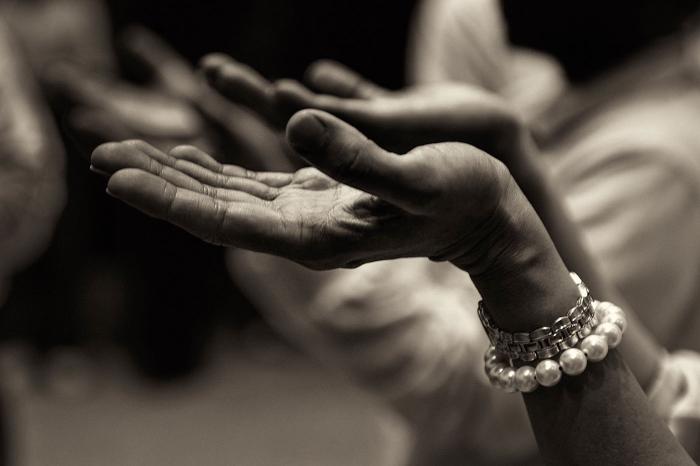
You’re correct, as the Bishops of England and Wales state.
 
No, you sit and pray. As @FrDavid96 says in a different thread:

“There are no blessings at Communion-time in the Mass. Such a thing is merely a misguided innovation that goes against everything Vatican II had to say about the Mass—that it is not something to be altered on personal whims, but that any changes to the Mass must be made through legitimate channels.”
 
Last edited:
I’ve noticed that in giving a blessing, the priest has to adjust his grip on things first. It interrupts his flow as well. Perhaps unlikely, but that could cause an accident. And that couldn’t be good.
 
Print out a prayer for a spiritual communion and take it with you.


your time will be much better served communing with Jesus. I like to sit at the front, so those who are going up do so and then I have the remainder of Communion to pray without distraction. I really like the Anima Christi

https://www.ewtn.com/devotionals/prayers/anima2.htm

You can also meditate on the readings of the day. and as Jesus how to apply them to your life.
They wanted us to go up or we would have stuck out like a sore thumb
This is a very special situation.
 
I’ve noticed that in giving a blessing, the priest has to adjust his grip on things first. It interrupts his flow as well. Perhaps unlikely, but that could cause an accident. And that couldn’t be good.
Many people argue against kneeling to receive communion because it disrupts the flow or that we must be unified in how we receive communion. Many, maybe even most, of those same people likely support blessings and completely disregard the exact same concerns in that case.
 
I’ve found giving that ministering the Eucharist to someone who desires to receive kneeling, and offering a spiritual communion to someone who does not desire to receive Holy Communion that day, are quite easy and neither interrupt the flow of traffic.

I’m with Don Ruggero on this one. This is an easy way for people who are not disposed to receive the Eucharist on a given day to not stand out. This practice has saved many a sacrilegious Communion, particularly from teenagers who don’t want to tell mom and dad about their struggle with sin X, Y, or Z.
 
buc fan is a Priest.

I must say , here in Aus, in my Diocese, my clergy delight in giving blessings in the Communion line. I have a wonderful image of my Bishop beaming on Father’s Day, giving children and adults blessings in the Communion line. The blessings I see are not xyz , go away. They are considered and caring blessings.

We are the Communion of Saints. We are the Body of Christ. All of us.
 
Last edited:
Finally, before the reform and renewal of the liturgy all those years ago, blessings were given at the Communion rail…however, it was babies or children who had not made their First Communion that were being blessed. My practice never changed from then – except that it included adults coming forward as that became a normal occurrence.
This is very interesting. In the many, many discussions that I have read on this subject here on this forum, I have never heard this. Thanl you.
 
Blessings might “Disrupt the flow of traffic in the communion line”? 🤨

Goodness gracious.
 
Last edited:
Status
Not open for further replies.
Back
Top