Inequality – A moral issue

  • Thread starter Thread starter YourNameHere
  • Start date Start date
Status
Not open for further replies.
but the number of wealthy people that don’t use their money to push sick agendas or consolidation of power is about zero.
The group that makes up the largest percentage of the top 1% in the US are doctors. Your statement is over-the-top judgmental, unless of course you can show me how doctors use the money to push “sick agendas”.
 
A true free market - without intellectual property, regulations, etc. - would never allow someone to become as rich as Gates or Zuckerberg. They’re both welfare addicts and cronyists.
Why are you against intellectual property? If I can think up a cool new idea or product, and spend time developing it into something I can make money at, why should someone who didn’t think of the idea get to use me as their “R&D” for free?
 
I’d love to see the proof for that doctor statistic? It just seems unlikely.
 
40.png
AnnaTheCat:
A true free market - without intellectual property, regulations, etc. - would never allow someone to become as rich as Gates or Zuckerberg. They’re both welfare addicts and cronyists.
Why are you against intellectual property? If I can think up a cool new idea or product, and spend time developing it into something I can make money at, why should someone who didn’t think of the idea get to use me as their “R&D” for free?
Because current intellectual property laws have become a stranglehold on creativity and last far longer than they should.
 
In some areas I would agree (Like copyrighting an “undo” button in an App)…in other areas (like copying the look, feel, and functionality of an App) I would disagree.

I could agree that our copyright laws need updating for the digital age, but within reason.
 
From a Forbes article, a chart from the Economist—


And there’s nothing really all that surprising about the US numbers. We know very well that the US has both the highest living standards for the rich and also the largest inequality among the large, advanced, nations.

However, look at it a little more closely in relation to other countries. We’re often told that to be poor in the US is much worse than being poor in the social democracies of Europe. And the bottom 10% in the US are indeed worse off than the bottom 10% in Sweden. But they’re better off than the bottom 10% in Germany or France: places where we are told that there is indeed that social democracy.

Maybe there’s something for this capitalism red in tooth and claw then: given that it does seem to improve the lives of the poor.

Take another look as well: we know that Russia is where bloated plutocrats loot everything from the country: and yet the bottom 10% in the US have, by this measure at least, better lives than the top 10% in Russia. And the top 10% in Portugal (where I live) and Mexico.

From later on in the same article, a chart from the World Bank–


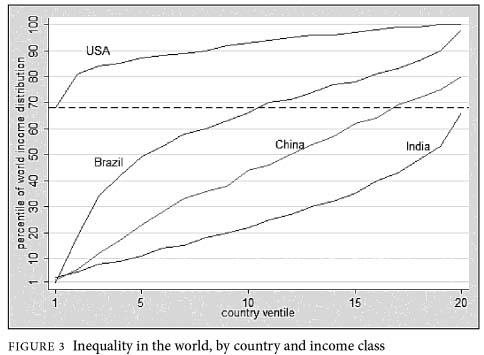
And the third comes from Branco Milanovic, the World Bank’s main man on global inequality:
The New York Times has a slightly different version of the chart about which they say:

Notice how the entire line for the United States resides in the top portion of the graph? That’s because the entire country is relatively rich. In fact, America’s bottom ventile is still richer than most of the world: That is, the typical person in the bottom 5 percent of the American income distribution is still richer than 68 percent of the world’s inhabitants.
I don’t know if @YourNameHere is American, or European, or whatever— but there’s a good chance you’re in the top 5% of the world. (Hint: An income of $32k/year puts you in the top 1% of the world, just based on income. If you go by net worth, though, it takes a net worth of $770k to make the top 1%. An adult in India has a median wealth of $608 in total wealth. The average wealth of adults in Africa is just $411.) I presume you’re using your comparative affluence to help the rest of the world? I’m doing my best over here.

And ultimately, that’s what we’re going to be accountable for to God: how we do our bit with the resources we have, not the Rich Kids of Dubai or the affluent children of Hong Kong gazillionaires.
 
Last edited:
I think she’s talking about the top part of the top 1:. People. Like Bill Gates and All who set up foundations to manage their. Charitable money.

If you look at the role of those four stations in society, they can be very disruptive. A history of this can be found in the Underground History of American Education, wherein Gatto to spends some time examining the role of foundations in shaping US education starting back in the 1800s.
 
Inequality is great, actually. It indicates progress. People only make mega-sums of money when they come up with great innovations.

The end result of progress is that everyone does better,
Some inequality can be a sign of a progressing society. It can also be a sign of a kleptocracy.
 
How about promoting abortion and intensive state control of the medical industry to reduce competition, drive up their wages and make health care unaffordable to millions of people? The American Medical Association is a travesty.
 
Most charities are basically scams, set up to promote liberal nonsense and evade taxes. The B & M Gates Foundation promotes all sorts of shady stuff.
 
It is a state-granted monopoly and amounts to mind control if taken to its logical conclusion.
Although I am not a libertarian I agree with them entirely here (Stephen N. Kinsella). It is a holdover from British mercantalism. Its alleged practical benefits are exaggerated, more like nonexixstent. Look at the actual figures and data, it doesn’t remotely bear up to the school-marm line. It exists to protect companies from competition, not any nonsense about the ‘public weal’ This is true of virtually all “regulations”, for that matter
 
Look into the Clinton Foundation too, if you want to know how deep the rabbit hole goes…
 
I’d say around 50 years. The original US ruling was 56 years as that would normally cover the vast majority of the creator’s life in which they could benefit from the royalties. After that let things enter the public domain.

Here’s a quick video on public domain and how it’s steadily been extended to a crazy degree;
 
Status
Not open for further replies.
Back
Top