Is Hinduism the eldest of Islam and Christianity and budism?

  • Thread starter Thread starter excaliber
  • Start date Start date
Status
Not open for further replies.
Just as I thought!!
Nice post.

No MAJOR religion can teach that all roads lead to heaven, because then it would be giving away its power over peoples lives.
That begs the question:
“Does a religion want power over my life, or does it just want to offer a road to heaven?”

If the former, why would I want to join it?

If the latter, why would it be concerned about other valid roads?
 
I never realy considerd hinduism.
Only Christian denominations and Islam.

It seems Hinduism is older then I thought, and I see no reason to remain ignorant of it.

Dose hindu religion have any fruits to show for itself, such as resurections…miracle healings…etc…etc?
Some point to the Ramayana, the story of Rama, a name which literally means “Light coming from within” as a prefiguring of Christ. Rama is the perfect human being, the incarnation of Vishnu who comes to earth to defeat the demon Ravana.
 
Some point to the Ramayana, the story of Rama, a name which literally means “Light coming from within” as a prefiguring of Christ. Rama is the perfect human being, the incarnation of Vishnu who comes to earth to defeat the demon Ravana.
Our tradition teaches us that every Truth is contained in the Life of Christ, and that there is no new Truth or revelation outside the Life of Christ.

However, also in our tradition, we understand that Christ may reveal His Mysteries in the course of time, and that all mysteries already in His life, may not be fully comprehended, understood, revealed.

That said, in today’s “Information Age”, if we Catholics do not reconcile the Sacred Scriptures of the East with the revelation of Christ, then we can expect the East to reconcile their scripture with our Blessed Savior, Jesus Christ.

In fact, it is being done by scholars and religious of all faiths daily and in recent history.

We should therefore, NOT discourage any scholar or religious from the study of the Bible and the life of Jesus Christ while searching meanings and similarities within their own traditions.

This very act, would be in some sense, a sin against the Holy Spirit, because it is the seed of the Holy Spirit that inspires one to contemplate Christ.

Therefore, taking the Ramayana as a “prefiguring of Christ” only strengthens and further punctuates the teachings of the Church, again, specifically, that All Truth is contained in the life of Jesus Christ.

Due to the vast amount of literature, both published and available via the Internet concerning the “synthesis” of Christianity and eastern religion, it is very important for Catholics to understand our faith, in context of world faiths.

If we ignore, and merely expect that eastern religions can discard their spiritual identity and cultural expressions of worship, then we will fail the Church.

The study of Hinduism and Buddhism is a very important ministry for Catholics called to evangelize the east.

However, this ministry is not for every Catholic. One cannot study eastern scriptures properly unless one’s faith in Jesus Christ is firm.

 
That’s why I like Franklin Jones’ statement: “This is always already the ‘other world.’”
Franklin Jones had some good ideas.😃 And some crazy ones.:rolleyes: I hope he did the best he could do, while on this earth.
 
Maybe his *Dawn Hores Press *could have been called *Wild Horse Press?*LOL! In any case, reading his work stretched my mind. I much prefer Ramana, Nisargadatta, or even Katie. K.G. Mills is easliy, though, the most lyrical and least popular of the few I know, and Merrell-Wolff the most analytical. My hat is currently off to Thomas Harpur, however, for doing the necessary work to show the relationship of christianislm to the Perennial Way. Definitly NOT everyone’s cup of tea, vital as it is in my particular view.
 
Our tradition teaches us that every Truth is contained in the Life of Christ, and that there is no new Truth or revelation outside the Life of Christ.

However, also in our tradition, we understand that Christ may reveal His Mysteries in the course of time, and that all mysteries already in His life, may not be fully comprehended, understood, revealed.

That said, in today’s “Information Age”, if we Catholics do not reconcile the Sacred Scriptures of the East with the revelation of Christ, then we can expect the East to reconcile their scripture with our Blessed Savior, Jesus Christ.

In fact, it is being done by scholars and religious of all faiths daily and in recent history.

We should therefore, NOT discourage any scholar or religious from the study of the Bible and the life of Jesus Christ while searching meanings and similarities within their own traditions.

This very act, would be in some sense, a sin against the Holy Spirit, because it is the seed of the Holy Spirit that inspires one to contemplate Christ.

Therefore, taking the Ramayana as a “prefiguring of Christ” only strengthens and further punctuates the teachings of the Church, again, specifically, that All Truth is contained in the life of Jesus Christ.

Due to the vast amount of literature, both published and available via the Internet concerning the “synthesis” of Christianity and eastern religion, it is very important for Catholics to understand our faith, in context of world faiths.

If we ignore, and merely expect that eastern religions can discard their spiritual identity and cultural expressions of worship, then we will fail the Church.

The study of Hinduism and Buddhism is a very important ministry for Catholics called to evangelize the east.

However, this ministry is not for every Catholic. One cannot study eastern scriptures properly unless one’s faith in Jesus Christ is firm.
Great post! 👍

Did you ever read the Joseph Ratzinger on this in Truth & Tolerance?
 
Yes, I agree with Fighting that that is a great post. Our reasons, however differ. To me it has great excellence in that it is a sterling example of what Don Juan Matus described as the “assemblage point.” Don Juan noted to his students that the human has a node on his being that is the place where he “assembles” the world according to the filaments of perception he chooses to weave together. The human is generally unaware of this point and its function and identifies with it as being equal to the sumtotal of reality in that he “knows” his world as “real.” Of course, it is. As his private experience.

However, if the being recieves a particular kind of shock, the assemblage point can move. It can shift a bit, or it can shift radically. In the latter case, it is experientially possible to know that the world as percieved is manufactured as a galaxy of perceptions taken together, valid within itself as a “bundle.” This in no way affects the basic Reality (God) but only the perception of oneself as existing in a particular way.

This is an enormous shock. It is similar but far more profound than discovering at once that the mythic trinity of Santa, the Bunny, and the Faerie, really don’t exist and that the reality of the system now has to be dealt with as distinct from the illusion. Or, it is similar to looking at a “magic picture” that reveals its dimensionality and actual contents only when viewed a particular way.

Once this is known, the awakened or reborn person sees themselves in a radically new light. There is a freedom independent of the former belief system that doesn’t destroy it, but puts it on a different footing that is more actual. The basic operating sytem is still there, as it was before the shift, but now it is known that the world view was only partial and now capable of a far greater scope.

I submit, therefore that the post by codebilly is a superb example of the world as viewed from a very sane, correct, and devout Catholic “assemblage point.” It does not, however, speak from the base that, without destroying the Church, Jesus, or any such, can see all of that in a new light that also reveals the actual significance of the Eastern “assemblage points.” These will remain in fact opaque and seen as “outside” the Catholic system of ontology or cosmology, even the Magesterium, whereas they are both in fact aspects of something far greater than either might suspect.

From the strictly Catholic assemblage point this may seem a contradiction or even heretical, In fact and practice, it is not. How that is so is the matter of redemption as experience as distinct from belief. It eliminates much of what seems contradictory or mutually exclusive in appearance. It is also why Don Juan Matus gave his students astonishing series of shocks. One asked later, (in effect) “If it is so simple, why did you do all that to me?” The answer was “Because you are so insufferably stupid, it took that to shake you out of your habitual view.” He could have been speaking about any one of us.
 
Here is an image of Kali; the bloodiness and destructive qualities of Kali are reminiscent of Lilith
That’s funny. “Kali” in Greek means “good, beautiful”, which is why Greek Orthodox often say “Kali Dynami” (“Good Strength!”) to one another.🙂
 
That’s funny. “Kali” in Greek means “good, beautiful”, which is why Greek Orthodox often say “Kali Dynami” (“Good Strength!”) to one another.🙂
Yeah, in the language the Hindus use it means “blackness” “darkness” or “black”. Kali Ma means “Black Mother” or “Mother of Darkness”.
 
This is an enormous shock. It is similar but far more profound than discovering at once that the mythic trinity of Santa, the Bunny, and the Faerie, really don’t exist and that the reality of the system…
Actually, Santa Claus did exist. His real name was Saint Nicolas, he lived in Myra, Turkey in the 300’s A.D. He was a bishop of Myra during the Arian controversy.

And the Bunny is a mere personification of fertility and spring-life.
 
I never realy considerd hinduism.
Only Christian denominations and Islam.

It seems Hinduism is older then I thought, and I see no reason to remain ignorant of it.

Dose hindu religion have any fruits to show for itself, such as resurections…miracle healings…etc…etc?
Hi

All revealed religions are from one source God Allah YHWH and hence truthful in its origin.

Hindus claim that their religious books mention of Jesus 3000 years prior to Jesus actual coming to India, after surving death on Cross.

What does that prove?

It proves, in my opinion, that originally their books were truthful. It is another matter that they lost the guidance later like Christians, who lost guidance from God Allah YHWH when they started following Paul and Church instead of Jesus.

I love Jesus like I love Krishna.

Thanks
 
Yeah, in the language the Hindus use it means “blackness” “darkness” or “black”. Kali Ma means “Black Mother” or “Mother of Darkness”.
Kali sounds like someone Christian mystic Pseudo-Dionysius, author of The Mystical Theology, might like to meet:
The radically ‘negative’ (apophatic) mysticism of The Mystical Theology culminates in ‘the divine Dark [that] is the inaccessible light where God is said to dwell.’
I. The Divine Dark
O Trinity
beyond essence and
beyond divinity and
beyond goodness
guide of Christians in divine wisdom,
direct us towards mysticism’s heights
beyond unknowing
beyond light
beyond limit,
there where the
unmixed and
unfettered and
unchangeable
mysteries of theology
in the dazzling dark of the welcoming silence
lie hidden, in the intensity of their darkness
all brilliance outshining,
our intellects, blinded – overwhelming,
with the intangible and
with the invisible and
with the illimitable,
Such is my prayer.

Into this Dark beyond all light, we pray to come and,
unseeing and unknowing,
to see and to know
Him that is
beyond seeing and
beyond knowing
precisely by not seeing,
by not knowing.
Harvey Egan. An Anthology of Christian Mysticism. 2nd Edition. 94-100.
 
You mean that guy in the red suit is really?.. Aw…c’mon. I just saw him four weeks ago!
 
No, it’s an extra-biblical Jewish tradition. Lilith appears in the Bible in Isaiah, though.

Here is an image of Kali; the bloodiness and destructive qualities of Kali are reminiscent of Lilith:

fatima.org/news/newsviews/images/kali.jpe

There are still religious truths in Hinduism, though.
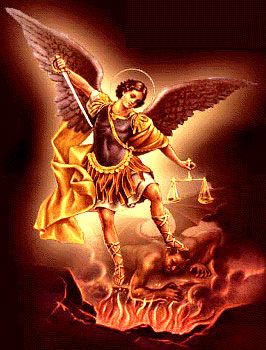
The Hindu goddess Kali is actually a benevolent figure in Hinduism. She is not a reminiscent of Lilith. Her fearsome depictions are meant to ward off the evil dominions of Ravana (King of demons) and she thirsts for blood - not of the innocent, but of the demons and the unrighteous. As frightening as her pose and iconography maybe, she is indifferent than St. Michael the Archangel:

Seen here with his foot on a demon, brandishing a sword and about to strike. His depiction is a ‘friendlier’ image than compared to Kali, but different cultures depict similar storylines differently. Kali has an unfriendly image to many, but i would like to see the expression on a person’s face who has hatred (for evil) and fight the unholy with a sombre smile.

I was a former Hindu and my dream is to evangelize the North Indian Hindu community in Singapore by respecting them first - and this also means to be able to empathize with them. I know they face lots of unfriendly remarks about their beliefs because of ignorant comments from those outside their faith and also through lousy ‘research’ and terribly uninformed authors on the subject. By the way, ‘Diwali’ (Festival of Lights) is celebrated because of Kali defeating the forces of evil and bringing light back again into the world. Now you know why Hindus light oil lamps and place it everywhere around their houses during Diwali - to welcome light into their darkened homes - and to ward off evil.
 
Originally Posted by morning_star777 forums.catholic-questions.org/images/buttons_cad/viewpost.gif
For your kind information,Hindu trinity is not like Christian trinity.Thank you.
If I am not wrong , there is one common matter in both Hindu’s & Christian’s Trinity concept : 3 dieties make one God.
There is no ‘trinity’ in Hinduism. This is something conjured up by western authors to try and make a similarity with Christianity’s Trinity. This is akin to saying that Allāt, al-'Uzzā and Manāt (one of Islam’s most perplexing contradictions) is Islam’s version of the ‘Trinity’.
 
There is no ‘trinity’ in Hinduism. This is something conjured up by western authors to try and make a similarity with Christianity’s Trinity. This is akin to saying that Allāt, al-'Uzzā and Manāt (one of Islam’s most perplexing contradictions) is Islam’s version of the ‘Trinity’.
Yeah. The Hindu religion does not have a Trinity like Christianity. It has a Trimurti of Brahma, Vishnu, and Shiva. They are cyclic deity of creation, preservation, and destruction and rebirth.
 
The Hindu goddess Kali is actually a benevolent figure in Hinduism. She is not a reminiscent of Lilith. Her fearsome depictions are meant to ward off the evil dominions of Ravana (King of demons) and she thirsts for blood - not of the innocent, but of the demons and the unrighteous. As frightening as her pose and iconography maybe, she is indifferent than St. Michael the Archangel:
http://www.theworkofgod.org/images/SMichael.jpg...By the way, ‘Diwali’ (Festival of Lights) is celebrated because of Kali defeating the forces of evil and bringing light back again into the world. Now you know why Hindus light oil lamps and place it everywhere around their houses during Diwali - to welcome light into their darkened homes - and to ward off evil.
Good post, and very enlightening.

How do you explain that one of the names that Lilith offered Moses as a name she goes by was “Kali”? Perhaps she meant the Greek word “Kali” which means “Beautiful”. This would make sense because Lilith is a seducer of men.
 
Good post, and very enlightening.

How do you explain that one of the names that Lilith offered Moses as a name she goes by was “Kali”? Perhaps she meant the Greek word “Kali” which means “Beautiful”. This would make sense because Lilith is a seducer of men.
Everything has to be taken into context. Even names and its meanings:
There are several different derivations for the name Kali.
  • In Sanskrit, Kali means “time,” from the Sanskrit word kaal. Kali is the Hindu goddess of destruction. She is fierce and kills demons, and brings about the death of the ego, thus allowing followers to be liberated. While she is often depicted in a fearful light, she is actually a compassionate goddess, if only one can free oneself from the ego. She is often depicted with black or dark blue skin, and is decorated with a garland of skulls. Kali is the consort and equal of the god Shiva.[1]
  • Kali is also a Polynesian name. In the Tongan language of Tonga, Fiji, American Samoa and New Zealand[2], Kali means “wooden pillow.”[3]
  • Kali is a Swahili name that means “fierce” or “intense.”[4] It comes from a Swahili word that means “sharp.”[5]
  • The name Kali is used in Africa by the Senufo people of northwestern Africa, in the area of Mali and the Ivory Coast.[6] [7]
  • In Hawaiian, Kali means “hesitating.”[8] It is the Hawaiian equivalent of names like Carrie and Callie.[9] It is likely related to the Tongan name mentioned above.
  • Kali may be a shortened version of several Greek names such as Kallista, Kalida, or Kaligenia, all of which mean “beautiful.”[10][11]
    Kali may also be a surname, possibly of Hungarian origin.[12] The surname may also be Greek: a shortened form of Kalinikos, from a family originating in Ithica.
 
What do you guys think of Ram Seta? They call it Adam’s Bridge
Also someone who is hindu told me that Hanuman was probably not a monkey man as he is often described but instead a caveman or neanderthal.
Pictures taken by NASA [National Aeronautics & Space Administration], USA from space show the remains of what appears to be an ages old man-made bridge between Rameshwaram and Sri Lanka. According to Hindu scriptures and belief, Lord Ram and his vaanar sena had built a bridge from Rameshwaram to Sri Lanka about 17 lacs 25 thousands years ago. The discovery of Shri Ram Setu by NASA confirms that Hindu scriptures and belief are correct in this matter and that Ramayana is ‘history’ and not “mythology” as is often construed.
 
Status
Not open for further replies.
Back
Top