Is it really necessary to date the NT that late?

  • Thread starter Thread starter minichibi
  • Start date Start date
Status
Not open for further replies.
I see an increasing tendency to date the Canonical Gospels as late as possible, and the “Heretical” Gospls as early as possible, as an attempt to even them up…

But, I wonder, is it really THAT necessary to date the NT that late? Is there no possibility at all for the Gospels to be written before 70 A.D.?
Clement of Rome quotes about half of the NT books in His writings, which began prior to 100 AD (I have the list somewhere, I’ll see if I can find it). Additionally, Polycarp and I believe Ignatius also quoted extensively from the canonical books of the NT by the very early second century, obviously not canonized at the time. Also, several fragments of NT books, including Mark, were found with the Dead Sea Scrolls, and have been dated as early as 50 AD. Late dates are the world’s attempt to discredit Scripture, such claims attract a lot of attention but are usually unsupported by evidence.
 
Clement of Rome quotes about half of the NT books in His writings, which began prior to 100 AD (I have the list somewhere, I’ll see if I can find it). Additionally, Polycarp and I believe Ignatius also quoted extensively from the canonical books of the NT by the very early second century, obviously not canonized at the time. Also, several fragments of NT books, including Mark, were found with the Dead Sea Scrolls, and have been dated as early as 50 AD. Late dates are the world’s attempt to discredit Scripture, such claims attract a lot of attention but are usually unsupported by evidence.
No, fragments of Mark or any other gospel were NOT found among the DSS contrary to what some may allege.
 
The DSS had only OT books… plus some essenes’ original material…
 
I seem to remember that news from earlier this year, but more on that later. In the meantime, let’s talk about the purported fragment of Mark found in Qumran.


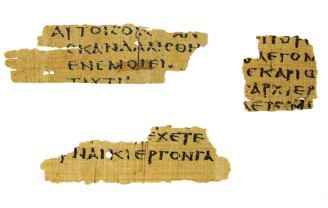
This baby here is the so-called 7Q5, discovered in Cave 7. Like the other finds in that cave, this particular fragment is in Greek. In 1972, Spanish papyrologist Fr. Jose O’Callaghan S.J. identified this particular fragment as a copy of Mark 6:52-53, also identifying another fragment from the same cave (7Q4) as a copy of 1 Timothy 3:16-4:13. A few people like Carsten Peter Thiede (the same person who controversially redated the Magdalen papyrus to the mid 1st century) have came out in support of O’Callaghan, but most others were not convinced.

The main problem, first of all, is the tiny nature of the fragments in question: they have come down to us in a very badly-mutilated state that only a handful of letters can be identified with certainty (the only legible word in 7Q5 is KAI, “and”). Given this, the fragments could be identified with almost anything. The arguments for and against the identification are already summed well enough in Wikipedia. Some other scholars have variously identified 7Q5 with Genesis 46:20, Exodus 36:10-11, Numbers 22:38, 2 Kings 5:13-14, or even Matthew 1:2-3 (!). Callaghan had also attempted to identify some of the other fragments of Cave 7 with various NT books. For instance, 7Q4 was identified with 1 Timothy 3:16; 4:1-3; 7Q6.1 and 2 (these small ones here) is associated with Mark 4:28 and Acts 27:38; 7Q8 is purported to be James 1:23-24.

Recently, three people (Gerhard-Wilhelm Nebe, Emile Puech, and Ernest A. Muro) have made a far more convincing case that seven of the texts from Cave 7 actually contain text from the book of Enoch (7Q4.1, 7Q8, 7Q12, 7Q14 = 1 Enoch 103.3-8, 12; 7Q4.2 = 98:11? 105:1?; 7Q11 = 100:12; 7Q13 = 103.15).

http://wiki.scu.edu/live/wiki71b/images/8/89/7qGk-all-n.jpg


Original Essene material?

FROM the Essenes?

I would like to see that.
It really boils down to as to whether the Qumran sectarians were Essenes or not. We know that the Dead Sea Scrolls are connected with the settlement because of the cylindrical pottery jars with distinctive lids which reportedly contained the first discovered scrolls in Cave 1: similar jars were found within Qumran itself, dating from the so-called Periods Ib (2nd century BC-31 BC) and II (4-1 BC to AD 68), with most samples dating from Period II.

http://i-cias.com/e.o/ill/dead_sea_scrolls03.jpg
 
👍

An excellent read is Dennis Barton’s The Authors of the Gospels It used to be available as one giant pdf, but it appears to have been broken up into “bite-size chunks” recently.
Dennis Barton does an admirable job of presenting the Clementine tradition regarding the order of gospel composition (Matthew-Luke-Mark-John but Mark was able to “publish” before Luke) and the approximate years of composition (all of them before 70 AD excepting a few parts of John)
 
Dennis Barton does an admirable job of presenting the Clementine tradition regarding the order of gospel composition (Matthew-Luke-Mark-John but Mark was able to “publish” before Luke) and the approximate years of composition (all of them before 70 AD excepting a few parts of John)
The Griesbach theory.
 
A few people like Carsten Peter Thiede (the same person who controversially redated the Magdalen papyrus to the mid 1st century) have came out in support of O’Callaghan, but most others were not convinced.
Carsten Peter Thiede redated the Magdalen Papyrus of Matthew to sometime before the end of the first century (and as early as 60), based on a comparison of the style of its script with papyrus scrolls from Qumran, Pompeii, and Herculaneum (which, of course, are datable before 70 or 79).

Thiede actually argued that since the main comparative script (from Nahal Hever) is generally dated no later than AD 50, the possibility of a date around the middle of the first century for the Magdalen papyrus would be possible. Matthew D’Ancona even says as much in the book he co-wrote with Thiede, Eyewitness to Christ:

“…Yet Thiede…argued that they * were of astonishingly early origin, dating from the mid-first century A.D…”

This review of that book* even describes how Thiede arrived at that date:

“…Thiede reexamined the fragments, using state-of-the-art electronic scanners with close analysis of the paper, ink, letter formation, line length, and other factors to redate the fragments to around A.D. 60. Thiede’s tests and skill appear to be well within responsible papyrology, although his conclusions have met with strong opposition from critics…”

Well,* of course* Thiede’s conclusions “have met with strong opposition from critics.” Since Mark’s Gospel is commonly dated between 64 and 70, a date of 60 (or even as early as 50) for Matthew would have important implications for the dating of Mark (and for Markan priority). Not only that, but a date of 60 (or even as early as 50) for Matthew supports the Clementine theory that Matthew – an eyewitness Apostle – wrote first.
 
Well, I have no problem with accepting a late redaction date itself, what I don’t like is the hypothesis used to assign a late date to the text, e.g.: Christ is made to say things he didn’t really say but that it was borrowed / inspired by what someone else said or did, including Josephus and another person named Jesus, the so called “advanced Christology” that in fact undermines the truth in our belief.
Even the Catholics seem to admit Jesus was made to say / do things he never said/did by admitting the late date hypothesis… 😦
 
What made Thiede arrive at his conclusion was by comparing the handwriting of the Magdalen papyrus with 1st century fragments from different areas (Qumran, Naḥal Ḥever, Herculaneum). In his opinion, similarities of script ‘could point towards a first century date’ for the fragment.

Some of the similarities which Thiede proposes. however, are doubtful. Compare for example the handwriting of the Magdalen papyrus with the Naḥal Ḥever Minor Prophets scroll (8ḤevXIIgr, mid-1st century AD), which Thiede used with the Magdalen papyrus as the main comparative script. Even one with totally no experience on papyrology or paleography would see that the two exhibit different styles of handwriting. As this rebuttal of Thiede notes (footnotes have not been included):

Thiede suggested that the consensus ‘around A.D. 200’ was merely a convenient ‘dumping ground’ and that Roberts’ revision of Hunt’s suggested date from fourth century to late second century needs further revision in light of new manuscript finds. These manuscript finds come with archaeologically fixed final dates (termini ante quem).

The first is the Greek Minor Prophet scroll from Nahal Hever (8HevXIIgr), dated by most scholars between 50 BC and AD 50 (see plate two). Thiede noted: ‘the identity and near-identity of several letters is striking: alpha, epsilon…, iota, omicron, rho and nu are particularly close’. We have reproduced as plate two the page to which Thiede refers in his discussion (columns B1-2 = Zc. 8.18-9.5). This represents the work of one of the two scribes involved in producing the manuscript (this incidentally shows that two contemporary scribes from the same location working on the same text in a similar style can nevertheless have quite distinct scripts).

Close inspection provides little support for Thiede’s contention that two scripts are similar. Other than the obvious similarity of bilinear majuscule lettering, this script (8HevXIIgr Scribe B) has a more decorated appearance than P64; note especially the ornamentation of the letter-forms in blobs, hooks and half-serifs. In the size and spacing of the letters, the thinner pen-strokes, and the use of small spaces between words, 8HevXIIgr appears quite distinct from P64. Even the letters which Thiede specifically highlights are actually quite distinct: the alphas of 8HevXIIgr have a generally horizontal cross-bar (P64: distinct angle from lower left to upper right); the epsilons have detached cross bars (no parallel in P64); the iotas have decoration and do not extend as far below the line as P64; the rho has a pronounced decorative blob on the end of its down-stroke (contrast P64); the nus also have pronounced decorative blobs at each join (unlike P64). Of the letters to which Thiede draws attention, only the omicrons are similar, and little significance can be drawn from this.

Furthermore to take into account only similarities between letters and to ignore their differences is methodologically untenable. In many ways, when trying to draw comparisons between scripts, differences between letter-forms are of more importance than the odd similarity (after all there are only so many ways in which letters can be written). For differences, note the upsilon (8HevXIIgr: straight lines and 90 degree angle cf. P64 with curve), sigma (8HevXIIgr: extended horizontals), and mu (8HevXIIgr: outward pointing down-strokes).[49] The only conclusion which can be drawn from this evidence is that there is no significant relationship between the script and style of P. Magd. Gr. 17 and 8HevXIIgr. There is, then, nothing to be gained from a discussion of the date of 8HevXIIgr, and Thiede’s claim to have found significant new evidence may be unfounded.


http://img15.imageshack.us/img15/696/nahalhever2.jpg

The thing is, dating the date of a manuscript solely by the handwriting is really difficult and shaky: given how the dating of papyri is not really an exact science, this should tell us something. (This was actually an issue with the first undisputed surviving fragment of the NT, Papyrus 52.) Papyrologists get an idea of when a manuscript was written based on the writing materials (the medium - in this case, papyrus - and the ink) and the evaluation of the forms of the letters. Fortunately, some ancient documents are dated by their scribes, or they refer to some datable event, and the forms of writing on these documents can help papyrologists determine when different forms of writing passed into and out of use. This knowledge can also be applied to other manuscripts which are not dated. If the independents of several, trained papyrological experts agree on a rough date, we can place confidence in their evaluations. But, as one can imagine, unless the scribe provided a date, these methods can only produce approximate results. In fact, it is often the case that experts disagree to a greater or lesser extent in their datings of manuscripts.

Oh, and finally, what Thiede actually claims is not so much that the Magdalen papyrus dates from the mid-1st century (although he is sympathetic towards a pre-AD 70 date), but that it is from the 1st century in general with no specific date in mind (he repeatedly refers to “a first-century date” or “prior to the turn of the century”), although he does in conclusion seem to date it “some time after the destruction of the Temple in Jerusalem.”

I do not give a precise date, but suggest a date in the last third of the first century: The ‘starting point’ is the middle of the century; I allow for a variation of c. 20 years + / - and then opt for the later end, ‘soon after A.D. 70’.

 
No, fragments of Mark or any other gospel were NOT found among the DSS contrary to what some may allege.
According to Norman Geisler, ( Baker Encyclopedia of Christian Apologetics, Baker Publishing, Grand Rapids, 1999) there were fragments in the DSS that are believed to be from Mark, Acts, Roman,1 Timothy, 2 Peter, and James and dated between 50 and 70 AD. The disagreement seemed to be that scholars were searching for other ancient writings that could match the words on the fragments.
If that scholarship has changed could you give me a couple of sources?
 
I see an increasing tendency to date the Canonical Gospels as late as possible, and the “Heretical” Gospls as early as possible, as an attempt to even them up…

But, I wonder, is it really THAT necessary to date the NT that late? Is there no possibility at all for the Gospels to be written before 70 A.D.?
A N Sherwin Wright, a historian who wrote Roman Society and Roman Law in the New Testament says Roman and Greek histories are generally biased and removed 1 or 2 generations or even centuries after the events they record. Yet he says historians reconstruct with confidence Greek and Roman history. For example the 2 earliest biographies of Alexander the Great written by Arrian and Plutarch were written 400 years after Alexander’s death, yet classical historians still consider them trustworthy
 
pleaseconvinceme.com/index/Are_There_Early_Eyewitness_Accounts_of_Jesus

One of the biggest events in the 1st century, on 70 AD the destruction of the Jewish temple. Jesus predicted the temple would be destroyed. No gospel confirms the destruction of the temple and the simplest explanation is that the Gospels were already written

Book of Acts says nothing about the destruction of the temple, persecution of Christians by Nero in 64 AD, martydom of Peter in 65 AD, martydom of Paul in 64 AD, martyrdom of James in 61 AD. Book of Acts is a history of the early Church, Paul is alive at the end of Acts and the fact that the above are not mentioned gives reasonable belief that Book of Acts was written before 64 AD

Gospel of Luke also does not mention the above which gives reason to believe it was written before 64 AD

Clement’s letter which is dated to 95 AD or 96 AD used sections of Matthew’s gospel in 1 Clement 13: 1 - 2 which means Matthew’s gospel was circulating

Jesuit papyrologist Jose O’Callaghan looked at a fragment of papyri called 7Q5 from Cave 7 in Qumran, it is part of the Dead Sea Scrolls. He concluded that it was part of Mark’s gospel, Mark 6: 52 - 53 and that papyri was dated 50 AD
 
pleaseconvinceme.com/index/Are_There_Early_Eyewitness_Accounts_of_Jesus
Giuseppe Ricciotti
Ricciotti was an Italian Bible scholar, archeologist and historian. He wrote extensively, including seminal works on the Life of Christ%20and%20Paul%20the%20Apostle%20(http://www.amazon.com/Paul-Apostle-...=sr_1_9?ie=UTF8&s=books&qid=1272644999&sr=8-9) and Paul the Apostle. Ricciotti concluded that the gospels were written early on the basis of some of the same lines of internal textual evidence that we have cited in this article. He argued that the Gospel of Matthew was written from 50 to 55AD, that the Gospel of Mark was written from 55 to 60AD, that the Gospel of Luke was written near 60AD, and that the Gospel of John was written near 100AD.
John Arthur Thomas Robinson
Robinson was a former Anglican bishop and New Testament scholar who wrote “Redating the New Testament”. Although Robinson was known for his theological liberalism (revealed in his 1963 book entitled, “Honest to God”, he rejected the late dating of the liberal school of “form criticism”. He utilized an historical approach to his research (grounded primarily the fall of Jerusalem in 70AD) to conclude that the gospels were written early. He argued that the Gospel of Matthew was written from 40 to 60AD, that the Gospel of Mark was written from 45 to 60AD, that the Gospel of Luke was written from 57 to 60AD, and that the Gospel of John was written from 40 to 65AD.
John W. Wenham
Wenham was a Professor of New Testament Greek and Biblical scholar. He wrote “Redating Matthew, Mark and Luke: A Fresh Assault on the Synoptic Problem" and concluded that the gospels were written early by comparing them to one another and examining their relationship to the early writings and traditions of Church Fathers from the first to third century. He concluded that the Gospel of Matthew was written near 40AD, that the Gospel of Mark was written near 45AD, and that the Gospel of Luke was written by the mid-50’s.
Birger Gerhardsson
Gerhardsson is a Swedish Biblicist and and professor at Lund University. He wrote “The Reliability of the Gospel Tradition” and examined the Jewish oral and written tradition, particularly the teaching and memorization techniques of Jewish Rabbis in Jesus’ day. A similar approach to the evidence was also presented by Harald Riesenfeld (Sweden), Thorleif Boman (Norway). All these scholars conclude that the gospels are consistent with the teaching and memorization traditions of first century Rabbi’s. As a result, they conclude that the gospels should be dated very early.
Marcel Jousse
Jousse is a Biblical scholar from France. He wrote “L’anthropologie du geste” and examined the Semitic nature and rhythm of Jesus’ statements in the gospels. He concluded that the gospels are consistent with the language and characteristics of first century rabbinical teaching. As a result, he also concluded that the gospels should be dated very early.
Jean Carmignac
Carmignac is a French scholar who spent twenty years researching the Hebrew language as a backdrop to the writing of the gospels. He wrote “The Birth of the Synoptic Gospels” and concluded that one or more of the gospels had a Semitic origin (other scholars like Robert Lindsey, David Flusser, Pinchas Lapide and David Bivin agree). His work argued that the synoptic gospels (Matthew, Mark and Luke) formed amidst the Jewish culture of the first half of the first century. He concluded that the Gospel of Mark was written from 42 to 55AD, that the Gospel of Matthew was written from 50 to 60AD, and that the Gospel of Luke was written from 50 to 60AD.
Philippe Rolland
Rolland is a Biblical scholar from France. He wrote “Epitre aux Romains: Texte Grec Structure” among other works. He ultimately compared the language of several New Testament letters and the Book of Acts and formed the opinion that the Gospel of Matthew was first written in Hebrew near 40AD, then translated into Greek from 63 to 64AD along with the Gospel of Luke. He argued that the Gospel of Mark appeared in 66 or 67Ad and that the Gospel of John appeared near 100AD.
Carsten Peter Thiede
Theide was a German papyrologist, archaeologist and New Testament scholar. He wrote “The Jesus Papyri”. He examined three papyrus fragments of the Gospel of Matthew from Luxor Egypt (now housed at Magdalen College, Oxford) and concluded that they dated to 60AD.
 
Hi, Julia Mae,

I am a bit confused as to the tow distinctions you are making:

1.) the Gospels themselves - and the material of the Gospels and

2.) that anything in the NT was written just after the Incarnation (but, before the Birth of Christ)

Seriously, how can this possibly be from a strictly historical point of view? Luke is the only one who addressess the Annunciation. The other 3 essentially start with Christ’s Public Ministery - about the year 30AD.

God bless
There’s a difference between the Gospels and the material in the Gospels. Much of what is contained in the Canonical Gospels was surely written during or just after Jesus’ Incarnation. The Gospels in their final form, would not have been completed until later.

What we know for sure, is that the oldest fragment of a Gospel we have is dated to about 125 A.D. This doesn’t mean it was an original document, of course. It’s highly unlikely it was, but that it was copied from an older document.

en.wikipedia.org/wiki/Rylands_Library_Papyrus_P52
 
According to Norman Geisler, ( Baker Encyclopedia of Christian Apologetics, Baker Publishing, Grand Rapids, 1999) there were fragments in the DSS that are believed to be from Mark, Acts, Roman,1 Timothy, 2 Peter, and James and dated between 50 and 70 AD. The disagreement seemed to be that scholars were searching for other ancient writings that could match the words on the fragments.
If that scholarship has changed could you give me a couple of sources?
For the moment, how about chapter 14 of Peter Flint and James C. VanderKam’s The Meaning of the Dead Sea Scrolls: Their Significance for Understanding the Bible, Judaism, Jesus and Christianity? Also VanderKam’s The Dead Sea Scrolls Today, Fr. Joseph Fitzmyer S.J.'s The Dead Sea Scrolls and Christian Origins (p. 24) and Responses to 101 Questions on the Dead Sea Scrolls (p. 16), and Emanuel Tov’s Hebrew Bible, Greek Bible and Qumran: Collected Essays (pp. 347-350).
 
I should add the following from Geza Vermes’ The Complete Dead Sea Scrolls in English (p. 472-73):

(A) GREEK BIBLE TRANSLATIONS
(4Q119-22; 7Q1-2)

Compared to the quantity of Hebrew and Aramaic manuscripts, the Greek documents found in two of the Qumran caves, Caves 4 and 7, are remarkably few, and this scarcity is significant in itself as regards the cultural identity of the Qumran Community. Those which have been identified with certainty belong to the Greek translation of the Bible, mostly the Pentateuch. Cave 4 has yielded remains of two scrolls of Leviticus, one of leather (4Q119) and one of papyrus (4Q120), as well as one of Numbers (4Q121) and of Deuteronomy (4Q122), all dating to the second or the first century BCE. On the whole, they represent the traditional text of the Septuagint with minor variations such as a word being replaced by its synonym (harvesting by threshing, for example, or nation by people) but 4QLXX Numbers (4Q121) testifies to an effort to bring the LXX closer to the Hebrew Pentateuch. Since the translation scarcely differs from the original, there is no purpose in reproducing it. However, it is worth noting that in Lev. iv, 27 (4Q120, fr. 20, 4) the Tetragram (the divine name YHWH) is rendered semi-phonetically as Iao, and is not replaced, as was customary later, by the Greek Kurios (Lord).
Among the nineteen minute fragments found in Cave 7 – which contained only Greek texts – two have been identified as relics of Exodus xxviii, 4-7 (7Q1) and the Letter of Jeremiah, verses 43-4 (7Q2). The former is said to be closer to the traditional Hebrew text than to the LXX. Both are dated to about 100 BCE.

(B) OTHER GREEK FRAGMENTS
(4Q126-7; 7Q3-19)

The remaining two Greek fragments in Cave 4 date roughly to the turn of the era. One (4Q126) cannot be identified and the other (4Q127) is either a paraphrase of Exodus, mentioning among others Pharaoh, Moses and Egypt, or possibly an apocryphal account of Israel in Egypt.
Seventeen out of the nineteen minute Greek papyrus fragments from Cave 7 have been declared by the editors to be unidentifiable. Yet against all verisimilitude, several of them have generated sensational and even revolutionary claims, especially that they represented the earliest textual examples of the Greek New Testament.
The contention originated with a Spanish Jesuit, José O’Callaghan, who in 1972 persuaded himself that these hardly legible scraps derived from six books of the New Testament: the Gospel of Mark iv, 28 (7Q6 1), vi, 48 (7Q15), vi, 52-3 (7Q5), xii, 17 (7Q7); the Acts of the Apostles xxviii, 38 (7Q6 2); 1 Timothy iii, 16, iv, 1, 3 (7Q4); James i, 23-4 (7Q8) and even one of the latest New Testament writings, 2 Peter i, 15 (7Q10). Of these, the case for Mark vi, 52-3 is purported to be the ‘strongest’. The real facts are the following. We are dealing with a fragment on which the written area measures 3.3 x 2.3 cm. Letters appear on four lines; these are of unknown length since both the beginning and the end of each line are missing. An unrecognizable trace of another letter is observed at the top of the fragment. In the editio princeps seventeen letters are identified of which only nine are certain. A single complete word has survived: the Greek kai = and!
The leading experts in the field, the late C.H. Roberts of Oxford and the German Kurt Aland, unhesitatingly discarded O’Callaghan’s theory. Roberts jokingly told me [Vermes] that if he wanted to waste his time, he was sure he would be able to ‘demonstrate’ that 7Q5 belonged to any ancient Greek text, biblical or non-biblical. Yet this unlikely and clearly unprovable hypothesis was revived in the 1980s by C.P. Thiede and others, only to encounter the same fate of summary dismissal as Father O’Callaghan’s a decade or so earlier.
For the editio princeps of the 4Q and 7Q material, see P.W. Skehan and E. Ulrich, DJD, IX (Oxford, 1992); 161-97, 219-42; M. Baillet et al., DJD, III (Oxford, 1962), 142-6. For the theory that 7Q contains New Testament texts, see J O’Callaghan, Los papiros griegos de la cueva 7 de Qumrán (Madrid, 1974), and C.P. Thiede, The Earliest Gospel Manuscripts (London, 1992); Re-Kindling the Word (Valley Forge, Pa, 1996). For views for and against expressed at a symposium, see B. Mayer, ed., Christen und Christliches in Qumran? (Regensburg, 1992). Against the theory, see C.H. Roberts, ‘On Some Presumed Papyrus Fragments of the New Testament from Qumran’, Neue neutestamentlische Papyri III’, New Testament Study 20 (1973-4), 357-81. For the latest authoritative views, see G. Stanton, Gospel Truth? (London, 1995); E. Puech, ‘Des fragments grecs de la grotte 7 et le Nouveau Testament?’, RB 102 (1995), 570-84 ; M.-E. Boismard (the first decipherer of the fragment), ‘A propos de 7Q5 et Mc. 6, 52-53’, ibid. 102-4.
 
I am amazed and sometimes amused at those who set late dates for the NT with a smug assurance. usually, they are crypto-atheists masquerading as scholars.

Like the folks who doubt that Shakespeare wrote his plays, or that the Kennsington Rune stone in Minnesota was a fake, created by an illiterate farmer.
 
Status
Not open for further replies.
Back
Top