Is Mormonism a Polytheistic religion?

  • Thread starter Thread starter rock17
  • Start date Start date
Status
Not open for further replies.
…In your opinion, which Greek philosophies were the culprit? Which Greek writings were used by Christians during the 1st Century and who did the corrupting? In an earlier post, you mentioned doctrines that crept into the Church asserting that matter was evil and only spirit was pure. … which Greek philosophies corrupted the Church in the 1st Century, creating an obviously very Catholic Church in both Rome and Antioch by the end of the 1st Century?

Sorry for the long post. I am looking forward to your answer.

NS
NewSeeker,

First, just because Aristotle’s writings weren’t available to be studied or found later, doesn’t mean his teachings hadn’t had influence on Greek thought from the time he taught them. To read the entire books of Acts, Thessalonians, and Corinthians is to read repeated examples and warnings about Greek philosophy and Greek thinking about their gods as well as about the body. Paul’s words that the body is a temple is an example of his teaching to counter the Greek philosophy that converts evidently struggled to leave behind them. Further, Paul certainly didn’t show an acceptance of the philosophy that had been taught by Aristotle about the “First Cause”. Rather, he showed an awareness and an understanding of a personal God, of the relationship God had with Adam and Eve, and of the mission of Christ as Redeemer which was planned from the foundation of the world, meaning before the creation of this earth.

It was not just Greek philosophy that had a part in the apostasy–it was also the very strong influence of the Pharisees converts. Both of these groups relied strongly on reasoning rather than on what Paul described in 1 Corinthians 2 and 3.

I would say a student studying this topic ought to read Acts and Paul’s epistles to the Thessalonians and the Corinthians at least three times for all of those Biblical writings, and look for Paul’s messages about Greek philosophy as part of the sub-text as well as direct references.

Again, when it comes down to the final “what does it mean to me?”, a person can choose their religion based on “reason”, and that will be exactly what they wanted for themselves, so have at it.

Hebrews 11 shows a very different approach to divine religion, with a very different result. “We seek a city whose builder and maker is God.”
 
Further, Paul certainly didn’t show an acceptance of the philosophy that had been taught by Aristotle about the “First Cause”. Rather, he showed an awareness and an understanding of a personal God, of the relationship God had with Adam and Eve, and of the mission of Christ as Redeemer which was planned from the foundation of the world, meaning before the creation of this earth.
"Indeed, even though there are so-called gods in heaven and on earth (there are, to be sure, many “gods” and many “lords”), yet for us there is one God, the Father, through whom all things are and for whom we exist, and one Lord, through whom all things are and through whom we exist.". (1 Cor 8:5, 6) (Emphasis mine)

Sounds like a first cause to me, since nothing existed without him. I find it strange that you equate believing in an eternal God who created all things from nothing, being the only cause of their existence, with a lack of belief in a personal God. I don’t see the connection but this is not the first time this has been more than implied. The Dallin Oaks article on “Apostasy and Restoration” said the same thing, as if we believe in some impersonal, unfeeling, dispassionate God. Nothing could be further from the truth. I believe in a God so personal and loving that he sent his only Son to suffer and die for me so that I might live in complete happiness with him for eternity. That’s pretty personal, wouldn’t you say?
It was not just Greek philosophy that had a part in the apostasy–it was also the very strong influence of the Pharisees converts. Both of these groups relied strongly on reasoning rather than on what Paul described in 1 Corinthians 2 and 3.
Well, Parker, you know very well that we do not arrive at our faith by reason alone. We have received the revelation of Jesus Christ and so walk by faith. Reason is a gift of God given to us so that we may realize and perceive truth. When reason conflicts with faith, it should give one great pause because truth can never conflict with truth. Either one’s reasoning is wrong or one’s faith is wrong. Faith and reason are very compatible.
I would say a student studying this topic ought to read Acts and Paul’s epistles to the Thessalonians and the Corinthians at least three times for all of those Biblical writings, and look for Paul’s messages about Greek philosophy as part of the sub-text as well as direct references.
Why? So that we can come to the understanding that Paul could discern truth from myth and that he argued against believing in Greek idols? I think we get that. But nowhere do I find Paul arguing against a God that is the first Cause. Please show me where that is.
Hebrews 11 shows a very different approach to divine religion, with a very different result. “We seek a city whose builder and maker is God.”
You’ve lost me completely here. 🤷
 
Hello ParkerD, thanks for your reply.
First, just because Aristotle’s writings weren’t available to be studied or found later, doesn’t mean his teachings hadn’t had influence on Greek thought from the time he taught them. To read the entire books of Acts, Thessalonians, and Corinthians is to read repeated examples and warnings about Greek philosophy and Greek thinking about their gods as well as about the body.
My reading of Paul indicates to me that Paul’s purpose was to combat gnosticsm and Greek mythology and associated practices - like offering to idols. Greek thought at the time was not uniform, as your blanket indictment (through your interpretation of Paul) implies. For instance, Socrates and Plato challenged Greek mythological explanations for the origin and meaning of the cosmos, as well as the teachings of Stoics and Sophists; Aristotle, in turn, challenged and built upon Plato to develop his metaphysical system. Which of these Greek schools of thought is the culprit? Or is it all of them, together? As I just said, my reading of Paul indicates to me that he was concerned principally with combatting gnosticsm and Greek paganism, not the metaphysics of Socrates/Plato/Aristotle. In fact, in Acts 17:27-28 (KJV), Paul sounds very Aristotelian - “That they should seek the Lord, if haply they might feel after him, and find him, though he be not far from every one of us: For in him we live, and move, and have our being; as certain also of your own poets have said, For we are also his offspring.” God is “not far from us” precisely because we are “in Him”. We possess our being, ἐσμέν, the principle of our existence, in God. Our continual existence depends on God, who is Pure Being, holding all things in perpetual existence, just as Paul (here in Acts and also in Colossians), and Aristotle, taught. But even if Paul didn’t have this element of Greek thought in mind when he was speaking and Aristotle influenced the Church after Paul’s passing, so what? Aristotle was absolutely correct in his description of the characterics that God must necessarily possess, given the existence of essential causation in the material cosmos. We Catholics accept all truths, no matter their source. The fact that Paul and Aristotle were obviously in agreement indicates that not all Greek philosophy is bad, as you seem to be implying.
Paul’s words that the body is a temple is an example of his teaching to counter the Greek philosophy that converts evidently struggled to leave behind them.
I assume you’re again referencing the gnostic teaching that the body is evil? As I’ve already stated, this was a gnostic teaching and was not part of the mainstream of Greek philosophy. Paul was most definitely sought to counter this teaching (along with Greek mythology) in his letters, as you’ve correctly asserted. But you are in error when you equate gnosticism with Greek philosophy writ large.
 
Further, Paul certainly didn’t show an acceptance of the philosophy that had been taught by Aristotle about the “First Cause”.
Paul also didn’t show rejection of that philosophy. He didn’t address the issue at all. I wouldn’t expect Paul to have thought much about first causes. Paul was a Jew and Hebrew society was pre-philosophic and oral. I wouldn’t expect Paul, or any other Jew, to have put much thought into working out categories philosophically, using nothing but unaided reason. But Paul likely was aware of, or agreed with, Aristotelian notions of being (even if he didn’t know who Aristotle was), as indicated above. This is hardly controversial, as Aristotle was absolutely correct about what God necessarily must be like (immaterial, Prime Mover, First Cause, and ground of being).
Rather, he showed an awareness and an understanding of a personal God, of the relationship God had with Adam and Eve, and of the mission of Christ as Redeemer which was planned from the foundation of the world, meaning before the creation of this earth.
Well, yes, Paul’s god was personal, just like our God. As Catholics, we believe in a god Who is First Cause, Pure Being, immaterial, and also Personal. That’s the great mystery (we can enter into that mystery, but not fully grasp it - which is why it is called a Mystery). And it is amazing that our God took on human form and became one of us.
It was not just Greek philosophy that had a part in the apostasy–it was also the very strong influence of the Pharisees converts. Both of these groups relied strongly on reasoning rather than on what Paul described in 1 Corinthians 2 and 3.
Why the animus against reasoning? We are human animals, endowed by God with reason, which separates us from the other animals. It is our reason that makes us “god-like”; it is the imprint of the divine in all of us. To denigrate reason as you do (and as LDS church leaders do) is an impious act. It is also extremely ungrateful. God endowed each of us with a rational soul. That is what makes us human. Why make it out to be something bad? Any revelation that contradicts reason contradicts the God who gave us our rational faculties. Reason and revelation go together. Reason is your friend when seeking God. It’s the only way to be sure your emotions aren’t leading you astray into barren fields, far from the True God.
I would say a student studying this topic ought to read Acts and Paul’s epistles to the Thessalonians and the Corinthians at least three times for all of those Biblical writings, and look for Paul’s messages about Greek philosophy as part of the sub-text as well as direct references. Again, when it comes down to the final “what does it mean to me?”, a person can choose their religion based on “reason”, and that will be exactly what they wanted for themselves, so have at it.
Hebrews 11 shows a very different approach to divine religion, with a very different result. "We seek a city whose builder and maker is God
See above about your unfortunate denigration of reason, God’s gift to you and me. You are repudiating the very thing God gave us that makes us different from the other animals and therefore capable of entering into a personal relationship with Him.

NS
 
I’d like to add to something I wrote in my previous post.
Paul’s words that the body is a temple is an example of his teaching to counter the Greek philosophy that converts evidently struggled to leave behind them.
I assume you’re again referencing the gnostic teaching that the body is evil? As I’ve already stated, this was a gnostic teaching and was not part of the mainstream of Greek philosophy. Paul was most definitely sought to counter this teaching (along with Greek mythology) in his letters, as you’ve correctly asserted. But you are in error when you equate gnosticism with Greek philosophy writ large.

Edited to add: Additionally, as I’ve already discussed, the “matter is evil” gnosticism that Paul was countering in the verse you referenced never was part of Catholic doctrine. It is thus incorrect to use Paul’s ‘body is a temple’ teaching as an example of how greek thought led to the Apostasy. If this was true, you would find this gnostic teaching as part of Holy Tradition. This you cannot do. In fact, the Church took up where Paul left off and continued the attack on this false body of teaching until it was thoroughly defeated.
 
"We seek a city whose builder and maker is God"
"
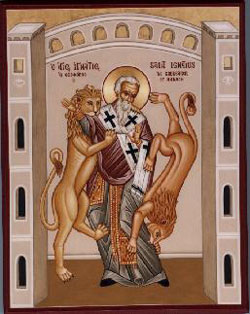
“I prefer death in Christ Jesus to power over the farthest limits of the earth. He who died in place of us is the one object of my quest. He who rose for our sakes is my one desire.”

Parker. I hear the same tone in a lot of your writing that I hear in Genesis, in the garden. There are consequences to accepted Heresy. To temping others especially the children to leave the Church Jesus built for our salvation in Him alone. . To leave who He really is behind.

We are not just sinners in transition, rather helpless sinners in transition. Our reliance on Jesus is because of our nothingness without Him. Think about this Parker. What could be more beautiful than that? It is not in going up that we find Him, it is in going down. “Cross”

You can be a good leaf or branch, but even a good leaf falls to the ground and dies. It cannot remain alive unless connected to the tree of life. It cannot fall off, go out and become its own tree.

Think about the thousand of Saints who gave their lives over to a personal relationship with Jesus when you write what you write, defend what you defend.

How you would have us cut off from God because of a desire to work hard to become a god. Tempting only to those that do not have the wisdom / Christ that over a billion Christians do have.

A personal speaking and praying relationship with Jesus. Who for us Christians is our Lord and our God.

I found this through the maze of life, even through the Mormon maze at an early stage of my life. It was a big part of my journey home. Without the Mormon Church I may not have seen the stark difference between what is real and what is not real. What is right and what is wrong.

“I prefer death in Christ Jesus to power over the farthest limits of the earth. He who died in place of us is the one object of my quest. He who rose for our sakes is my one desire.” …St. Ignatius of Antioch
In 107, during the reign of the brutal Emperor Trajan, this holy Bishop was wrongfully sentenced to death because he refused to renounce the Christian faith. He was taken under guard to Rome where he was to be brutally devoured by wild beasts in a public spectacle.

 
One more quick edit [in brackets] to something I wrote (thanks SteveVH, for making this evident to me in your 1 Cor citation):

“Paul also didn’t show rejection of that philosophy. He didn’t address the issue [directly]. I wouldn’t expect Paul to have thought much about first causes. Paul was a Jew and Hebrew society was pre-philosophic and oral.”
 
Parker. I hear the same tone in a lot of your writing that I hear in Genesis, in the garden…
Catholic-RCIA,

It was an interesting comment to make. Perhaps you are unfamiliar with Hebrews 11:10, (though I don’t know how that verse reads in the version of the Bible you use.) Look it up in the KJV, if you have time and wish to understand what I meant. It is describing the motive of Abraham, who is the “heir of the promise” (v. 9). Abraham was not content to go along with the prevailing “thought” or “teachings of men” in his day, including of his own father.

I suppose one could say Abraham’s desire to gain wisdom directly from God does relate to the fact that humankind were placed on earth for that very purpose, by learning to walk by faith but through free will choices including the choice Eve and Adam were given whether to partake of the fruit of the tree of knowledge of good and evil.

By totally missing the plain words of Genesis 3:6 and misjudging Eve, it makes sense that one with that teaching in their background would make the kind of statement you made about Abraham’s having sought and become an “heir of the promise” by having sought “a city which hath foundations, whose builder and maker is God”. It is a totally different attitude about why we are on this earth. One could call it the “Abrahamic attitude” versus the “shame on Eve for desiring wisdom and now we have all this trouble” attitude.
 
Catholic-RCIA,

It was an interesting comment to make. Perhaps you are unfamiliar with Hebrews 11:10, (though I don’t know how that verse reads in the version of the Bible you use.) Look it up in the KJV, if you have time and wish to understand what I meant. It is describing the motive of Abraham, who is the “heir of the promise” (v. 9). Abraham was not content to go along with the prevailing “thought” or “teachings of men” in his day, including of his own father.

I suppose one could say Abraham’s desire to gain wisdom directly from God does relate to the fact that humankind were placed on earth for that very purpose, by learning to walk by faith but through free will choices including the choice Eve and Adam were given whether to partake of the fruit of the tree of knowledge of good and evil.

By totally missing the plain words of Genesis 3:6 and misjudging Eve, it makes sense that one with that teaching in their background would make the kind of statement you made about Abraham’s having sought and become an “heir of the promise” by having sought “a city which hath foundations, whose builder and maker is God”. It is a totally different attitude about why we are on this earth. One could call it the “Abrahamic attitude” versus the “shame on Eve for desiring wisdom and now we have all this trouble” attitude.
Rich, you poor, ignorant, deluded individual, how could you have missed that? :rolleyes:

I guess there really is no end to the condescension. This is getting really old.
 
Hmmm. :hmmm:The Lord revealed “stuff” to you about Mormonism “by his grace”?
Hmmm. hmmm, hmmm:: Don’t Catholics say the same thing? Why do we think that the Gospel of Thomas is suspect enough to be kept out of the Canon? Why do we believe that Trent is definitive? etc. etc. Of course, we pick the Holy Spirit to keep us on track, but it is hard to see any actual difference between the action of the Holy Spirit and the Grace of the Lord.

Why would anyone think that a Mormon would be impressed by an argument that doubts the efficacy of the Lord’s Grace to return the Mormons to the true path, especially if he believes that the “apostasy” of the Church proves that the Church must not have followed the guidance of the Holy Spirit?
 
Hmmm. hmmm, hmmm:: Don’t Catholics say the same thing? Why do we think that the Gospel of Thomas is suspect enough to be kept out of the Canon? Why do we believe that Trent is definitive? etc. etc. Of course, we pick the Holy Spirit to keep us on track, but it is hard to see any actual difference between the action of the Holy Spirit and the Grace of the Lord.

Why would anyone think that a Mormon would be impressed by an argument that doubts the efficacy of the Lord’s Grace to return the Mormons to the true path, especially if he believes that the “apostasy” of the Church proves that the Church must not have followed the guidance of the Holy Spirit?
Well, there is a big difference in how we view the guidance of the Holy Spirit as compared to the Mormon view. When they find themselves in a position of having to defend contradicting doctrines or teachings, they immediately retreat to the “burning in the bosom” and view reason as something to be avoided. After discussing the “Apostasy” with a Mormon bishop and pointing out the lack of historical evidence supporting this idea, I was told “I don’t study history and have no reason to study it. I have the words of Joseph Smith and the witness of the Holy Spirit”. That is a true story.

You will also find that much of the “witness of the Holy Spirit” purportedly experienced by Mormons borders on gnosticism, secret knowledge revealed only to them. You will never get specifics, just comments like the one being discussed that the Holy Spirit has revealed “stuff” to me. The message being delivered is that they are more enlightened then you because God has spoken directly to them, therefore, end of argument. This relieves them of having to deal with reality, with historical facts or contradictory doctrines. It’s true because God told them it is true.
 
Well, there is a big difference in how we view the guidance of the Holy Spirit as compared to the Mormon view. When they find themselves in a position of having to defend contradicting doctrines or teachings, they immediately retreat to the “burning in the bosom” and view reason as something to be avoided. After discussing the “Apostasy” with a Mormon bishop and pointing out the lack of historical evidence supporting this idea, I was told “I don’t study history and have no reason to study it. I have the words of Joseph Smith and the witness of the Holy Spirit”. That is a true story.

You will also find that much of the “witness of the Holy Spirit” purportedly experienced by Mormons borders on gnosticism, secret knowledge revealed only to them. You will never get specifics, just comments like the one being discussed that the Holy Spirit has revealed “stuff” to me. The message being delivered is that they are more enlightened then you because God has spoken directly to them, therefore, end of argument. This relieves them of having to deal with reality, with historical facts or contradictory doctrines. It’s true because God told them it is true.
I’ve had a bishop tell me the exact same thing. Others, my dad for one, will say “I keep my faith in one pocket and history and science in the other.” My mom once told me (paraphrasing) “I don’t care what evidence you bring. Even if they found Joseph Smith’s authenticated, signed confession, I still wouldn’t believe it. I have a testimony, so I know that if Joseph did write such a document, he would have been under the influence of Satan. The emotion-based Mormon testimony is the ultimate trump card.” Mormons walk the reason-based, historical walk, but they always hold their testimony in reserve and they always pull it when their backs are against the wall in the face of irrefutable evidence. It’s best to begin any discussion with a Mormon by clarifying up front that you’ll only have a discussion with them if they agree to never bear their testimony or use personal spiritual experiences as evidence. Those who refuse to only stick to known historical facts will just waste your time, otherwise. You can’t have a discussion about historical matters (e.g. the Apostasy) if one party in the debate refuses to stick just to the historical evidence.
 
I’ve had a bishop tell me the exact same thing. Others, my dad for one, will say “I keep my faith in one pocket and history and science in the other.” My mom once told me (paraphrasing) “I don’t care what evidence you bring. Even if they found Joseph Smith’s authenticated, signed confession, I still wouldn’t believe it. I have a testimony, so I know that if Joseph did write such a document, he would have been under the influence of Satan. The emotion-based Mormon testimony is the ultimate trump card.” Mormons walk the reason-based, historical walk, but they always hold their testimony in reserve and they always pull it when their backs are against the wall in the face of irrefutable evidence. It’s best to begin any discussion with a Mormon by clarifying up front that you’ll only have a discussion with them if they agree to never bear their testimony or use personal spiritual experiences as evidence. Those who refuse to only stick to known historical facts will just waste your time, otherwise. You can’t have a discussion about historical matters (e.g. the Apostasy) if one party in the debate refuses to stick just to the historical evidence.
I had this discussion with the Mormon bishop I mentioned because one of the teens in my youth group was converting to the LDS church due to her being enamoured by a Mormon boy. It broke my heart and I took it personally, feeling that I had failed in my attempt to catechize her properly. In a last attempt I asked her to please find the most knowledgeable Mormon in the local ward so that the three of us could have a discussion. I was truly a novice in Mormon teaching but knew some of the basics, such as the Mormon claim of the Apostasy. She failed to show. Instead I was visited by the bishop and two, very young missionaries. His answer, being a bishop, astounded me and I went away with the assumption that I had just run into a very ignorant bishop, not believing that anyone would actually base their faith on such a premise. Even the missionaries could not look at me when he gave this answer, instead they just stared at the table at which we were seated. Since then I have learned, as you have verified, that this type of response is common place. It is still difficult for me to grasp that the human mind can discard reason so easily in order to come to such a conclusion.
 
Hello ParkerD, thanks for your reply.

…Which of these Greek schools of thought is the culprit? Or is it all of them, together? As I just said, my reading of Paul indicates to me that he was concerned principally with combatting gnosticsm and Greek paganism, not the metaphysics of Socrates/Plato/Aristotle. In fact, in Acts 17:27-28 (KJV), Paul sounds very Aristotelian - “That they should seek the Lord, if haply they might feel after him, and find him, though he be not far from every one of us: For in him we live, and move, and have our being; as certain also of your own poets have said, For we are also his offspring.” God is “not far from us” precisely because we are “in Him”. We possess our being, ἐσμέν, the principle of our existence, in God. Our continual existence depends on God, who is Pure Being, holding all things in perpetual existence, just as Paul (here in Acts and also in Colossians), and Aristotle, taught. But even if Paul didn’t have this element of Greek thought in mind when he was speaking and Aristotle influenced the Church after Paul’s passing, so what? Aristotle was absolutely correct in his description of the characterics that God must necessarily possess, given the existence of essential causation in the material cosmos. We Catholics accept all truths, no matter their source. The fact that Paul and Aristotle were obviously in agreement indicates that not all Greek philosophy is bad, as you seem to be implying.

I assume you’re again referencing the gnostic teaching that the body is evil? As I’ve already stated, this was a gnostic teaching and was not part of the mainstream of Greek philosophy. Paul was most definitely sought to counter this teaching (along with Greek mythology) in his letters, as you’ve correctly asserted. But you are in error when you equate gnosticism with Greek philosophy writ large.
NewSeeker,

I wasn’t talking about the gnostic beliefs, at all.

Greek philosophy was arrived at without the benefit of revelation, so the answer to your first two questions is “all of them together”.

“His offspring” is a set of words that Catholics don’t really believe, and is what this thread is about at its root set of ideas. Neither, it appears from what you mentioned in an earlier post, do you seem to believe that Christ is a Separate Person with individuality who is the offspring of God the Father–God the Father also being a “Separate Person with individuality”.

So what ends up is that the phrase “His offspring” needs to be explained and philosophized into a meaning that fits into the other sets of beliefs about “First Cause” and “outside of time and space”. Latter-day Saints know that the phrase “His offspring” is literal, and means precisely what the translated words say.

As far as the body, Paul described the body as a temple, and that is a far cry from its being full of “concupiscence” because of the fall of Adam and Eve, or being completely unable to become like God through the atoning grace of Christ because supposedly God doesn’t have that kind of omnipotence to be able to bring humankind to that real and true “measure of the stature of the fullness of Christ” and be able to be really and truly like Christ and be a joint heir with Him.
 

See above about your unfortunate denigration of reason, God’s gift to you and me. You are repudiating the very thing God gave us that makes us different from the other animals and therefore capable of entering into a personal relationship with Him.

NS
NewSeeker,

I didn’t say reason should be dropped. I cited Paul’s teachings that the reasoning of men’s minds, unaided by revelation, are “foolishness unto him: neither can he know them…”. (1 Corinthians 2:14) At some point, the two don’t mix.

However, what your post could remind of if it didn’t get attributed to “being condescending” is of Eve’s desire for wisdom, by choosing experience beyond what she was experiencing in the garden of Eden. Her reasoning led her to make that choice, as is evidenced in Genesis 3:6. Her reasoning had nothing to do with the silly temptation implied by the words “ye shall be as gods”. I don’t know what people take Eve for to have thought she had that level of silliness in her reasoning.

I wasn’t repudiating reasoning, at all. Just because the gospel in its fullness makes sense in a completely reasonable way to me and not to you, doesn’t mean I haven’t arrived there by using reasoning. I have, in every respect, since the Bible backs up my beliefs in every respect and happens to also show the need for an understanding of personal revelation which is the ultimate goal of coming “back into the presence of God” through the Holy Ghost, who reveals truth to the soul and confirms truth when truth is presented.
 
Parker - You forgot this one:

Your Quote:
They are self-existing. Answer, then, is “no one.”

My Question:
If God’s parents are self-existing, then they are the beginning. Were they gods?
Don’t you believe that God was once a man?
Hi Parker - This is my third time asking this.
 
Joseph Smith said:

Hence, the doctrine of a plurality of Gods is as prominent in the Bible as any other doctrine. It is all over the face of the Bible . . . Paul says there are Gods many and Lords many . . . but to us there is but one God–that is pertaining to us; and he is in all and through all" (History of the Church, Vol. 6, page 474). “In the beginning, the head of the Gods called a council of the Gods; and they came together and concocted a plan to create the world and people it.”

If one believes there is a council of the Gods, then one is polytheistic.

If you don’t believe JS, then who created the world and how did s/he they/it do it?
Hi Cal Fullerton - Second posting. Please tell me who created the world.
 
Why should we aspire to be Gods?
And what evidence other than the books of Abraham and Moses do we have that we will become Gods?
 
The early Christian believers were surrounded by all sorts of gods…you pick one that fits you…really…serves you…

They found that entering into the divine life of grace was a true historic event that no god or billions of gods could match.

Christ liberated them from the bondage of sin and the bondage of the world, and brought them into His divine life.
 
Why should we aspire to be Gods?
Mwok,

One certainly shouldn’t “aspire to be a god”. One should aspire to be a servant just as Christ taught His disciples and apostles to “abase himself” to “be exalted”. One should aspire to love with a Christ-like love, and to “be ye therefore perfect” even as Father in Heaven is perfect. One who desires to accept what Christ and John taught should feel hopeful about being a “joint heir” with Christ, and should accept that this means there will be a significant learning process to “get there”, and that Christ will be the Master Teacher.

Plus, that He has both the power and the willingness to do that teaching, as we show a willingness to do the learning.
 
Status
Not open for further replies.
Back
Top