(continued from previous post)
came to Nazareth: The village of his birth as Luke has already told us.
Interestingly, archaeologists have recently discovered indisputable evidence that Nazareth existed since at least the time of Jesus. Up until this time, since there was no mention of Nazareth in the Old Testament or archaeological evidence for the town prior to the 4th or 5th century, some modern scholars were of the opinion that Nazareth was not a real place, being built only after the Christian era began. One again, however, science has proved the biblical record true.
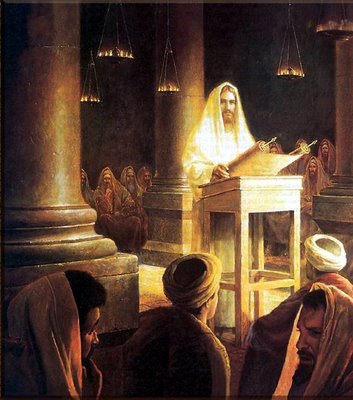
And he stood up to read: It was the custom of the Rabbi of the Synagogue to ask a visitor to read the lesson of the day. Christ began his preaching in the synagogues of Galilee, and at first was well received by the Jews.
16-30. For the Jews the Sabbath was a day of rest and prayer, as God commanded (Exodus 20:8-11). On that day they would gather together to be instructed
in Sacred Scripture. At the beginning of this meeting they all recited the “Shema”,a summary of the precepts of the Lord, and the “eighteen blessings”. Then a passage was read from the Book of the Law–the Pentateuch–and another from the Prophets. The president invited one of those present who was well versed in the Scriptures to address the gathering. Sometimes someone would volunteer and request the honor of being allowed to give this address–as must have happened on this occasion. Jesus avails Himself of this opportunity to instruct the people (cf. Luke 4:16ff), as will His Apostles later on (cf. Acts 13:5, 14, 42, 44; 14:1; etc.). The Sabbath meeting concluded with the priestly blessing, recited by the president or by a priest if there was one present, to which the people answered “Amen” (cf. Numbers 6:22ff).
The synagogue tradition apparently did not exist before the time of the Babylonian Exile. It was then, during the time when the Jews were away from Jerusalem and Solomon’s temple had been destroyed, that the Jews developed this way to keep the Law and Jewish traditions alive. In the First Reading from Nehemiah, we see something of a hint of this as the reading of the Law and worship by the people takes place *outside *the temple. We see in Jesus’ time, it was also practiced, even though the temple had been rebuilt. After the second temple is destroyed in AD 70, the Jews reverted back to the synagogue system, which they practice to this day.
spirit of the Lord is upon me: Most likely the reading for that Sabbath happened to be this messianic prophecy of second-Isaiah, or perhaps Christ chose this very prophecy. The words of Isaiah refer to the Messiah and the messianic liberation of all the people. The Messiah would be moved and enlightened by God. He would work miracles of healing and preach deliverance for all. He would bring the great Jubilee, when all God’s people would rejoice and receive God’s favors.
18-19. The words of Isaiah which Christ read out on this occasion describe very graphically the reason why God has sent His Son into the world – to redeem
men from sin, to liberate them from slavery to the devil and from eternal death. It is true that in the course of His public ministry Christ, in His mercy, worked many cures, cast out devils, etc. But He did not cure all the sick people in the world, nor did He eliminate all forms of distress in this life, because pain, which entered the world through sin, has a permanent redemptive value when associated with the sufferings of Christ. Therefore, Christ worked miracles not so much to release the people concerned from suffering, as to demonstrate that He had a God-given mission to bring everyone to eternal salvation.
- The Fathers of the Church see in this verse a reference to the three persons of the Holy Trinity: the Spirit (the Holy Spirit) of the Lord (the Father) is upon Me (the Son); cf. Origen, “Homily 32”. The Holy Spirit dwelt in Christ’s soul from the very moment of the Incarnation and descended visibly upon Him in the form of a dove when He was baptized by John (cf. Luke 3:21-22).
“Because He has anointed Me”: this is a reference to the anointing Jesus received at the moment of His Incarnation, principally through the grace of the hypostatic union. “This anointing of Jesus Christ was not an anointing of the body as in the case of the ancient kings, priests and prophets; rather it was entirely spiritual and divine, because the fullness of the Godhead dwells in Him substantially” (“St. Pius X Catechism”, 77). From this hypostatic union the fullness of all graces derives. To show this, Jesus Christ is said to have been anointed by the Holy Spirit Himself–not just to have received the graces and gifts of the Spirit, like the saints.
- “The acceptable year”: this is a reference to the jubilee year of the Jews, which the Law of God (Leviticus 25:8) lays down as occurring every fifty years, symbolizing the era of redemption and liberation which the Messiah would usher in. The era inaugurated by Christ, the era of the New Law extending to the end of the world, is “the acceptable year”, the time of mercy and redemption, which will be obtained definitively in Heaven.
The Catholic Church’s custom of the “Holy Year” is also designed to proclaim and remind people of the redemption brought by Christ, and of the full form it will take in the future life.
(continued below)