As we we did last week, let’s use the commentary from this week’s Catholic Matters study aid as a base, with commentary from the Navarre in blue, and my own comments (if any) in green.
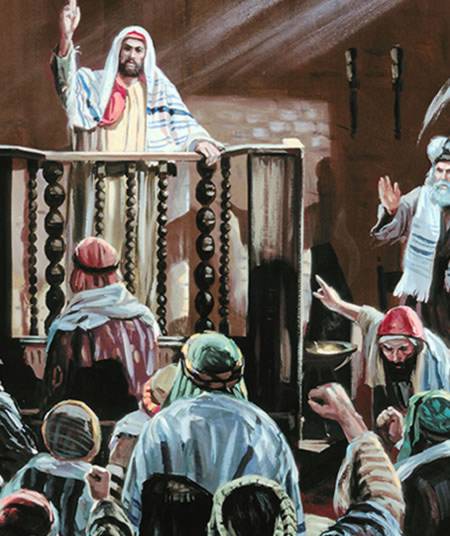
[21] **Today this Scripture . . . fulfilled: **He tells the congregation that these words of Isaiah are being fulfilled, that in other words, he himself was the promised Messiah.
The words being referred to (from last Sunday’s Gospel) are the words that Jesus read from the scroll of Isaiah:
*“The Spirit of the Lord is upon Me, because He has anointed Me to preach good news to the poor. He has sent Me to proclaim release to the captives and recovering of sight to the blind, to set at liberty those who are oppressed, [19] to proclaim the acceptable year of the Lord.” *
As noted in last week’s study, this was widely seen as a Messianic prophecy in the atmosphere of high expectancy that marked Jesus’ time. It was clear this was what John the Baptist and his followers were looking for, as we see later in Luke 7:18-23:
[18] The disciples of John (the Baptist) told him of all these things. [19] And John, calling to him two of his disciples, sent them to the Lord, saying, “Are You He who is to come, or shall we look for another?” [20] And when the men had come to Him, they said, “John the Baptist has sent us to You, saying, `Are You He who is to come, or shall we look for another?’” [21] In that hour He cured many of diseases and plagues and evil spirits, and on many that were blind He bestowed sight. [22] And He answered them, “Go and tell John what you have seen and heard: the blind receive their sight, the lame walk, lepers are cleansed, and the deaf hear, the dead are raised up, the poor have good news preached to them. [23] And blessed is he who takes no offense at Me.”
[22]
all spoke well of him: His sincerity and eloquence appealed to them, they “wondered at his discourse.” **Is not this Joseph’s son?: **But very soon they began to change their minds, they remembered he was the son of Joseph, the carpenter. That, of course, was the common opinion of him in his native town. Neither Mary nor Joseph had revealed the secret known to them only.
**20-22. **Christ’s words in verse 21 show us the authenticity with which He preached and explained the Scriptures: “Today this scripture has been fulfilled in your hearing.” Jesus teaches that this prophecy, like the other main prophecies in the Old Testament, refers to Him and finds its fulfillment in Him (cf. Luke 24:44ff). Thus, the Old Testament can be rightly understood only in the light of the New—as the risen Christ showed the Apostles when He opened their minds to understand the Scriptures (cf. Luke 24:45), an understanding which the Holy Spirit perfected on the day of Pentecost (cf. Acts 2:4).
“Is this not the carpenter’s son?” may either be an exclamation of amazement, or a sarcastic jibe at Jesus’ (apparently) humble origins and station in life. Strictly speaking, there was no "caste system in ancient Israel, but the social classes were strictly delineated. A carpenter would be quite near the bottom of the social order.
[23] **Physician, heal yourself: **He has read their hearts, they could not possibly accept that a mere carpenter’s son was the promised Messiah. He anticipated their challenge: how can you heal us if you are ill yourself, that is to say—how can you be the Messiah, the Son of King David, when you are only a very ordinary man, like the rest of us? **Do here . . . in your own country: **They were about to challenge his claim to work miracles. He could fool the people of Capernaum, a town some thirty-five miles away but not his own neighbors. **We have heard you did: **The implication is that the talk of miracles, worked by him, was empty rumor. Let him prove himself now. They would not be taken in so easily, as they knew all about him!
Variations of this saying (“Physician, heal thyself”) have been found all over antiquity. One ancient Greek manuscript contained a remark made in a sarcastic context; “Physician, heal thy own diseased limb.”
[24] **No prophet is acceptable in his own country: **This was and still is a fairly universally accepted fact.
[25]
But . . . I tell you: To show them that they were no better than their ancestors, he goes on to quote examples from the past, where prophets sent by God to the Chosen People were not listened to by the people, but that the Gentiles listened to them and were rewarded for so doing. (see 1
Kgs. 17 and
2 Kgs. 5 for these two incidents).
[26] **Elijah . . . but only to Zarephath: **Elijah worked a miracle to feed a Gentile widow during a three-and-a-half-year famine while many widows of Israel were given no such divine favor,
He also went on to raise her only son from the dead.
[27]
and the prophet Elisha: Elisha, the successor of Elijah, healed Naaman, the Syrian leper, a Gentile, while there were hundreds of lepers in Israel left uncured. The reason was in both cases that the Israelites refused to believe that these men were prophets sent by God.
(continued below)



 G 31,896B.