Jesus in the Four Gospels

  • Thread starter Thread starter patrick457
  • Start date Start date
Status
Not open for further replies.
We now delve into the Passion narrative in Mark, really the heart and the soul of the whole gospel. Toward the end of the 19th century, Martin Kähler (author of the essay The So-called Historical Jesus and the Historic, Biblical Christ) said that the gospels, and especially Mark’s, is “a passion narrative with an extended introduction.” The designation, while a bit of an oversimplification, is very fitting; Mark constructs his gospel such that this “extended introduction” prepares the way for the passion narrative by seeking to explain what led up to it. In fact, some people have made the observation that while Mark’s story of the end of Jesus’ life (often divided into four sections: the journey to Jerusalem in 8:30 up to chapter 10; the ministry in Jerusalem in chapters 11-13; the Passion proper in chapters 14-15, and the conclusion at chapter 16) is carefully constructed, the first half of the gospel is more loosely organized, almost as if they were just hastily cobbled together. Hence, some people have raised the suggestion that perhaps there was already a Passion narrative before Mark even wrote his gospel, who merely added some stuff into it. Against this it should said that even if a written Passion narrative already existed, nobody seriously suggests that Mark simply copied it down word-for-word, since the second half of the gospel has the same style and share the same themes as the first, pointing that the same author worked on both sections; it is an integral part of Mark’s gospel.

There is a clear break in the gospel after 8:26. In the first half of Mark, the action is largely set in the Galilee (as well as nearby regions), and we have a Jesus who publicly preaches about the kingdom of God in parables. Despite Mark’s introduction of Jesus as “Christ” and “son of God,” He never claims these titles for Himself, and silences everyone who proclaims Him to be such. And as said earlier, this Jesus is for some reason a loner, who disengages Himself from the crowds who follow Him by deliberate withdrawal. By the second half, however, the setting moves southwards to Judaea and Jerusalem. In contrast to the plethora of miracles Mark shows us in the first half, hardly any miracles are recorded; Jesus’ performance of miracles gradually decrease as the story hastens to its conclusion, so that when we get to the cross, Jesus refuses to miraculously come down off it. Instead of publicly teaching the crowds in parables, Jesus becomes occupied with privately teaching His disciples more “open,” but equally cryptic themes like His impending death or eschatological prophecies.
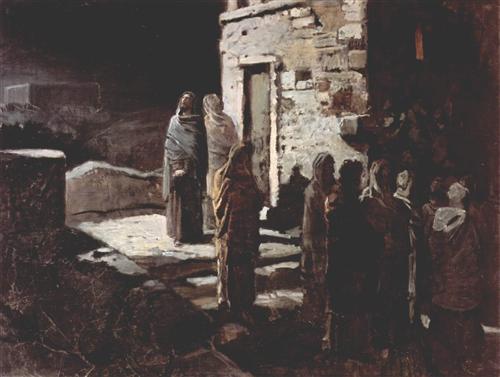


All the themes we’ve talked about: the blindness of the disciples, the messianic secret, the suffering Messiah, and the pervading dramatic irony show up in their fullest form during the last twenty-four hours of Jesus in Mark’s gospel.

After the Last Supper, we are treated to the following scene:

And when they had sung a hymn, they went out to the Mount of Olives. And Jesus said to them, “You will all fall away, (skandalisthēsesthe) for it is written, ‘I will strike the shepherd, and the sheep will be scattered.’ But after I am raised up, I will go before you to Galilee.” Peter said to him, “Even though they all fall away, (skandalisthēsontai) I will not.” And Jesus said to him, “Truly, I tell you, this very night, before the rooster crows twice, you will deny me three times.” But he said emphatically, “If I must die with you, I will not deny you.” And they all said the same.

Remember the parable of the sower earlier in Mark’s gospel? “And these are the ones sown on rocky ground: the ones who, when they hear the word, immediately receive it with joy. And they have no root in themselves, but endure for a while; then, when tribulation or persecution arises on account of the word, immediately they fall away (skandalizontai).” It is the same verb in Greek: skandalizomai, ‘to be scandalized’, ‘to stumble’, ‘to trip up’.

Despite their promises, however:

And they went to a place called Gethsemane. And he said to his disciples, “Sit here while I pray.” And he took with him Peter and James and John, and began to be greatly distressed and troubled. And he said to them, “My soul is very sorrowful, even to death. Remain here and watch.” And going a little farther, he fell on the ground and prayed that, if it were possible, the hour might pass from him. And he said, “Abba, Father, all things are possible for you. Remove this cup from me. Yet not what I will, but what you will.” And he came and found them sleeping, and he said to Peter, “Simon, are you asleep? Could you not watch one hour? Watch and pray that you may not enter into temptation. The spirit indeed is willing, but the flesh is weak.” And again he went away and prayed, saying the same words. And again he came and found them sleeping, for their eyes were very heavy, and they did not know what to answer him. And he came the third time and said to them, “Are you still sleeping and taking your rest? It is enough; the hour has come. The Son of Man is betrayed into the hands of sinners. Rise, let us be going; see, my betrayer is at hand.”

And immediately, while he was still speaking, Judas came, one of the twelve, and with him a crowd with swords and clubs, from the chief priests and the scribes and the elders. Now the betrayer had given them a sign, saying, “The one I will kiss is the man. Seize him and lead him away under guard.” And when he came, he went up to him at once and said, “Rabbi!” And he kissed him. And they laid hands on him and seized him. But one of those who stood by drew his sword and struck the servant of the high priest and cut off his ear. And Jesus said to them, “Have you come out as against a robber, with swords and clubs to capture me? Day after day I was with you in the temple teaching, and you did not seize me. But let the Scriptures be fulfilled.” And they all left him and fled. And a young man followed him, with nothing but a linen cloth about his body. And they seized him, but he left the linen cloth and ran away naked.

And they led Jesus to the high priest. And all the chief priests and the elders and the scribes came together. And Peter had followed him at a distance, right into the courtyard of the high priest. And he was sitting with the guards and warming himself at the fire. …] And as Peter was below in the courtyard, one of the servant girls of the high priest came, and seeing Peter warming himself, she looked at him and said, “You also were with the Nazarene, Jesus.” But he denied it, saying, “I neither know nor understand what you mean.” And he went out into the gateway and the rooster crowed. And the servant girl saw him and began again to say to the bystanders, “This man is one of them.” But again he denied it. And after a little while the bystanders again said to Peter, “Certainly you are one of them, for you are a Galilean.” But he began to invoke a curse on himself and to swear, “I do not know this man of whom you speak.” And immediately the rooster crowed a second time. And Peter remembered how Jesus had said to him, “Before the rooster crows twice, you will deny me three times.” And he broke down and wept.

Jesus’ words came true: the male disciples, like the seed which fell on rocky ground, were all ‘scandalized’ at the end, either having betrayed or abandoned Him. Jesus’ going through all this alone is further emphasized by Peter, James, and John falling asleep, as well as the young man (another one-shot character) who first attempts to follow Him but ending up running away as well, leaving his linen cloth behind.
 
Now the chief priests and the whole council were seeking testimony against Jesus to put him to death, but they found none. For many bore false witness against him, but their testimony did not agree. And some stood up and bore false witness against him, saying, “We heard him say, ‘I will destroy this temple that is made with hands, and in three days I will build another, not made with hands.’” Yet even about this their testimony did not agree. And the high priest stood up in the midst and asked Jesus, “Have you no answer to make? What is it that these men testify against you?” But he remained silent and made no answer. Again the high priest asked him, “Are you the Christ, the Son of the Blessed?” And Jesus said, “I am, and you will see the Son of Man seated at the right hand of Power, and coming with the clouds of heaven.” And the high priest tore his garments and said, “What further witnesses do we need? You have heard his blasphemy. What is your decision?” And they all condemned him as deserving death.

Here we see the end of the messianic secret: Jesus, under interrogation, finally admits to being “the Christ” and “the son of the Blessed.” (Notice that the high priest does not use the term “son of God”!) And this is interesting, because here we see that these titles are inextricably bound up with Jesus’ fate: as soon as the Markan Jesus confesses to being what the narrator, God and the demons have proclaimed Him to be since the beginning of the gospel, His doom is inevitable.

The following scenes further provides us with further dramatic irony:

And some began to spit on him and to cover his face and to strike him, saying to him, “Prophesy!” And the guards received him with blows.

Jesus is taunted to “prophesy” here, but what the people in the narrative who mock Him do not know (but what the audience hearing the story does know) is that they are at that very moment fulfilling Jesus’ earlier prophecy about how “the Son of Man must suffer many things and be rejected by the elders and the chief priests and the scribes and be killed.” (8:31) In addition, the following episode (14:66-72) recounts Peter’s denial, again in fulfillment of Jesus’ prophecy.

And as soon as it was morning, the chief priests held a consultation with the elders and scribes and the whole council. And they bound Jesus and led him away and delivered him over to Pilate. And Pilate asked him, “Are you the King of the Jews?” And he answered him, “You have said so.” And the chief priests accused him of many things. And Pilate again asked him, “Have you no answer to make? See how many charges they bring against you.” But Jesus made no further answer, so that Pilate was amazed.

Now at the feast he used to release for them one prisoner for whom they asked. And among the rebels in prison, who had committed murder in the insurrection, there was a man called Barabbas. And the crowd came up and began to ask Pilate to do as he usually did for them. And he answered them, saying, “Do you want me to release for you the King of the Jews?” For he perceived that it was out of envy that the chief priests had delivered him up. But the chief priests stirred up the crowd to have him release for them Barabbas instead. And Pilate again said to them, “Then what shall I do with the man you call the King of the Jews?” And they cried out again, “Crucify him.” And Pilate said to them, “Why, what evil has he done?” But they shouted all the more, “Crucify him.” So Pilate, wishing to satisfy the crowd, released for them Barabbas, and having scourged Jesus, he delivered him to be crucified.

And the soldiers led him away inside the palace (that is, the governor’s headquarters), and they called together the whole battalion. And they clothed him in a purple cloak, and twisting together a crown of thorns, they put it on him. And they began to salute him, “Hail, King of the Jews!” And they were striking his head with a reed and spitting on him and kneeling down in homage to him. And when they had mocked him, they stripped him of the purple cloak and put his own clothes on him. And they led him out to crucify him.

The scene of the trial before Pilate is rife with further irony. Pilate and the soldiers mock and torture Jesus for being ‘King of the Judaeans’ (traditionally ‘King of the Jews’), but the audience could not help but think, “Ah, but Jesus is a king!” I mean, the people who welcomed Jesus to Jerusalem said as much.

And they compelled a passerby, Simon of Cyrene, who was coming in from the country, the father of Alexander and Rufus, to carry his cross. And they brought him to the place called Golgotha (which means Place of a Skull). And they offered him wine mixed with myrrh, but he did not take it. And they crucified him and divided his garments among them, casting lots for them, to decide what each should take. And it was the third hour when they crucified him. And the inscription of the charge against him read, “The King of the Jews.” And with him they crucified two robbers, one on his right and one on his left.

Further irony here. Need I say more? :cool: Note that the two robbers are on either side of Jesus, which brings us back to an earlier episode:

And James and John, the sons of Zebedee, came up to him and said to him, “Teacher, we want you to do for us whatever we ask of you.” And he said to them, “What do you want me to do for you?” And they said to him, “Grant us to sit, one at your right hand and one at your left, in your glory.” Jesus said to them, “You do not know what you are asking. Are you able to drink the cup that I drink, or to be baptized with the baptism with which I am baptized?” And they said to him, “We are able.” And Jesus said to them, “The cup that I drink you will drink, and with the baptism with which I am baptized, you will be baptized, but to sit at my right hand or at my left is not mine to grant, but it is for those for whom it has been prepared.” And when the ten heard it, they began to be indignant at James and John. And Jesus called them to him and said to them, “You know that those who are considered rulers of the Gentiles lord it over them, and their great ones exercise authority over them. But it shall not be so among you. But whoever would be great among you must be your servant, and whoever would be first among you must be slave of all. For even the Son of Man came not to be served but to serve, and to give his life as a ransom for many.”

In other words, for Mark, Jesus the King has finally come “in [His] glory” by being hung on a cross.
 
And those who passed by derided him, wagging their heads and saying, “Aha! You who would destroy the temple and rebuild it in three days, save yourself, and come down from the cross!” So also the chief priests with the scribes mocked him to one another, saying, “He saved others; he cannot save himself. Let the Christ, the King of Israel, come down now from the cross that we may see and believe.” Those who were crucified with him also reviled him.

And when the sixth hour had come, there was darkness over the whole land until the ninth hour. And at the ninth hour Jesus cried with a loud voice, “Eloi, Eloi, lema sabachthani?” which means, “My God, my God, why have you forsaken me?”

Here is Mark emphasizing again how alone Jesus was. Virtually everyone - from the passersby to the chief priests to the robbers - is mocking Him (with words that drip further dramatic irony! :cool:), and even God is silent. As if to add further insult to injury, Mark again shows everyone as being ‘blind’ and ‘deaf’ to the point that they misinterpret Jesus’ cry.

And some of the bystanders hearing it said, “Behold, he is calling Elijah.” And someone ran and filled a sponge with sour wine, put it on a reed and gave it to him to drink, saying, “Wait, let us see whether Elijah will come to take him down.”

http://img694.imageshack.us/img694/1023/9921296.jpg

The Markan Jesus then dies in a rather gritty, unadorned way.

And Jesus uttered a loud cry and breathed his last. And the curtain of the temple was torn in two, from top to bottom. And when the centurion, who stood facing him, saw that in this way he breathed his last, he said, “Truly this man was the Son of God!”

For the very first time in the gospel, a human character (a gentile, to boot!) proclaims the now-dead Jesus as being the “son of God,” those exact same words. In Mark, there was really no grand reason for the centurion to make the declaration (there is no hint that he or anyone else saw the temple veil being torn at that exact moment - perhaps that is another dramatic irony :D); he had merely seen Jesus die. There are two ways of interpreting the centurion’s statement in Mark: one interprets it in the light of dramatic irony - the centurion meant his remark to be an off-hand, sarcastic insult in response to Jesus’ very inglorious death (“Huh, now this is the son of God”) - while the other interprets it as a straightforward, if rather paradoxical, confession. Both interpretations agree that Mark intended this piece of dialogue to proclaim Jesus’ true title which no human in the narrative had ever before spoken. The irony (there’s that word again) is that nowhere in the gospel had a human being recognized Jesus’ identity as “son of God” in the context of confession. It was not Jesus’ display of power - all the miracles and the healings - which penetrate the blindness of the witnesses, but His frailty at the cross.

Mark then focuses on the women disciples who were watching things from afar. The funny thing is that it is only here at the end of the gospel does he ever introduce them, when he himself states that they had been with Jesus ever since He was still in the Galilee.

There were also women looking on from a distance, among whom were Mary Magdalene, and Mary the mother of James the younger and of Joses, and Salome. When he was in Galilee, they followed him and ministered to him, and there were also many other women who came up with him to Jerusalem.

Mark seems to be at once commending and critical of the women. He commends them for their fidelity to Jesus even after all the male disciples have fled, but he also at the same time casts a dark shadow over it by noting that they were watching “from a distance,” like Peter in 14:54 (apo makrothen; cf. Psalm 38:11 LXX). Ultimately, we revert to the negative portrayal of the disciples in Mark’s gospel. Quoting Keefer again:

It must be said, however, that although Jesus explains very clearly that he is going to die, he never spells out why his sufferings must occur. While other books in the New Testament fill in this gap, in Mark the purpose of Jesus’ suffering and death remain opaque. It is not surprising, therefore, that the disciples–perhaps not the brightest students to begin with–recoil at Jesus’ strange insistence on his death. The crucifixion itself becomes one more parable that they do not understand. In fact, only one character in the entirety of the gospel does understand, and he shares only a few moments with Jesus. At the cross, the centurion who presides over the execution “saw that in this way he breathed his last” and proclaims, “Truly this man was God’s son.” This proclamation, made on the basis of whatever is meant by “in this way,” recalls the very first words of the gospel, when Mark called Jesus “Son of God.” This centurion is the only human character to agree publicly with Mark’s initial designation.
 
Before we move on, let’s show highlights of the characters in Mark being affected by their ‘blindness’ in the first half of the gospel. 😉

http://duncebrewery.com/dunce.jpg

And they came, bringing to him a paralytic carried by four men. And when they could not get near him because of the crowd, they removed the roof above him, and when they had made an opening, they let down the bed on which the paralytic lay. And when Jesus saw their faith, he said to the paralytic, “Son, your sins are forgiven.” Now some of the scribes were sitting there, questioning in their hearts, “Why does this man speak like that? He is blaspheming! Who can forgive sins but God alone?”

===

And as he reclined at table in [Levi’s] house, many tax collectors and sinners were reclining with Jesus and his disciples, for there were many who followed him. And the scribes of the Pharisees, when they saw that he was eating with sinners and tax collectors, said to his disciples, “Why does he eat with tax collectors and sinners?”

===

Again he entered the synagogue, and a man was there with a withered hand. And they watched Jesus, to see whether he would heal him on the Sabbath, so that they might accuse him. …] The Pharisees went out and immediately held counsel with the Herodians against him, how to destroy him.

===

Then he went home, and the crowd gathered again, so that they could not even eat. And when his family heard it, they went out to seize him, for they were saying, “He is out of his mind.” And the scribes who came down from Jerusalem were saying, “He is possessed by Beelzebul,” and “by the prince of demons he casts out the demons.” …]​

And a great windstorm arose, and the waves were breaking into the boat, so that the boat was already filling. But he was in the stern, asleep on the cushion. And they woke him and said to him, “Teacher, do you not care that we are perishing?” And he awoke and rebuked the wind and said to the sea, “Peace! Be still!” And the wind ceased, and there was a great calm. He said to them, “Why are you so afraid? Have you still no faith?” And they were filled with great fear and said to one another, “Who then is this, that even the wind and the sea obey him?”

===

And Jesus, perceiving in himself that power had gone out from him, immediately turned about in the crowd and said, “Who touched my garments?” And his disciples said to him, “You see the crowd pressing around you, and yet you say, ‘Who touched me?’”

===

He went away from there and came to his hometown, and his disciples followed him. And on the Sabbath he began to teach in the synagogue, and many who heard him were astonished, saying, “Where did this man get these things? What is the wisdom given to him? How are such mighty works done by his hands? Is not this the carpenter, the son of Mary and brother of James and Joses and Judas and Simon? And are not his sisters here with us?” And they took offense at him.

===

King Herod heard of it, for Jesus’ name had become known. Some said, “John the Baptist has been raised from the dead. That is why these miraculous powers are at work in him.” But others said, “He is Elijah.” And others said, “He is a prophet, like one of the prophets of old.” But when Herod heard of it, he said, “John, whom I beheaded, has been raised.”

===

http://www.toonpool.com/user/3447/files/blind_leading_the_blind_409025.jpg

And when it grew late, his disciples came to him and said, “This is a desolate place, and the hour is now late. Send them away to go into the surrounding countryside and villages and buy themselves something to eat.” But he answered them, “You give them something to eat.” And they said to him, “Shall we go and buy two hundred denarii worth of bread and give it to them to eat?”

===

And he saw that they were making headway painfully, for the wind was against them. And about the fourth watch of the night he came to them, walking on the sea. He meant to pass by them, but when they saw him walking on the sea they thought it was a ghost, and cried out, for they all saw him and were terrified. But immediately he spoke to them and said, “Take heart; it is I. Do not be afraid.” And he got into the boat with them, and the wind ceased. And they were utterly astounded, for they did not understand about the loaves, but their hearts were hardened.

===

Now when the Pharisees gathered to him, with some of the scribes who had come from Jerusalem, they saw that some of his disciples ate with hands that were defiled, that is, unwashed. …] And the Pharisees and the scribes asked him, “Why do your disciples not walk according to the tradition of the elders, but eat with defiled hands?”

===

In those days, when again a great crowd had gathered, and they had nothing to eat, he called his disciples to him and said to them, “I have compassion on the crowd, because they have been with me now three days and have nothing to eat. And if I send them away hungry to their homes, they will faint on the way. And some of them have come from far away.” And his disciples answered him, “How can one feed these people with bread here in this desolate place?”

===

The Pharisees came and began to argue with him, seeking from him a sign from heaven to test him.

===

Now they had forgotten to bring bread, and they had only one loaf with them in the boat. And he cautioned them, saying, “Watch out; beware of the leaven of the Pharisees and the leaven of Herod.” And they began discussing with one another the fact that they had no bread.

===

And he began to teach them that the Son of Man must suffer many things and be rejected by the elders and the chief priests and the scribes and be killed, and after three days rise again. And he said this plainly. And Peter took him aside and began to rebuke him.
Here is a better hat picture
 
P.S. You should have tried a smaller picture. 🙂

Which finally brings us to the end of Mark’s gospel, only in this case, it’s not so much a denouement as a cliffhanger.


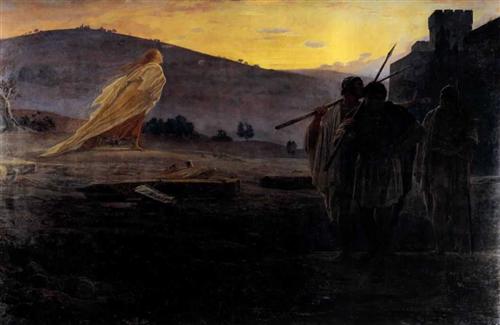
When the Sabbath was past, Mary Magdalene, Mary the mother of James, and Salome bought spices, so that they might go and anoint him. And very early on the first day of the week, when the sun had risen, they went to the tomb. And they were saying to one another, “Who will roll away the stone for us from the entrance of the tomb?” And looking up, they saw that the stone had been rolled back—it was very large. And entering the tomb, they saw a young man sitting on the right side, dressed in a white robe, and they were alarmed. And he said to them, “Do not be alarmed. You seek Jesus of Nazareth, who was crucified. He has risen; he is not here. See the place where they laid him. But go, tell his disciples and Peter that he is going before you to Galilee. There you will see him, just as he told you.” And they went out and fled from the tomb, for trembling and astonishment had seized them, and they said nothing to anyone, for they were afraid.

It is now widely agreed that the original gospel ends at this point, although there are differing opinions as to whether Mark intended to end here on purpose, or was prevented from finishing, or whether he wrote an ending which was subsequently lost. It is not only us moderns who are unsatisfied with this abrupt ending: we have a number of ‘endings’ attached to the gospel from antiquity which attempt to provide the rest of the story, the longest of which is familiar to many people as verses 9-20. The way 16:8 ends is rather odd in the original Greek, since it finishes with the conjunction gar (‘for’, ‘because’): literally translated the text would run, “they were afraid for.” While we do have some examples from Greek literature where gar may end a sentence (it was not a common construction, but although gar is never the first word of a sentence, there is no rule against it being the last word), Mark’s gospel would be the only narrative in antiquity to do so, if Mark did intend to finish here.

That being said, even if we assume that the author actually intended to end at 16:8 on purpose, the text as it stands is still very Markan in its theme.

Three of the women Mark had introduced just a while ago in the narrative figure prominently in this final pericope: Mary Magdalene, Mary the mother of James, and Salome, all of whom watched the dying Jesus “from a distance,” and two of whom saw where Joseph of Arimathaea buried Him. The women go to the tomb intending to anoint Jesus’ body, but all they find inside was a young man in white claiming that “Jesus the Nazarene, who was crucified…has been raised.” (Ēgerthē, the so-called ‘divine passive’ which we also see in 14:28; some translations like the ESV above unfortunately obscure this by turning the aorist passive into an active: “he is risen.”) The young man also adds that “the disciples and Peter” will “see” (one of those words in Mark’s gospel which is pregnant in meaning; cf. 13:26) Jesus again in the Galilee. The followers of Jesus who have repeatedly failed to understand anything throughout the course of the story, the disciples who ran away at Gethsemane and the Peter who disowned Jesus in the high priest’s courtyard (note the order the young man names them) are now to be given a fresh start: they will meet Jesus again in the place where it all began (1:16-20).

Once again, however, a dark cloud seems to loom over this great promise: the women are so struck with “fear” that they run away and fail to relay the young man’s words. And the irony (there it is again!) goes two ways, which harkens back to two overall themes of the gospel. Whereas back when Jesus forbade people to proclaim who He was or what He did they did so anyway, now when the young man explicitly orders the women to tell the male disciples news of Jesus’ resurrection, they could not even say a word. Also, Jesus never appears in person to confirm what the young man has claimed. We are told that He was raised, but Jesus has disappeared from the narrative, seemingly for good. This is why I’ve described Mark’s ending as a literal cliffhanger: the narrative moves at such a rapid pace (as mentioned, Mark sure does love using the words “and immediately” a lot) that when we get to the ending, we have to catch our breath to keep ourselves from falling off the figurative cliff.

Mark’s gospel thus ends enigmatically in confusing ambiguity. Just as Jesus has been isolated throughout the gospel yet continually puzzling everyone around Him, the gospel itself concludes by compounding the mystery, as if it were challenging the audience with the same questions Jesus posed to His disciples. Richard A. Burridge (Four Gospels, One Jesus? A Symbolic Reading) once said: “Mark’s narrative as we have it now ends as abruptly as it began. There was no introduction or background to Jesus’ arrival, and none for his departure. No one knew where he came from; no one knows where he has gone; and not many understood him when he was here.” By the end of the gospel, Mark encourages his listeners to carefully reflect on everything they have just heard, implicating the audience into the story (again quoting Burridge): “Mark’s story of Jesus becomes the story of his followers, and their story becomes the story of the readers. Whether they will follow or desert, believe or misunderstand, see him in Galilee or remain staring blindly into an empty tomb, depends on us.”
 
So that’s basically it for Mark. I’d just like to further tie up a few ends before going to the other three gospels.
 
In Mark 1:41, Jesus is approached by a leprous man, who asks to be healed. Some of the texts say Jesus was moved with compassion but some texts say Jesus was angry.
Was Jesus compassionate or angry at the man? Did the copists change it to eliminate Jesus’ anger?
 
In Mark 1:41, Jesus is approached by a leprous man, who asks to be healed. Some of the texts say Jesus was moved with compassion but some texts say Jesus was angry.
Was Jesus compassionate or angry at the man? Did the copists change it to eliminate Jesus’ anger?
It is true that while the majority of the manuscripts of Mark do have splanchnistheis (“having bowels that yearn,” in other words “moved with compassion”) there are a few which contain the curious variant orgistheis (Greek) or iratus (Latin), “becoming angry.” The late Bruce Metzger, in his Textual Commentary on the Greek New Testament, supports the traditional reading, saying thus about the variant:

It is difficult to come to a firm decision concerning the original text. On the one hand, it is easy to see why orgistheis (“being angry”) would have prompted over-scrupulous copyists to alter it to splagchnistheis (“being filled with compassion”), but not easy to account for the opposite change. On the other hand, a majority of the Committee was impressed by the following considerations. (1) The character of the external evidence in support of orgistheis is less impressive than the diversity and character of evidence that supports splagchnistheis. (2) At least two other passages in Mark, which represent Jesus as angry (3:5) or indignant (10:14), have not prompted over scrupulous copyists to make corrections. (3) It is possible that the reading orgistheis either (a) was suggested by embrimesamenos “warn sternly”] of ver. 43, or (b) arose from confusion between similar words in Aramaic (compare Syriac ethraham, “he had pity,” with ethra’am, “he was enraged”).

Maurice Casey (Jesus of Nazareth: An Independent Historian’s Account of His Life and Teaching), who theorizes that Mark is an unrevised translation of an Aramaic source, agrees in substance with Metzger here. R.T. France (in his commentary on Mark) disagrees with the second reason given by Metzger above, saying that in the other two passages in Mark (3:5; 10:14), the reasons why Jesus is angry or indignant is clear, in contrast to this particular passage, which is more ambiguous as to why.

However, even if we believe that orgistheis, being the more difficult reading, is more ‘original’ (under the principle of lectio difficilior potior), there is still the case that we don’t know the target of Jesus’ anger. Some do think that Jesus was angry at the leper: Luke Timothy Johnson (Faith’s Freedom: A Classic Spirituality for Contemporary Christians) proposes that Jesus was frustrated at the leper for ruining His desire to teach when everyone wanted Him as a healer, while William Loader (Jesus’ Attitude Towards the Law: A Study of the Gospels) suggests that Jesus was angry because the leper was walking around in public instead of isolating himself as expected. Others, however, disagree with these interpretations: for instance, France, Graham H. Twelftree (Jesus the Miracle Worker: A Historical and Theological Study), and Michael Green (The Meaning of Salvation), and Craig A. Evans (Bible Knowledge Background Commentary: Matthew-Luke) suggest that Jesus was not so much angry with the leper himself as He was with the disease itself and/or the system which had ostracized this man (and those like him) as an outcast on the grounds of ‘impurity’, forever dooming the man to a life outside of ‘normal’ society, while Robert H. Stein does not prefer any one idea over the other.
 
There is one thing I’d like to introduce before I move to Matthew.

One of the unique features of Mark’s gospel are two stories - not found in Matthew or Luke - where Jesus heals people in a rather physical (one could even say ‘primitive’) way by applying saliva to the affected body part and touching with the fingers or hands - both common gestures in ancient healings.

(Please Note: This uploaded content is no longer available.)

Then he returned from the region of Tyre and went through Sidon to the Sea of Galilee, in the region of the Decapolis. And they brought to him a man who was deaf and had a speech impediment, and they begged him to lay his hand on him. And taking him aside from the crowd privately, he put his fingers into his ears, and after spitting touched his tongue. And looking up to heaven, he sighed and said to him, “Ephphatha,” that is, “Be opened.” And his ears were opened, his tongue was released, and he spoke plainly. And Jesus charged them to tell no one. But the more he charged them, the more zealously they proclaimed it. And they were astonished beyond measure, saying, “He has done all things well. He even makes the deaf hear and the mute speak.”

=====

And they came to Bethsaida. And some people brought to him a blind man and begged him to touch him. And he took the blind man by the hand and led him out of the village, and when he had spit on his eyes and laid his hands on him, he asked him, “Do you see anything?” And he looked up and said, “I see people, but they look like trees, walking.” Then Jesus laid his hands on his eyes again; and he opened his eyes, his sight was restored, and he saw everything clearly. And he sent him to his home, saying, “Do not even enter the village.”

The latter pericope is especially interesting in that it immediately precedes Peter’s confession at Caesarea Philippi: Peter ‘sees’ that Jesus is “the Christ,” but he does not ‘see’ that the Messiah must suffer. Unlike the blind man, Peter is stuck with walking trees. Here again is a typical example of Markan irony: like the man, Peter (and the reader) are going to need a second stage - the second half of the gospel.
 
sigh… very sorry for ranting once more… as expected, we don’t have a straight “this is, this is not” aswer again… (no, I’m not angry or disappointed with you, I know nobody will know, want to make this clear in case I might offend you, which I ultimately don’t intend to offend or hurt anybody in this forum) but I’m really frustrated we can never get a straight answer in anything related to religion… 😦
Sometimes I really wonder if it’s worth questioning this stuff, seems to lead nowhere… 😦
 
sigh… very sorry for ranting once more… as expected, we don’t have a straight “this is, this is not” aswer again… (no, I’m not angry or disappointed with you, I know nobody will know, want to make this clear in case I might offend you, which I ultimately don’t intend to offend or hurt anybody in this forum) but I’m really frustrated we can never get a straight answer in anything related to religion… 😦
Sometimes I really wonder if it’s worth questioning this stuff, seems to lead nowhere… 😦
That’s life for you. The last thing you should ever expect to get is a clear “yes” or “no.”
 
While Christians often expect that part of what it meant for Jesus to be “the Christ” was to suffer and die for the sins of the world, there was no such concept in the ancient world. In other words, the Jews did not have any idea of God’s anointed dying an ignoble death.
Apparently, only John the Baptist knew of Jesus’ fate beforehand, as seen in John 1:29:
“The next day John saw Jesus coming toward him and said, “Look, the Lamb of God, who takes away the sin of the world!”
Even though John (the Apostle/Evangelist) knew that quotation from John the Baptist, it took them over half a century to realize what he really meant by that? Shouldn’t the Apostles have realized that by the time Mark wrote his gospel already? 🤷
John the Apostle apparently only realized that when he was at a very very old age… :eek:
 
Apparently, only John the Baptist knew of Jesus’ fate beforehand, as seen in John 1:29:
“The next day John saw Jesus coming toward him and said, “Look, the Lamb of God, who takes away the sin of the world!”
Even though John (the Apostle/Evangelist) knew that quotation from John the Baptist, it took them over half a century to realize what he really meant by that? Shouldn’t the Apostles have realized that by the time Mark wrote his gospel already? 🤷
John the Apostle apparently only realized that when he was at a very very old age… :eek:
As per the other gospels, Jesus told them afterwards, apparently. Besides, Pentecost. 😉 You could also argue that Mark simply chose to highlight (dare I say ‘exaggerate’) the disciples’ pre-Easter slow comprehension and failure as a means to comment on the situation at his time. In this scenario, by the time Mark was writing there were Christians who were acting pretty much like the disciples in the narrative - having trouble with the very same concept of a crucified Messiah and suffering in general - so the author intended the gospel as a means to teach them to that suffering is not so bad after all and to encourage them to hold on to the faith and never fail like his gospel’s disciples do.
 
As per the other gospels, Jesus told them afterwards, apparently. Besides, Pentecost. 😉 You could also argue that Mark simply chose to highlight (dare I say ‘exaggerate’) the disciples’ pre-Easter slow comprehension and failure as a means to comment on the situation at his time. In this scenario, by the time Mark was writing there were Christians who were acting pretty much like the disciples in the narrative - having trouble with the very same concept of a crucified Messiah and suffering in general - so the author intended the gospel as a means to teach them to that suffering is not so bad after all and to encourage them to hold on to the faith and never fail like his gospel’s disciples do.
This is also one of the ultimate purposes of the “little apocalypse” of chapter 13, where Jesus gives out words of encouragement and warning that would have resonated with the original audiences of the gospel just as it would have with the disciples.

And Jesus began to say to them, “See that no one leads you astray. Many will come in my name, saying, ‘I am he!’ and they will lead many astray. And when you hear of wars and rumors of wars, do not be alarmed. This must take place, but the end is not yet. For nation will rise against nation, and kingdom against kingdom. There will be earthquakes in various places; there will be famines. These are but the beginning of the birth pains.

But be on your guard. For they will deliver you over to councils, and you will be beaten in synagogues, and you will stand before governors and kings for my sake, to bear witness before them. And the gospel must first be proclaimed to all nations. And when they bring you to trial and deliver you over, do not be anxious beforehand what you are to say, but say whatever is given you in that hour, for it is not you who speak, but the Holy Spirit. And brother will deliver brother over to death, and the father his child, and children will rise against parents and have them put to death. And you will be hated by all for my name’s sake. But the one who endures to the end will be saved.

“But when you see the abomination of desolation standing where he ought not to be (let the reader understand), then let those who are in Judea flee to the mountains. Let the one who is on the housetop not go down, nor enter his house, to take anything out, and let the one who is in the field not turn back to take his cloak. And alas for women who are pregnant and for those who are nursing infants in those days! Pray that it may not happen in winter. For in those days there will be such tribulation as has not been from the beginning of the creation that God created until now, and never will be. And if the Lord had not cut short the days, no human being would be saved. But for the sake of the elect, whom he chose, he shortened the days. And then if anyone says to you, ‘Look, here is the Christ!’ or ‘Look, there he is!’ do not believe it. For false christs and false prophets will arise and perform signs and wonders, to lead astray, if possible, the elect. But be on guard; I have told you all things beforehand.

“But in those days, after that tribulation, the sun will be darkened, and the moon will not give its light, and the stars will be falling from heaven, and the powers in the heavens will be shaken. And then they will see the Son of Man coming in clouds with great power and glory. And then he will send out the angels and gather his elect from the four winds, from the ends of the earth to the ends of heaven.

“From the fig tree learn its lesson: as soon as its branch becomes tender and puts out its leaves, you know that summer is near. So also, when you see these things taking place, you know that he is near, at the very gates. Truly, I say to you, this generation will not pass away until all these things take place. Heaven and earth will pass away, but my words will not pass away.

“But concerning that day or that hour, no one knows, not even the angels in heaven, nor the Son, but only the Father. Be on guard, keep awake. For you do not know when the time will come. It is like a man going on a journey, when he leaves home and puts his servants in charge, each with his work, and commands the doorkeeper to stay awake. Therefore stay awake—for you do not know when the master of the house will come, in the evening, or at midnight, or when the rooster crows, or in the morning—lest he come suddenly and find you asleep. And what I say to you I say to all: Stay awake.”
 
Status
Not open for further replies.
Back
Top