A
angell1
Guest
why did the jews never make statues of abraham, moses and all the other important old testament saints?

I don’t know of any Semitic culture-- Jewish or pagan-- that made statues of their great men. The Mesopotamians, Egyptians and the Greeks all did, but statue making (except for the small cultic images that some of the pagans worshipped and which Israel sometimes copied) doesn’t seem to have been part of their culture-- even BEFORE the 10 Commandments were given.why did the jews never make statues of abraham, moses and all the other important old testament saints?
except for the temple of solomon… there seemed to be plenty of statues there, just not of moses, abraham or any oef the other important peopleI don’t know of any Semitic culture-- Jewish or pagan-- that made statues of their great men. The Mesopotamians, Egyptians and the Greeks all did, but statue making (except for the small cultic images that some of the pagans worshipped and which Israel sometimes copied) doesn’t seem to have been part of their culture-- even BEFORE the 10 Commandments were given.
And don’t forget: for most of Old Testament history, the Israelites were nomadic and rather primitive. You don’t see a lot of nomadic and primitive tribes making statues.
Out of fear, their honouring the Patriarchs would turn into worship just as they fear saying God out loud (which is why they type it as G-d) in case they violate the commandment not to take the Lord’s name in vain.why did the jews never make statues of abraham, moses and all the other important old testament saints?
The only freestanding statuary in the Temple of Solomon are the two gigantic cherubim inside the Holy of Holies. Most of the others described are more like relief carvings.except for the temple of solomon… there seemed to be plenty of statues there, just not of moses, abraham or any oef the other important people

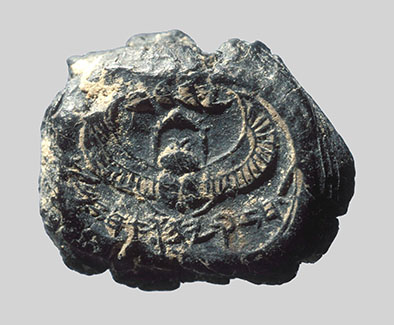
The interpretation of the prohibition of images fluctuated from lax to strict and then back to lax throughout Israelite/Jewish history. Before the Exile, it was interpreted more along the lines of not being allowed to depict God - which even then wasn’t always followed on the popular level - and not to worship other gods. So apparently, representations of stuff like cherubim, lions, bulls and trees weren’t considered to be a violation of the commandment. We even have seal impressions on the handles of royal Judahite storage jars and even some personal seals (such as those of pious King Hezekiah - see below) which carry images of winged sun disks and scarabs (dung beetles; Egyptian/Phoenician) and later, rosettes (Assyrian-Babylonian):Obviously the Protestant fundamentalist interpretation of the Jewish prohibition of images is a bit off.

I disagree with the statement that the Israelites were nomadic for most of their history, and that they were primitive.I don’t know of any Semitic culture-- Jewish or pagan-- that made statues of their great men. The Mesopotamians, Egyptians and the Greeks all did, but statue making (except for the small cultic images that some of the pagans worshipped and which Israel sometimes copied) doesn’t seem to have been part of their culture-- even BEFORE the 10 Commandments were given.
And don’t forget: for most of Old Testament history, the Israelites were nomadic and rather primitive. You don’t see a lot of nomadic and primitive tribes making statues.
I didn’t say for most of their history, I said for most of the time described in the Old Testament (which is what the OP was asking). From Abraham to David was about 1000 years, but from David to to the destruction of the Temple and the Exile (the 1st Temple period) was less than 400 years. Even during the time of the First Temple period, when the city of Jerusalem was the capital and there were a couple of other good-sized towns, most Israelites were rural-- shepherds and farmers.I disagree with the statement that the Israelites were nomadic for most of their history, and that they were primitive.
Abraham was certainly a nomad and his family went into Egypt while the patriarch was still alive. The tribes stayed in Egypt however for 450 years, wandered the desert for only 40 years, and were then given their portion of the promised lands by Joshuah immediately after crossing the Jordan river. There they stayed until the exile hundreds of years later. The ten northern tribes never came back from exile but the tribe of Judah and Benjamin returned to Judea where they stayed until 70 AD. For most of their history they stayed put.
The Israelites built a water system for Jerusalem under King Hezekiah (2 Kings 20) which was highly advanced for its time. They built the temple and had experience in most trades and crafts with the exception of iron working - they were not that good with making things from metal.
-Tim-