Lazarus in Luke and John

  • Thread starter Thread starter Melkite_Sword
  • Start date Start date
Status
Not open for further replies.
M

Melkite_Sword

Guest
Is the Lazarus in Luke’s Gospel the same as the one in John? I can’t help but notice the coincidences. What is interesting to me is that one is a parable (Luke) and the other is an event (John)… ???

 
There does not appear to be any similarities between the poor man Lazarus in Luke’s Gospel and Lazarus from Bethany (Jesus’ friend) in John’s Gospel. The only thing they share in common is their name. Lazarus in Luke’s Gospel is poor and destitute and apparently homeless (he lays at the rich man’s gate). The Lazarus from John’s Gospel is a friend of Jesus who lives with his sisters Mary and Martha in Bethany (where Jesus probably stayed when he was in the area). Lazarus’ sister Mary anointed Jesus ‘with a costly ointment of pure nard’, which according to John’s Gospel was worth three hundred denarii (about one year of salary for a laborer). So it does not sound like this Lazarus was destitute like the Lazarus in the parable from Luke’s Gospel.
 
Which Lazarus, the poor man or the one Jesus raised?
OP has to be talking both, because Lazarus and the rich man is in one, and Lararus raised from the dead another…they do not both appear in Luke and John.
 
Lazarus is not a very common name today, but it is still a given name in the Jewish community; it comes from the Hebrew meaning “God has helped”.

Helped, indeed!
 
Is the Lazarus in Luke’s Gospel the same as the one in John? I can’t help but notice the coincidences. What is interesting to me is that one is a parable (Luke) and the other is an event (John)… ???
Personally I don’t think so. As was mentioned, the ‘Lazarus’ in the Lukan parable (who is unique in that he is the only character out of all Jesus’ recorded parables to ever have a name - from the Hebrew Eleazar) is portrayed as being a beggar. In John, however, the implication s that Lazarus was a man of means - as evidenced by the fact that Mary of Bethany anoints Jesus with three hundred denarii worth of spikenard ointment and that Lazarus is recorded as apparently being buried in a burial cave (John 11:38).

Now, conflation of the two did occur during the medieval period: because the Lazarus of the parable had a name many people assumed that he was a real person, and very often he was considered to be one and the same as Lazarus of Bethany. This explains why the Order of Saint Lazarus, a number of leper hospitals and hospices, as well as lepers in general in the Middle Ages all claimed Lazarus of Bethany as their patron and honored his feast day (17th December).
 
I think they are the same; but I don’t think the parable is relating a scientific account of Lazarus’ life. Parables are about things that people could see, and which were near to them (real events); however, they are spoken about in veiled language.

The word Parable indicates something(s) thrown beside each-other; these things thrown together (haphazardly?) are to be compared and contrasted.

In the vineyard parables, for example, the vineyard it clearly to be compared with “Israel”. In the farming parables, the “earth” represents people, or the “seed” does, etc.

In this way, one doesn’t need to see the rich man as a literal rich-man. It may well represent the Priests, Pharisees, or other figures of authority to whom God gave gifts to share; it was, for example, the Priest’s duty to cast out demons, or attempt cure’s. Lazarus had sores, and is presumed a leper – but even that is suspect – for a literal Leper could not come anywhere near a non-leper rich man’s house. (Law prevents such things.) The reasoning of the parable here is obscure to me…

Scott Hahn (whom I often consider cavalier, but on this point I solidly agree) notes the similarity of Jesus’ emotional posture toward both Lazarus’s.

Jesus is quite angry with the rich man of the parable, and quite disturbed at parabolic Lazarus’ death – presumably without need. (Hellfire being assigned the rich man is a stark reminder of how extreme Jesus’ anger was).

The actual Lazarus, too, died. This too is very disturbing to our Lord emotionally – John 11:33-36.

The parabolic rich man asks that Lazarus be sent back so that his brothers may repent; The real Lazarus is also a sign to the Pharisees and even the high priest – who follow the exact words of Abraham concerning their disbelief; John 11:46 and especially 11:50-52.

There is enough here to grasp a solid connection between the parable’s teaching – and the events of salvation history; even if every point of the parable is not yet understood in detail.

I have never seen evidence that this “brother” of Mary lived in their house; nor that he had a house of his own. What we know is that Jesus loved Lazarus – and that Mary, who broke the oil jars over Jesus’ feet – prophesied the burial of our Lord; and also buried Lazarus; for this reason it may be supposed that possibly Lazarus was cared for by Mary/Martha on account of Jesus’ teaching, and as an alms to a more distant cousin than a blood/breast brother – for the annointing of Jesus’ feet is specifically brought up in connection with Lazarus’ death; John 11:2. It is in John 11:1 that we learn he is of the same “town” as Martha and Mary that Lazarus belongs.

I do respect other’s opinion that it isn’t the same Lazarus – but if is not the same man, then still by “Lazarus” Jesus meant other people who rose from the dead; not just one specific man. It is also the boy that Elijah brought back from the dead, it is Jonas, the one mentioned in the book of Tobit (at the end, and at Nineveh).
etc.
 
I think they are the same; but I don’t think the parable is relating a scientific account of Lazarus’ life. Parables are about things that people could see, and which were near to them (real events); however, they are spoken about in veiled language.

The word Parable indicates something(s) thrown beside each-other; these things thrown together (haphazardly?) are to be compared and contrasted.

In the vineyard parables, for example, the vineyard it clearly to be compared with “Israel”. In the farming parables, the “earth” represents people, or the “seed” does, etc.

In this way, one doesn’t need to see the rich man as a literal rich-man. It may well represent the Priests, Pharisees, or other figures of authority to whom God gave gifts to share; it was, for example, the Priest’s duty to cast out demons, or attempt cure’s. Lazarus had sores, and is presumed a leper – but even that is suspect – for a literal Leper could not come anywhere near a non-leper rich man’s house. (Law prevents such things.) The reasoning of the parable here is obscure to me…

Scott Hahn (whom I often consider cavalier, but on this point I solidly agree) notes the similarity of Jesus’ emotional posture toward both Lazarus’s.

Jesus is quite angry with the rich man of the parable, and quite disturbed at parabolic Lazarus’ death – presumably without need. (Hellfire being assigned the rich man is a stark reminder of how extreme Jesus’ anger was).

The actual Lazarus, too, died. This too is very disturbing to our Lord emotionally – John 11:33-36.

The parabolic rich man asks that Lazarus be sent back so that his brothers may repent; The real Lazarus is also a sign to the Pharisees and even the high priest – who follow the exact words of Abraham concerning their disbelief; John 11:46 and especially 11:50-52.

There is enough here to grasp a solid connection between the parable’s teaching – and the events of salvation history; even if every point of the parable is not yet understood in detail.

I have never seen evidence that this “brother” of Mary lived in their house; nor that he had a house of his own. What we know is that Jesus loved Lazarus – and that Mary, who broke the oil jars over Jesus’ feet – prophesied the burial of our Lord; and also buried Lazarus; for this reason it may be supposed that possibly Lazarus was cared for by Mary/Martha on account of Jesus’ teaching, and as an alms to a more distant cousin than a blood/breast brother – for the annointing of Jesus’ feet is specifically brought up in connection with Lazarus’ death; John 11:2. It is in John 11:1 that we learn he is of the same “town” as Martha and Mary that Lazarus belongs.

I do respect other’s opinion that it isn’t the same Lazarus – but if is not the same man, then still by “Lazarus” Jesus meant other people who rose from the dead; not just one specific man. It is also the boy that Elijah brought back from the dead, it is Jonas, the one mentioned in the book of Tobit (at the end, and at Nineveh).
etc.
There was actually an interpretation (among many) which goes that the parable was, like that of the tenants, a veiled attack against the Temple priesthood, more specifically the high priestly family. The ‘rich man’ is supposed to represent the high priest (Caiaphas), with the father and five brothers standing for ex-high priest Ananus/Annas (Caiaphas’ father-in-law) and his five biological sons, one of whom was Caiaphas’ immediate predecessor with the other four also coming to hold the office after him (three of them in succession). Then there’s the whole ‘not believing even if Lazarus is raised from the dead’ bit.
 
I think they are the same; but I don’t think the parable is relating a scientific account of Lazarus’ life. Parables are about things that people could see, and which were near to them (real events); however, they are spoken about in veiled language.

The word Parable indicates something(s) thrown beside each-other; these things thrown together (haphazardly?) are to be compared and contrasted.

In the vineyard parables, for example, the vineyard it clearly to be compared with “Israel”. In the farming parables, the “earth” represents people, or the “seed” does, etc.

In this way, one doesn’t need to see the rich man as a literal rich-man. It may well represent the Priests, Pharisees, or other figures of authority to whom God gave gifts to share; it was, for example, the Priest’s duty to cast out demons, or attempt cure’s. Lazarus had sores, and is presumed a leper – but even that is suspect – for a literal Leper could not come anywhere near a non-leper rich man’s house. (Law prevents such things.) The reasoning of the parable here is obscure to me…

Scott Hahn (whom I often consider cavalier, but on this point I solidly agree) notes the similarity of Jesus’ emotional posture toward both Lazarus’s.

Jesus is quite angry with the rich man of the parable, and quite disturbed at parabolic Lazarus’ death – presumably without need. (Hellfire being assigned the rich man is a stark reminder of how extreme Jesus’ anger was).

The actual Lazarus, too, died. This too is very disturbing to our Lord emotionally – John 11:33-36.

The parabolic rich man asks that Lazarus be sent back so that his brothers may repent; The real Lazarus is also a sign to the Pharisees and even the high priest – who follow the exact words of Abraham concerning their disbelief; John 11:46 and especially 11:50-52.

There is enough here to grasp a solid connection between the parable’s teaching – and the events of salvation history; even if every point of the parable is not yet understood in detail.

I have never seen evidence that this “brother” of Mary lived in their house; nor that he had a house of his own. What we know is that Jesus loved Lazarus – and that Mary, who broke the oil jars over Jesus’ feet – prophesied the burial of our Lord; and also buried Lazarus; for this reason it may be supposed that possibly Lazarus was cared for by Mary/Martha on account of Jesus’ teaching, and as an alms to a more distant cousin than a blood/breast brother – for the annointing of Jesus’ feet is specifically brought up in connection with Lazarus’ death; John 11:2. It is in John 11:1 that we learn he is of the same “town” as Martha and Mary that Lazarus belongs.

I do respect other’s opinion that it isn’t the same Lazarus – but if is not the same man, then still by “Lazarus” Jesus meant other people who rose from the dead; not just one specific man. It is also the boy that Elijah brought back from the dead, it is Jonas, the one mentioned in the book of Tobit (at the end, and at Nineveh).
etc.
hmm thank you very much for your reply :). Where does Scott Hahn mention it, can you please provide a reference? I tried doing a google search but nothing came up.
 
Is the Lazarus in Luke’s Gospel the same as the one in John? I can’t help but notice the coincidences. What is interesting to me is that one is a parable (Luke) and the other is an event (John)… ???
These are two distinct persons… St. Luke’s parable depicts a scene where end of times event takes place… all of the characters serve to Teach one important lesson… though it is interesting that Jesus chose to name His main character on this occasion, the fact remains that His friend, Lazarus, is far removed from the story:

a) Lazarus, the friend: family, well-known and liked, owned/rented property, was able to host events and remained alive (after Jesus brought him back from the dead).

vs.

b) Lazarus, the underdog of the parable: destitute, rejected, ignored, suffered hunger and the incidentals (environment, homeless, jobless, sick…).

Interestingly enough, many seem to ignore Jesus’ revelation: “even if a man (Son of Man) came back from the dead, they would not Believe!”

Maran atha!

Angel
 
hmm thank you very much for your reply :). Where does Scott Hahn mention it, can you please provide a reference? I tried doing a google search but nothing came up.
I am not sure how to locate it; I am pretty sure I was listening to him either through Catholic answer’s , or on a Scott Hahn audio tape.
The discussion was some 5 to 8 years ago; but it made a strong impression on me.

Catholic Answer’s keeps a radio archive, I am pretty sure…
If so, you might try searching it for Scott Hahn, and listening to them.

Best wishes…
–Andrew.
 
These are two distinct persons… St. Luke’s parable depicts a scene where end of times event takes place… all of the characters serve to Teach one important lesson… though it is interesting that Jesus chose to name His main character on this occasion, the fact remains that His friend, Lazarus, is far removed from the story:

a) Lazarus, the friend: family, well-known and liked, owned/rented property, was able to host events and remained alive (after Jesus brought him back from the dead).

vs.

b) Lazarus, the underdog of the parable: destitute, rejected, ignored, suffered hunger and the incidentals (environment, homeless, jobless, sick…).

Interestingly enough, many seem to ignore Jesus’ revelation: “even if a man (Son of Man) came back from the dead, they would not Believe!”

Maran atha!

Angel
I was wondering if Our Lord was not poking fun a little of his rich friend Lazarus in giving his name to the destitute sickly beggar of the parable?
 
I was wondering if Our Lord was not poking fun a little of his rich friend Lazarus in giving his name to the destitute sickly beggar of the parable?
I though something similar… but more on the side of acknowledging his good qualities; Jesus friend, Lazarus, seemed to be well-liked and known and a generous host–these qualities could easily have given rise to that of Lazarus of the parable as this man did not hold a grudge, was known and accepted even by the wealthy, and dogs attempted to diminish his pain… :hmmm:

Maran atha!

Angel
 
I was wondering if Our Lord was not poking fun a little of his rich friend Lazarus in giving his name to the destitute sickly beggar of the parable?
🙂

Except the wishing to fill his belly with the scraps from the rich man’s table; I wonder if having one’s sores licked by dogs is a sign of destitution.
I mean, that’s medicinal after all.

Even a rich man, when ill, could not be healed as we take for granted in a modern medical facility. Even the Emperor’s of Rome and the Kings (Herod?) fell ill to sudden and mortal illnesses from which there was no cure by antibiotics or minor surgery.

Some dogs are friendly – but the ancients generally didn’t keep them as mere pets. The Mastiff, for example, was meant to guard the home and wife and children – so that when the Roman soldier went off to war; when they got home they STILL had a wife and children.

But, in the case of Lazarus, what makes you think he was rich?

I am thinking it is Beth-ania, the house of the poor?
eg: It is not the same Beth-anias, of Mark 14:3?
I need to guess the Hebrew from the sound, beth is obviously house.
Ania / Anias, is perhaps aniwim? “poor” ? I’ll have to look, but it’s very close.

"And while he was in the house of Simon the leper, at Beth-any, sitting at table, a woman came in with a pot of very precious spikenard ointment, which, first breaking the pot …

But Jesus said, Let her alone; why should you vex her? She did well to treat me so. You have the poor among you always … she has anointed my body beforehand to prepare it for burial."

It sounds like a place of disease and alms-giving to me.
And Jesus explicitly tells us of his body in John, at the place of Lazarus’ burial.

“John 11:24 Martha said to him, I know well enough that he will rise again at the resurrection, when the last day comes. Jesus said to her, I am the resurrection.”

Present and continual life is in the Body of Jesus; who associated himself with the poor. Lazarus was part of that body; who, then, anointed him for burial?

In the RKV, it does not say a stone hewn tomb … although, in likeness to Jesus, he is placed in something similar; It says:
“John 11:34 Where have you laid him? he asked. Lord, they said to him, come and see.”

Strange, that Lazarus were really rich – with his own garden and tomb – that Jesus wouldn’t know where he was. He did know and love Lazarus specially.

“John 11:38 So Jesus, once more sighing to himself, came to the tomb; it was a cave, and a stone had been placed over the mouth of it.”

biblos.com/john/11-38.htm

The word immediately after tomb – is a contradistinction word, the most common (literal) translation of the word is “But”;
biblos.com says the word is “moreover”, which is less often used – but acceptable. The “cave” comment is used to clarify that Lazarus’ burial wasn’t a glorious tomb … but something different than the word tomb might signify.

I am wondering if this tomb is more of a common catacomb; for I don’t suppose it was special like the rich man’s tomb which Jesus was laid in – although the rock laid in front of Lazarus’ cave is a more decorative kind of rock. (Lithos.)

Often, Lepers lived in wild places – in Caves, even. This might even been where he lived up and until he died?
 
I though something similar… but more on the side of acknowledging his good qualities; Jesus friend, Lazarus, seemed to be well-liked and known and a generous host–these qualities could easily have given rise to that of Lazarus of the parable as this man did not hold a grudge, was known and accepted even by the wealthy, and dogs attempted to diminish his pain… :hmmm:

Maran atha!

Angel
Hi Angel!

Poking pfun yourself ? 🙂

Yes, I think Lazarus was not a grudge holder. His affliction, and illness, would be seen as something from God himself by many of that time. Both Lazarus’ share that history. But he didn’t rob the rich man in the parable; nor would Jesus have been said to have loved the real Lazarus specially if Lazarus were a thug-hypocrite in life.

Jesus associated himself with sinners, but he loved those who did the father’s will. It is these he would call “friends.”

What do you make of this, below?
“John 11:14 So now, Jesus told them openly, Lazarus is dead. And for your sakes, I am glad I was not there.”

Did not Jesus, then, choose Lazarus’ lot in life and his death?
For at the sight of weeping – Perhaps Jesus would have not been able to resist preventing Lazarus’ death ?
 
🙂

Except the wishing to fill his belly with the scraps from the rich man’s table; I wonder if having one’s sores licked by dogs is a sign of destitution.
I mean, that’s medicinal after all.
Really? I know that dog saliva (or for that matter, saliva in general) does get ascribed curative properties in old wives’ tales and does seem to have some bactericidal effects against Escherichia coli and Streptococcus canis, but there seems to be much more risks in allowing animals to lick sores.
But, in the case of Lazarus, what makes you think he was rich?

I am thinking it is Beth-ania, the house of the poor?
eg: It is not the same Beth-anias, of Mark 14:3?
I need to guess the Hebrew from the sound, beth is obviously house.
Ania / Anias, is perhaps aniwim? “poor” ? I’ll have to look, but it’s very close.
The exact etymology of Bethania is uncertain. One theory does propose that it comes from Aramaic beth 'anya or Hebrew beth 'ani “house of [the] poor,” which is supported by St. Jerome’s Onomasticon (domus adflictionis). Brian J. Capper (“Essene Community-Houses and Jesus’ Early Community,” in James H. Charlesworth’s Jesus and Archaeology) uses this for his idea that Bethany was in reality one of several Essene poorhouses near the Jerusalem area.

Wikipedia summarizes it rather well:

The root meaning and origin of the name Bethany has been the subject of much scholarship and debate. William Hepworth Dixon devotes a multi-page footnote to it in his The Holy Land (1866), largely devoted to debunking the meaning “house of dates,” which is attributed to Joseph Barber Lightfoot by way of a series of careless interpretative mistakes. Dixon quotes at length a refutation of Lightfoot’s thesis in the form of a letter by Emanuel Deutsch of the British Museum, who notes that neither the name Bethany, nor any of the roots suggested by Lightfoot, appear anywhere in the Talmud. Deutsch suggests a non-Hebrew root, a word transcribed in Syriac script whose meaning he gives as “House of Misery” or “Poor-house.”[7]
This theory as to Bethany’s etymology, which was eventually also adopted by Gustav Dalman in 1905, is not without challengers. For example, E. Nestle’s Philologica Sacra (1896) suggests that Bethany is derived from the personal name Anaiah, while others have suggested it is a shortened version of Ananiah, a village of Bethel mentioned in the Book of Nehemiah (11:32). Since Greek can neither reproduce an ‘h’ sound nor the Hebrew harsh ‘ch’ sound (cheth) in the middle of a word, a derivation from the personal name Chananya (“Yah has been gracious”) is also possible. Another suggestion, arising from the presence of nearby Bethphage (“house of unripe figs”), is that its name comes from beit hini, meaning “house of figs”.
Deutsch’s thesis, however, seems to also be attested to by Jerome. In his version of EusebiusOnomasticon, the meaning of Bethany is defined as domus adflictionis or “house of affliction.” Brian J. Capper writes that this is a Latin derivation from the Hebrew beth 'ani or more likely the Aramaic beth 'anya, both of which mean “house of the poor” or “house of affliction/poverty,” also semantically speaking “poor-house.” Capper concludes, from historical sources as well as this linguistic evidence, that Bethany may have been the site of an almshouse.[8]
According to Capper and Deutsch before him, there are also linguistic difficulties that arise when the Anaiah/Ananiah, “house of figs” or “house of dates” theses are compared against the bethania form used in Greek versions of the New Testament. Additionally, the Aramaic beit 'anya is the form used for Bethany in Christian Palestinian and Syriac versions of the New Testament. Given this, and Jerome’s familiarity with Semitic philology and the immediate region, Capper concludes that the “house of affliction” / “poor-house” meaning as documented by Jerome and in the Syriac New Testament usage is correct, and that this meaning relates to the use of the village as a centre for caring for the sick and aiding the destitute and pilgrims to Jerusalem.[8]
It may be possible to combine the Ananiah (as a personal name) and “house of the poor” derivations, since the shortening of Ananiah (“Yah has intervened”) to Anya is conceivable though unattested (cf. the common shortening of Yochanan [and perhaps also Chananyah?] to Choni), whence a typical semitic wordplay might arise between Anya as a shortening of the personal name within the name of the village and as Aramaic for “poor”. Such a wordplay may have served the choice of the village as the location for an almshouse.[9]
 
In the RKV, it does not say a stone hewn tomb … although, in likeness to Jesus, he is placed in something similar; It says:
“John 11:34 Where have you laid him? he asked. Lord, they said to him, come and see.”

Strange, that Lazarus were really rich – with his own garden and tomb – that Jesus wouldn’t know where he was. He did know and love Lazarus specially.

“John 11:38 So Jesus, once more sighing to himself, came to the tomb; it was a cave, and a stone had been placed over the mouth of it.”

biblos.com/john/11-38.htm

The word immediately after tomb – is a contradistinction word, the most common (literal) translation of the word is “But”;
biblos.com says the word is “moreover”, which is less often used – but acceptable. The “cave” comment is used to clarify that Lazarus’ burial wasn’t a glorious tomb … but something different than the word tomb might signify.

I am wondering if this tomb is more of a common catacomb; for I don’t suppose it was special like the rich man’s tomb which Jesus was laid in – although the rock laid in front of Lazarus’ cave is a more decorative kind of rock. (Lithos.)

Often, Lepers lived in wild places – in Caves, even. This might even been where he lived up and until he died?
At the time of Jesus, there were at least two popular modes of burial: the method more popular with the poorer classes - which of course in those days meant the majority of the population - and some groups such as the Qumran community involved burying the body of the deceased (sometimes placed in a wooden coffin) in a trench grave, not unlike modern day grave cuts. After the pit was filled in, the grave was marked either by erecting a headstone or a pile of rocks at one or both ends, or simply pouring a mixture of lime/chalk and water over the backfill, so that people would recognize the presence of a burial - and thus avoid accidentally passing through it and becoming ritually impure as a result. Given the inconspicuous and highly flimsy nature of this type of grave, relatively few examples of this type of burial survives in the archaeological record.

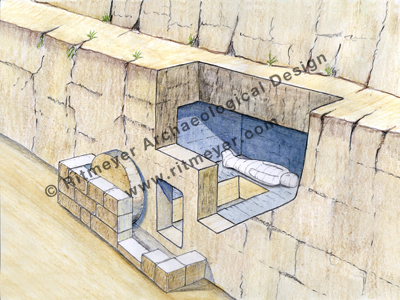
For those who could afford to make and/or own one meanwhile, the other option was a burial cave, either natural or man-made (completely man-made burial complexes were apparently more rare and costly than natural caverns), which were family affairs, unlike the individual trench graves: the bones of generations upon generations could all be interred in a single cave. The basic design of these rock-cut tombs consists of a square or rectangular room with benches on three sides of the chamber, leaving a pit in the middle, and a low, narrow doorway which could be closed with a blocking stone, which could be either a round disk which could be rolled over the entrance, or more commonly, square/rectangular ‘plug-type’ stones). Some tombs could be more elaborate - for instance, having multiple chambers, decorated with carvings, and whatnot. Around the time of Jesus you also had tombs with shelves cut into the walls of the interior: one type of shelf is called the arcosolia, which has a bench-like aperture (known as an arcosolium) with an arched ceiling hewn into the length of the wall. Another is the loculus or kokh, a narrow shaft running perpendicularly back from the chamber wall.

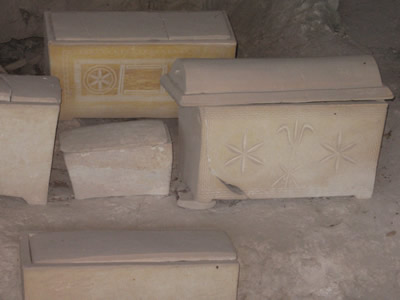
In this scenario, the body of the deceased would usually first be laid on the bench, a shelf (arcosolium) or on a niche (kokh) inside the burial chamber and left there, allowing the flesh to rot (the Jews did not practice embalming) until it has totally decomposed - something which is usually considered to occur within the space of a year. Sometimes the body could even be placed on a sort of coffin when it is placed on the shelf. This is what is known as primary burial. At the following year, once the flesh had decomposed, family members would return to the tomb and practice the continuation of the funerary rite known as secondary burial, which involves taking the bones and reinterring it in some way, either by depositing it in a specially-designated area somewhere inside the tomb or - more common at the time of Jesus - in stone boxes called ossuaries, which would then be also placed on a certain spot inside the burial chamber, in the loculi or on the benches.

http://rsc.byu.edu/sites/default/files/image/Religious Educator/4 1/image019.gif
Single-chamber tomb from Herodian period, located at Gilo, Jerusalem, shown with (square) blocking stone

http://rsc.byu.edu/sites/default/files/image/Religious Educator/4 1/image020.gif
Single-chamber tomb (Tomb of Caiaphas) from Herodian period with kokhim, located at Jerusalem, Peace Forest


Ossuaries

http://rsc.byu.edu/sites/default/files/i4.jpg
Tomb with the corpse in an arcosolium and ossuaries on shelf and loculi


Kokhim atop benches


The tomb of Joseph of Arimathea where Jesus was buried, a newly-hewn tomb (Matthew 27:60; Luke 23:53; John 19:41), would have probably looked like this. You can notice that only the benches are present: the first stage in tomb construction is the cutting out of the chamber with the benches on three sides. Other chambers and niches and shelves could then be added.
BTW, archaeologists have recently found the tomb of a 1st century man in Jerusalem who was afflicted with leprosy and tuberculosis, but was clearly a man of means - for one, our man was buried in an ornamented burial cave, had a well-groomed (no traces of lice), short-cropped hair, was apparently buried in burial cloths of some quality, and was buried close to other tombs of importance, notably the tomb of Annas/Ananus (cf. Josephus, War 5.506). Given the nature of the diseases however, the man’s family did not return to practice secondary burial, but left him lying inside the tomb’s kokh (which was where his bones and the fragments of his burial shroud were found) and apparently had the entrance to the tomb completely sealed with plaster.

http://jamestabor.com/wp-content/uploads/2009/12/ShroudDrawing.jpg
 
🙂

I wonder if having one’s sores licked by dogs is a sign of destitution.
I mean, that’s medicinal after all.

Even a rich man, when ill, could not be healed as we take for granted in a modern medical facility. Even the Emperor’s of Rome and the Kings (Herod?) fell ill to sudden and mortal illnesses from which there was no cure by antibiotics or minor surgery.

Some dogs are friendly – but the ancients generally didn’t keep them as mere pets. The Mastiff, for example, was meant to guard the home and wife and children – so that when the Roman soldier went off to war; when they got home they STILL had a wife and children.
…my point is two-fold:

a) Lazarus was indigent not because dogs licked his wounds but because he sought to fill his stomach with the scraps that fell from the rich man’s table; instead of attacking Lazarus, as most guard dogs would in order to repel an intruder, they recognized his state and did what dogs do (lick their wounds); this comparison is a demonstrative contrast to their master’s ignorance of Lazarus’ needs.

b) The rich man knew Lazarus, a beggar, and while he did nothing to assist Lazarus, he, in the least, did not contend that Lazarus was a threat, hence the dogs were not commanded to attack this particular interloper; Lazarus financial and physical condition would have inspired, from most people (including those barely above his station), distrust and rejection… maybe even outright loathing.

Coincidentally, Scriptures are not exact in to whom the dogs belonged; the passage only states that Lazarus laid at the rich man’s gate and dogs came to lick his wounds–this does not automatically exclude strays or dogs from other households… the contrast is still vivid!

Maran atha!

Angel
 
Hi Angel!

Poking pfun yourself ? 🙂

Yes, I think Lazarus was not a grudge holder. His affliction, and illness, would be seen as something from God himself by many of that time. Both Lazarus’ share that history. But he didn’t rob the rich man in the parable; nor would Jesus have been said to have loved the real Lazarus specially if Lazarus were a thug-hypocrite in life.

Jesus associated himself with sinners, but he loved those who did the father’s will. It is these he would call “friends.”

What do you make of this, below?
“John 11:14 So now, Jesus told them openly, Lazarus is dead. And for your sakes, I am glad I was not there.”

Did not Jesus, then, choose Lazarus’ lot in life and his death?
For at the sight of weeping – Perhaps Jesus would have not been able to resist preventing Lazarus’ death ?
This is a very interesting passage… it demonstrates both Jesus’ Divinity and His Humanity… as with many events, Jesus takes advantage of Lazarus’ death to Teach His Disciples that He is in deed the Resurrection and the Life. By allowing the sickness to proceed to it’s terminal end, Lazarus’ return from the dead cannot be attributed to a natural occurrence (heart failure and self-resuscitation, etc.); while Jesus knows exactly what will take place (death and resurrection of Lazarus), once He is amongst Lazarus’ sisters His Human Nature compels Him to feel empathy and Jesus shares their grief and their desolation–much like Isaiah’s Suffering Servant, His Woes for Jerusalem, and His Lament for those who ultimatedly would insist on rejecting Him (the beggar, Lazarus, and the rich man and Christ’s Shedding of Blood at mount of Olives) and thus will not enter into the Kingdom of Heaven.

Maran atha!

Angel
 
Status
Not open for further replies.
Back
Top