well, the caption of the drawing in the little black book said it was a 'blasphemous" picture which it is.
so, what does this mean, in general. Can they put a pornographic picture in there, as long as they label it “pornographic”?
See, I think blasphemous is WORSE than pornographic. If pornographic has no place in those books, then blasphemous doesn’t have a place either.
I guess I AM the only one who has an objection to what they printed.
See, on the chance that I was wrong, I thought (if I had the money) I’d have that image reproduced on T-shirts and lots of stuff that could be distributed in Church. After all, if it belongs in the little black book – in a Catholic church – then well lets have the head of a donkey on all our crucifixes. Yeah, I thought of having small plastic crucifixes and maybe rosaries made up with Christ having the head of a donkey.
And, we could combine THAT with Christ naked on the cross, because that is how he was crucified, after all.
And depict Him bleeding and bruised all over and
really suffering…
hey wait…
Well, Michelangelo
did make this one crucifix which shows Jesus nude. And THAT was placed over the high altar. And that Last Judgment he painted in the Sistine Chapel…

But to be serious, I can see your point: it is probably ill-advised to put a picture of the graffito accompanied only by a very vague caption, on a church book. But I think my point still stands: I don’t think the picture is meant to be understood or viewed in a devotional context (if that was the case, there are loads of other images of Christ on the Cross with human heads that one could use), but in an historical one.
Yes, there’s no denying that the graffiti
is offensive - it is intended to be so after all - but that does not mean it no longer has some significance from an historical and artistic POV (it is as of now the first surviving depiction of the crucified Jesus we have after all, even if He is caricatured). But in your defence, if they would include it, I just wish they put in a more detailed description of it to put it in its proper context and to keep folks from being scandalized. Or just don’t include it.
Still, whenever I look at this graffiti it usually brings to my mind the horror of crucifixion (right up there with
the heelbone of a 1st-century crucified man named Jehohanan with a nail sticking out of it)
and (precisely because of its offensiveness) the cost we pay in following Jesus. That doesn’t mean I would use the image in a devotional way though: even I have limits.
(Still, it does not prevent me from thinking of making a T-shirt with the graffiti on the front and John 15:18 or some such verse on the back. Or something like: “
The Catholic Church: mocked and persecuted repeatedly like her Lord yet still standing.”

)
Let’s face it: long before orthodox Christians have gotten around to portraying the crucified Savior, other people (read: anti-Christians, non-Christians and heterodox Christians) were already doing so to an extent. Here’s a little more palatable ancient portrayal of the crucifixion for the moment:
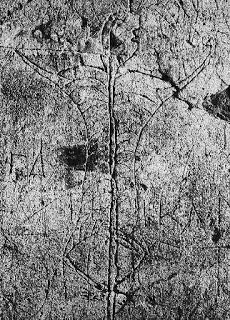
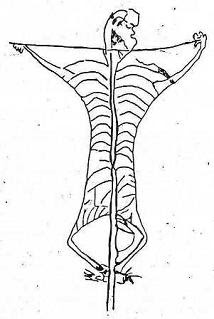
Here’s another sketch of a crucified victim, this time found in a tavern in Puzzuoli. Not as offensive as the Alexamenos graffito, but still of nearly-equal antiquity.



 )
)
