C
CatholicLife
Guest
Does the Syro-Malabar Catholic Church require all their church buildings to have the liturgical curtain? Why is there an altar behind the curtain? Why is there an altar in front of it?
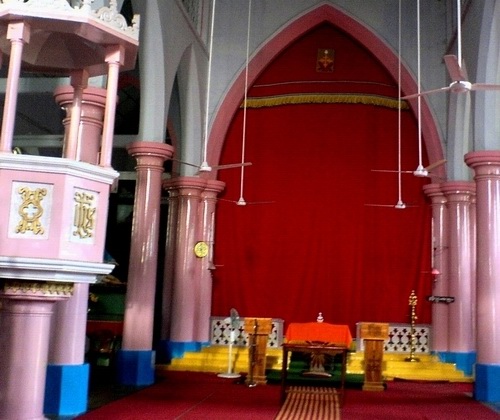
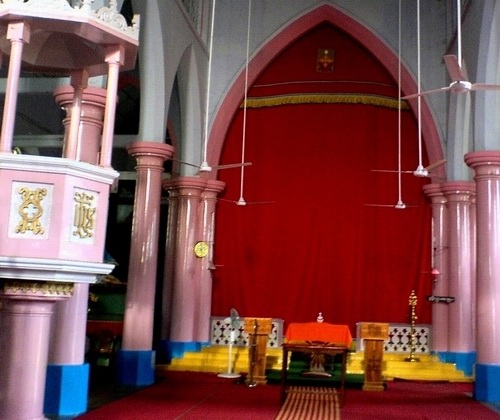


I got the picture from Wikipedia!The liturgical curtain or the sanctuary veil is found in the Syriac Churches (I think the Armenians also have it, but the Maronites don’t IIRC). The sanctuary symbolizes heaven or the Holy of holies and the veil symbolizes the separation and is the continuation of the veil in the Jewish Temple of Jerusalem (and before you note that the veil was torn in the NT, all our veils are also “torn” down the middle too). The altar is, of course, located in the sanctuary where the Qurbana is offered. The table or “altar” which you see in the picture" is called the bema. It is the “altar of the word”, where the Liturgy of the Word is conducted and from which the Gospel is proclaimed. It used to be much more elaborate and closely resemble the same structure found in the synagogue, a unique feature of Mesopotamian Christianity. Alas, it has fallen into decline and been reduced to what you see in the picture. From what I understand, there is one Chaldean church in Michigan with a bema but I am pretty sure it is not being used properly lol.
Which church is this?! It is obviously not one in the US since it lacks the necessary pews

Nedumkunnam Church, Kottayam district, Kerala, IndiaThe liturgical curtain or the sanctuary veil is found in the Syriac Churches (I think the Armenians also have it, but the Maronites don’t IIRC). The sanctuary symbolizes heaven or the Holy of holies and the veil symbolizes the separation and is the continuation of the veil in the Jewish Temple of Jerusalem (and before you note that the veil was torn in the NT, all our veils are also “torn” down the middle too). The altar is, of course, located in the sanctuary where the Qurbana is offered. The table or “altar” which you see in the picture" is called the bema. It is the “altar of the word”, where the Liturgy of the Word is conducted and from which the Gospel is proclaimed. It used to be much more elaborate and closely resemble the same structure found in the synagogue, a unique feature of Mesopotamian Christianity. Alas, it has fallen into decline and been reduced to what you see in the picture. From what I understand, there is one Chaldean church in Michigan with a bema but I am pretty sure it is not being used properly lol.
Which church is this?! It is obviously not one in the US since it lacks the necessary pews


It is worth noting that some Byzantine Rite Churches Sui Iuris call for a curtain in addition to the iconostas.The liturgical curtain or the sanctuary veil is found in the Syriac Churches (I think the Armenians also have it, but the Maronites don’t IIRC).
I know that the Armenian Orthodox keep it, but I’m not sure about the Armenian CC. The use of the sanctuary veil among the Maronites faded over the centuries, although there is renewed interest in some quarters in restoring it. (One can always hope.) BTW, it seems that the Syriac CC has also, by and large, sadly abandoned the sanctuary veil, although the Chaldeans have, officially at least, restored it.The liturgical curtain or the sanctuary veil is found in the Syriac Churches (I think the Armenians also have it, but the Maronites don’t IIRC).
including our own [Ruthenian], if such can be accommodatedIt is worth noting that some Byzantine Rite Churches Sui Iuris call for a curtain in addition to the iconostas.
The SOC does, of course, retain the sanctuary veil, but not so much the SCC. For example, if you see a broadcast from The SCC Cathedral in Beirut, you’ll notice that it no longer has a sanctuary veil. (To make matters worse, they’ve also put up a versus populum table and no longer use the altar that sits below an incredible rose marble canopy, but I digress.) I’ve observed the same in other SCC churches as well. (So, too, the versus populum table but again I digress.)The Malankara and Syriacs retain the Curtain.

Starting some centuries ago, (partially for economic reasons and partially due to the effects of latinization), use of the sanctuary veil among the Maronites gradually faded. Personally, I’d love to see it restored but, at present, there is no Maronite church of which I am aware that has done so.The Maronites and Chaldeans traditionally use the Curtain, but less frequently today - it is steadily making a comeback.
Thank God for this one!Starting some centuries ago, (partially for economic reasons and partially due to the effects of latinization), use of the sanctuary veil among the Maronites gradually faded. Personally, I’d love to see it restored but, at present, there is no Maronite church of which I am aware that has done so.
Yes now I recall that one. IIRC, there was a bit of a kerfuffle with the bishop about it, too. Notice, though, that the curtain looks more like a misplaced living room drape than a real sanctuary veil. In any case, aesthetic comments aside, I don’t know if or how its actually used.Thank God for this one!
ourladysmaronite.org/tour

Hi SyroMalankaraThank God for this one!
ourladysmaronite.org/tour
I could be wrong, but IIRC think what that Synod did was to make use of the sanctuary veil optional. There were some churches that kept it well into the 20th century (again I could be wrong – and I don’t have the books at hand – but I seem to recall Attwater (or perhaps it was King) having noted this).We(Syriac Catholic Church) unfortunately got rid of our curtains in our bishop synod in 1888 in sharfeh Lebanon.
Although I don’t see why we can’t just bring it back considering things like married priests stilled continued after the synod even though it explicitly banned it.
Pressure from the Chaldeans and Latin revival in the west, as well as grass roots movements will hopefully bring it back in the next 10 years.
My priest is from the sharfeh patriarchal seminary I will ask him about this. Do u have the documents from that synod? I would greatly appreciate it if u could somehow direct me to the right direction in obtaining them.I could be wrong, but IIRC think what that Synod did was to make use of the sanctuary veil optional. There were some churches that kept it well into the 20th century (again I could be wrong – and I don’t have the books at hand – but I seem to recall Attwater (or perhaps it was King) having noted this).
Personally, I think the SCC should first and foremost totally eliminate the versus populum table and restore use of an ad orientem altar universally. Only when that is done does addressing the issue of the sanctuary veil make any sense to me.
FWIW, as much as I love the idea of the sanctuary veil, total elimination of the versus populum table and universal restoration of the ad orientem altar is also the first priority for the Maronites. A sanctuary veil makes no sense otherwise.
Sorry, but no, I don’t. What I recall is from my studies many years ago and, as I said, I could be mistaken. But it might be helpful to have a look at Attwater anyway. It won’t answer the question about the Synod, but it will give a reference to what the actual practice was (at least through the mid-20th century).My priest is from the sharfeh patriarchal seminary I will ask him about this. Do u have the documents from that synod? I would greatly appreciate it if u could somehow direct me to the right direction in obtaining them.


Sorry. But what is attwater?Sorry, but no, I don’t. What I recall is from my studies many years ago and, as I said, I could be mistaken. But it might be helpful to have a look at Attwater anyway. It won’t answer the question about the Synod, but it will give a reference to what the actual practice was (at least through the mid-20th century).
For the documents themselves, I suspect you’d have to actually go through the Patriarchal library in Charfeh. I recall that the late, great Moran Mor Ignatious Ephraim Rahmani did a remarkable job in gathering and cataloging manuscripts and documents. Perhaps you can find out the name of the librarian from your priest and go from there.
It’s a he … Donald Attwater was the author of several books including “Eastern Catholic Worship” published in 1945 (I think). It’s rather hard to come by these days, but you might find one in the library or perhaps through an on-line source. BTW, Archdale King also authored work on Eastern liturgy.Sorry. But what is attwater?
I shall ask Abun next time I see him.
 Feel to PM if you find anything interesting.
Attwater says:Sorry, but no, I don’t. What I recall is from my studies many years ago and, as I said, I could be mistaken. But it might be helpful to have a look at Attwater anyway. It won’t answer the question about the Synod, but it will give a reference to what the actual practice was (at least through the mid-20th century).
The sanctuary of the church should be separated from the choir and nave by a screen, either open or solid, having three doors; normally there are no pictures on it, and sometimes there is no screen at all.
I don’t have a copy of King on hand and I don’t want to drive to the library at school and brave the climb to the distant corner where the Eastern Christian section has been banished so I’m not sure what he has to say.A curtain being drawn across the altar, the priest (the deacon at a pontifical celebration) goes within in his ordinary clothes and prepares the offerings at the altar, with appropriate prayers…After more prayers, the celebrant goes to the sacristy to vest, and the curtain is withdrawn…