Lord God of Hosts?

  • Thread starter Thread starter Dstep
  • Start date Start date
Status
Not open for further replies.
D

Dstep

Guest
During the Sanctus, The Lord is called the “God of Hosts”. Is host supposed to mean the communion type of host or is something else?

Sorry if this is a dumb question, I’m still learning:)
 
There are no dumb questions. 🙂 It simply means that God is the Lord of the heavenly hosts–the angels and archangels.
 
From Wikipedia:
Heavenly host (Hebrew Sabaoth “armies”) refers to a large army (Luk.2:13; Rev.19:19) of good angels mentioned in the Bible and other Jewish and Christian texts.
It is led either by an Angel of the Lord, Jesus in angelic form (a Christophany), by the Archangel Michael, or by God Himself.
The word “host” in reference to Holy Communion is from the Latin “hostia,” “victim.”
 
No, (Good grief guys, don’t you read your Bible?!)

Good answer Della!:clapping::clapping::clapping:

“Lord God of Hosts” is a name for Him because He is over all the angelic hosts of angels.

There’s only about 273 uses in the Douay-Rheims Bible, just for instance.

See this link…

Suggested reading:

A Biblical Walk Through the Mass
 
Hi all,

.“Host” is an old English word for “army”. Lord of Hosts. in the Bible means "chief of armies. The Hebrews believed that it was God Himself who led them into battle.

The Heavenly Hosts refers to the inhabitants of heaven.

Verbum
 
During the Sanctus, The Lord is called the “God of Hosts”. Is host supposed to mean the communion type of host or is something else?

Sorry if this is a dumb question, I’m still learning:)
Nope, not a dumb question at all.

‘Hosts’ in this case comes from the Latin hostis via the French hoste. The original Latin word meant ‘foreign enemy’, but the meaning had eventually shifted to “a multitude of people arrayed as an army,” which is what the word means in English.

In other words, Yhwh Ṣĕḇā’ōṯ (that’s how the title is in Hebrew; one might be familiar with the second word as Sabaoth) is a title meaning “Yhwh [of] Armies.”

Sometimes, ṣĕḇā’ōṯ (from a Hebrew word meaning “to wage war”) is understood as referring to Israel’s military force. The idea is either that (1) Yhwh is the commander who led the army of Israel to battle; or (2) that under the idea that Yhwh is the one who waged war for the Israelites, either Yhwh is compared to armies (I’m reminded of the phrase ‘one-man army’ here :D) or the Israelite army is seen as a symbol of Yhwh. Other times, ṣĕḇā’ōṯ is interpreted as referring to the ‘hosts’ of stars and heavenly bodies (Judges 5:20; Isaiah 40:26) or angelic beings (Joshua 5:14f).

The name was specifically connected with the sanctuary at Shiloh (cf. 1 Samuel 1:3, 11; 4:4). One theory has it that the name may have originated with the idea of Yhwh as king - in reference to the fact that the cherubim of the Ark (and later the temple) was seen as His throne. (Thrones in those days were usually flanked with depictions of winged beasts and/or human-animal hybrids, which is often seen as analogous with the biblical ‘cherubim’ - no, cherubs weren’t cute baby-heads. 😉 Sometimes gods are even shown to ride upon these creatures - which would be comparable to the Israelite idea of God sitting on the cherubim.) One idea has it that the concept started with the idea that Yhwh was the ruler of the heavenly council of angelic beings, eventually also being applied to earthly, human armies.
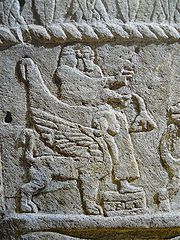


http://img90.imageshack.us/img90/6559/q192.jpg

 
Adding on to Patrick’s exellent post, Jesus had access to an entire army of angels.

Then Jesus said to him, “Put your sword back into its sheath, for all who take the sword will perish by the sword. Do you think that I cannot call upon my Father and he will not provide me at this moment with more than twelve legions of angels? (Matthew 26:52:53)

A legion was typically about 6000.

-Tim-
 
Adding on to Patrick’s exellent post, Jesus had access to an entire army of angels.

Then Jesus said to him, “Put your sword back into its sheath, for all who take the sword will perish by the sword. Do you think that I cannot call upon my Father and he will not provide me at this moment with more than twelve legions of angels? (Matthew 26:52:53)

A legion was typically about 6000.

-Tim-
The better question is, why does Jesus say “twelve legions”? Either Matthew portrays the Son as commanding one angelic legion per disciple or the eleven disciples plus Jesus. (It is in Matthew after all that we get a reference to guardian angels; 18:10.)
 
Status
Not open for further replies.
Back
Top