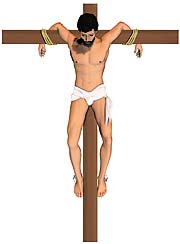
We’re speaking about Jesus’ hands here, but I’d just digress a bit to talk about the feet as well.
It’s not directly stated in any gospel about whether Jesus’ feet were nailed. Maybe the closest we can get is Luke 24: “See my hands and my feet.” But then again, Luke doesn’t mention explicitly in his gospel whether nails were used when Jesus was crucified; only John mentions nails being involved, and then again, he only implies Jesus’ “hands” being nailed (the feet are not mentioned).
In other words, Luke’s account is not exactly like John where Jesus’ showing His hands is explicitly Him showing His crucifixion scars there. For all we know, Luke’s Jesus was simply inviting the disciples to see and touch His exposed body parts (aside from His head) to see that He isn’t a ghost, regardless of whether there were stigmata there or not. In fact, an early Christian work known as the
Didascalia Apostolorum (ca. 3rd century) interprets Jesus’ command in Luke to see His feet not in conjunction with any scars, but in light of a popular (Greco-Roman?) belief that ghosts and other incorporeal entities float or hover: in other words, this work has Jesus asking the disciples to look at His feet to see if they are planted on the ground and leave behind footprints, like any physically alive human being does.
“That you may know that it is I, put your finger, Peter, in the nailprints of my hands, and you, Thomas, put your finger in the spear-wounds of my side; but you, Andrew, look at my feet and see if they do not touch the ground. ‘The foot of a ghost or a demon does not join to the ground’.”
Whatever happened to Jesus’ feet is something our earlier sources are quite unclear. We can already find the idea that the feet were nailed from St. Justin Martyr (our earliest source to make the connection); this idea eventually won because it’s a nicer fit with Psalm 22 (“they dug my hands and my feet”). But then again you also have other sources like the
Didascalia and the
Gospel of Peter where only the nails in the ‘hands’ are explicitly mentioned as in John. (
GoP 21: “And then they plucked the nails off of the Lord’s hands and laid him on the earth…”)
The earliest artworks depicting people who were crucified (predating the 4th-5th century, when Christians began to mass-produce images of Jesus crucified) are not of much help here either. There are at least three or four such artworks: two of them depict the feet not being nailed while the other two could depict the feet fixed in some way, but it’s really hard to tell since these two are really crude wall graffiti.
Our earliest possible depiction of a crucifixion is a fresco from a tomb in Rome dating from the mid-3rd century BC showing a naked man who is likely crucified. It seems that the man is portrayed as being
pinned to this horizontal beam by a nail through his hand or wrist/forearm, but there’s no indication that the feet are nailed. In fact,
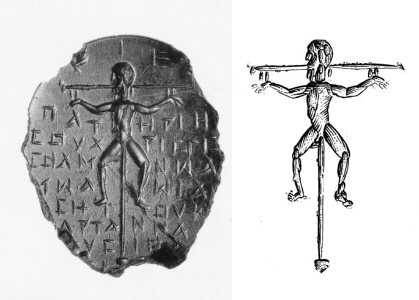
it kinda seems like he’s dangling off the ground. The second artwork that doesn’t show the feet nailed is a gemstone from the 2nd/3rd century with a carving depicting the crucified Jesus, most likely used as a talisman. In this depiction, Jesus’ feet are clearly not nailed; instead He is portrayed with His legs spread out as if on horseback, ‘sitting’ on the peg-like projection that juts out near the middle of the vertical post just below the crotch. (To be fair though, this artist seems to have depicted Jesus being tied to the crossbeam by the wrists rather than nailed to it.)
As for the other two artworks, they are graffiti from Rome and from Pozzuoli (ancient Puteoli), respectively. The Roman one, a graffiti mocking a Christian named Alexamenos from ca. the 3rd century, is in fact our earliest depiction of the crucified Jesus (here shown with the head of a donkey). In this drawing,
the donkey-headed crucified Jesus is possibly shown standing on a sort of footrest or pedestal (represented by a vertical line). But of course, the nature of the drawing makes it impossible to determine whether the artist thought Jesus was nailed at the feet.
The one from Pozzuoli possibly depicts a crucified woman named Alcimilla: Alcimilla seems to be shown with her ankles or feet fixed in some way to the vertical post, but again, since this is a very childish drawing you can’t make any definite statement on this particular element.
In fact, because of this confusion in our available data, during the early 1960s a few scholars in fact thought - because of the silence in John and some early sources - that maybe crucified victims were not nailed in the feet at all, that that was just later guesswork from the Psalm 22 passage. But then, in 1967 archaeologists discovered the remains of a crucifixion victim (
Jehohanan) who was
clearly nailed on his ankles, which reopened the question. Now the answer is generally just ‘He could have been, He could have been not’ - since the available data allows for both possibilities really. (For the record, Jehohanan, while nailed at his ankles, was apparently not nailed through his hands/wrists; his arms were simply tied to the cross. In other words, he’s somewhat Jesus’ opposite.)



 )
)