
Old Earth vs. Young Earth

  • Thread starter Thread starter Banff9
  • Start date Start date
Status
Not open for further replies.
A) Would you care to substantiate your claim that human population has been basically the same “for most of human history”? Source?

B)** If humans didn’t exist 50 million years ago, then neither did the Earth, if you even basically believe the Creation story. Perhaps you believe in an Old Earth and Young Man, i.e. evolution?**
I think this is what most of us who believe in old Earth believe in. It is called Theistic Evolution and was supported by Blessed John Paul the Great.
 
I think this is what most of us who believe in old Earth believe in. It is called Theistic Evolution and was supported by Blessed John Paul the Great.
According to one definition on Theistic Evolution, about 58% of Catholic in 2007 supported the idea of evolution as the explanation of human origin on Earth.

My argument against evolution is this. If an animal has a deformed baby, it rejects it. Some humans accept their malformed (differently formed) children, but you don’t get many of them
accepted in marital situations. It’s not natural to accept biological changes.

Evolution presupposes a general acceptance of biological changes. I don’t believe in evolution, but that the first creation of man was Adam, not a pre-human for this reason.
 
According to one definition on Theistic Evolution, about 58% of Catholic in 2007 supported the idea of evolution as the explanation of human origin on Earth.

My argument against evolution is this. If an animal has a deformed baby, it rejects it. Some humans accept their malformed (differently formed) children, but you don’t get many of them
accepted in marital situations. It’s not natural to accept biological changes.

Evolution presupposes a general acceptance of biological changes. I don’t believe in evolution, but that the first creation of man was Adam, not a pre-human for this reason.
Which is why Catholics make the exception that the human soul was set aside upon creation. It’s what makes us different from animals
 
According to one definition on Theistic Evolution, about 58% of Catholic in 2007 supported the idea of evolution as the explanation of human origin on Earth.

My argument against evolution is this. If an animal has a deformed baby, it rejects it. Some humans accept their malformed (differently formed) children, but you don’t get many of them
accepted in marital situations. It’s not natural to accept biological changes.

Evolution presupposes a general acceptance of biological changes. I don’t believe in evolution, but that the first creation of man was Adam, not a pre-human for this reason.
Evolution happens on timescales that aren’t easy for us to picture. In a geologic sense of time, yes - it’s a quick process. From a human perspective, no. We can track our history back through about 10-15 thousand years. From what remains we’ve found, H. sapiens in our current physical form (note- I’m saying nothing about the soul here) has been around for at least 10 times that long. To find the point where the genus Homo splits from the other primates, we have to go back a lot further - about another order of magnitude - ~2-3 Mya.

The reason that we see the differences between H. habilis and H. sapiens is that when we look at them side-by-side, we’re compressing 2 million years of incremental physical changes.

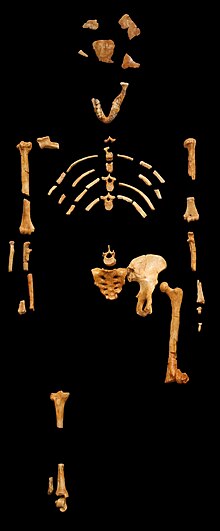
Why don’t we find “transitional” remains? Well, because every set of remains is “transitional”. The species names we assign to our physical ancestors are simply for shorthand. It’s a lot easier to say “H. habilis” than “homonid living roughly 2 million years ago whose remains are associated with the first stone tools, is typically less than 2m tall, and retains a prominent brow ridge”. The actual number of pre-sapiens remains we’ve found is miniscule, and almost never a more than a few fragments from any given individual. That’s why Lucy was such a big deal - we had found an almost-complete skeleton!
 
Evolution happens on timescales that aren’t easy for us to picture. In a geologic sense of time, yes - it’s a quick process. From a human perspective, no. We can track our history back through about 10-15 thousand years. From what remains we’ve found, H. sapiens in our current physical form (note- I’m saying nothing about the soul here) has been around for at least 10 times that long. To find the point where the genus Homo splits from the other primates, we have to go back a lot further - about another order of magnitude - ~2-3 Mya.

The reason that we see the differences between H. habilis and H. sapiens is that when we look at them side-by-side, we’re compressing 2 million years of incremental physical changes.

Why don’t we find “transitional” remains? Well, because every set of remains is “transitional”. The species names we assign to our physical ancestors are simply for shorthand. It’s a lot easier to say “H. habilis” than “homonid living roughly 2 million years ago whose remains are associated with the first stone tools, is typically less than 2m tall, and retains a prominent brow ridge”. The actual number of pre-sapiens remains we’ve found is miniscule, and almost never a more than a few fragments from any given individual. That’s why Lucy was such a big deal - we had found an almost-complete skeleton!
I took Anthropology in college–I’m a scientist, but I don’t accept the unsubstantiated claim that human developed from a common ancestor to apes. Natural selection actually countermands evolution, as biological changes are rejected not accepted, mostly.
 
Evolution happens on timescales that aren’t easy for us to picture. In a geologic sense of time, yes - it’s a quick process. From a human perspective, no. We can track our history back through about 10-15 thousand years. From what remains we’ve found, H. sapiens in our current physical form (note- I’m saying nothing about the soul here) has been around for at least 10 times that long. To find the point where the genus Homo splits from the other primates, we have to go back a lot further - about another order of magnitude - ~2-3 Mya.

The reason that we see the differences between H. habilis and H. sapiens is that when we look at them side-by-side, we’re compressing 2 million years of incremental physical changes.

Why don’t we find “transitional” remains? Well, because every set of remains is “transitional”. The species names we assign to our physical ancestors are simply for shorthand. It’s a lot easier to say “H. habilis” than “homonid living roughly 2 million years ago whose remains are associated with the first stone tools, is typically less than 2m tall, and retains a prominent brow ridge”. The actual number of pre-sapiens remains we’ve found is miniscule, and almost never a more than a few fragments from any given individual. That’s why Lucy was such a big deal - we had found an almost-complete skeleton!
Huh?

 
Evolution happens on timescales that aren’t easy for us to picture. In a geologic sense of time, yes - it’s a quick process. From a human perspective, no. We can track our history back through about 10-15 thousand years. From what remains we’ve found, H. sapiens in our current physical form (note- I’m saying nothing about the soul here) has been around for at least 10 times that long. To find the point where the genus Homo splits from the other primates, we have to go back a lot further - about another order of magnitude - ~2-3 Mya.

The reason that we see the differences between H. habilis and H. sapiens is that when we look at them side-by-side, we’re compressing 2 million years of incremental physical changes.

Why don’t we find “transitional” remains? Well, because every set of remains is “transitional”. The species names we assign to our physical ancestors are simply for shorthand. It’s a lot easier to say “H. habilis” than “homonid living roughly 2 million years ago whose remains are associated with the first stone tools, is typically less than 2m tall, and retains a prominent brow ridge”. The actual number of pre-sapiens remains we’ve found is miniscule, and almost never a more than a few fragments from any given individual. That’s why Lucy was such a big deal - we had found an almost-complete skeleton!
i don’t know about slow incremental changes. experiments, which i cannot quote but you can find, found that bone - like brow-ridges - can change in response to environmental factors i suppose like cold. the bone builds up, thickening, changing the shape of the brow during the life of the animal.

there is also a small carp in china which will grow a large hump-back and becomes a much deeper bodied fish when it senses chemicals of a predator, like a pike, which has been introduced into the water.
 
Evolution happens on timescales that aren’t easy for us to picture. In a geologic sense of time, yes - it’s a quick process. From a human perspective, no. We can track our history back through about 10-15 thousand years. From what remains we’ve found, H. sapiens in our current physical form (note- I’m saying nothing about the soul here) has been around for at least 10 times that long. To find the point where the genus Homo splits from the other primates, we have to go back a lot further - about another order of magnitude - ~2-3 Mya.

The reason that we see the differences between H. habilis and H. sapiens is that when we look at them side-by-side, we’re compressing 2 million years of incremental physical changes.

Why don’t we find “transitional” remains? Well, because every set of remains is “transitional”. The species names we assign to our physical ancestors are simply for shorthand. It’s a lot easier to say “H. habilis” than “homonid living roughly 2 million years ago whose remains are associated with the first stone tools, is typically less than 2m tall, and retains a prominent brow ridge”. The actual number of pre-sapiens remains we’ve found is miniscule, and almost never a more than a few fragments from any given individual. That’s why Lucy was such a big deal - we had found an almost-complete skeleton!
We now know DNA actively fights against evolution.

Dr. John Sanford “Genetic Entropy and the Mystery of the Genome”

“the human race is degenerating at 1-5% per generation”
 
i don’t know about slow incremental changes. experiments, which i cannot quote but you can find, found that bone - like brow-ridges - can change in response to environmental factors i suppose like cold. the bone builds up, thickening, changing the shape of the brow during the life of the animal.

there is also a small carp in china which will grow a large hump-back and becomes a much deeper bodied fish when it senses chemicals of a predator, like a pike, which has been introduced into the water.
Who’s to say that Lucy wasn’t a child, therefore small? Or that the big brow belong to an ape?

They have the technology to do DNA analysis on these finds; why don’t they?
 
Who’s to say that Lucy wasn’t a child, therefore small? Or that the big brow belong to an ape?

They have the technology to do DNA analysis on these finds; why don’t they?
Who says they don’t? Even if they don’t, perhaps it’s because it isn’t required, and we can tell a lot without doing a DNA analysis.
 
i don’t know about slow incremental changes. experiments, which i cannot quote but you can find, found that bone - like brow-ridges - can change in response to environmental factors i suppose like cold. the bone builds up, thickening, changing the shape of the brow during the life of the animal.

there is also a small carp in china which will grow a large hump-back and becomes a much deeper bodied fish when it senses chemicals of a predator, like a pike, which has been introduced into the water.
Let’s assume that your view of human development is correct: We were created exactly as we are, and all homonid remains are humans. Why is it that we only find the freaks with large brow-ridges, small cranial capacity, and increasingly primitive characteristics the older the remains “appear to be”? Were the vast bulk of Adam’s children fit only for a freak show?

That’s the mark of a good scientific theory: It makes testable predictions that turn out to be correct. Theistic evolution predicts almost exactly what we find. Young-earth creationism predicts that we should find anatomically modern human remains throughout all strata, but we don’t.
 
Let’s assume that your view of human development is correct: We were created exactly as we are, and all homonid remains are humans. Why is it that we only find the freaks with large brow-ridges, small cranial capacity, and increasingly primitive characteristics the older the remains “appear to be”? Were the vast bulk of Adam’s children fit only for a freak show?
It seems that in the vast majority of cases where human-looking bones were found, they made no mention of it. Only when unnatural-looking bones were found did they say, “Hey, look! Man evolved.”
 
It seems that in the vast majority of cases where human-looking bones were found, they made no mention of it. Only when unnatural-looking bones were found did they say, “Hey, look! Man evolved.”
You’re claiming a pretty widespread conspiracy on the part of every single physical anthropologist - both professional and amateur - that has never once broken its silence. Can you show evidence for this?
 
Status
Not open for further replies.
Back
Top