For centuries, it has become common wisdom that Pope Gregory was the source of Gregorian Chant, and people pretty much assumed it to be the chant tradition of the Roman Church. However, certain discoveries in the 19th century (which were not given proper attention until the 20th century!) has put the veracity of the story into question, at least among experts.
Before 1891, no serious enquiry had been made into the direct origins of Roman Chant or its forerunners. It was in that year when a monk from the famous Benedictine monastery of Solesmes, Dom André Mocquereau (1849-1930), as part of his research into the manuscript tradition of Gregorian chant, published an account of three books he discovered in the Vatican Library: two Graduals (Vatican City, Biblioteca Apostolica Vaticana, Archivio di San Pietro, MS lat. 5319 and MS F. 22) and an Antiphonary (MS B.79), all dating from somewhere between the 11th and the 13th century.
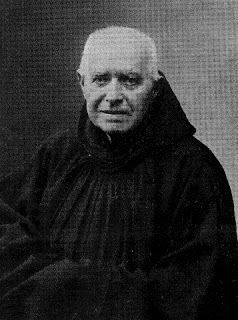
Dom André Mocquereau.
Now what intrigued Dom Mocquereau about these manuscripts was that although the material in these sources covered the same liturgical feasts as did the Gregorian books (showing that they were related to each other), it was melodically distinct from both it, as well as with Ambrosian chant. He wrote a letter to his abbot:
I must tell you of a discovery we made at the Vatican, and that continues to astonish us. Perhaps Dom Pothier will be able to explain what I am going to say? It is a 12th-century
Gradual, certainly of the Roman liturgy, with the exception of some slight peculiarities, but in which
the chant is not the one used in all manuscripts in all countries. This is a singular exception that intrigues me. For a time, I had thought that the
Ambrosian chant had replaced the
Gregorian chant; but this is not the case, because in this new chant the universal Gregorian chant is easy to recognize, but with constant variations that give it a very special character. This is surely an Italian manuscript, as proven by the notation. One note that I found, I no longer know where, advances the unsubstantiated notion that it belonged to St. John Lateran. We have yet to see the Archives at that Basilica; are surprises of this kind awaiting us there, perhaps? I have no idea. I would be most interested to know what the Reverend Father Dom Joseph Pothier thinks about all this. I have not yet studied this curious manuscript in detail, because I had hoped to manage to get it to Solesmes.
(for the record, Pothier wrote a reply dated the 8th of April, asking to “
bring us as many details as possible,” and noting that at St. Peter’s “
they still use not only ancient hymns, but even a special Psalter that dates from far back.”)
Eventually publishing the results of his study of the manuscripts, Dom Mocquereau then concluded that this repertory, which he recognized as distinct from Ambrosian and Gregorian chant, seems to date from a “
relatively recent period, when the rules of Gregorian composition were beginning to fall into disuse.” (
Paléographie Musicale, volume II, pp. 4-5, footnote 1) In short, it was a later corruption of Gregorian chant.
Contrary to this view, fellow Benedictine Dom Raphael Andoyer, who after analysing the same sources, expressed the opinion in 1911-12 that they actually represented an earlier stage of musical development than that of Gregorian - a stage he defined as ‘pre-Gregorian’ (
ante-grégorien). For Dom Andoyer, these melodies are the ones which Pope Gregory the Great organized and revised (thus he views Gregory’s ‘authorship’ of plainchant, rather than composing it outright, in the strict sense) into what would become known as Gregorian chant.



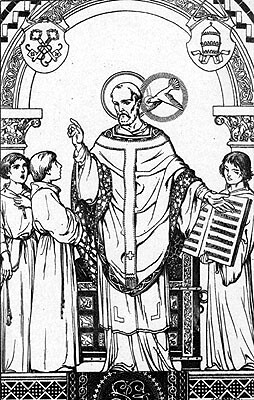
 I LOVE old Roman chant! I think it’s stunningly beautiful…very reverant…almost even more so than Gregorian chant. There’s something timeless about it; it has a sound of permanence, you could say.