Orans for laity during Our Father

  • Thread starter Thread starter RachelKH
  • Start date Start date
Status
Not open for further replies.
R

RachelKH

Guest
My pastor and Bishop are telling all the laity to adopt the orans position during Mass for praying the Our Father. I’ve seen several links saying this is wrong and not to be done, especially by the deacon but our deacon is also adopting the orans position.
How widespread is this? Why is this? How am I to respond when I’m told to do what I understand to be wrong?
 
My pastor and Bishop are telling all the laity to adopt the orans position during Mass for praying the Our Father. I’ve seen several links saying this is wrong and not to be done, especially by the deacon but our deacon is also adopting the orans position.
How widespread is this? Why is this? How am I to respond when I’m told to do what I understand to be wrong?
It is very widespread, and a very frequent topic of conversation here on CAF. As to whether it’s wrong or not is a matter of opinion, as there is really no prescribed posture in the General Instructions for the Our Father, although you will see a lot of argument about this. Honestly, you will have to make up your own mind about this, but keep in mind this is coming from the Bishop (I’m not suggesting that you do one thing or another–that is up to you). There is no sin involved either way, if that is what is bothering you.
 
This has been standard procedure in our diocese for several years.
 
It became popular after Vatican II. However, nothing was said about it in any of the documents. It appears to be a protestant phenomenon. We don’t do it at our parish.
 
The orans gesture is a posture of prayer from the ancient Church. I am very pleased to see its use extended…and extending.

The bishops whom I served neither encouraged nor discouraged the gesture since the GIRM neither prescribes nor proscribes what the laity are to do with their hands during the Our Father.

Had one of my bishops chosen to encourage the orans, I would have, of course, supported him since he is the shepherd of the diocese, since he is a successor to the apostles, since he sits upon the cathedra as the teacher of his flock, and moreover the liturgy is entrusted to him in a singular way regarding the Particular Church that has been confided to his care.

Personally, I never asked how I could avoid conforming myself to the bishop’s will but rather how I could do so more fully and more faithfully, given the contents of chapter 3 of the Dogmatic Constitution on the Church, Lumen Gentium, of Vatican II.

vatican.va/archive/hist_councils/ii_vatican_council/documents/vat-ii_const_19641121_lumen-gentium_en.html

Wherein we read:
*27. Bishops, as vicars and ambassadors of Christ, govern the particular churches entrusted to them by their counsel, exhortations, example, and even by their authority and sacred power, which indeed they use only for the edification of their flock in truth and holiness, remembering that he who is greater should become as the lesser and he who is the chief become as the servant. This power, which they personally exercise in Christ’s name, is proper, ordinary and immediate, although its exercise is ultimately regulated by the supreme authority of the Church, and can be circumscribed by certain limits, for the advantage of the Church or of the faithful. In virtue of this power, bishops have the sacred right and the duty before the Lord to make laws for their subjects, to pass judgment on them and to moderate everything pertaining to the ordering of worship and the apostolate.

The pastoral office or the habitual and daily care of their sheep is entrusted to them completely; nor are they to be regarded as vicars of the Roman Pontiffs, for they exercise an authority that is proper to them, and are quite correctly called “prelates,” heads of the people whom they govern. Their power, therefore, is not destroyed by the supreme and universal power, but on the contrary it is affirmed, strengthened and vindicated by it, since the Holy Spirit unfailingly preserves the form of government established by Christ the Lord in His Church.*
Also, from the Catholic Encyclopedia about the orans posture: newadvent.org/cathen/11269a.htm
 
My pastor and Bishop are telling all the laity to adopt the orans position during Mass for praying the Our Father. I’ve seen several links saying this is wrong and not to be done, especially by the deacon but our deacon is also adopting the orans position.
How widespread is this? Why is this? How am I to respond when I’m told to do what I understand to be wrong?
Doesn’t this imply that we are not to hold hands with the persons next to us as well? At least that’s what came into my mind first.

My advice, though, is not to fight it. We’re not supposed to mimic the priest, or however it’s worded, but he’s the bishop.
 
But I found this although it may be outdated and changed:

Adoremus, Society for the Renewal of the Sacred Liturgy
Online Edition - Vol. IX, No. 8: November 2003

In some dioceses in the United States, people are being told that they should adopt this gesture, though it is not a customary posture for prayer for Catholic laity. Sometimes people are told that their bishop mandates this change because the new General Instruction of the Roman Missal (GIRM) requires it or at least encourages it.

Thus it may be helpful to review the actual regulations on the orans posture.

What does the GIRM say?

First of all, nowhere in the current (2002) General Instruction of the Roman Missal (GIRM) does it say that the orans posture is recommended for the congregation during the Our Father.

In GIRM 43 and 160, the paragraphs dealing with the people’s posture during Mass, the only posture specified for the congregation at the Lord’s Prayer is standing. It says nothing at all about what people do with their hands. This is not a change from the past.

Background of present confusion

The history of the bishops’ debate on the orans question suggests the origin of the confusion that persists.

During the US bishops’ discussion in the 1990s of the proposed ICEL (International Commission on English in the Liturgy) revision of the “Sacramentary” (prayers for Mass), some liturgists were urging that this orans gesture, which by centuries of custom only the priest assumes, should now be mandated for the entire congregation as well.

In 1995, the Bishops Committee on the Liturgy (BCL), then chaired by Bishop Donald Trautman of Erie, proposed certain amendments to the proposed revision. Among these, the BCL recommended specifying the orans posture for the people during the Our Father. The rationale was that the orans gesture was used in the “early Church”, and that this posture should replace hand-holding during the Our Father, a practice that was becoming increasingly common.

Several bishops objected to adopting the orans for the people (by custom a priestly gesture), and strongly opposed making this a rule. But eventually the bishops compromised, at this 1995 session, and voted to make the orans a permissible option for the congregation during the Our Father.

It is important to note that the bishops’ debate and vote on the orans posture for the people involved the ICEL Sacramentary, not the new Roman Missal.

Source of continuing confusion

One source of continuing confusion is this. When the proposed ICEL Sacramentary was sent to the Holy See for approval (after the November 1999 meeting of the US Conference of Catholic Bishops), the BCL posted on its web site a description of the orans posture, saying that this posture would be permitted when the new Sacramentary was approved.

This 1999 BCL comment stated, in part:

No position is prescribed in the present Sacramentary for an assembly gesture during the Lord’s Prayer. While the recently approved revised Sacramentary does provide for the use of the orans gesture by members of the assembly during the Lord’s Prayer, the revised Sacramentary may not be used until it has been confirmed by the Holy See. I might also note that in the course of its discussion of … this question, the Bishops’ Committee on the Liturgy expressed a strong preference for the orans gesture over the holding of hands since the focus of the Lord’s Prayer is a prayer to the Father and not primarily an expression of community and fellowship.

The Sacramentary revision, however, was not only replaced by the new Roman Missal, but it was officially and specifically rejected by the Holy See after the new Missal appeared.

Unfortunately, however, this outdated and misleading comment on the USCCB web site was never removed. It was still there as of October 28, 2003.

[Update: The response about “orans” on the USCCB web site was later changed, and simply reads: “No position is prescribed in the present Sacramentary for an assembly gesture during the Lord’s Prayer.” www.usccb.org/liturgy/q&a/mass/orans.shtml]

At their November 2001 meeting, the bishops discussed “adaptations” to the new Institutio Generalis Missalis Romani (or GIRM) of the new Missal (reported in AB February 2002). The proposal to introduce the orans posture for the people was not included even as an option in the US’ “adaptations” to the GIRM.

Furthermore, the bishops did not forbid hand-holding, either, even though the BCL originally suggested this in 1995. The reason? A bishop said that hand-holding was a common practice in African-American groups and to forbid it would be considered insensitive.

Thus, in the end, all reference to any posture of the hands during the Our Father was omitted in the US-adapted GIRM. The orans posture is not only not required by the new GIRM, it is not even mentioned.

The approved US edition of the GIRM was issued in April 2003, and is accessible on the USCCB web site -http://www.usccb.org/liturgy/current/revmissalisromanien.shtml

Not on the list

The posture of the people during prayer at Mass is not one of the items in the GIRM list that bishop may change on his own authority (see GIRM 387). Thus it is not legitimate for a bishop to require people to assume the orans posture during the Our Father.

The GIRM does say that a bishop has the “responsibility above all for fostering the spirit of the Sacred Liturgy in the priests, deacons, and faithful”. He has the authority to see that practices in his diocese conform to the norms liturgical law, and, mindful of this, a bishop is to “regulate” these things:
  1. “the discipline of concelebration”;
  2. “the establishing of norms regarding the function of serving the priest at the altar”;
  3. “the distribution of Holy Communion under both kinds”;
  4. “the construction and ordering of churches”.
The posture of the people at prayer is not on this list.

 
And this:
by Church Militant • ChurchMilitant.com • January 1, 2016
By Arturo Ortiz
Disunity Within the Mass
Many Catholics might not know that the use of the orans posture at Mass is solely to be used by the priest, as it is exclusively a priestly gesture. The rubrics for the Mass give the priest sole authority of praying with elevated hands — not the deacon nor the laity.

Donovan goes on to say that the main symbolism behind this posture as a solely priestly gesture is based on the fact that the priest is “praying on behalf of us, acting as ‘alter Christus’ as pastor of the flock, head of the body.” This is shown by the fact that his uplifted hands represent his lifting up of our prayers to God in Heaven.

Because the deacon and laity are not given the liturgical role of praying in this manner, and furthermore because it is solely a priestly gesture in the context of the Mass, liturgical disunity results when the laity engage in the orans posture:

While lay people are doing this, the deacon, whose postures are governed by the rubrics, may not do it. So, we have the awkward disunity created by the priest making an appropriate liturgical gesture in accordance with the rubrics, the deacon not making the same gesture in accordance with the rubrics, some laity making the same gesture as the priest not in accordance with the rubrics, and other laity not making the gesture (for various reasons, including knowing it is not part of their liturgical role). In the end, the desire of the Church for liturgical unity is defeated.

Many laity use this gesture during Mass because they see the priest doing it and assume they are supposed to do it as well. Some more progressive and creative priests with a desire to abolish the distinction between the clerical and lay state have at times encouraged laity to take part in the orans gesture. And poorly catechized laity don’t know any better.

The sooner priests and laymen return to a proper implementation of the rubrics through good catechesis and an authentic explanation of the Sacred Liturgy, the sooner the Church will experience greater unity at Mass.
 
From Thomas, FWIW:

Objection 5. Further, nothing which appears ridiculous ought to be done in one of the Church’s sacraments. But it seems ridiculous to perform gestures, e.g. for the priest to stretch out his arms at times, to join his hands, to join together his fingers, and to bow down. Consequently, such things ought not to be done in this sacrament.


Reply to Objection 5. The actions performed by the priest in mass are not ridiculous gestures, since they are done so as to represent something else. The priest in extending his arms signifies the outstretching of Christ’s arms upon the cross. He also lifts up his hands as he prays, to point out that his prayer is directed to God for the people, according to Lamentations 3:41: “Let us lift up our hearts with our hands to the Lord in the heavens”: and Exodus 17:11: “And when Moses lifted up his hands Israel overcame.” That at times he joins his hands, and bows down, praying earnestly and humbly, denotes the humility and obedience of Christ, out of which He suffered. He closes his fingers, i.e. the thumb and first finger, after the consecration, because, with them, he had touched the consecrated body of Christ; so that if any particle cling to the fingers, it may not be scattered: and this belongs to the reverence for this sacrament.

newadvent.org/summa/4083.htm#article5

The whole Article is fantastic in its explanation of the symbolism of the Mass at the time (13th century).
 
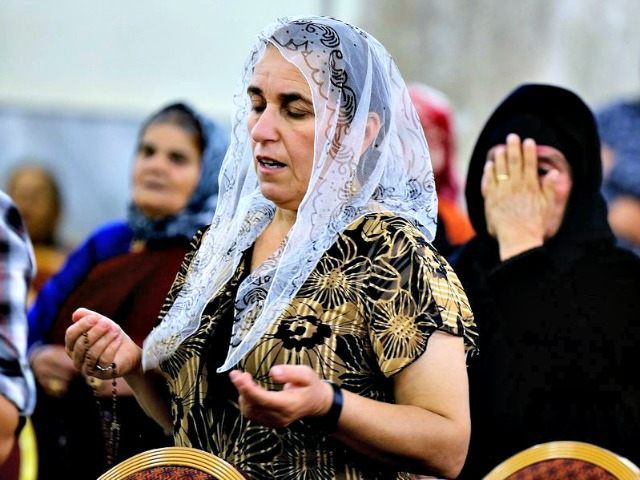
The orans position is not limited to ordained clergy. Hands extended in a petitioning manner, is how many Syriac and Malankara laity normally pray the Our Father. They do not do the full orans like priests, such as hands elevated above shoulder level at the side. Instead hands are placed in front, at the level a Latin would recieve Eucharist, stomach/chest level.
 
I’m not a fan of “full orans” for the Our Father in the Latin Rite, but I would suggest following your Bishop’s direction.
 
The orans position is not limited to ordained clergy. Hands extended in a petitioning manner, is how many Syriac and Malankara laity normally pray the Our Father. They do not do the full orans like priests, such as hands elevated above shoulder level at the side. Instead hands are placed in front, at the level a Latin would recieve Eucharist, stomach/chest level.
[picture]
As SyroMalankara says, there is a tradition of orans being used across other Apostolic Churches by laity. It is, intuitively, a posture of supplication and petition. In fact, the Shi’a muslims imitate and have obtained orans from Syriac Christianity, just as both Shi’a and Sunni received the metanoia as well.

That being said, that doesn’t necessitate the Latins allow it because all the other Churches have a history of wider use. Many will cite simulation and lack of conformity, but what of when the bishop issues a degree asking people use orans? Likewise, isn’t it problematic if a bishop decides to legislate against 400 years of popular practice to artificially impose a gesture on some?
 
My pastor and Bishop are telling all the laity to adopt the orans position during Mass for praying the Our Father. I’ve seen several links saying this is wrong and not to be done, especially by the deacon but our deacon is also adopting the orans position.
How widespread is this? Why is this? How am I to respond when I’m told to do what I understand to be wrong?
It is up to the Bishop to decide what the liturgical practices of his diocese are.
You are not being asked to sin, so I don’t understand you need to tell your Bishop “he’s doing it wrong.”

Maybe, just maybe, a little obedience is in order.

We, here in the US, complain so much about our priest shortage and with attitudes such as this, “I read it somewhere, so my Bishop/Pastor must be wrong”, I can’t help but see why we have a problem. Who in their right mind wants this kind of hassle? 🤷
 
My pastor and Bishop are telling all the laity to adopt the orans position during Mass for praying the Our Father. I’ve seen several links saying this is wrong and not to be done, especially by the deacon but our deacon is also adopting the orans position.
How widespread is this? Why is this? How am I to respond when I’m told to do what I understand to be wrong?
Have you considered that it is your understanding that is potentially wrong? Have you considered that the bishop and the officials of his curia – as well as his presbyterate – are, in fact, more competent in matters of liturgy and the theology, that underlies the liturgy and its norms, than you seem to give them credit?
The posture of the people during prayer at Mass is not one of the items in the GIRM list that bishop may change on his own authority (see GIRM 387). Thus it is not legitimate for a bishop to require people to assume the orans posture during the Our Father.
The GIRM does say that a bishop has the “responsibility above all for fostering the spirit of the Sacred Liturgy in the priests, deacons, and faithful”. He has the authority to see that practices in his diocese conform to the norms liturgical law, and, mindful of this, a bishop is to “regulate” these things:
  1. “the discipline of concelebration”;
  1. “the establishing of norms regarding the function of serving the priest at the altar”;
  1. “the distribution of Holy Communion under both kinds”;
  1. “the construction and ordering of churches”.
The posture of the people at prayer is not on this list.
This is beyond unsustainable as an assertion.

The power of the diocesan bishop over the liturgy in the Particular Church entrusted to him FAR exceeds the four items you relate.

Such an approach as you take indicates, in point of fact, why such reductionism to this sort of approach is, in point of fact, fatally flawed.

Even for those of a list mentality, you have overlooked the fact in this list that, based just on the GIRM and not drawing from the myriad resources a liturgist uses, the Bishop does have the power to mandate postures beyond what the GIRM has stipulated. More importantly, you have overlooked all that is to be gleaned from the many loci that exceed the mere GIRM.

If you have some personal aversion to praying using the orans posture, then don’t do it. It is not an obligation. But you cannot make your disregard of your bishop’s encouragement to adopt this posture into a superior act of virtue on your part.

And to be clear: what he and your pastor are encouraging is not wrong…from the perspectives of ecclesiology, theology, and liturgy.
 
Many will cite simulation and lack of conformity, but what of when the bishop issues a degree asking people use orans? Likewise, isn’t it problematic if a bishop decides to legislate against 400 years of popular practice to artificially impose a gesture on some?
Do you have familiarity with this case that is lost upon me? You speak of a decree, of legislating, and of imposing and I am trying to understand why these terms are being evoked since the particular case is unknown to me but perhaps it is known to you and others. Or is it that you are referencing some other instance? Or perhaps a post that had provided more detail of the situation at hand has been edited? I am confused.

If, as you write, this involves an act of particular legislation or decree, I should like to see the legislative or executive instrument as that is essential to making commentary.

In every instance in which I have encountered something of this general nature, the diocesan bishop is actually not engaging the full power that his office gives him but is operating several levels beneath that, in point of fact.
 
Do you have familiarity with this case that is lost upon me? You speak of a decree, of legislating, and of imposing and I am trying to understand why these terms are being evoked since the particular case is unknown to me but perhaps it is known to you and others. Or is it that you are referencing some other instance? Or perhaps a post that had provided more detail of the situation at hand has been edited? I am confused.

If, as you write, this involves an act of particular legislation or decree, I should like to see the legislative or executive instrument as that is essential to making commentary.

In every instance in which I have encountered something of this general nature, the diocesan bishop is actually not engaging the full power that his office gives him but is operating several levels beneath that, in point of fact.
To clarify, that was a hypothetical (and the emphasis was not on the mode of implementation but rather the object of the topic).
 
But I found this although it may be outdated and changed:

Adoremus, Society for the Renewal of the Sacred Liturgy
Online Edition - Vol. IX, No. 8: November 2003

[Update: The response about “orans” on the USCCB web site was later changed, and simply reads: “No position is prescribed in the present Sacramentary for an assembly gesture during the Lord’s Prayer.” www.usccb.org/liturgy/q&a/mass/orans.shtml]
At their November 2001 meeting, the bishops discussed “adaptations” to the new Institutio Generalis Missalis Romani (or GIRM) of the new Missal (reported in AB February 2002). The proposal to introduce the orans posture for the people was not included even as an option in the US’ “adaptations” to the GIRM.

Furthermore, the bishops did not forbid hand-holding, either, even though the BCL originally suggested this in 1995. The reason? A bishop said that hand-holding was a common practice in African-American groups and to forbid it would be considered insensitive.

Thus, in the end, all reference to any posture of the hands during the Our Father was omitted in the US-adapted GIRM. The orans posture is not only not required by the new GIRM, it is not even mentioned.

The approved US edition of the GIRM was issued in April 2003, and is accessible on the USCCB web site -http://www.usccb.org/liturgy/current/revmissalisromanien.shtml

While Adoremus has value, Adoremus is not the bishop, does not have authority over the bishop, and is only commentary.

The authority in the matter lies with the bishop; and if the bishop oversteps his bounds, the appeal, if any is to the dicastery in Rome.

It would be helpful, if you could cite what the bishop actually said. There is a wide range between saying that something is permitted in his diocese, to saying something is required.

I would note also that while Rome rejected the request for the orans position, it did so by not including it in the changes; not by coming out and saying “this is not permitted”. There is a significant difference between not specifically allowing something, and specifically forbidding it.

Holding hands during the Our Father has been occurring on a regular and wide-spread basis since 1964 - 1966, or for about 50 years. And the orans position has about the same length of time. One would think, with that passage of time and several iterations of the GIRM, that if Rome intended to forbid the matter, that they were not only informed, but also competent to do so; the silence has been deafening.

And the orans posture goes back well before the founding of the Church: Psalm 141: “O Lord, I have cried out to you, hear me. Attend to my voice, when I cry out to you.
Let my prayer be guided like incense in your sight: the lifting up of my hands, like the evening sacrifice.”

Again, it would be helpful if you could cite what the bishop actually said or wrote.
 
And this:
by Church Militant • ChurchMilitant.com • January 1, 2016
By Arturo Ortiz
Disunity Within the Mass
Many Catholics might not know that the use of the orans posture at Mass is solely to be used by the priest, as it is exclusively a priestly gesture. The rubrics for the Mass give the priest sole authority of praying with elevated hands — not the deacon nor the laity.

Donovan goes on to say that the main symbolism behind this posture as a solely priestly gesture is based on the fact that the priest is “praying on behalf of us, acting as ‘alter Christus’ as pastor of the flock, head of the body.” This is shown by the fact that his uplifted hands represent his lifting up of our prayers to God in Heaven.

Because the deacon and laity are not given the liturgical role of praying in this manner, and furthermore because it is solely a priestly gesture in the context of the Mass, liturgical disunity results when the laity engage in the orans posture:

While lay people are doing this, the deacon, whose postures are governed by the rubrics, may not do it. So, we have the awkward disunity created by the priest making an appropriate liturgical gesture in accordance with the rubrics, the deacon not making the same gesture in accordance with the rubrics, some laity making the same gesture as the priest not in accordance with the rubrics, and other laity not making the gesture (for various reasons, including knowing it is not part of their liturgical role). In the end, the desire of the Church for liturgical unity is defeated.

Many laity use this gesture during Mass because they see the priest doing it and assume they are supposed to do it as well. Some more progressive and creative priests with a desire to abolish the distinction between the clerical and lay state have at times encouraged laity to take part in the orans gesture. And poorly catechized laity don’t know any better.

The sooner priests and laymen return to a proper implementation of the rubrics through good catechesis and an authentic explanation of the Sacred Liturgy, the sooner the Church will experience greater unity at Mass.
This is a matter of one individual’s personal opinion, and what the individual states as facts are anything but facts… And the history of the matter is not even accurate; Catholics using the orans posture can be traced back to the Charismatic Movement within the Catholic Church in the 60’s.
 
While Adoremus has value, Adoremus is not the bishop, does not have authority over the bishop, and is only commentary.

The authority in the matter lies with the bishop; and if the bishop oversteps his bounds, the appeal, if any is to the dicastery in Rome.

It would be helpful, if you could cite what the bishop actually said. There is a wide range between saying that something is permitted in his diocese, to saying something is required.

I would note also that while Rome rejected the request for the orans position, it did so by not including it in the changes; not by coming out and saying “this is not permitted”. There is a significant difference between not specifically allowing something, and specifically forbidding it.

Holding hands during the Our Father has been occurring on a regular and wide-spread basis since 1964 - 1966, or for about 50 years. And the orans position has about the same length of time. One would think, with that passage of time and several iterations of the GIRM, that if Rome intended to forbid the matter, that they were not only informed, but also competent to do so; the silence has been deafening.

And the orans posture goes back well before the founding of the Church: Psalm 141: “O Lord, I have cried out to you, hear me. Attend to my voice, when I cry out to you.
Let my prayer be guided like incense in your sight: the lifting up of my hands, like the evening sacrifice.”

Again, it would be helpful if you could cite what the bishop actually said or wrote.
The points you express are quite correct.
 
This is a matter of one individual’s personal opinion, and what the individual states as facts are anything but facts… And the history of the matter is not even accurate; Catholics using the orans posture can be traced back to the Charismatic Movement within the Catholic Church in the 60’s.
I would add that the individual’s personal opinions are not only poorly stated but are poorly based. In all my years, I have not met anyone who used the orans posture “because they see the priest doing it and assume they are supposed to do it as well”.

I have always found troubling how, in certain countries, there appear views as though the rubrics require always and everywhere an absolute rigidity and utter uniformity that reduces one to the level of a mindless automaton.

It reminds me of when it was necessary for the dicastery to intervene in the United States against the full-throated zealousness of rigid imposition of postures – even by punitive action when the person does not comply – when there may be very good reason why the person does not or cannot comply. One would have hoped the Holy See’s intervention would have definitively re-oriented away from such a mindset.
 
Status
Not open for further replies.
Back
Top