(Continued)
From the 14th century onwards in Germany - much of our sources from this time actually come from German or Dutch-speaking areas - you see versions of the Marian/Jesus Psalter (now in some versions actually more a litany than a psalter or even a set of repetated prayer) which insert the idea of reflecting on scenes from the lives of Jesus or Mary to the devotion. It was also around this time you see the term ‘rosary’ (
rosenkranze) being applied to these forms of devotion.
A Dominic was instrumental in shaping the rosary into the form that we know it today. Unfortunately, it’s not so much the founder of the Dominican order.
Some scholars now even think that it’s doubtful whether St. Dominic de Guzman really had an active role in the rosary devotion. For one, the sources which claim a connection between him and the rosary only appeared a couple hundred or so years
after he died; sources from his lifetime or immediately afterwards don’t mention anything on the matter. Not to mention that the rudiments of the devotion already existed in his time: so even if the story about St. Dominic is true, he wouldn’t have been preaching an entirely new devotion that no one had ever heard of before. (Plus, his ‘rosary’ would not have been the same as our modern one.)
A German Carthusian monk from the mid-15th century named
Dominic of Prussia (1384-1460) first proposed
his version of the rosary in 1458. His version had 50 Hail Marys (ending in “blessed is the fruit of your womb, Jesus…”, in 15th century fashion) after which comes a theme of Christ’s life to be meditated upon. So for example: “… and blessed is the fruit of your womb, Jesus,
conceived of the Holy Spirit during the Annunciation of the Angel.”
Dominic of Prussia’s devotion wasn’t the first “life of Jesus rosary” there was. For one, a similar but independent devotion was attested in a nearby Cistercian nunnery from 1300, some 82 years before Dominic was even born. (In addition, you have a number of “life of Jesus/Mary” psalters/rosaries in either Latin or vernacular already existing by that time.) But Dominic’s version was the first to become
very popular. Not to mention that it was the first to contain
just 50 Hail Marys + meditations. (The Cistercian version from 1300 by comparison had ninety-eight - probably originally a hundred.)
You can see Dominic’s influence even today in the German version of the (modern) rosary: apparently it’s still a custom for Germans
to recite a short clause in the middle of the Hail Mary. ("… und gebenedeit ist die Frucht deines Leibes, Jesus,
den du, o Jungfrau, vom Heiligen Geist empfangen hast…")
Soon everybody jumped onto Dominic’s bandwagon; many people produced their own versions or variations of the ‘older’ (repetitive/psalter) and the ‘newer’ (meditative) models. By the late 15th century, you have rosary confraternities being started throughout Europe.
But still, there was still no fixed form of the devotion: a late-15th century prayer book called “About the Psalter and Rosary of Our Lady” (
Von dem psalter unnd Rosenkrancz vnser lieben frauen) gives
six different ways of reciting the rosary (it doesn’t include Dominic’s version) and even encourages the reader to find another method if he didn’t find any of the six satisfying. Depending on the version, you could have as many as 200 or as few as five mysteries. There were rosaries both based on the old repetitive / psalter (just the prayers, no mysteries to meditate upon) type and the new meditative type. The version we know today - fifteen mysteries on 150 Hail Marys, divided into three mysteries - didn’t become the standard until a papal proclamation in 1569.
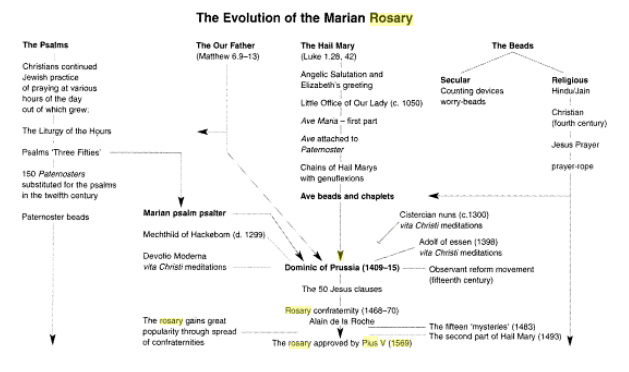
Here’s a little chart (from John Desmond Miller’s
Beads and Prayers: The Rosary in History and Devotion):