[cont’d from last post]
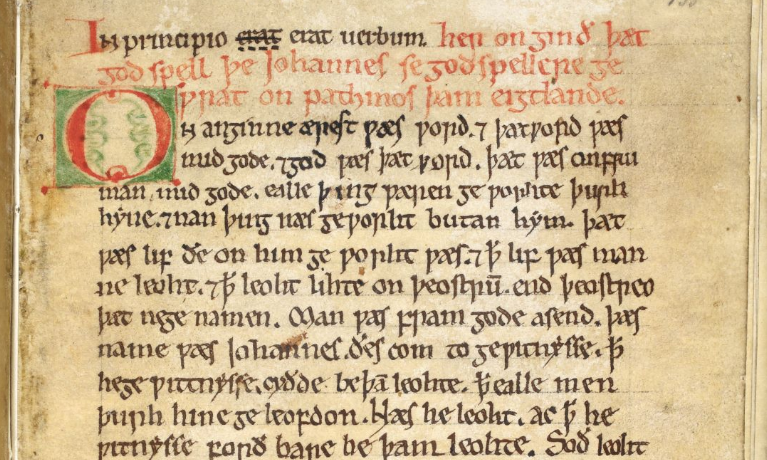
The Pepysian Harmony - This is a Harmony of the Gospels. It takes the text of the gospels and arranges them into one continuous narrative. This translator paraphrases some stuff instead of translating it, so in many places it is non literal. But there’s nothing wrong with that, today this would be called a “dynamic equivalence” technique as opposed to a “literal” technique. There are a few bad effects of this in this particular version, though. One is that the author sometimes summarizes long chapters instead of translating or paraphrasing them. And occasionally he misreads a word and thus gives a poor translation. Nonetheless, this book stands out as a notable example of a Catholic translation of the gospels into Middle English independent of Wycliffe. The translation is called the Pepysian Harmony because the manuscript was found in the library of a British book collector from the 1700s named Samuel Pepys.
The Midland Psalter - This translation of the psalms is sometimes called “The Earliest Complete English Prose Psalter.” Scholars aren’t sure if it came before the Rolle Psalter or not, but it definitely wasn’t as popular. It doesn’t contain a commentary, which is one of several things that makes it different from Richard Rolle’s translation, but it was definitely in use before the Wycliffe Bible was produced, which is just another piece of evidence that Catholics could have English translations of the Bible before Wycliffe, at least partial ones while a complete version was being made.
It is also important to point out that between 1066 A.D. and 1342 A.D., the official language of England was Norman French. Saxon English was still spoken by the common people, but, ever since William the Conqueror, Norman French was spoken by the court, and Bibles in England from this time period were therefore mostly in various dialects of French. For example, the Earl of Warwick (named Guy Beauchamp) died in 1315 A.D. and left behind him a library of books that included French copies of various books of the Bible.
In short, no, there was no penalty for reading non-Latin translations of Scripture, unless they were heretical or violated other norms of the Church.
Two possible exceptions: in the French town of Toulouse in 1229 A.D. and in the Spanish town of Tarragona in 1234 A.D., there were two local councils which temporarily placed severe limitations on the laity’s access to the Bible. In Toulouse, only Latin Scriptures were permitted, and then only the Psalms; in Tarragona, I haven’t been able to find the full text, but the partial text indicates that not even that was permitted, but there was a blanket ban. However, Wikipedia includes a significant “dot-dot-dot” at that part, and I wonder if there is an exception clause that got omitted from Wikipedia.
Other than these two temporary restrictions in parts of France and Spain, I am unaware of any Church council that placed a blanket prohibition on the laity such that no one could read a vernacular Bible.