C
Christine85
Guest
I don’t think there should be any discrimination as to which way you take communion, nor should anyone judge others who don’t do it their way. Everyone is entitled to their own experience.


This is one of the reasons why I post.We have many people who read these threads and may not post, but they’re reading. Some of them get confused. I receive about 20 PMs a week from observers. It’s always the same thing, “Brother, what does this mean?” or “Brother, do I have to do this?” or “Brother, is it a sin if I don’t do that?” It’s usually because someone is interested in a subject, but the posters left out a detail. The inquirer is uncomfortable asking for a clarification on the thread.
The fine print is helpful to many people.
Fraternally,
Br. JR, FFV
I thought I made it clear I was only talking about Roman Catholics. I’m given to understand that kneeling has a different context in the Eastern traditions.Subjective. Not Fact.
I receive the Eucharist in the way that is most reverent for me.
You are correct in that kneeling has a different context in Eastern traditions. It is a penitential posture. You may also be aware that we stand when receiving the Holy Eucharist, as standing is a posture of joy. There is indeed a “hierarchy of reverence when it comes to postures” in the Eastern Churches (which includes some not generally seen in the Latin Church, like full prostrations), as well.I thought I made it clear I was only talking about Roman Catholics. I’m given to understand that kneeling has a different context in the Eastern traditions.
Nonetheless, in our tradition, it’s the height of deconstructionist thinking to say that there is no hierarchy of reverence when it comes to postures. It’s fact to say that there is, not subjectivity. To take a different example: there is a reason we must stand for the Gospel if we’re able. I also listen to what my priests say about it and try to follow the example they put for me.
I don’t think our unworthiness can be comtemplated enough. The fault is in distorting our perception of God’s infinite love for us, displayed most of all on the cross. I think the right balance, found in the reading of the saints, is to appreciate first our utter unworthiness, and then see how our unworthiness actually shows how great is God’s love for us.I think we need to take a breather and just appreciate Christ in the Eucharist in which ever manner we accept him. He loves us so much he would not want us arguing over how to approach him. Let’s just accept that different people have their preferences. Though I must say I have realized tonight that by considering us unworthy to approach him defeats what he did on the Cross for us.
Of course as stated by the Church we are to be free from mortal sin, but even when we are why do people who promote receiving on the tongue insist they are not worthy to touch Jesus. Do you think Jesus believes this too?
Again, I receive in the manner that is most reverent for me. Stating that how you receive is more reverent than any other option is a matter of preference and is subjective.I thought I made it clear I was only talking about Roman Catholics. I’m given to understand that kneeling has a different context in the Eastern traditions.
Nonetheless, in our tradition, it’s the height of deconstructionist thinking to say that there is no hierarchy of reverence when it comes to postures. It’s fact to say that there is, not subjectivity. To take a different example: there is a reason we must stand for the Gospel if we’re able. I also listen to what my priests say about it and try to follow the example they put for me.
I thought this was a very uplifting thread where we could share the joy we find in a traditional practice, not a condemnation of COTH, but naysayers jumped in and made it an argument. Thanks.
May I ask you who is the arbiter of what is traditional? Just because something is a practice that is pre-vatican II does not necessarily make it traditional. What about pre-trent practices? What about practices that come from the early church? Are those not traditional?Yes, it is interesting how in the “Traditional Catholicism” forum there are self-appointed monitors who make sure they have something to say against traditional Catholic practices.
Sometimes it seems like they want every post on traditional Catholic spirituality to come with the fine-print disclaimers that accompany pharmaceutical ads
- PAX
Maybe they are voted down because they are inaccurate in what they are posting.Every traditional thread is somehow voted down by trolls. Reminds me of YouTube haters voting down religious videos
Well, it’s not my place to argue with you brother David. Have a nice day.Again, I receive in the manner that is most reverent for me. Stating that how you receive is more reverent than any other option is a matter of preference and is subjective.
I will also point out to you that while I am a Byzantine Catholic I am also a Carmelite friar so I am well versed in the Roman Church as my order is a Roman order.
So there is “our” about it. It is also mine.
Most of the time it does, because it has been practiced for centuries and centuries.Just because something is a practice that is pre-vatican II does not necessarily make it traditional.
Yes, but they were developed upon through hundreds of years of organic development; which enhances orthodoxy and worship.What about pre-trent practices? What about practices that come from the early church? Are those not traditional?
I dont quite think that this was/is the case.But everything changed in the 1960’s. It was a new beginning! We realised how much more worthy we were and how rigid our forefathers were.
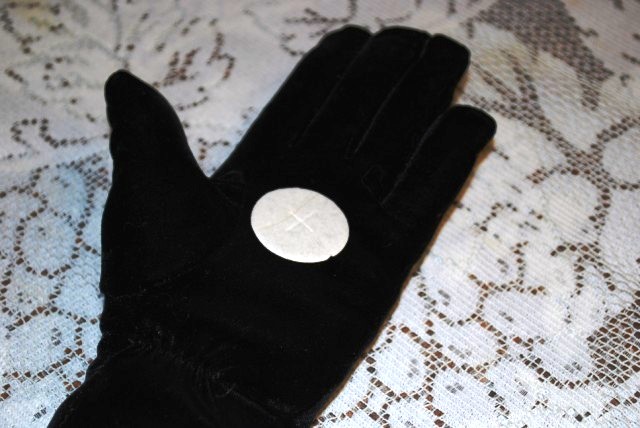
Yes, it is about symbolism."The thing about COTT is symbolism. "Oh Lord, I am not worthy that Thou shoulds’t enter under my roof …".
The Church teaches that when the Eucharist looses the appearance of bread that the real presence is no longer there.From Father Z’s blog in 2009:
Do you believe that each particle of a Host is the Body, Blood, Soul and Divinity of Christ Jesus, God and man?
I think we’ve been here before.Yes, it is about symbolism."
"Take, eat; this is my body. . . "
The Church teaches that when the Eucharist looses the appearance of bread that the real presence is no longer there.
Looking at that glove I do not see bread, I see dust.

Yes we have.I think we’ve been here before.
