
Pope Pius V broke with tradition too

  • Thread starter Thread starter Lucky7
  • Start date Start date
Status
Not open for further replies.
L

Lucky7

Guest
I thought it would be interesting to note that one of the great Popes, Pope Pius V, broke with tradition as well. It was he, after hundreds of years, who changed the Pope’s dress to white:

From: catholicculture.org/culture/liturgicalyear/calendar/day.cfm?date=2012-04-30
His holiness and austerity of life were notable, and he succeeded in bringing simplicity even into the papal household. He refused to wear the flowing garments of previous popes and insisted upon wearing his white Dominican habit even as head of the Church. To this day, the pope wears white, a custom begun by this Dominican pontiff.*

As you can see by the other comments about his simplicity, it appears that these two popes have other similarities. Knowing Pope Francis visited his tomb makes me hopeful that there is good reason why there are similarities…and that those similarities will continue into the future.
 
God bless our Holy Father, he is indeed what the Church needs.
 
The thing that’s troubling about attributing the practice of the Pope wearing a white cassock to Pius V is that there are so many contemporary portraits of earlier popes wearing white cassocks.

For example:

(Please Note: This uploaded content is no longer available.)
Melozzo da Forli’s painting of Sixtus IV (r. 1471-1484) is a contemporary portrait (ca. 1477-1480). Sixtus is clearly wearing a white cassock.


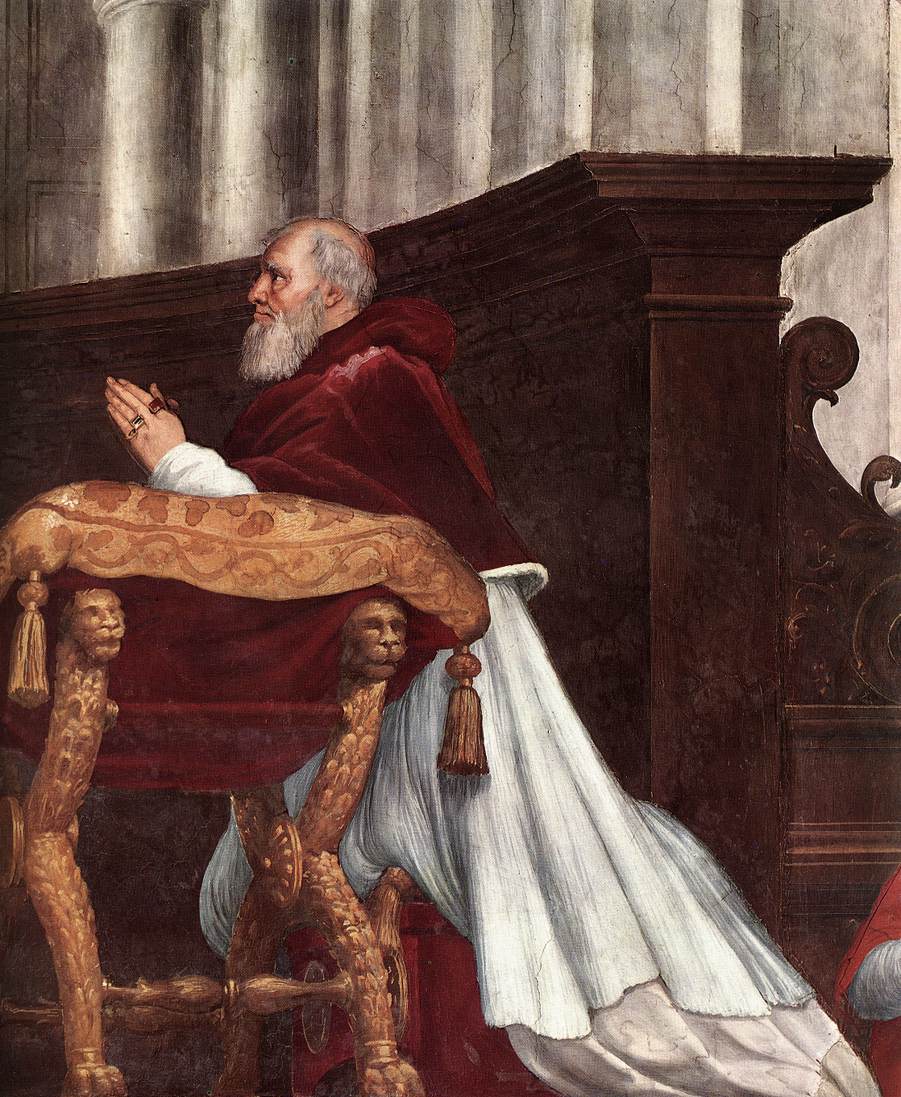
Raphael’s The Mass at Bolsena (ca. 1512-1514) shows Julius II wearing white cassock and red mozzetta. So does his seated portrait of Julius II (ca. 1511-1512).

http://imgc.allpostersimages.com/im...-luigi-de-rossi-and-giulio-de-medici-1518.jpg
Raphael’s portrait of Leo X with Cardinals (Luigi de Rosso and Giulio de Medici), ca. 1518-1519, also shows the pope in white cassock and red mozzetta.

Similarly Piombo’s portrait of Clement VII ca. 1531.

Also Titian’s 1546 portrait of Pope Paul III and his Nephews/Grandsons.

Now, having seen all of those portraits of popes in white cassocks and red mozzettas, what distinguishes the attire of Pius V in the usual portrait by El Greco (who lived in Rome and worked for Pius V)? As far as I can tell, the answer is: nothing. No innovation in papal dress whatsoever.

To be fair, I didn’t find any evidence of contemporary depictions of popes prior to Sixtus IV wearing white cassock, so I don’t know if we can really say that the practice goes back any farther than the 15th century, but it’s definitely older than Pius V.

On the whole, I don’t think substituting one Dominican (Innocent V) for another (Pius V) makes the story any more plausible. If everyone knew that the reason Innocent V wore white was because he was a Dominican and not because it was what Popes were supposed to wear, why on earth would his non-Dominican successors adopt the practice? Especially keeping in mind that Innocent V was only Pope for about five months. It’s not like people would have really gotten used to seeing the Pope in white during such a short time.

In conclusion, the practice definitely predates Pius V, but how far back it goes and why it started is still somewhat mysterious.
 
The thing that’s troubling about attributing the practice of the Pope wearing a white cassock to Pius V is that there are so many contemporary portraits of earlier popes wearing white cassocks.

For example:

http://media.kunst-fuer-alle.de/img/41/m/41_00094421.jpg
Melozzo da Forli’s painting of Sixtus IV (r. 1471-1484) is a contemporary portrait (ca. 1477-1480). Sixtus is clearly wearing a white cassock.

http://uploads2.wikipaintings.org/i...-from-the-stanza-dell-eliodor-detail-1514.jpg
Raphael’s The Mass at Bolsena (ca. 1512-1514) shows Julius II wearing white cassock and red mozzetta. So does his seated portrait of Julius II (ca. 1511-1512).

http://imgc.allpostersimages.com/im...-luigi-de-rossi-and-giulio-de-medici-1518.jpg
Raphael’s portrait of Leo X with Cardinals (Luigi de Rosso and Giulio de Medici), ca. 1518-1519, also shows the pope in white cassock and red mozzetta.

Similarly Piombo’s portrait of Clement VII ca. 1531.

Also Titian’s 1546 portrait of Pope Paul III and his Nephews/Grandsons.

Now, having seen all of those portraits of popes in white cassocks and red mozzettas, what distinguishes the attire of Pius V in the usual portrait by El Greco (who lived in Rome and worked for Pius V)? As far as I can tell, the answer is: nothing. No innovation in papal dress whatsoever.

To be fair, I didn’t find any evidence of contemporary depictions of popes prior to Sixtus IV wearing white cassock, so I don’t know if we can really say that the practice goes back any farther than the 15th century, but it’s definitely older than Pius V.

On the whole, I don’t think substituting one Dominican (Innocent V) for another (Pius V) makes the story any more plausible. If everyone knew that the reason Innocent V wore white was because he was a Dominican and not because it was what Popes were supposed to wear, why on earth would his non-Dominican successors adopt the practice? Especially keeping in mind that Innocent V was only Pope for about five months. It’s not like people would have really gotten used to seeing the Pope in white during such a short time.

In conclusion, the practice definitely predates Pius V, but how far back it goes and why it started is still somewhat mysterious.
Then why are reputable Catholic sites/biographies attributing it to Pius V? Is there something different about his white cassock than the others? Perhaps it’s the collar part? Did he wear the red part on top of it or just the white alone?
 
Posting such large photos make it impossible to read the thread.
 
Even if Pius V wasn’t the first to start the white cassock, the point being that the white cassock wasn’t always tradition…what seems to be at least 1,000 years? It changed. So, Pius V didn’t change it…some other pope changed it. Therefore, the current pope’s decision to change vestments is more than okay.
 
The thing that’s troubling about attributing the practice of the Pope wearing a white cassock to Pius V is that there are so many contemporary portraits of earlier popes wearing white cassocks.

For example:

http://media.kunst-fuer-alle.de/img/41/m/41_00094421.jpg
Melozzo da Forli’s painting of Sixtus IV (r. 1471-1484) is a contemporary portrait (ca. 1477-1480). Sixtus is clearly wearing a white cassock.

http://uploads2.wikipaintings.org/i...-from-the-stanza-dell-eliodor-detail-1514.jpg
Raphael’s The Mass at Bolsena (ca. 1512-1514) shows Julius II wearing white cassock and red mozzetta. So does his seated portrait of Julius II (ca. 1511-1512).

http://imgc.allpostersimages.com/im...-luigi-de-rossi-and-giulio-de-medici-1518.jpg
Raphael’s portrait of Leo X with Cardinals (Luigi de Rosso and Giulio de Medici), ca. 1518-1519, also shows the pope in white cassock and red mozzetta.

Similarly Piombo’s portrait of Clement VII ca. 1531.

Also Titian’s 1546 portrait of Pope Paul III and his Nephews/Grandsons.

Now, having seen all of those portraits of popes in white cassocks and red mozzettas, what distinguishes the attire of Pius V in the usual portrait by El Greco (who lived in Rome and worked for Pius V)? As far as I can tell, the answer is: nothing. No innovation in papal dress whatsoever.

To be fair, I didn’t find any evidence of contemporary depictions of popes prior to Sixtus IV wearing white cassock, so I don’t know if we can really say that the practice goes back any farther than the 15th century, but it’s definitely older than Pius V.

On the whole, I don’t think substituting one Dominican (Innocent V) for another (Pius V) makes the story any more plausible. If everyone knew that the reason Innocent V wore white was because he was a Dominican and not because it was what Popes were supposed to wear, why on earth would his non-Dominican successors adopt the practice? Especially keeping in mind that Innocent V was only Pope for about five months. It’s not like people would have really gotten used to seeing the Pope in white during such a short time.

In conclusion, the practice definitely predates Pius V, but how far back it goes and why it started is still somewhat mysterious.
Also, are these your words? If not, could you please provide the link rather than post it as if these are your ideas?

Because I found this:

popes-and-papacy.com/wordpress/andrew-o-when-the-popes-started-wearing-white-and-why/
 
Also, are these your words? If not, could you please provide the link rather than post it as if these are your ideas?

Because I found this:

popes-and-papacy.com/wordpress/andrew-o-when-the-popes-started-wearing-white-and-why/
Just a :twocents: plain, (seltzer, anyone?), but irrespective of the provenance, I noticed one glaring inaccuracy in the first paragraph:
the Dominican Pius V (#226) [1566-1572], who continued to wear the white cassock of his old order
Dominicans do not wear a cassock. They have a proper habit, which is not the same as a cassock and it is **never **called a cassock. 🤷
 
Just a :twocents: plain, (seltzer, anyone?), but irrespective of the provenance, I noticed one glaring inaccuracy in the first paragraph:

Dominicans do not wear a cassock. They have a proper habit, which is not the same as a cassock and it is **never **called a cassock. 🤷
Perhaps that’s the difference between his white and the other “whites”? I’m having a hard time believing so many reputable Catholic sources (including CAF) points to Pius V as making the change. I think there was something different even if it isn’t noticeble in the pre-Pius V portraits.
 
Perhaps that’s the difference between his white and the other “whites”? I’m having a hard time believing so many reputable Catholic sources (including CAF) points to Pius V as making the change. I think there was something different even if it isn’t noticeble in the pre-Pius V portraits.
Perhaps so. Some of the portraits shown seemed to me to have watered white silk, which is not the Dominican habit.

But one thing is for sure: even it it started with Pius V, he certainly did not make any “change” in the mode of dress. If anything, it was his successor(s).
 
Perhaps so. Some of the portraits shown seemed to me to have watered white silk, which is not the Dominican habit.

But one thing is for sure: even it it started with Pius V, he certainly did not make any “change” in the mode of dress. If anything, it was his successor(s).
Maybe I’m dense, but I’m not following this. Do you mean predecessors?
 
Maybe I’m dense, but I’m not following this. Do you mean predecessors?
No, I meant successor(s). The claim is that the custom of “Papal white” derives from Pius V’s Dominican habit, and ergo it would have to be his successor(s) who adopted it. 🙂
 
I would be most impressed if the Bishop of Rome went back to wearing a Palestinian fisherman’s tunic.
 
What wonderful photos! Thank you so much. I’m wondering if some of the confusion of these paintings might be caused by the very very long skirt called the Falda—a particular papal vestment which forms a long skirt extending beneath the hem of the alb. The skirts of the falda were so long that the pope had train-bearers both in front and in back whenever he walked. en.wikipedia.org/wiki/Papal_garments

Maybe, it’s the white Falda you are seeing in the earlier paintings. It would make sense that the switch is attributed to Pope Pius V then. He set aside wearing this very restrictive garment and continued wearing his Dominican habit. The important thing, at least to me, is that he retained the RED mozzetta, hat, and shoes.

While I don’t remember the context of the teaching it might have been at Christmas since photos of St. Pius V, to children, might evoke Santa Claus 🙂 The sisters in school taught us, that the Pope wore the red hat=crown of thorns, red mozzetta=blood that covered Christs back from the beatings and scourging, and the red sandals/slippers/shoes= the blood that covered our Lord’s feet as he was scourged and as he made his way to Calvary.
 
There is a BIG difference between ‘tradition’ and ‘Tradition’

The clothes that the pope wears is mere tradition, while our veneration of Mary and the Saints is Tradition.
 
I guess I must be lost. What was the point of this thread? The title suggests a certain tone of “ah ha! See?!” but I don’t understand why. :confused:
 
Status
Not open for further replies.
Back
Top