Prayer in Catholicism

  • Thread starter Thread starter MontChevalier
  • Start date Start date
Status
Not open for further replies.
M

MontChevalier

Guest
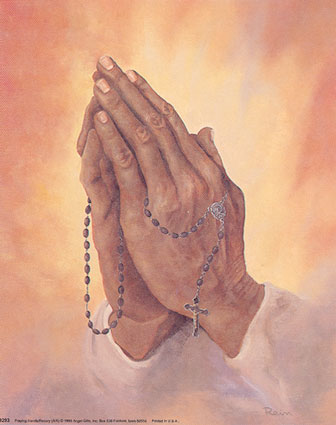
Where does it say in the bible that we should pray with our hands placed together?

Like in the photo below.


It shows in the Bible that people pray placing their faces over the ground. Kinda like the Muslims do it. Matthew 26:39, Exodus 4:31, Chronicles 20:18.

So what’s up? Can someone give me a clue? :confused:

-MontChevalier
 
Not everything in Catholicism is directly rooted in the Bible. That said, I have no idea if this prayer stance is or not.
 
The tradition of folding or joining one’s hands while praying was to emphasize that this time belonged to God, in other words, you weren’t doing any work with your hands, and that your thoughts were supposed to be turned to prayer instead of more mundane things. Of course, you’re free to pray privately in any respectful posture you choose.
 
I never heard anyone say you have to hold your hands some specific way to pray. I do recall that only the priest is supposed to raise up his arms, though.
 
So praying with both hands together has no doctrinal backing???:eek:
 
I don`t know if folded hands in prayer has doctrinal backing or not.You are free to do this or not, use the prayer posture that is most reverential to you.

Also. as far as the prostrations the Muslims do, actually this is an ancient posture of prayer that was taken from the Christian East.🙂
 
I don`t know if folded hands in prayer has doctrinal backing or not.You are free to do this or not, use the prayer posture that is most reverential to you.

Also. as far as the prostrations the Muslims do, actually this is an ancient posture of prayer that was taken from the Christian East.🙂
This.
 
So praying with both hands together has no doctrinal backing???:eek:
Why would you think it did?

You know, come to think of it, the classic praying hands posture is a yoga thing - at least - back in the day when I did yoga regularly, it was part of one of the classic poses.
 
Where does it say in the bible that we should pray with our hands placed together?

Like in the photo below.
http://catholicsistas.files.wordpress.com/2011/08/praying-hands-and-rosary-posters.jpg

It shows in the Bible that people pray placing their faces over the ground. Kinda like the Muslims do it. Matthew 26:39, Exodus 4:31, Chronicles 20:18.

So what’s up? Can someone give me a clue? :confused:

-MontChevalier
This actually comes into Catholicism from the East, probably from Judaism itself. There are two positions that are very common in the East, the open arms extended upward to signify that our prayer rises to God and the other is praying hands, which in the East is a sign of reverence for God and monarch. You will find it among Christians, Hindus, Muslims and Jews from the East.

In Europe, religious communities discouraged it until Vatican II. Hands were not to be seen, except when kneeling. If you were standing, you kept your arms crossed inside your sleeves. It was a little more difficult to do when kneeling in a pew. You gently rested your folded hands in front of you.

As you can see, the use of the hands in prayer has taken many forms and many gestures. None of them are doctrinal. They are cultural. The essential attitude remains unchanged. In the presence of the divine, one assumes a posture of reverence, be it with folded hands; outstretch arms or arms crossed inside the sleeves where the hands are out of sight.

When I was a boy, a rabbi once told me that the hands could be a source of distraction in prayer and so our ancestors engaged the hands as well as the mind and heart. I don’t know if that is a historical fact, but the idea of the hands being a distraction is certainly believable. Try watching a public speaker who does not know what to do with his or her hands. Even if it does not distract the speaker, it distracts the audience and those around him.

I taught for 35 years. Even when I was not writing, if my hands were not on the podium or in my sleeves, I held a chalk or later a marker, when white boards came in. You needed to do something with the hands to avoid distraction.

I guess that’s why Easterners folded their hands when bowing before God and king. If you have ever watched videos of Mother Teresa, she always folded her hands as in prayer and bowed to say hello and goodbye. Among Hindus, this is a sign of reverence and respect for a person who is in a cast above you. Mother used it with all peoples, placing herself in the lowest cast.

Over the centuries, these cultural behaviors worked their way into many religious practices, including Christianity. They are quite beautiful. If we greet another human being with special gestures, how much more attentive should we be when speaking to God. Obviously, we can’t use the gestures of the angels, because we’ve never seen them. Therefore, we use the best ones we have in our human repertoire.

Fraternally,

Br. JR, OSF 🙂
 
40.png
JReducation:
As you can see, the use of the hands in prayer has taken many forms and many gestures. None of them are doctrinal. They are cultural. The essential attitude remains unchanged. In the presence of the divine, one assumes a posture of reverence, be it with folded hands; outstretch arms or arms crossed inside the sleeves where the hands are out of sight.
This! Thanks again brother JR. 🙂

@MontChevalier: I guess that is one of the humps you have to get over. There are a lot of things we do that don’t need doctrinal or Scriptural backing.

But If we’re going to be strictly Scriptural… What was described in the Scripture you showed was the prostrate position–a posture of submission. Every time we pray, wherever we are, we should then prostrate ourselves. But it’s not the only posture found in the bible. To illustrate this is the parable of the Pharisee and the publican (Luke 18:10-13).

And when Christ taught us the prayer to the Father, He didn’t say that we should lie face down while praying.

🤷
 
Palms together. Fingers together and pointed upward. Hands centered at chest level. Head slightly bowed.

Many of us were taught this position when we were initially formed as Catholics. Although I originally learned it from my parents, it was formally demonstrated to my first grade class in 1962 and was used when we prayed in the classroom as a group and whenever we were in church.

For those who were trained as altar servers, this was the default position when the hands were not engaged in another task during the Holy Sacrifice of the Mass. I believe that it was derived from the position the priest assumes before beginning Prayers at the Foot of the Altar. Priests and servers in EF continue to use the rubric to this day.
 
Status
Not open for further replies.
Back
Top