Priest facing away from the congregation.

  • Thread starter Thread starter Gfourbees
  • Start date Start date
Status
Not open for further replies.
The Holy Father accepted Cardinal Arinze’s resignation due to age. The new prefect is Antonio Cardinal Canizares Lloera.
Benedictgal:

Thanks for telling me - Though I sorry to hear that. I rather liked Cardinal Arinze.

Your Brother, Michael
 
Actually he retired a little over a year ago, Antonio Cardinal Cañizares Llovera is the current prefect.
CD:

It’s obvious I don’t follow things over at the Vatican. I was trying to make the point that the latest statement from the Congregation of the Sacraments was that Catholic Churches needed Kneelers & Altar Rails, and that those who removed them, or who never had them installed in the first place, have been going against centuries of Catholic Practice. Has that changed?

Your Brother in Christ, Michael
 
The priest doesn’t just face the altar and liturgical east to symbolically lead the people, who face the same direction with him. He also stands between the altar and the people in part as intercessor, turning first to the altar, then to the people, then back to the altar again, fulfilling his function AS a priest.

Old, beautiful churches were designed with this in mind. When our church turned the altar around decades ago, the original Gothic high altar and reredos behind it were removed. A painting of the Virgin and saints above it was painted over, statues and the altar rail were removed, and the church interior looked like a glorified barn. A horizontal swath of pews was also removed to facilitate processions and an offering table was smacked down into the center of it all as the starting point for the ritual “schlep to the altar by stumbling laypeople bearing offerings”. (Now there’s talk of removing the kneelers!) Right around the same time, our nuns abandoned their blue-grey habits and graceful starched coronets, and took to wearing tacky lay clothes, moved from the convent to an apartment, took secular jobs, and got their hair done.

Some of us have asked our pastor for a Tridentine Mass, or even a more reverential Novus Ordo, but his head is stuck in the 60’s. Nice to know that some priests sense the value and historic continuity in ad orientem.

Frankly, I have always found such statements to be an unusual move by the various pastors at each parish during the turbulent time of liturgical reform. While countless churches were altered, particularly forever, others did not change greatly. For example, the majority of historic parishes throughout the City of San Francisco kept their high altars. Such as,

St. Peter and Paul Church:

St. Boniface Church:


Regarding the op, I congratulate the pastor of the parish.
 
CD:

It’s obvious I don’t follow things over at the Vatican. I was trying to make the point that the latest statement from the Congregation of the Sacraments was that Catholic Churches needed Kneelers & Altar Rails, and that those who removed them, or who never had them installed in the first place, have been going against centuries of Catholic Practice. Has that changed?

Your Brother in Christ, Michael
No problem, didn’t expect you to know that actually. One of the main reasons I know it is that I had the honor of serving for Cardinal Arinze a number of years ago in OH.

There have been few policy changes since he retired, and the CDWDS has been (in my opinion) a little more vocal in support of tradition and continuity.
 
For example, the majority of historic parishes throughout the City of San Francisco kept their high altars. Such as,

St. Peter and Paul Church:
It’s always good to hear of churches in this country that were not totally gutted in the name of the “spirit of Vatican II.” While I know there are some exceptions, IMO it’s a shame that most of the new construction still embraces it and the idea of a High Altar (and, oh horrors! ad orientem) is totally alien.

Not that it makes much difference, but I noticed that Ss Peter & Paul has a “Latin Mass” scheduled once a month. If it’s OF, is it offered ad orientem? On the High Altar? If it’s EF, the question is simply is the High Altar used?
Since I reside on peninsula south of SF, I haven’t attended the Latin Mass at St. Peter and Paul. Yet, I would assume it’s offered in the OF in versus populum.
 
It’s always good to hear of churches in this country that were not totally gutted in the name of the “spirit of Vatican II.” While I know there are some exceptions, IMO it’s a shame that most of the new construction still embraces it and the idea of a High Altar (and, oh horrors! ad orientem) is totally alien.

Not that it makes much difference, but I noticed that Ss Peter & Paul has a “Latin Mass” scheduled once a month. If it’s OF, is it offered ad orientem? On the High Altar? If it’s EF, the question is simply is the High Altar used?
With regard to your statement in bold, the tide may be turning. Well, at least in church design.
catholicnewsagency.com/news/georgia_parish_hopes_to_move_historic_church_900_miles_south/
 
Our priest has begun facing away from the congregation during the consecrecration. He has written a letter to us in our bulletin explaining reasoning for the change. He said that it makes the prayer a verticle prayer instead of a closed circle which results from facing us. Could someone help me to understand why this is better. I feel that looking at the back of the priest during this important time of the mass excludes us.
His back it not to you. He is facing Christ WITH you!

Deo Gratias!

:-))
 
Our priest has begun facing away from the congregation during the consecrecration. He has written a letter to us in our bulletin explaining reasoning for the change. He said that it makes the prayer a verticle prayer instead of a closed circle which results from facing us. Could someone help me to understand why this is better. I feel that looking at the back of the priest during this important time of the mass excludes us.
You are being distracted by staring at the priest. You should be looking past at the crucifix upon which is nailed Christ our redeemer and thinking of the supreme blessing that is shortly to come your way be means of the holy eucharist.

You can think of it this way. In a battle, the commander always is at the head of his charges and becons to those behind him: “Follow me, men, to victory!” does he not? Same idea. We are being asked to follow the priest forward to the sacrificial victory which is ours at the mass. Why shoold he be staring at us if he is addressing our lord? Why should he be staring at us if he is leading us forward? If he says ‘follow me’ should we all run up onto the sacristy and fall in by rows and columns behind him? Or, if in a procession, do you want the priest to walk backwards so that he doesn’t lose eye contact with you? That makes no sense. No, you always look at the back of your leader.
 
\ Our priest has begun facing away from the congregation during the consecrecration.\

**Wrong.

He is facing liturgical East.**
In other words, they’re ALL facing liturgical East together (well except if the church has pews to the “North” and “South” of the altar which some parishes, mine, do have.)
Would that the priest in my Latin parish priest would do it…
 
I certainly believe that their is a renewed interest to celebrating the Mass in a pre-Vatican II liturgy. No less than our present Holy Father spearheads the campaign. I have no objections whatever to this type of liturgical style. Although I already received my dispensation from the priesthood my value for the Eucharist has never diminished. We were instructed in our Liturgy class that one of the important gestures during consecration aside from saying the Form of consecratory prayer is to raise the Consecrated Host and later the Chalice for everyone in the congregation to see and worship. And even if the priest has his back on the people this is still possible. Changes such as these however sometimes make us uncomfortable because we have grown accustomed to facing the priest. I could just imagine how some people felt when the first masses were celebrated with the priest facing the congregation after Vatican II. Hopefully the liturgy helps us become more devoted and make the mass more solemn.
 
Remember, when we are facing forward at the alter; we are not doing so to look upon the priest, but to look towards Christ in the Blessed Sacrament. The Priest, by looking forward towards Christ as well, is pointing us towards Christ. In some denominations, reverence is all but lost, the pastor is the star of the show and everyone is looking at him…a good priest knows it is not about him, he is merely a servant.
A good Priest knows that when Mass begins, the central point of worship is at the Altar and not the Tabernacle. Therefore it is not necessary for a Priest to be facing the Tabernacle. And since the Priest during Mass is acting in Persona Christi, he should be facing the people just as Christ did. The Mass was instituted at the Last Supper, have you ever gone to a meal where the host was facing away from you? Can you cite one Scripture Passage where Christ turned His back on the people he was ministering to? Then where does the thology come from where a Priest acting in Persona Christi can turn his back on those he is ministering to?

This facing away from the people by Priests during Mass is nothing but an attempt on the part of Priests to exclude the people from the Mass as was done in the Dark Ages. There is no real theology to back it up. Some claim it is an attempt to face east during Mass but very few churches were ever built with an eastern orientation in mind, they were built as the property allowed. Not even St. Peter’s faces east and the idea of facing east in prayer is from the Eastern Churches and NOT from the Roman Rite.
 
This facing away from the people by Priests during Mass is nothing but an attempt on the part of Priests to exclude the people from the Mass as was done in the Dark Ages. There is no real theology to back it up. Some claim it is an attempt to face east during Mass but very few churches were ever built with an eastern orientation in mind, they were built as the property allowed. Not even St. Peter’s faces east and the idea of facing east in prayer is from the Eastern Churches and NOT from the Roman Rite.
Actually, very many churches in the western tradition were built to be oriented to the east. St. Peter’s and a few other ancient basilicas in Rome are notable exceptions due to various historical accidents, but it may surprise you to learn that the traditional practice in these “occidented” churches was that at the Consecration, the congregation would turn around to face the east – the front doors of the basilica – thereby turning their backs on the priest. (This was easy to do because there were no pews or chairs.) The priest was not considered the “host” and the congregation his “guests” at an ordinary meal; all are worshipers at a sacrifice.

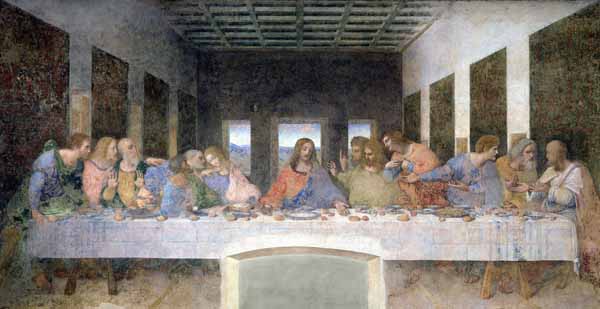
With respect to the Last Supper, it is a false dilemma to ask whether Christ faced his disciples or turned his back on them. We don’t have a photo of the event or anything, but historical dining practices make it very likely that they were all reclined on benches on one side of the table so that service could be done from the other side, much as shown in Da Vinci’s Last Supper and similar representations. This would mean that they were all facing the same way:

 
Actually, very many churches in the western tradition were built to be oriented to the east. St. Peter’s and a few other ancient basilicas in Rome are notable exceptions due to various historical accidents, but it may surprise you to learn that the traditional practice in these “occidented” churches was that at the Consecration, the congregation would turn around to face the east – the front doors of the basilica – thereby turning their backs on the priest. (This was easy to do because there were no pews or chairs.) The priest was not considered the “host” and the congregation his “guests” at an ordinary meal; all are worshipers at a sacrifice.

With respect to the Last Supper, it is a false dilemma to ask whether Christ faced his disciples or turned his back on them. We don’t have a photo of the event or anything, but historical dining practices make it very likely that they were all reclined on benches on one side of the table so that service could be done from the other side, much as shown in Da Vinci’s Last Supper and similar representations. This would mean that they were all facing the same way
Very nicely said. Thank you Mark! Taken altogether (and particularly the last sentence, bolded) it makes for a great argument in favor of ad orientem. 👍
 
I have a question. Before it was changed at VII and priests always faced east, or away from the congregation, etc, was the homily done this way as well?
 
I have a question. Before it was changed at VII and priests always faced east, or away from the congregation, etc, was the homily done this way as well?
In the EF the priest faces the same direction as the congregation when addressing God.
When addressing the people, for readings and the homily, the priest faces the people.
 
I have a question. Before it was changed at VII and priests always faced east, or away from the congregation, etc, was the homily done this way as well?
“A shepard leads his flock walking forward not backwards , as a priest leads his flock facing forward during mass.”
That is a statement made to me last thursday by a priest on the discussion we had on “Ad Orientum.”
The gospel was proclaimed at the ambo facing the congregation.
 
This facing away from the people by Priests during Mass is nothing but an attempt on the part of Priests to exclude the people from the Mass as was done in the Dark Ages. There is no real theology to back it up. .
Deacon Tony, perhaps you would benefit from reading Pope Benedict’s book “The Spirit of the Liturgy”.

It explains a lot of the theology, and needless to say, the person doing the explaining has a LOT more theological expertise than is offered in your average Diaconate program.

And I’m not saying that with any belittleing of Diaconal programs. I was in one myself 👍
 
In the EF the priest faces the same direction as the congregation when addressing God.
When addressing the people, for readings and the homily, the priest faces the people.
Not in my experience. I forget what the precise rules are (maybe different for a low Mass and a Missa cantata?), but I customarily see the Epistle and Gospel proclaimed toward to the wall with backs to the people. As far as I know, the rubrics call for the missal to be placed on the altar, so I don’t see how it could be otherwise in a standard ad-orientem setup.

Obviously, the homily would said versus populum, and if the priest cares to repeat the lessons in the vernacular during his homily then he’s free to do that too, but it is not required and isn’t really part of the Mass.
 
Status
Not open for further replies.
Back
Top