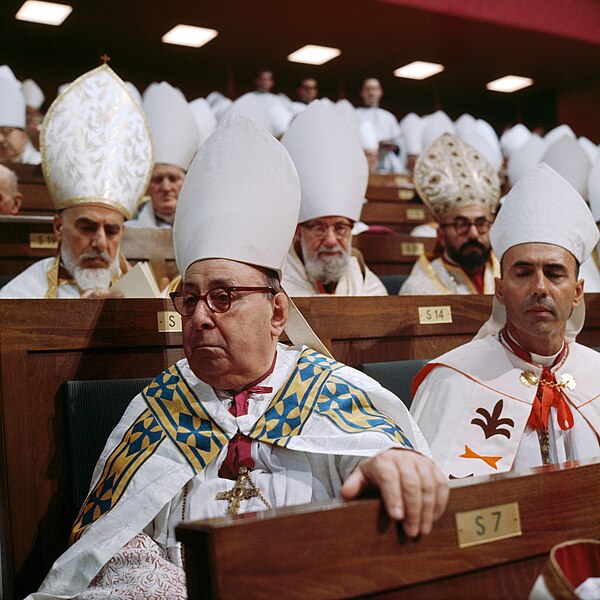
You can shrug all you want. Really the Protestant ministers present translated or interpreted Latin documents for American Bishops who were deficit in the Holy Language of the Roman Catholic Church. I believe it was the other way around.
Code:
Don't you think that priests when attending an official Church function should where their Roman collars?
This is a statement of ontological fact: The New Book of Blessings has done away with constitutive blessings.
One can stand on their head, hold their breath until they turn blue but this is a fact.
Constitutive blessings can only be performed by ordained priests.
"I just reviewed 1085 ff in De Benedictionibus, the post-Conciliar collection of “blessings”. I use ” ” there because only a couple of the prayers in the book that explicitly bless something. All the rest refer to the blessings God could give to someone nearby, or around the place, or who might look in the direction of something, etc. The book attempts to change the Church’s theology about blessings, effectively trying to eliminate the concept of the constitutive blessing and reducing every prayer and action to an invocative blessing.
In my review of the Ordo ad faciendam aquam benedictam, used outside Mass to “bless” water, even though I found a rubric that says that the “celebrans… dicit orationem benedictionis… the celebrant … says the prayer of blessing” and there are three options that follow, I cannot find in any of the three prayers, in the Latin mind you, an explicit statement that the water is to be blessed water. These paragraphs use the word “blessing” throughout and the prayers ask for blessings on those on whom the water is sprinkled. Also, the “celebrans” can be a deacon, which is not possible in the older rite, with the traditional Rituale Romanum.
Here is the first of the new prayers as an example:
Code:
Benedictus es, Domine, Deus omnipotens,
qui nos in Christo, aqua viva salutis nostrae,
benedicere dignatus es et intus reformare:
concede ut qui huius aquae aspersione
vel usu munimur,
renovata animae iuventute
per virtutem Sancti Spiritus
in novitate vitae iugiter ambulemus.

Blessed are you, Lord, Almighty God,
who deigned to bless us in Christ, the living water of our salvation,
and to reform us interiorly,
grant that we who are fortified
by the sprinking of or use of this water,
the youth of the spirit being renewed
by the power of the Holy Spirit,
may walk always in newness of life.
The others are not more explicit.
The difference with the older rite is not just that there is no exorcism or blending of exorcised and blessed salt. There is not explicit act of blessing. The fact that a deacon can use this rite means that it is not connected to the power of the priestly office. There is no sign of the cross indicated in the text. The words don’t say the water is blessed. [NB: In a comment below we learn that the CDW indicates that a sign of the Cross is to be made.]
In the older rite, which priests can use (reason #4378 for why we needed Summorum Pontificum) first salt is exorcised and then blessed. Then water is exorcised and then blessed. In the exorcism of the salt and the water, the two elements are addressed directly, personally, in the second person. By this exorcism they are entirely and without question ripped from the domination of the “Prince of this World”, as our Lord calls the our Enemy. Then they are blessed with explicit words and gestures of blessings…Mind you, there is no exorcism of the water in the newer Missale Romanum during Mass. And keep in mind that in the older rite, the water was blessed outside of Mass. Easter water is another kettle of fish.
There is a world of difference, of sensibility, of theology, between what we find in the newer Missale Romanum and what we find De benedictionibus.
So, my answer is, I know without question that when I bless water with the older rite, it is blessed water, holy water. I have never used – and never will use – the newer book. But were I to imagine myself to do such a thing, I am not sure what there would be in the bucket when I was done."

 ) and realize that the Council was a great blessing and its teachings are inspired by the Holy Spirit, but that many people have misinterpreted the documents of the Council to further their own agenda.